Medical Treatment in Yinchuan China: Navigating Ningxia Northwest Medical Service for International Patients
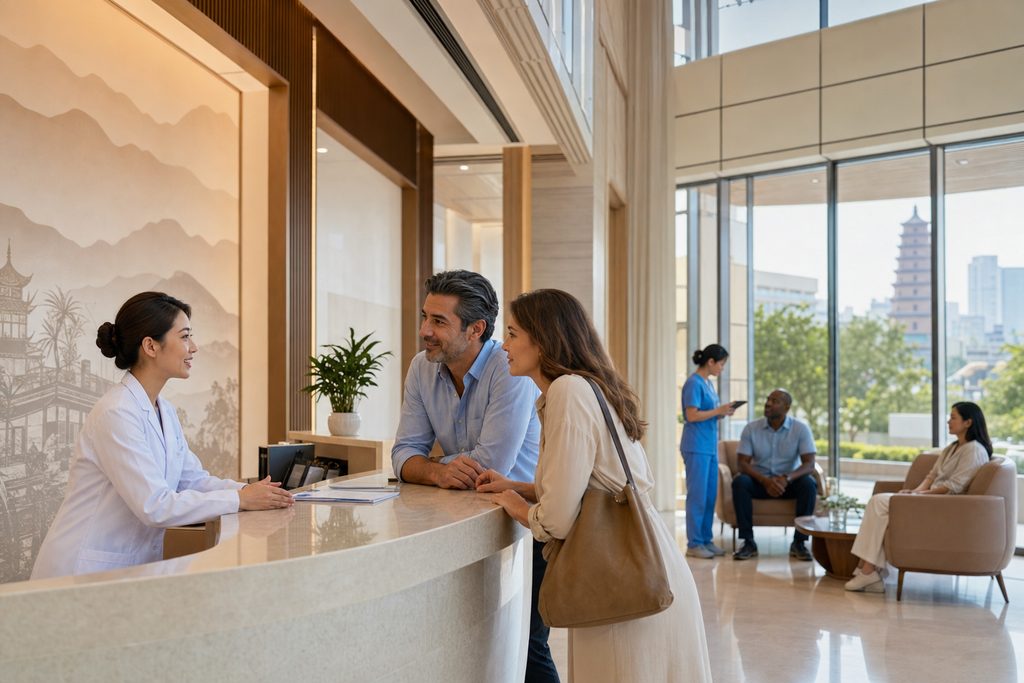
When 52-year-old David from Manchester first researched his hip resurfacing options, he hit a wall. The NHS waiting list stretched past 14 months. A private surgery quote in London came back at £14,500. He started searching further afield. Thailand. India. Then he stumbled upon a city he had never considered: Yinchuan, in China’s Ningxia Hui Autonomous Region. His first question was blunt. “Is this even real? Can a foreigner actually get safe, affordable surgery in northwest China?” His second question was even sharper. “And if so, how much does it actually cost?”
The answer surprised him. And it might surprise you too.
Key Takeaways
- The Ningxia medical tourism cost for major orthopedic procedures typically ranges from $8,000 to $18,000 USD, roughly 60-80% less than comparable private care in the US or UK.
- Yinchuan’s top public hospitals handle patient volumes that dwarf Western facilities, creating deep clinical expertise in high-demand specialties like orthopedics and cardiology.
- The biggest barrier for international patients is not clinical quality—it is navigating a Mandarin-only hospital system with no Western-style appointment infrastructure for overseas visitors.
- Walking into a Chinese public hospital without a bilingual guide and a pre-arranged pathway is not a viable strategy. The system simply is not built for it.
The Problem: When Waiting Is Not an Option
Long surgical wait times are not a minor inconvenience. They are a clinical risk. A 2023 report from the Canadian Institute for Health Information showed that only 66% of hip replacement patients received surgery within the recommended 6-month benchmark. In parts of the UK, the waiting list for trauma and orthopedics has ballooned to over 800,000 patients. That is not a typo. Eight hundred thousand people. Waiting. Some in pain. Some losing mobility by the month.
David was one of the lucky ones. He had savings. He could look abroad. But the fear was real. He had read horror stories about medical tourism gone wrong. Infections. Implant failures. No legal recourse. He needed a destination that combined three things: clinical credibility, transparent pricing, and someone on the ground who could actually speak his language. That is where Ningxia enters the picture.
Who We Are
We are not a hospital. We do not provide medical treatment, clinical diagnoses, or surgical opinions. Our team at China Medical Services functions as your logistical architects—we bridge the gap between you and the 340+ top-ranked hospitals in our network across 37 Chinese cities. We handle the things that make overseas treatment feel impossible: hospital matching, appointment coordination, bilingual medical companions, and visa guidance. We do not promise miracles. We promise preparation. And in a foreign hospital system, preparation is everything.
Why Medical Treatment in Yinchuan China Deserves a Serious Look
Yinchuan is not Beijing. It is not Shanghai. That is precisely its advantage for certain patients. The capital of Ningxia has invested heavily in healthcare infrastructure over the past decade, building hospital campuses that rival anything on China’s eastern seaboard—but without the congestion and cost premiums of the megacities. For international patients considering medical treatment in Yinchuan China, the value proposition centers on three factors: clinical volume, focused specialization, and structural cost advantages.
Clinical Volume Creates Unusual Expertise
A senior orthopedic surgeon at a top Yinchuan public hospital may perform 300 to 450 joint replacements annually. Compare that to the average US orthopedic surgeon, who performs roughly 65 per year according to a 2022 study in the Journal of Arthroplasty. Volume is not just a number. It is a proxy for pattern recognition. When a surgeon sees thousands of hip anatomies, they recognize subtle variations faster. Complications get caught earlier. The operating room team moves with a rhythm that only repetition can produce.
This is not unique to Yinchuan. It is true across China’s top-tier public hospitals. But in a smaller provincial capital, the patient-to-specialist ratio in certain departments can be even more concentrated. The General Hospital of Ningxia Medical University, for instance, serves as the referral center for a region of roughly 7 million people. That means complex cases that would scatter across multiple hospitals in a larger city all flow to a single institution.
What Are the Best Hospitals in Yinchuan for International Patients?
Let us be direct. Yinchuan does not have a United Family Hospital. It does not have a Parkway or a Raffles. The private international hospital model that works well in Beijing and Shanghai has not yet arrived in Ningxia. That means international patients in Yinchuan are looking at the public system—specifically the top-tier public hospitals with dedicated international or VIP departments.
The best hospitals in Yinchuan for international patients cluster around two names. First, the General Hospital of Ningxia Medical University. This is the heavyweight. A Grade A, Class 3 hospital—the highest designation in China’s system—with a particularly strong reputation in orthopedics, cardiovascular medicine, and oncology. Second, the People’s Hospital of Ningxia Hui Autonomous Region. Slightly smaller but with well-regarded departments in general surgery and neurology. Both institutions have VIP wards. These are not luxury hotels. They are functional clinical floors with private rooms, faster access to imaging, and staff who are at least somewhat accustomed to working with non-Mandarin speakers.
But—and this matters—a VIP ward is not an international patient department. The nurses may not speak English. The discharge paperwork will be in Chinese. The billing system will not talk to your UK insurer. These are solvable problems. But they must be solved before you arrive, not after.
How Safe Is Surgery in Ningxia China?
This is the question that keeps patients up at night. How safe is surgery in Ningxia China? The honest answer is that safety depends more on hospital selection and communication than on geography.
China’s top-tier public hospitals operate under a national hospital accreditation system that has tightened significantly since 2016. Infection control protocols, surgical safety checklists, and adverse event reporting are mandated. The General Hospital of Ningxia Medical University is accredited by the National Health Commission at the highest level. Its orthopedic department publishes in international peer-reviewed journals. Its surgeons train on the same implant systems used in Europe and North America—Zimmer, DePuy, Stryker. The hardware is not a question. The sterility protocols are not a question.
The risk lies in the gaps. A miscommunication about allergies. An unsigned consent form that you cannot read. A post-operative instruction that gets lost in translation. Safety in Ningxia is not about whether the surgeon knows how to operate. It is about whether the system around the surgeon is equipped to handle a patient who does not speak the language and does not understand the workflow. That is why international patient services in northwest China exist in the first place—to close those gaps.
Ningxia Medical Tourism Cost: The Real Numbers
Let us talk money. The Ningxia medical tourism cost structure is fundamentally different from what Western patients expect. In the US or UK, you receive a bundled quote that covers the surgeon, the anesthesiologist, the implant, the hospital stay, and the follow-up. In a Chinese public hospital, these components are often billed separately. Your total cost depends on whether you go through the standard public channel or the VIP/international channel.
| Procedure | Standard Public Channel (USD est.) | VIP/International Channel (USD est.) | US Private Pay (USD est.) |
|---|---|---|---|
| Total Hip Replacement | $6,000 – $9,000 | $10,000 – $16,000 | $40,000 – $70,000 |
| Total Knee Replacement | $5,500 – $8,500 | $9,500 – $15,000 | $35,000 – $65,000 |
| Cardiac Bypass (CABG) | $10,000 – $14,000 | $16,000 – $22,000 | $120,000+ |
| Spinal Fusion (1-2 levels) | $8,000 – $12,000 | $13,000 – $18,000 | $80,000 – $110,000 |
These figures are estimates. They vary by hospital, implant brand, length of stay, and case complexity. The standard public channel is cheaper—but it is also almost entirely inaccessible if you do not speak Mandarin and lack a Chinese national ID for registration. The VIP channel costs more. It also includes English-speaking coordination, private rooms, and faster access to senior surgeons. For international patients, the VIP channel is not an upgrade. It is the only functional pathway.
When you factor in flights, accommodation, and post-operative recovery in Yinchuan—a city where a good hotel room costs $40 to $80 per night—the total package still lands far below Western private pay prices. That is the math that brought David to the table.
What Is the Recovery Time for Hip Replacement in Yinchuan?
Recovery timelines in China can feel accelerated compared to Western norms. This catches some patients off guard. What is the recovery time for hip replacement in Yinchuan? The surgical technique and implant are the same. The biological healing is the same. What differs is the post-operative protocol.
In a typical UK private hospital, you might stay 3 to 5 nights after a hip replacement. In a Yinchuan public hospital VIP ward, the expected stay is often 5 to 7 nights—slightly longer, because the rehabilitation infrastructure inside the hospital is more intensive. Physiotherapy starts the day after surgery. Twice daily. Patients are expected to be walking with a frame within 24 hours. By discharge, you should be able to climb stairs and manage basic self-care.
Full recovery—return to normal gait, resumption of low-impact activities, complete soft tissue healing—still takes 8 to 12 weeks. That does not change based on geography. What changes is the expectation around how much of that recovery happens inside the hospital versus at home. Chinese surgeons tend to keep patients under observation slightly longer. For an international traveler, this is actually a benefit. You are not being discharged to a hotel room alone on day three. You have more supervised recovery time before you board a flight.
What You Need to Know Before Going Alone
The clinical quality exists. The cost advantage is real. But walking into this system without preparation is a recipe for frustration. Here is what you are up against.
- Visa Requirements: Medical treatment in China requires an S2 visa, specifically annotated for medical purposes. Accompanying family members also need S2 visas. This is not a tourist visa. You need an invitation letter from the hospital confirming your treatment arrangement. Getting that letter as an individual, emailing a hospital’s general inquiries address in English—that is extremely difficult. Most public hospital administrative offices do not routinely issue these documents to unrepresented foreign patients.
- Payment Systems: Chinese public hospitals operate on a prepaid deposit model. You load money onto a hospital card at admission. As services are rendered, funds are deducted. When the balance runs low, you top up. This system does not interface with international credit cards. It often requires WeChat Pay or Alipay—platforms that require a Chinese bank account to fully activate for large transactions. Cash is possible but impractical for sums over a few thousand dollars.
- Medical Records and Imaging: Your MRI from home? The surgeon needs it on a CD in DICOM format, not a printed report. Your medical history? It needs to be translated into Chinese—accurately, with attention to medication names and prior surgical details. A Google Translate summary will not cut it. Errors in medication translation can be dangerous.
How International Patient Services Northwest China Bridge the Gap
These barriers exist for structural reasons. They are not designed to exclude foreigners. They exist because China’s public hospital system was built to serve a domestic population of 1.4 billion people at scale. International patient services northwest China exist to retrofit that system for overseas visitors.
Our process starts with your medical records. We translate them properly—clinical terminology, not conversational Mandarin. We present your case to the appropriate department head at your target hospital. We secure the invitation letter that makes your S2 visa possible. Before you land in Yinchuan, a bilingual medical companion is assigned to your case. This person meets you at the hospital entrance. They handle registration, payment deposits, queue management, and real-time translation during every consultation. They stay with you through discharge, pharmacy visits, and follow-up appointments. You focus on recovery. They handle the friction.
Can you book medical treatment package Yinchuan online like a hotel room? No. That is not how this system works. But you can arrange a coordinated treatment pathway that includes hospital admission, surgeon consultation, surgical scheduling, inpatient stay, and post-operative follow-up. The package is not a product on a shelf. It is a custom-built sequence, confirmed directly with the hospital’s international or VIP department. That is what coordination means. It is not a shopping cart. It is a case file.
Frequently Asked Questions
Yes, through a coordinated video consultation. We arrange a remote consultation with the treating surgeon before you commit to travel. This costs between $100 and $300 for a standard session and up to $800 for a top-specialist video consultation. The surgeon reviews your imaging and history in advance, so the conversation is substantive—not just an introductory call.
Yinchuan is an affordable city for longer stays. Serviced apartments near the major hospitals run $25 to $50 per night for monthly rentals. Your medical companion can help arrange accommodation and coordinate any follow-up visits or physiotherapy sessions. Some patients stay two weeks. Some stay six. The cost of extending your stay is low enough that it rarely drives the decision.
Yes. The top hospitals in Yinchuan use the same implant brands—Zimmer, DePuy Synthes, Stryker, Medtronic—that are standard in the US and Europe. These are imported, FDA-approved or CE-marked devices. The supply chain is global. The implant in your hip is not a local knockoff. It is the same prosthesis a surgeon in Manchester would use.
This is a fair question. The hospitals we work with have intensive care units, 24-hour on-call surgical teams, and the capacity to manage complications. Medical liability in China works differently than in Western jurisdictions—this is a fact, not a sales pitch. We advise all patients to carry comprehensive medical tourism insurance that includes complication coverage and medical evacuation. We do not sell insurance. But we will not let you board a plane without understanding your coverage gaps.
Yes. Family companions apply for the same S2 visa category. VIP wards typically allow one family member to stay in the room. Hotels are nearby and affordable. Your bilingual companion can assist your family member with logistics, food, and communication—so they can focus on supporting you, not navigating a foreign city alone.
Your Next Step
David had his hip resurfacing at the General Hospital of Ningxia Medical University. His total cost, including surgery, VIP ward, flights, accommodation, and our coordination fee, came to just under $17,000. He was walking unaided at six weeks. His only regret, he told us later, was spending six months in pain while he debated whether it was safe.
The information is here. The pathway exists. If you are considering medical treatment in Yinchuan China, the next step is not a commitment. It is a conversation. Send us your medical records. We will translate them, present them to the right department, and come back to you with a clear, honest assessment of what is possible—and at what cost. No pressure. No promises we cannot keep. Just the facts, so you can make the decision that is right for your body and your life.
Start with a free consultation. We will take it from there.
For more medical information and treatment options in China, visit chinamedservices.com (China Medical Services).
