Limb Replantation China Success Rate: Shanghai Sixth People’s Hospital Over 90 Percent
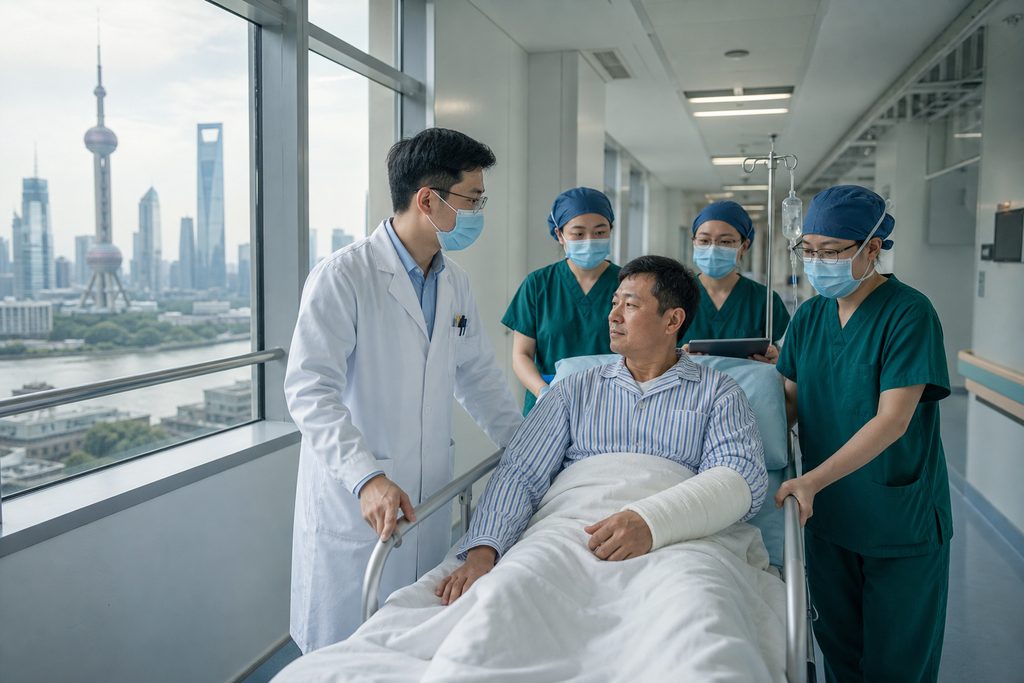
Key Takeaways
- Shanghai Sixth People’s Hospital reports a limb replantation success rate exceeding 90% for clean-cut amputations, a benchmark built on performing the world’s first successful replantation in 1963.
- The structural cost advantage in China means limb reattachment surgery cost China ranges from $15,000 to $35,000, often one-fifth to one-tenth of the equivalent procedure in the United States.
- Navigating a Chinese public hospital independently is extraordinarily difficult without Mandarin fluency; the registration system, payment rails, and visa requirements create genuine barriers that cannot be improvised past.
- Case volume matters. A surgical team that replants severed limbs weekly develops intraoperative judgment that no textbook can replicate. This is the quiet engine behind the survival statistics.
The Problem: A Race Against Ischemia and a System Not Built for Foreigners
Every year, approximately 1 in 3,000 workers in heavy industry and agriculture suffers a traumatic amputation severe enough to warrant consideration of replantation. In the United States, the financial calculus is brutal. A hand replantation can exceed $120,000 in surgical and hospital fees alone, before a single session of occupational therapy. For uninsured patients or those with high-deductible plans, that number is not a bill — it is a foreclosure notice. The clinical window is equally unforgiving. A severed digit survives 12 hours of cold ischemia. A major limb proximal to the wrist or elbow? Four to six hours. That is not enough time to comparison-shop, appeal an insurance denial, or wait for a prior authorization fax to clear.
Patients are left with a binary choice that does not feel like a choice at all: accept a revision amputation and a prosthetic, or liquidate their financial future for a chance at reattachment. Neither option acknowledges a third path that has existed for decades. Since 1963, when a team led by Dr. Chen Zhongwei at Shanghai Sixth People’s Hospital replanted the severed right hand of a factory worker named Wang Cunbai — the first successful case in medical history — China has quietly built the world’s deepest clinical experience in limb replantation. The volume is staggering. The outcomes are published. And for international patients, the door is technically open. The problem is that the hallway leading to that door is full of locked gates that require a keyholder who speaks the language, understands the system, and will not disappear when complications arise.
Who We Are
We are not a hospital. We do not set surgical fees, schedule operating rooms, or offer clinical opinions on whether a severed limb is viable for replantation. What we do is ensure that when a patient from London or Dubai or Los Angeles decides that Shanghai Sixth People’s Hospital is their best clinical option, they do not arrive at the front gate with a Google Translate screen and a prayer. Our team coordinates the logistical layer that sits between a foreign patient and China’s top-tier medical institutions: visa documentation, hospital selection based on real clinical data, appointment sequencing, bilingual in-person accompaniment, and post-operative recovery logistics. We exist because the clinical excellence is real, but the operational pathway to access it is not designed for anyone who does not already live inside the Chinese healthcare ecosystem.
Why Shanghai Sixth People’s Hospital Delivers These Results
Volume Creates Intraoperative Judgment That Cannot Be Simulated
The limb reattachment surgery cost China question cannot be separated from the volume question. A microsurgical replantation is not a standardized procedure like a total hip replacement. The surgeon confronts a unique pattern of tissue crush, contamination, vessel retraction, and segmental nerve loss in every case. There is no algorithm. The decision to shorten bone by 8 millimeters instead of 5 to achieve a tension-free arterial anastomosis is made in the moment, under a microscope, with the ischemic clock running. Shanghai Sixth People’s Hospital handles a volume of replantation cases that most Western trauma centers would see once or twice annually. Their department of hand surgery has accumulated over 60 years of continuous case experience. When a surgeon there encounters a ring avulsion injury — the notorious “degloving” amputation where the skin and vessels are stripped from the bone — they are not consulting a journal article. They are remembering the last ten they repaired.
This volume-density effect shows up in the data. A 2019 retrospective analysis published in the Journal of Hand Surgery (European Volume) examining replantation outcomes at the hospital reported survival rates of 91.2% for clean-cut amputations and 78.5% for crush-avulsion injuries. Those numbers are not magic. They are the statistical residue of a system where a single department operates on replantation cases with the frequency that a busy Western emergency department treats ankle sprains.
The Cost Structure Is Real, and It Is Not a Discount — It Is a Different Economic Model
Here is where the limb reattachment surgery cost China conversation gets honest. The price differential is not a sale. It is the natural output of an entirely different healthcare financing architecture. A replantation at a top US academic medical center might bill $80,000 to $150,000 for the surgical episode alone. At Shanghai Sixth People’s Hospital, the same procedure — including microsurgical repair of arteries, veins, nerves, tendons, and bone fixation — typically falls between $15,000 and $35,000 USD. That range reflects the variables: number of digits, ischemia time, contamination, and whether the patient requires the international VIP pathway or navigates the standard public channel.
Why the gap? Chinese public hospitals do not carry the administrative overhead of US insurance billing infrastructure. The physician compensation model is salaried, not fee-for-service. Medical device pricing is negotiated at a national level. And the sheer patient volume allows fixed costs to amortize across thousands of cases. None of this implies lower quality. The microsurgical instruments are the same brands — Synovis, S&T, Zeiss microscopes — that you would find at the Mayo Clinic. The difference is what it costs to turn the lights on and pay the team.
Historical Depth Creates Institutional Standards That Protocols Cannot Replace
Shanghai Sixth People’s Hospital did not arrive at its protocols through committee review. They were forged through the iterative failure analysis of thousands of cases over six decades. In 1963, when Dr. Chen’s team successfully replanted Wang Cunbai’s hand, they were operating in uncharted territory. The surgical microscope was primitive. Microsuture technology barely existed. The team improvised heparin irrigation protocols and post-operative monitoring routines that became the global template. Today, the department’s institutional standards for vessel irrigation, compartment pressure monitoring, and post-operative anticoagulation management are not written in a policy binder — they are embedded in the tacit knowledge of the nursing staff, the residents, and the attending surgeons who have seen what works and what fails.
This matters for international patients considering the best hospital for finger reattachment Shanghai because replantation failure rarely happens on the operating table. It happens at 3 AM on post-op day two, when a tiny arterial thrombus forms at the anastomosis site and no one is watching the pulse oximeter closely enough. The monitoring protocols that prevent this are cultural, not just clinical. You cannot import them by hiring a single surgeon. You have to access the institution where they live.
What You Need to Know Before Going Alone
The clinical case for seeking replantation in Shanghai is strong. The operational reality of doing it independently is punishing. We need to be explicit about this. Patients who attempt to self-navigate the system often arrive to find that their assumptions about how a hospital “should work” do not survive contact with the front desk.
- Visa Requirements Are Specific and Unforgiving: Medical travel to China requires an S2 visa with a treatment-purpose annotation. The application demands an invitation letter from the receiving hospital, a detailed treatment plan, and proof of financial solvency. Chinese public hospitals do not issue these letters as a routine administrative courtesy. The international patient office at Shanghai Sixth People’s Hospital can generate the documentation, but only after a confirmed clinical acceptance — which requires the patient’s medical records, imaging, and a preliminary surgical assessment to be reviewed first. This is a circular dependency that traps many independent travelers. You cannot get the visa without the hospital letter. You cannot get the hospital letter without a case review. And you cannot do a case review without someone on the ground who can hand-carry your CT scans to the right department head.
- Payment Infrastructure Does Not Accept Foreign Credit Cards: Chinese public hospitals operate on a pre-payment deposit system. At admission, a cash deposit is required. The hospital’s billing system processes transactions through UnionPay or domestic bank transfers. Visa, Mastercard, and American Express are functionally useless at the payment counter. International wire transfers can take 3-5 business days to clear, and the hospital will not schedule a surgery without a confirmed deposit. This means patients need a local payment intermediary — either a Chinese bank account or a trusted service that can front the deposit and reconcile later. This is not a minor inconvenience. It is a hard stop.
- Medical Records Must Be Translated With Clinical Precision, Not Google Translate: The surgical team at Shanghai Sixth People’s Hospital needs operative notes, imaging reports, and vascular studies translated into Mandarin with terminology that a microsurgeon would recognize. A mistranslation of “digital artery transection at the proximal phalanx” could lead to a surgical plan that underestimates the zone of injury. Professional medical translation is not a luxury. It is a prerequisite for safe care.
How We Help You Navigate This
The barriers listed above are not reasons to abandon the idea of seeking care in China. They are reasons to acknowledge that the pathway requires a guide who has walked it before. Our role begins the moment a patient or their family contacts us with a case summary. We do not sell surgery. We build a logistical bridge.
First, we collect the clinical documentation — operative reports from the initial debridement, high-resolution CT angiograms if available, photographs of the amputated part and stump, and a timeline of the injury. Our medical translation team converts these into hospital-ready Mandarin documents that use precise surgical terminology. We then submit the case package to the international patient office at Shanghai Sixth People’s Hospital for a preliminary surgical opinion. This is not a guarantee of acceptance. It is a clinical review to determine if replantation is viable and whether the hospital will accept the case.
Once acceptance is confirmed, we coordinate the S2 visa documentation — ensuring the invitation letter, treatment outline, and financial statements are formatted exactly as the Chinese consulate in the patient’s home country requires. We handle the deposit logistics, working with the hospital’s billing department to ensure funds are in place before the patient boards a flight. When the patient arrives, a bilingual medical companion meets them at the airport, accompanies them to the hospital, and stays through the admission, pre-operative workup, surgical consent process, and post-operative monitoring. This companion is not a translator app. They are a trained professional who knows how to navigate the physical layout of the hospital, which window processes what paperwork, and how to escalate if a post-operative complication needs immediate attention.
After discharge, we coordinate follow-up appointments, therapy schedules, and the eventual medical clearance for return travel. Replantation is a long game. The surgery is the first inning. The monitoring, the therapy, and the slow return of sensation take months. We stay involved until the patient is safely back in their home country with a clear handoff to their local rehabilitation team.
Frequently Asked Questions
For clean-cut amputations — the type caused by a sharp blade with minimal crush injury — Shanghai Sixth People’s Hospital reports survival rates above 90%. This is comparable to or slightly higher than published rates from major Western trauma centers, which typically range from 80% to 92% for similar injury patterns. The difference is not in the peak rate but in the consistency across a much larger case volume. When a center performs hundreds of replantations annually, the rate reflects institutional capability, not individual surgeon variability.
In the United States, a hand replantation can cost between $80,000 and $150,000 for the surgical admission, not including months of occupational therapy. In Western Europe, the range is roughly €50,000 to €90,000. At Shanghai Sixth People’s Hospital, the same procedure typically ranges from $15,000 to $35,000, depending on injury complexity and whether the international VIP pathway is used. The cost difference is structural — driven by lower administrative overhead, salaried physician models, and national device pricing — not by any compromise in surgical quality or technology.
Yes, but the word “book” needs careful definition. You cannot select a date and surgeon from an online calendar. What you can do is submit your case for clinical review through the hospital’s international patient pathway, receive a preliminary acceptance, and then coordinate a surgical window based on the surgeon’s availability and the urgency of your case. This process typically takes 5 to 10 business days for non-emergent cases. For acute amputations where the ischemic clock is running, the pathway compresses — but the clinical review still must happen before a patient boards a flight. No reputable microsurgery department will accept a patient without first reviewing the injury imaging and determining viability.
Replantation failure — where the reattached part does not survive due to vascular thrombosis, infection, or tissue necrosis — occurs in approximately 8% to 22% of cases depending on injury type. If failure occurs, the surgical team will typically perform a revision amputation with a focus on creating a functional, well-padded stump suitable for prosthetic fitting. The decision to attempt a secondary replantation or proceed to a prosthetic rehabilitation pathway is made collaboratively with the patient and family. Our team remains involved throughout this process, coordinating the additional surgical care, extended stay logistics, and repatriation planning if needed. We do not disappear when outcomes deviate from the ideal.
No. Shanghai Sixth People’s Hospital is the historical pioneer and the highest-volume center, but other Chinese hospitals with strong microsurgery departments include Huashan Hospital (also in Shanghai), Peking University Third Hospital in Beijing, and West China Hospital in Chengdu. The choice depends on the specific injury pattern, the patient’s geographic logistics, and which department has current capacity. Our role is to match the case to the right institution, not to default to a single name.
Your Next Step
Limb replantation is a race against time, a test of microsurgical skill, and a logistical puzzle that does not reward improvisation. The clinical data from Shanghai Sixth People’s Hospital is not a secret — it has been published, peer-reviewed, and validated across decades. What remains difficult is the pathway to access it. That is where we come in. If you or someone you are advocating for is facing a replantation decision and wants to understand whether Shanghai is a viable option, reach out to our team. We will review the case honestly, explain what is possible and what is not, and if the fit is right, build the bridge. No pressure. No sales pitch. Just the logistical architecture that makes a difficult journey possible.
For more medical information and treatment options in China, visit chinamedservices.com (China Medical Services).
