Heart Screening in China: Costs, Hospitals, and How to Book
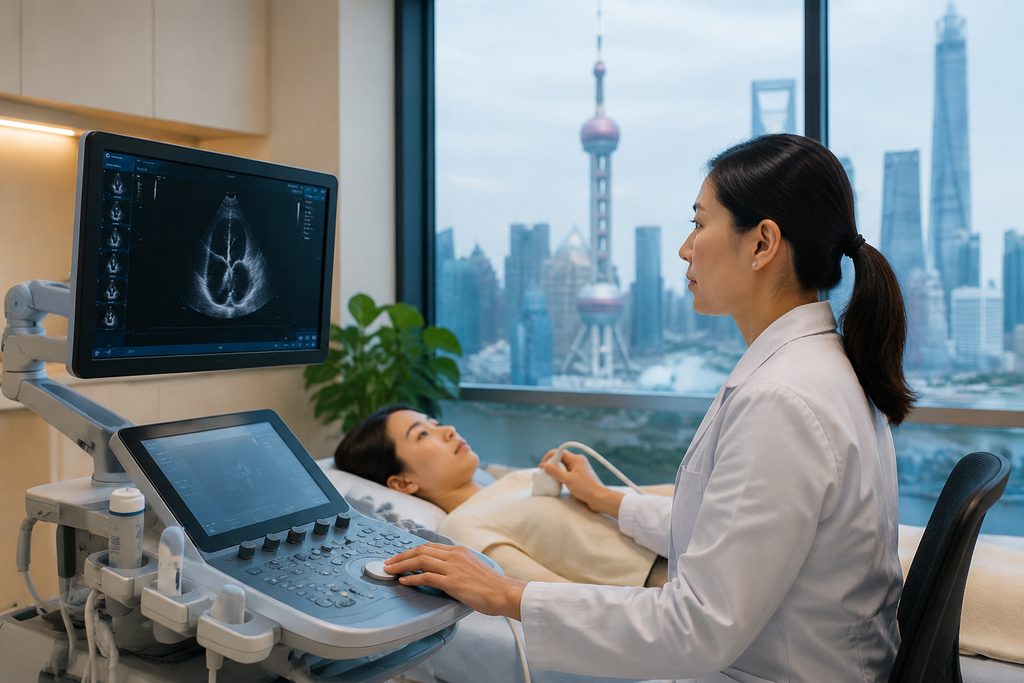
According to the World Health Organization, cardiovascular disease kills roughly 17.9 million people annually. That’s about 31% of all global deaths. Many of those deaths could have been prevented with earlier detection. That’s why you’re searching for heart screening cost China. You want to know if a comprehensive cardiac check is affordable, accessible, and safe in a country you may have never visited for medical care.
The short answer: yes, you can get a heart screening in China. The longer answer involves understanding which hospitals offer what, how much a cardiac check up price Shanghai compares to a similar package in Los Angeles, and what the actual process looks like from overseas. Our team has coordinated medical visits for patients from 37 countries. We have seen the confusion, the paperwork, and the relief when a plan comes together. This guide explains what you need to know, step by step.
How This Actually Works, Step by Step
You cannot simply walk into Fuwai Hospital in Beijing without preparation. The process starts remotely. Here is the sequence we walk every patient through.
First, you send us your existing medical records. That means recent ECGs, echocardiogram reports, stress test results, blood work, and any notes from your current cardiologist. If you have a known condition — say, a valve issue or a history of arrhythmia — those records matter even more. We translate them into Chinese medical terminology. Not literal translation. Medical translation that a Chinese cardiologist can act on.
Second, we match your case to the right hospital. A 45-year-old with no symptoms but a family history of early heart attacks needs a different facility than a 62-year-old with known coronary artery disease. We look at the Fudan rankings, the hospital’s cardiac volume, and whether the international department has English-speaking coordinators.
Third, you choose a service level. A written second opinion costs $300–500. A video consultation with a top specialist runs $500–800. If you want to come to China for the actual screening, we coordinate the appointment, the hospital registration, and a bilingual medical companion from $300 per day.
Fourth, you fly to China on an S2 visa. That’s the short-stay visa category used for medical treatment and private affairs. Your spouse or adult child traveling with you also applies for an S2. We provide the hospital invitation letter and supporting documents that the Chinese embassy or consulate typically requests. We never guarantee visa approval — that decision belongs to the visa officer — but we make sure your paperwork is complete.
Fifth, you complete the screening. Depending on the package, that takes one to two days. Results are usually available within 24 to 72 hours. You review them with the cardiologist, through an interpreter if needed. You leave with a written report in English.
What a Heart Screening in China Actually Includes
Heart screening packages vary widely by hospital and by what you’re looking for. A basic check at a private international hospital in Shanghai might include an ECG, blood lipids, fasting glucose, and a consultation. That runs $150–400. A comprehensive cardiac evaluation at a top-tier public hospital’s international department — think Fuwai Hospital in Beijing or Zhongshan Hospital in Shanghai — includes far more.
A full package typically covers: resting ECG, echocardiogram, carotid ultrasound, ankle-brachial index, coronary calcium score via CT, stress ECG or stress echocardiogram, lipid panel, HbA1c, high-sensitivity CRP, and a cardiologist consultation. Some packages add a coronary CT angiography if risk factors justify it. That comprehensive level runs $800–2,500 depending on the city and hospital tier.
Compare that to the United States, where a coronary calcium scan alone can cost $100–400, an echocardiogram $1,000–3,000, and a full preventive cardiology workup with CT angiography can reach $5,000–10,000. The heart screening cost China offers is typically one-fifth to one-third of the American price for equivalent technology.
What about the best hospital for heart scan China? The Fudan University hospital rankings place Fuwai Hospital at the top for cardiac surgery and cardiology. It performs over 14,000 cardiac surgeries annually — the highest volume in the world. Volume matters. Studies consistently show that hospitals performing more cardiac procedures have lower complication rates. Zhongshan Hospital in Shanghai is another heavyweight, particularly for complex adult cardiac cases. Peking Union Medical College Hospital has a strong cardiology reputation and excellent international patient services.
For a cardiac check up price Shanghai, private international hospitals like Jiahui and United Family offer English-speaking care with direct insurance billing. Their packages are pricier than public hospital international departments — typically $1,500–3,500 for a comprehensive screen — but the experience feels Western. No language friction. Shorter waits. More hand-holding.
A Realistic Timeline
People underestimate how long the preparation takes. Here is what a realistic timeline looks like, assuming you are starting from zero and live in the US, UK, or Europe.
| Stage | What Happens | Typical Duration |
|---|---|---|
| Day 1–3 | You send medical records, we review and translate | 2–3 days |
| Day 4–10 | Hospital matching, package selection, appointment request | 5–7 days |
| Day 11–20 | Hospital confirms appointment date, issues invitation letter | 5–10 days |
| Day 21–35 | S2 visa application at Chinese embassy or consulate | 1–2 weeks |
| Day 36–40 | Travel to China, screening (1–2 days on site) | 2–3 days |
| Day 41–45 | Results review, written English report, departure | 2–3 days |
Total elapsed time: roughly six weeks from first contact to completed screening. Can it go faster? Sometimes. If you already have a valid Chinese visa and your records are organized, we have coordinated screenings within three weeks. But planning for six weeks is realistic. Document translation alone can eat a week if your records are extensive.
One thing people forget: Chinese public hospitals do not allow overseas patients to book ordinary outpatient appointments in advance. You cannot reserve a slot at Fuwai’s general cardiology clinic from London. The international department or VIP channel is the only way to lock in a date before you fly. That channel costs 1.5 to 2 times the standard price. It also gives you English-speaking staff, shorter queues, and a designated coordinator. For most international patients, that premium is the entire point.
What Can Go Wrong — and What Happens Then
Let’s be honest about the failure modes. We have seen them all.
Your visa gets delayed or denied. This happens. Chinese embassies in some countries have long processing queues. If your S2 visa is delayed, we reschedule the hospital appointment. Hospitals understand. If the visa is denied, you lose the visa application fee but not the hospital deposit — most international departments allow rescheduling with 7 days’ notice. We cannot overturn a visa decision. We can help you reapply with stronger documentation.
The cardiologist recommends additional testing. A screening sometimes finds something that needs follow-up. A suspicious calcium score might lead to a CT coronary angiography. That adds $300–600 and another day. You pay that directly to the hospital. We never mark up hospital charges. Our coordination fee covers logistics, not treatment.
Language breaks down. Even at international departments, not every nurse or technician speaks English. That’s why we recommend a bilingual medical companion. From $300 per day, they handle registration, queueing, payment, and translation. It’s the single highest-value service we offer. Patients who skip it sometimes end up lost in a massive hospital complex with 10,000 daily outpatients and zero English signage.
Your insurance refuses to reimburse. Chinese public hospitals require prepayment. You pay first, then claim reimbursement from your insurer. Some insurers reimburse Chinese hospital bills without issue. Others demand itemized receipts translated into English — which the hospital can provide for a fee. We help with documentation. But if your insurer denies the claim, that’s between you and them. Check your policy before you book.
Is Heart Screening Safe in China?
The question “is heart screening safe in China” deserves a straight answer. The screening itself — ECG, echo, CT calcium score — carries the same minimal risks in China as anywhere else. Radiation from a cardiac CT is low but not zero. About 1–3 millisieverts for a calcium score, roughly equivalent to 6 months of background radiation. The technology is the same Siemens, GE, and Philips equipment used in American and European hospitals.
The real safety question is about quality control and interpretation. That’s where hospital selection matters. A top-tier Fudan-ranked hospital with 14,000 annual cardiac surgeries has cardiologists who read thousands of echocardiograms yearly. A small private clinic in a second-tier city might have a technician running the echo and a general physician interpreting it. Not the same thing.
So: is heart screening safe in China? At a top-ranked hospital’s international department — yes, the standard of care is comparable to Western teaching hospitals. At an unvetted clinic — the risk is the same as an unvetted clinic anywhere. This is why our hospital database covers only 340+ top-ranked hospitals across 37 cities. That’s the top 5% of China’s 35,000+ hospitals, ranked by Fudan and JCI. We don’t send patients anywhere else.
How Much Does a Full Heart Health Check Cost in Beijing?
Beijing is the most expensive city for cardiac screening in China, but still dramatically cheaper than the West. Let’s break down actual numbers.
A comprehensive cardiac screening at Fuwai Hospital’s international department — including ECG, echocardiogram, carotid ultrasound, coronary calcium score, lipid panel, and cardiologist consultation — typically runs $1,200–2,000. At Peking Union Medical College Hospital’s international medical services, expect $1,500–2,500 for a similar package. At a private hospital like Beijing United Family, the same comprehensive screen runs $2,500–4,000.
How much does a full heart health check cost in Beijing compared to home? A comparable preventive cardiology evaluation at a major US academic medical center — say, Cleveland Clinic or Mayo — runs $5,000–10,000 without insurance. Even with insurance, your deductible and copay might exceed the entire Chinese package price. That’s the math that drives patients to fly 12 hours for a checkup.
The price varies by hospital and case complexity. A 35-year-old with no symptoms needs fewer tests than a 58-year-old smoker with hypertension. We always get a written quote from the hospital before you commit. No surprises.
Practical Considerations: Records, Visa, Payment, Follow-Up
Before you book a cardiac screening package Shanghai or Beijing, get your paperwork in order. Here is what actually matters.
Medical records. Bring everything. ECGs from the last 2 years, any prior echo or stress test, your medication list, and a summary letter from your GP. Chinese cardiologists want baseline data. If you have a prior cardiac event — stent, bypass, ablation — bring the operative report. We translate it all before you arrive.
Visa. S2 visa, short-stay, purpose: medical treatment. Processing takes 1–2 weeks at most embassies. Your accompanying family member applies separately for S2. The hospital’s international department issues an invitation letter that supports your application. Start this process at least 3 weeks before your intended travel date.
Payment. Public hospital international departments accept cash, UnionPay, and major credit cards. Some accept international bank transfers for large deposits. Private international hospitals accept all major credit cards and often bill your insurer directly. Public hospitals do not do direct billing — you pay, then claim.
Language. Even at Fuwai’s international department, the cardiologist may speak limited English. A bilingual companion solves this. They sit in the consultation, translate your questions, translate the answers, and make sure you understand the plan. Patients who skip this often leave with a report they cannot read and a vague sense of uncertainty.
Follow-up at home. You leave China with a written English report and, if needed, a treatment recommendation. Your home cardiologist reviews it. If the Chinese team recommends a procedure — say, a stent — you decide whether to do it in China or at home. There is no obligation. The screening is diagnostic, not a commitment to treatment.
Frequently Asked Questions
Yes. Chinese hospitals do not require a physician referral for cardiac screening packages. You can book directly through the hospital’s international department or through a coordination service like ours. A referral from your home doctor is helpful for context but not mandatory.
You will be told immediately. The cardiologist explains the finding, shows you the images, and recommends next steps. You are never obligated to pursue treatment in China. You can take the report home and discuss it with your own cardiologist. If you do want treatment in China, we can coordinate that transition.
A coronary calcium score delivers about 1–3 millisieverts of radiation. For context, you receive about 3 millisieverts annually from natural background sources. A full coronary CT angiography delivers more — 5–15 millisieverts. The risk is small but real. Discuss with the cardiologist whether the scan is justified for your risk profile.
Some international health insurance plans cover preventive screening abroad. Others exclude it. Most reimburse after the fact — you pay the hospital, submit the claim, and wait. Check your policy’s language on overseas diagnostics and preventive care before you book. We provide itemized receipts and English translations to support your claim.
Your Next Step
Getting a heart screening in China is not complicated once you understand the path. The heart screening cost China offers is a fraction of Western prices, the technology is world-class at top-ranked hospitals, and the process is manageable with the right coordination. Our team at China Medical Services handles record translation, hospital matching, appointment coordination, visa documentation, and bilingual companionship. We do not provide medical advice, and we do not promise outcomes. We connect you with the right hospital and make sure nothing gets lost in translation. If you want to explore whether a cardiac screening in China makes sense for your situation, start with a free consultation. We will ask about your history, recommend hospitals, and give you a realistic cost estimate. No pressure. Just clarity.
Your heart deserves a clear picture. The technology exists. The price is right. The path is knowable.
For more medical information and treatment options in China, visit chinamedservices.com (China Medical Services).
