Sinus Surgery at Shanghai Fudan ENT: Cost, Safety, and Recovery for Chronic Sinusitis
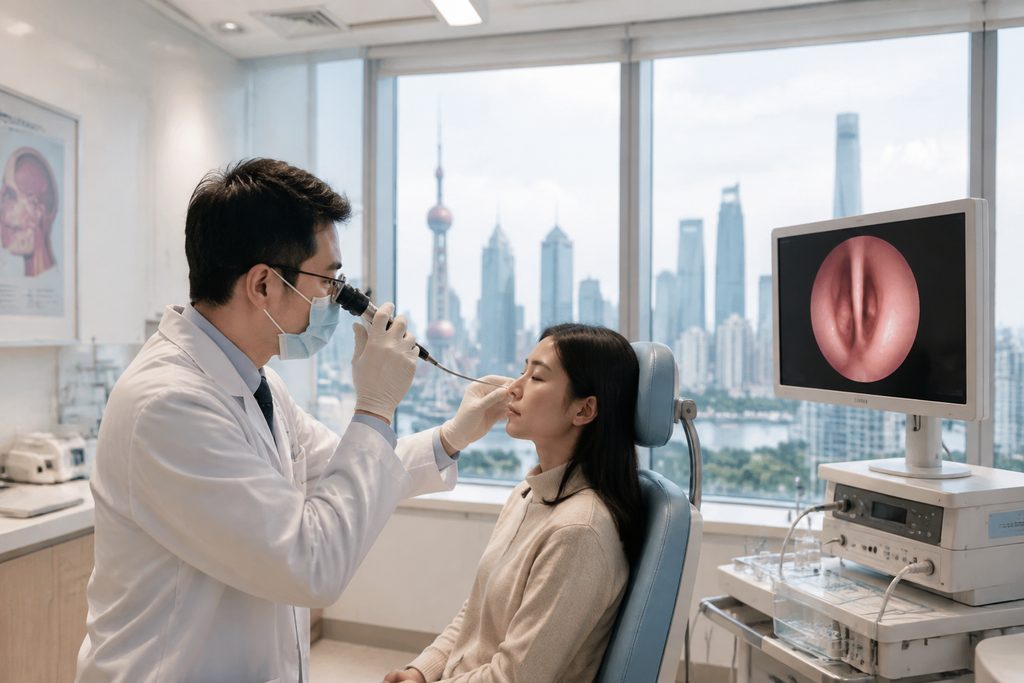
When 42-year-old Michael first heard the diagnosis—chronic rhinosinusitis with nasal polyps that had resisted years of antibiotics, steroid sprays, and two prior surgeries in Manchester—he had no idea where to start looking for treatment. His specialist had mentioned that some patients seek care abroad. The name that kept surfacing was the Eye & ENT Hospital of Fudan University in Shanghai. His first question was blunt: what is the actual sinus surgery cost Shanghai Fudan ENT Hospital, and is it worth traveling 9,000 kilometers for?
The short answer is that functional endoscopic sinus surgery (FESS) at this institution typically ranges from $6,000 to $12,000 USD for international patients using the hospital’s VIP international channel. This covers the surgeon’s fee, anesthesia, operating theater, a private recovery room, and a standard 2–3 night inpatient stay. By comparison, the same procedure in the United States often bills between $25,000 and $45,000 before insurance negotiations. But price is never the whole story.
The Short Answer: What This Surgery Costs and Why
The cost of sinus surgery at Fudan ENT’s international department sits in a narrow band between $6,000 and $12,000 USD. The variation hinges on three things: the extent of the disease on your CT scan, whether polyps need to be removed alongside the sinus openings, and the length of your inpatient stay. A straightforward FESS without extensive polypectomy stays near the low end. A revision case with grade 3 polyposis and a requirement for image-guided navigation pushes toward the upper figure. These are all-inclusive numbers for the hospital portion—no hidden facility fees, no surprise anesthesiologist bills arriving six weeks later. What they do not include is your flight, accommodation outside the admission window, or our coordination fee if you choose to use a service like ours.
Who This Is Right For — and Who It Isn’t
Not everyone with blocked sinuses should book a flight to Shanghai. The patients who benefit most from traveling for this care share a specific profile.
You are likely a good candidate if:
- You have confirmed chronic rhinosinusitis with or without nasal polyps, documented by a CT scan within the last 12 months.
- You have failed maximal medical therapy—meaning you have tried prolonged antibiotics, steroid rinses, and possibly biologic injections without lasting relief.
- You have had one or more previous sinus surgeries that did not resolve the problem, and you are seeking a high-volume revision surgeon.
- You are comfortable traveling and can stay in Shanghai for roughly 10–14 days to cover pre-operative assessment, surgery, and early post-operative debridement.
This path is not right for you if:
- Your primary issue is allergic rhinitis without CT evidence of chronic sinus disease. Surgery will not fix allergies.
- You have an active, untreated dental abscess causing odontogenic sinusitis. The tooth needs treatment first.
- You have uncontrolled asthma or a bleeding disorder that makes general anesthesia risky without a stable management plan.
- You cannot arrange for an adult companion to travel with you. Post-operative sinus surgery patients should not navigate a foreign city alone for the first five days.
The Options, Compared
When you are facing sinus surgery, your choices are not just about which hospital. They are about which approach, which technology, and which health system you trust. Here is how the main paths stack up for an international patient with chronic sinusitis.
| Factor | Fudan ENT, Shanghai (International Dept.) | Typical US Academic Hospital (Cash Price) | Private Hospital in Thailand or India |
|---|---|---|---|
| Procedure Cost (FESS) | $6,000–$12,000 | $25,000–$45,000 | $4,000–$9,000 |
| Surgeon Annual FESS Volume | Often 500+ cases per surgeon | Varies widely; 50–200 typical | Not always published |
| Navigation Technology | Standard for revision cases | Standard for most centers | Available at top-tier only |
| Language | Mandarin in hospital; English-speaking coordinator via international channel | English | English widely spoken in international hospitals |
| Post-Op Follow-Up Window | Requires 10–14 days in Shanghai | Local follow-up possible | Requires 7–10 days locally |
| Regulatory Oversight | China NMPA; Fudan is a university hospital with academic governance | FDA; Joint Commission accreditation | Varies by country |
The table makes one thing clear. If your priority is the lowest possible price, a well-vetted private hospital in Southeast Asia might win on the sticker number. But if your priority is a surgeon who performs revision sinus surgery multiple times a week—someone who has seen your exact complication before because they operate at a center that draws the hardest ENT cases from a population of 1.4 billion—then Fudan ENT enters the conversation on a different level. Volume matters in sinus surgery. A surgeon who does 500 FESS procedures a year has a tactile familiarity with the ethmoid labyrinth that no amount of textbook study can replicate.
Why Fudan ENT Specifically for Revision and Complex Sinus Disease
The Eye & ENT Hospital of Fudan University has held the top position in China’s national otolaryngology rankings for years. That is not a marketing claim. It is the result of the Fudan University Hospital Ranking, the country’s most authoritative annual hospital assessment, which places this institution at the summit of the specialty reputation list. For a patient with chronic sinus problems that have already survived one failed surgery, the question is not just “which hospital is good?” It is “which hospital sees my specific complication often enough to have a rehearsed plan for it?”
Fudan ENT’s rhinology division manages a caseload that is difficult to comprehend without seeing it. The outpatient clinics see hundreds of patients daily. The surgical schedule runs six days a week. Within that volume, the rhinologists have developed subspecialty expertise in revision endoscopic sinus surgery, allergic fungal rhinosinusitis, and endoscopic skull base repair for CSF leaks—procedures that many general ENTs in smaller systems might perform a handful of times per year. When you arrive with a CT showing opacified frontal recesses after a prior surgery that left scarred, distorted anatomy, the surgeon reviewing your scan has likely seen a dozen similar scans that month.
This is not to suggest that every case at Fudan ENT is complex. The hospital handles the full spectrum. But for the international patient who has already tried and failed local treatment, the concentration of revision experience is the draw. The hospital also maintains an active research program in chronic rhinosinusitis, with published work on the microbiome of recalcitrant sinusitis and the role of type 2 inflammation in polyp recurrence. That academic infrastructure means the surgeons are not just operating; they are actively studying why some sinuses refuse to heal, and they bring those insights into the operating theater.
What Recovery Actually Looks Like
Recovery from endoscopic sinus surgery is not a straight line. The first 48 hours are uncomfortable. You will have nasal packing or dissolvable sponges in place, which means you will breathe through your mouth. Your nose will feel congested and there will be some bloody drainage—this is normal and expected. Pain is usually manageable with oral medication and not severe. Most patients describe it as pressure or a bad head cold rather than sharp pain.
Day three is typically when the packing comes out, if non-dissolvable material was used. The relief is immediate but incomplete. Your nose will still be swollen inside. Over the next week, you will perform saline irrigations several times a day. This is non-negotiable. The rinses flush out clots and mucus and keep the surgical openings from sealing shut. The surgeon will see you for an endoscopic debridement around day seven to ten—this is the appointment where they suction out crusts and check that everything is healing open. It is mildly unpleasant but takes only a few minutes and makes a significant difference in long-term outcomes.
By two weeks, most patients feel functional. You can fly home. But you are not healed. The sinus mucosa takes months to fully remodel. You will need to continue nasal irrigations and any prescribed topical steroids for at least three to six months. You will also need a local ENT at home who can perform follow-up endoscopies at one month, three months, and six months. This is a critical planning point: before you travel to Shanghai, identify an ENT near your home who is willing to take over post-operative care. Not all will, especially if they did not perform the surgery. Our team can help you prepare a handover summary and operative report that makes this transition smoother.
Practical Considerations: Documentation, Visa, and Payment
Getting sinus surgery in Shanghai as an international patient requires more logistical preparation than the surgery itself. Start at least four to six weeks before your intended travel date.
Medical records. You will need a recent CT scan of the sinuses—ideally within six months—on a CD or USB with DICOM files, not just the radiology report. The surgeon needs to see the raw images. You will also need a referral letter or summary from your treating ENT, a list of all medications you have tried and for how long, and any operative notes from prior sinus surgeries. All documents should be in English; the hospital’s international coordinators can arrange translation if needed.
Visa. Medical treatment in China falls under the S2 visa category, which covers short-term private affairs including medical visits. This is not an M visa—that classification is strictly for commercial and trade activities and is not appropriate for hospital visits. Your S2 application will require an invitation letter from the hospital confirming your appointment. The international department at Fudan ENT can provide this once your case has been reviewed and accepted. Processing times vary by your home country’s Chinese embassy or consulate, so factor in three to four weeks. Family members accompanying you apply for the same S2 category.
Payment. Chinese public hospitals, including their international departments, operate on a pre-payment model. You will be asked to place a deposit before admission, typically an amount that covers the estimated full cost of your stay. Any unused funds are refunded at discharge. Payment is made via wire transfer, credit card, or cash. The hospital does not directly bill international insurance. You pay the hospital, then submit the itemized receipt and medical report to your insurer for reimbursement. Check with your insurance provider before traveling to confirm they cover elective surgery performed outside your home country. Some policies exclude it entirely; others require pre-authorization.
Language. The clinical staff at Fudan ENT—surgeons, nurses, anesthesiologists—conduct their work in Mandarin. The international patient department provides English-speaking coordinators who facilitate communication during consultations, consent, and discharge instructions. For the day of surgery and the inpatient stay, having a bilingual companion is not a luxury. It is the difference between knowing what is happening and guessing. Our bilingual medical companions handle the practical flow—registration, payment, pharmacy runs, and translating every question you want to ask but cannot phrase.
Frequently Asked Questions
At an institution like the Eye & ENT Hospital of Fudan University, the safety protocols are comparable to any Western academic medical center. The hospital uses the same endoscopic equipment you would find in a major US or European teaching hospital—Stryker or Karl Storz visualization systems, image-guided navigation for complex and revision cases, and standard anesthesia monitoring. What differs is the volume. The surgeons operate more frequently, which for a technically demanding procedure like FESS tends to correlate with lower complication rates. The primary risk for an international patient is not the surgery itself. It is the post-operative period and the need for meticulous follow-up. If you cannot commit to the irrigation schedule and the debridement appointments, the safety of the procedure is undermined by poor healing.
FESS at Fudan ENT’s international department costs between $6,000 and $12,000 USD for the hospital portion. The same procedure in the United States, billed at cash-pay rates, commonly ranges from $25,000 to $45,000. That is a factor of roughly four to one. The gap narrows if you have comprehensive US insurance with a low out-of-pocket maximum—you might only pay $3,000 to $6,000 yourself. But if you are uninsured, underinsured, or your plan excludes the surgeon you want, the Shanghai option becomes financially compelling. The cost includes the surgeon, anesthesia, operating room, a private inpatient room, nursing care, and standard medications during your stay. It does not include airfare, hotel, meals outside the hospital, or any complication management once you leave Shanghai.
Most patients feel well enough to fly home and resume light activities by day 10 to 14. Nasal breathing typically improves noticeably by week three, though the full benefit unfolds over months. You should expect to perform saline irrigations multiple times daily for at least three months, and many surgeons recommend continuing once daily for six to twelve months. Return to strenuous exercise or heavy lifting is usually cleared at three to four weeks. The mucosa inside the sinuses takes six months to a year to fully mature, and during that window, you remain susceptible to crusting and infection if irrigations are neglected. A local ENT should scope your nose at one, three, and six months post-operatively to remove any adhesions or scar bands before they become permanent.
You cannot book surgery directly. The standard pathway for international patients involves a remote evaluation first. You send your CT scans, medical history, and prior operative notes. The rhinology team reviews them and provides a written second opinion—our service can facilitate this at a cost of $300 to $500 USD. If the team confirms you are a surgical candidate and you decide to proceed, a video consultation is arranged for $500 to $800 USD, during which you speak directly with the specialist. Only after that consultation, and with mutual agreement on the plan, is a surgery date scheduled. You then travel to Shanghai for a pre-operative assessment and the procedure. This staged approach prevents you from arriving in Shanghai only to discover that surgery is not indicated or that a different procedure is needed. Any fees paid for the remote second opinion or video consultation are credited in full toward our coordination service if you proceed to treatment within 90 days—a one-time credit applied to the coordination fee, never to hospital charges.
This is the hardest question, and it deserves a straight answer. No sinus surgeon can guarantee that your symptoms will resolve completely. Chronic rhinosinusitis is a multifactorial disease. Surgery creates open, drainable sinus cavities. It does not cure the underlying mucosal inflammation. Some patients—particularly those with aspirin-exacerbated respiratory disease, severe allergic fungal sinusitis, or certain immune deficiencies—may see polyps recur despite technically excellent surgery. What a high-volume revision surgeon offers is the best possible anatomical outcome: widely patent openings, preserved normal mucosa, and a sinus cavity that can be effectively irrigated and examined. If symptoms persist or return, the question becomes medical management—topical steroids, biologics like dupilumab, or aspirin desensitization. The surgical part is only one piece. Before you commit to traveling for surgery, have an honest conversation with the consulting surgeon about your specific polyp type, your eosinophil count, and your realistic odds of long-term control. The answer will not be a percentage. It will be a nuanced discussion. That discussion is worth more than any price quote.
Your Next Step
Choosing where to have sinus surgery is as much about the team around the surgeon as the surgeon himself. At China Medical Services, we do not perform surgery, we do not diagnose, and we are not a hospital. We are the logistical layer that makes treatment at institutions like Fudan ENT accessible to patients who do not speak Mandarin and have never navigated a Chinese hospital. If you are considering sinus surgery in Shanghai, start with a written second opinion. Send us your CT and history. We will get it in front of the right specialist and give you an honest assessment of whether traveling makes sense for your case. If it does, we handle the rest—appointment coordination, visa invitation support, bilingual companionship, and recovery logistics. No pressure. No sales pitch. Just a clear path forward.
For more medical information and treatment options in China, visit chinamedservices.com (China Medical Services).
