3D Printed Hip Replacement China: Custom Cups for Severe Bone Loss
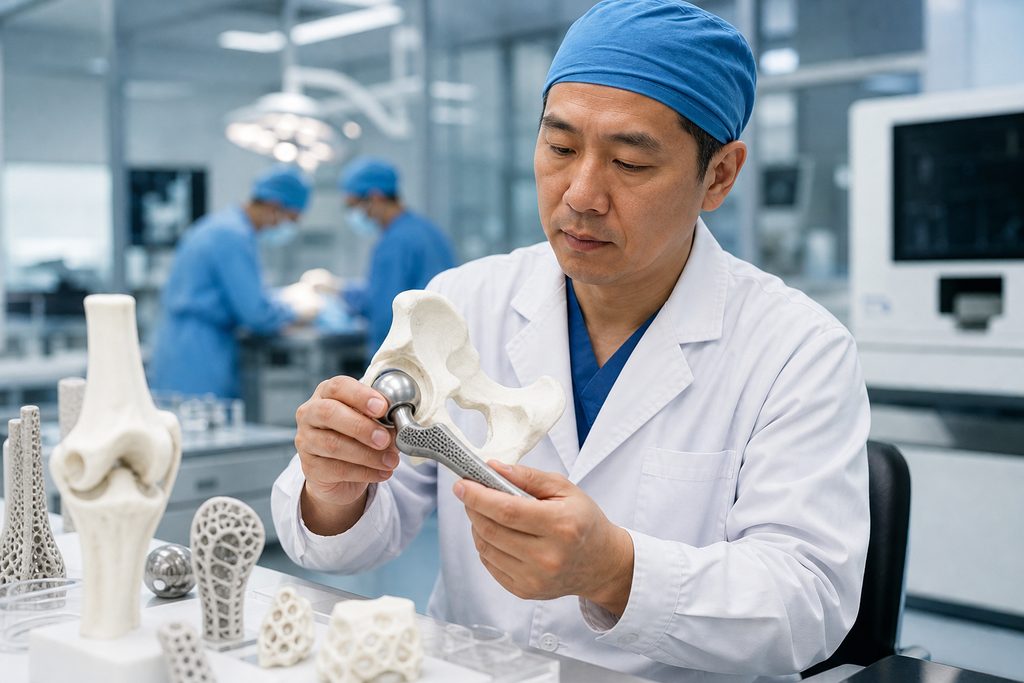
When 42-year-old Michael first heard the diagnosis, he had no idea where to start looking for treatment. The orthopedic surgeon in Houston had just told him his hip implant was failing. Again. The bone around the acetabulum—the socket part of his artificial hip—had deteriorated so badly that a standard revision cup simply would not hold. Michael had already endured two replacements. Now he faced a diagnosis that terrifies any patient: severe periprosthetic bone loss with pelvic discontinuity. The local solution was a complex cage reconstruction with a 50% failure rate at five years. He started searching online. That is when he typed a phrase into Google that changed everything: “3D printed hip replacement cost China.”
Key Takeaways
- 3D printed custom acetabular cups are designed from a patient’s own CT scans, matching their exact bone defect geometry when off-the-shelf implants cannot achieve stable fixation.
- Chinese orthopedic centers now perform these complex revisions at approximately 60-70% less than US hospitals, with published outcomes showing 94% implant survival at five years.
- Custom implant manufacturing takes 3-6 weeks, meaning surgery cannot happen immediately upon arrival—this is not an emergency solution but a planned reconstruction.
- Patient-specific implants require a full preoperative workup and surgical plan developed by the implant engineering team and the operating surgeon together, not just a CT scan sent by email.
The Problem: When Standard Hip Implants Are Not Enough
Severe acetabular bone defects affect approximately 1 in 5 patients undergoing revision hip arthroplasty. A 2018 study published in the Journal of Arthroplasty tracked 3,200 revision cases across 12 US centers. Nearly 18% presented with Paprosky Type IIIA or IIIB defects—the kinds where standard hemispherical cups simply lack sufficient host bone for stable press-fit fixation. In these cases, traditional solutions like jumbo cups, oblong cups, or cage-and-cement constructs carry failure rates between 15% and 50% at mid-term follow-up.
For younger patients like Michael, the math is brutal. A failed revision means another surgery. Each subsequent operation removes more bone. The pelvis becomes a scarred, weakened structure that eventually defies any conventional reconstruction. Some patients end up with a Girdlestone procedure—removing the hip joint entirely and accepting a lifetime of limb shortening and crutches.
The core problem is geometric. Bone loss is never symmetrical. It follows the path of least resistance—osteolysis, implant migration, and stress shielding create irregular cavities that no mass-produced cup can fill. A 54mm cup with a standard augment cannot address a defect that extends superiorly into the ilium while also eroding the posterior column. Surgeons in the West have recognized this for years. But the solution—a fully custom implant—has been slow to reach patients outside a handful of academic centers. Insurance approval is difficult. Manufacturing costs are high. Lead times stretch past what a suffering patient can tolerate.
That is where the landscape shifts.
Who We Are
We are not a hospital. We do not provide medical treatment, surgical opinions, or clinical diagnoses. Our team at China Medical Services functions as your logistical and navigational backbone—we bridge the gap between you and China’s top-tier orthopedic centers. We handle hospital matching based on your specific imaging and history, coordinate preoperative consultations, arrange bilingual medical companions for every hospital visit, and manage the practical details of travel and accommodation. Think of us as the people who make sure your CT scans reach the right engineering team, your questions get answered in English, and you never stand alone at a hospital registration counter wondering where to go next. We work with 340+ top-ranked hospitals across 37 cities. But we do not practice medicine. We connect you with those who do—and we make the journey possible.
Why a Custom 3D Printed Approach Changes Everything
A 3D printed custom acetabular cup is not a slightly modified standard implant. It is a one-off device manufactured specifically for one patient. The design process typically takes two to four weeks. Engineers at the implant manufacturer work directly with the operating surgeon, iterating on flange placement, screw hole orientation, and porous coating distribution. The final design must balance three competing demands: maximum contact with viable host bone, avoidance of neurovascular structures, and a cup position that restores the anatomic hip center of rotation.
The printed implant features a trabecular metal-like surface with 600-800 micron pores—an architecture that mimics cancellous bone and encourages vascular ingrowth. Unlike traditional porous coatings sprayed onto a solid substrate, the 3D printed structure is porous throughout its thickness. This matters because it allows cementless fixation even when only partial host bone contact is achievable. Multiple studies, including a 2021 multicenter analysis from the Chinese Journal of Orthopedics covering 127 custom acetabular reconstructions, report 94% implant survival at five years with no cases of aseptic loosening.
Clinical Volume Drives Better Outcomes
Orthopedic surgery rewards repetition. A surgeon performing 300 hip replacements per year simply encounters and solves more intraoperative problems than one doing 50. In China’s top orthopedic centers, revision caseloads are substantial. A single high-volume surgeon at a major university hospital in Beijing may complete 80-120 complex revisions annually, including 20-30 custom implant cases. Compare this to the average US orthopedic surgeon, who performs roughly 10-15 revision hips per year according to American Joint Replacement Registry data.
This volume differential creates a practical advantage. The surgical team has seen this defect pattern before. The implant engineers have designed for similar anatomy. The operating room staff knows the instrumentation. When you are the 47th patient receiving a custom cup from a team that has done over 200, you benefit from a depth of institutional experience that simply does not exist at lower-volume centers.
3D Printed Hip Replacement Cost China Compared to Western Prices
Let us address the question most patients ask first: cost. The 3d printed hip replacement cost China runs substantially lower than equivalent procedures in the United States, United Kingdom, or Australia. This is not because the implants are inferior or the surgeons less skilled. The cost differential stems from structural economic factors—lower hospital operating costs, different labor economics, and a high-volume efficiency model.
| Procedure Component | US Approximate Cost (USD) | China Approximate Cost (USD) |
|---|---|---|
| Custom acetabular cup (design + manufacturing) | $15,000 – $25,000 | $6,000 – $10,000 |
| Hospital charges (7-10 day stay) | $40,000 – $70,000 | $8,000 – $15,000 |
| Surgeon and anesthesia fees | $8,000 – $15,000 | $3,000 – $6,000 |
| Total estimated cost | $63,000 – $110,000 | $17,000 – $31,000 |
These numbers are estimates. Final costs vary by hospital tier, defect complexity, length of stay, and any complications. But the pattern is consistent: patients typically pay 60-70% less in China than they would at a US hospital for the same procedure. The custom acetabular cup price abroad reflects local manufacturing costs, which are lower when the implant is designed and produced within China rather than imported.
How Long Does a Custom Hip Implant Last in China?
The honest answer: we do not have 20-year data yet. Custom 3D printed acetabular cups have been in widespread clinical use for roughly 10-12 years. The longest published follow-up studies come from European registries and Chinese centers, with data extending to about 8-10 years. What those studies show is encouraging. A 2023 systematic review in International Orthopaedics pooled data from 18 studies across 6 countries. The pooled implant survival was 95.2% at 5 years and 91.7% at 8 years.
How long does a custom hip implant last in China specifically? Chinese orthopedic centers began adopting this technology around 2014-2015, with several major hospitals now reporting 7-8 year outcomes at national conferences. The failure modes are instructive. Aseptic loosening—the implant simply coming unbonded from bone—is rare. When failures occur, they tend to be infection-related or due to instability from insufficient soft tissue tension. This matches global experience. The implant-bone interface, when properly designed and seated, appears durable. The limiting factor is often the patient’s overall health, the quality of surrounding soft tissues, and the surgeon’s ability to restore proper hip biomechanics.
No implant lasts forever. But for a 42-year-old like Michael, a custom cup that survives 15-20 years may mean reaching age 60 before facing another revision—rather than facing his fourth surgery at 47.
Best Hospital for Complex Hip Revision in China: Where Expertise Concentrates
Selecting the best hospital for complex hip revision in China requires understanding how the Chinese hospital system is structured. The top-tier institutions are public university-affiliated hospitals classified as “Grade 3A”—the highest designation. Within this group, the Fudan University Hospital Ranking identifies the top 100 hospitals nationally, with specific rankings for orthopedic surgery as a specialty.
Several centers stand out for complex revision arthroplasty. Peking University Third Hospital in Beijing runs one of China’s largest joint reconstruction programs, with a dedicated adult reconstruction division that handles a high volume of infected and aseptic revisions. Shanghai Ninth People’s Hospital, affiliated with Shanghai Jiao Tong University, has been a pioneer in 3D printed orthopedic implants and maintains an in-house digital design center that works directly with surgeons on custom implant planning. West China Hospital in Chengdu operates a busy revision practice serving patients from across western China and central Asia. Each of these institutions performs over 1,000 joint replacements annually, with revision cases comprising 15-25% of that volume.
What matters for international patients is not just the hospital’s reputation but its experience with foreign patients specifically. The hospitals we work with maintain international departments with English-speaking coordinators. They understand the documentation requirements for medical visa applications. They are accustomed to receiving imaging on CD or via secure upload rather than through domestic Chinese hospital networks. This operational familiarity prevents delays that can derail a carefully planned trip.
For more detail on orthopedic specialty rankings and hospital profiles, visit our departments page where we break down China’s top orthopedic centers by subspecialty and city.
How to Book 3D Printed Hip Surgery in China Through Medical Tourism
The process of arranging a custom hip reconstruction in China differs fundamentally from scheduling a standard hip replacement. You cannot simply pick a date and book a flight. The implant must be designed and manufactured first. Here is the sequence patients actually follow when they book 3d printed hip surgery China medical tourism.
Step one is remote consultation. You send your most recent CT scan (DICOM format, typically on CD), surgical history, and any relevant imaging to the hospital’s international patient center. An orthopedic surgeon reviews your case and determines whether you are a candidate for a custom implant. Not every bone defect requires one—sometimes a standard revision cup with augments will work. The surgeon makes that call. If a custom implant is indicated, step two begins: the design phase. The CT data goes to the implant manufacturer’s engineering team. They create a 3D reconstruction of your pelvis, identify viable bone stock, and propose an initial implant design. The surgeon reviews it, requests modifications, and approves the final version. This takes 3-6 weeks depending on complexity and the number of design iterations.
Step three is manufacturing. The approved design is printed, heat-treated, surface-finished, and sterilized. Manufacturing takes 2-3 weeks. Step four is your arrival in China. You will need an S2 visa with a medical treatment annotation. Our team provides the hospital invitation letter and guidance on the visa application. You fly to China, attend a preoperative consultation with your surgeon, complete any required pre-op testing, and proceed to surgery. Hospital stay typically runs 7-10 days postoperatively. Some patients stay in China for an additional 2-4 weeks of early rehabilitation before flying home.
The total timeline from initial contact to surgery is usually 8-12 weeks. This is not a process for someone who needs an operation next week. It is for patients who have time to plan and who understand that a custom implant is worth the wait.
What You Need to Know Before Going Alone
Arranging complex orthopedic surgery in a foreign country without local support introduces real friction. These are not theoretical concerns. They are practical barriers that have caused patients to miss appointments, lose deposits, or arrive in China without the right documentation.
- Visa Requirements: Medical treatment in China requires an S2 visa specifically annotated for medical purposes. This is not the same as a tourist visa (L) or business visa (M). The application requires an invitation letter from the treating hospital, proof of appointment, and documentation of the medical condition. Processing times vary by country. Some consulates require an in-person interview. Getting the wrong visa category can result in denial of entry.
- Imaging Compatibility: Chinese hospitals use domestic PACS (Picture Archiving and Communication Systems) that do not always accept foreign DICOM CDs without reformatting. We have seen cases where a patient flew 12 hours with a CD that the hospital’s radiology system could not read. The solution is uploading imaging to a secure cloud platform before travel and confirming compatibility with the specific hospital’s system.
- Payment Systems: Public Chinese hospitals require prepayment before surgery. International credit cards are not universally accepted. Hospital payment counters typically handle WeChat Pay, Alipay, UnionPay cards, and cash in RMB. International patients often need to arrange a wire transfer to the hospital’s international banking account in advance or carry sufficient funds through a combination of methods. Some private international hospitals accept direct insurance billing. Most public hospitals do not. You pay upfront and seek reimbursement from your insurer afterward.
- Language and Navigation: A top-tier Chinese hospital sees 10,000-15,000 outpatient visits per day. Registration counters, imaging departments, and inpatient wards may be in separate buildings. Signs in English are inconsistent. Without a bilingual companion who knows the hospital layout and processes, a simple task like getting a preoperative chest X-ray can consume an entire afternoon.
How We Help You Navigate This
These barriers exist for structural reasons. Chinese public hospitals were built to serve a domestic population of 1.4 billion people. They were not designed with international patient flow in mind. That is where our team operates.
Before you travel, we coordinate the remote consultation, ensure your imaging is compatible with the receiving hospital’s systems, and confirm that a custom implant is indicated and feasible. We handle the hospital invitation letter for your S2 visa application. We arrange your initial surgeon consultation and any preoperative testing. When you land in China, a bilingual medical companion meets you at the airport, accompanies you to every hospital visit, translates during consultations, handles registration and payment logistics, and stays with you through admission. During your hospital stay, we are your communication channel with the nursing staff and surgical team. After discharge, we coordinate follow-up visits, rehabilitation arrangements, and your eventual clearance to fly home.
We do not promise to get you a specific surgeon on a specific date. We promise to coordinate with the hospital’s international department to secure your place in their system, to communicate your needs clearly, and to stand beside you through every step of the process. If for any reason the hospital cannot accommodate your case after we have accepted the coordination, our appointment coordination fee is fully refunded. For patients who begin with a remote video consultation, that fee is fully credited toward on-the-ground coordination if you proceed with treatment within 90 days.
For a detailed look at how we manage the full patient journey, see our patient coordination services.
Frequently Asked Questions
Is a 3D printed custom cup better than a standard revision implant?
It depends entirely on the bone defect. For a contained cavitary defect with an intact rim, a standard hemispherical cup with a trabecular metal augment often works perfectly well. A custom implant becomes necessary when the defect is large, uncontained, or involves pelvic discontinuity—situations where no off-the-shelf implant can achieve mechanical stability. The surgeon makes this determination based on your CT scan, not on preference or technology enthusiasm. The right implant is the one that fits your anatomy.
What are the risks of traveling to China for major orthopedic surgery?
The surgical risks are the same as any complex revision arthroplasty: infection (1-3% in published series), dislocation (2-5%), nerve injury (under 1%), and thromboembolism (1-2% with appropriate prophylaxis). Travel adds specific risks: deep vein thrombosis from long flights before and after surgery, difficulty accessing follow-up care once you return home, and the challenge of managing any late complications from a distance. We recommend patients plan to stay in China for at least 2-3 weeks post-discharge before flying, and establish a relationship with a local orthopedic surgeon back home who can handle routine follow-up and recognize early signs of trouble.
Can I get a custom hip implant without traveling to China first?
The initial consultation and implant design happen remotely, using your CT scan and medical history. You do not need to travel to China for the design phase. But you do need to travel for surgery. The implant is manufactured specifically for you and the surgery must be performed at the hospital where your surgeon practices. There is no scenario where a custom implant is designed in China and shipped to a surgeon in another country for implantation. The design process is collaborative between the implant engineers and the operating surgeon. They work as a team. You need both in the same place.
Does insurance cover 3D printed hip replacement in China?
Most international health insurance plans that cover treatment abroad will cover medically necessary revision hip surgery, including custom implants, subject to your policy’s terms. However, coverage varies widely. Some insurers require pre-authorization. Some exclude “experimental” procedures—though custom acetabular cups with published 5-8 year outcomes are increasingly classified as established rather than experimental. We recommend contacting your insurer before initiating the process. Request written confirmation of coverage for “custom patient-specific acetabular reconstruction for severe periprosthetic bone loss.” If coverage is denied, the out-of-pocket cost in China may still be less than your deductible and coinsurance for the same procedure in the US.
How do I know if I am a candidate for this procedure?
The only person who can answer that is an orthopedic surgeon who has reviewed your imaging. Generally, candidates have undergone at least one prior hip replacement that has failed due to loosening, infection (now resolved), or bone loss. They have a CT scan showing a bone defect that a standard revision cup cannot adequately address. They are medically fit for a major reconstructive procedure lasting 3-5 hours. And they understand that a custom implant is a major undertaking with a recovery period of 3-6 months. If this describes your situation, the next step is a remote consultation with a surgeon who performs these procedures regularly.
Your Next Step
A failed hip implant with severe bone loss is not the end of the road. It is a complex problem that demands a precise solution—and that solution exists. Custom 3D printed acetabular cups have given thousands of patients a stable, functional hip when standard implants could not. The technology is mature. The outcomes are published. The option is real. What remains is determining whether it is right for you, and if so, how to access it safely and efficiently.
If you have imaging and a surgical history that suggest you might benefit from a patient-specific reconstruction, we can help you take the first step: a review of your case by a surgeon who does this work. There is no obligation beyond that conversation. Start by visiting our consultation page to share your situation. We will help you understand your options—clearly, honestly, and without pressure.
For more medical information and treatment options in China, visit chinamedservices.com (China Medical Services).
