Sir Run Run Shaw Hospital Hangzhou: Western-Managed Care for International Patients
Key Takeaways
- Sir Run Run Shaw Hospital operates a unique Western-managed care model inside China, a direct legacy of its founding partnership with Loma Linda University, making it one of the safest choices for foreigners.
- The international patient package Hangzhou hospital offers wraps consultation, surgery, and inpatient recovery into a single, predictable cost—often 60-80% less than equivalent private care in the US or Europe.
- Navigating the public side alone is nearly impossible without Mandarin fluency; the hospital’s official International Medical Center is the only reliable gateway for foreign patients to book surgery and lock in transparent pricing.
- Avoid third-party agents promising “VIP access” to the general wards; the real value lies in the hospital’s own Western-style attending physician model, which eliminates the fragmented care common elsewhere in China.
The Problem: When a Surgery Quote Feels Like a Down Payment on a House
A hip replacement in the United States costs $30,000 to $50,000 on average. For uninsured or underinsured patients, that number is a wall. You can’t climb over it. You can’t go around it. The wait times in Canada or the UK stretch past six months for the same procedure, and every week spent waiting is another week of limping, another week of lost mobility. That is the reality for approximately 1 in 8 adults who suffer from severe osteoarthritis and face a joint replacement decision. The status quo forces a brutal calculus: drain your savings or live in pain. Neither is acceptable.
Medical tourism promises an escape. But the anxiety spikes when you look at China. The language barrier feels absolute. The hospital system seems opaque. You’ve heard stories—some good, some confusing—about quality and safety. The question is not just “can I afford this?” It becomes “will I be safe, and will anyone speak to me in a language I understand?”
Who We Are
We are China Medical Services, and we are not a hospital. We do not treat patients, and we do not offer clinical diagnoses. We are your logistical architects. Our team bridges the gap between you and China’s top-tier medical institutions. We translate medical records, coordinate with hospital international departments, secure appointments, and place a bilingual medical companion at your side throughout the process. We exist because knowing which hospital to choose is one thing—actually getting through its doors and navigating the financial and clinical maze is something else entirely.
Why Sir Run Run Shaw Hospital Delivers a Fundamentally Different Experience
Most Chinese public hospitals run on a Soviet-style model. The department chief holds absolute authority. Care is fragmented. A patient admitted for surgery might interact with a rotating cast of residents and never see the same attending physician twice. At Sir Run Run Shaw Hospital (SRRSH) in Hangzhou, that model was dismantled from the ground up. The hospital was founded in 1994 as a joint venture between Zhejiang University and Loma Linda University in California. Loma Linda managed the hospital’s operations for its first decade. The result is an attending physician-led system that mirrors a Western academic medical center, grafted onto a Chinese public hospital infrastructure. This is not a superficial branding exercise. It is a structural difference that affects every patient interaction.
Clinical Volume Builds Surgical Precision
Surgeons get better the more they operate. This is not opinion. A 2013 study in The Lancet found a clear inverse relationship between hospital surgical volume and patient mortality for complex procedures. At SRRSH, the orthopedic department handles a caseload that dwarfs most Western centers. The hospital performs over 15,000 surgeries annually across all departments. A senior joint replacement surgeon here may complete 300 to 400 hip and knee replacements per year. The average orthopedic surgeon in the United States performs roughly 65 per year. That volume differential translates into a level of routine expertise that is difficult to match. When a surgical team does a procedure several times a week—not several times a month—the muscle memory, the crisis response, and the efficiency all compound. The cost of hip replacement at Sir Run Run Shaw hospital reflects this operational efficiency, not a compromise on implant quality or surgical skill.
The Attending Physician Model: One Captain for Your Ship
Here is how Western-managed care works in China hospitals under the SRRSH system. When you are admitted, one attending physician owns your case. That doctor rounds on you daily. That doctor makes the decisions. That doctor is the person you speak to. This is standard in the US. It is rare in China. In a typical Chinese public hospital, the department director might see you once. Residents handle the daily work. The attending model at SRRSH was directly imported from Loma Linda and has been maintained for three decades. For an international patient who cannot casually flag down a nurse to ask a question, having a single, consistent point of clinical contact is a safety feature, not a luxury.
Cost Advantage Without Quality Compromise
The question of whether Sir Run Run Shaw hospital is safe for foreigners has a structural answer. The hospital holds JCI accreditation, the same international standard applied to hospitals in Singapore, the UAE, and the United States. It is ranked consistently in the top tier of Chinese hospitals by the Fudan University hospital rankings, placing it among the top 5% of China’s 35,000-plus hospitals. The cost differential is driven by economics, not by cutting corners. A total hip replacement at SRRSH’s International Medical Center typically ranges from $12,000 to $18,000. A comparable procedure at a private US hospital without insurance can exceed $40,000. The implant components—often from the same multinational manufacturers like Zimmer Biomet or DePuy Synthes—are identical. The operating theaters meet international sterility standards. The difference is in labor costs, hospital overhead, and the absence of the inflated charges that characterize the US fee-for-service billing system.
What You Need to Know Before Going Alone
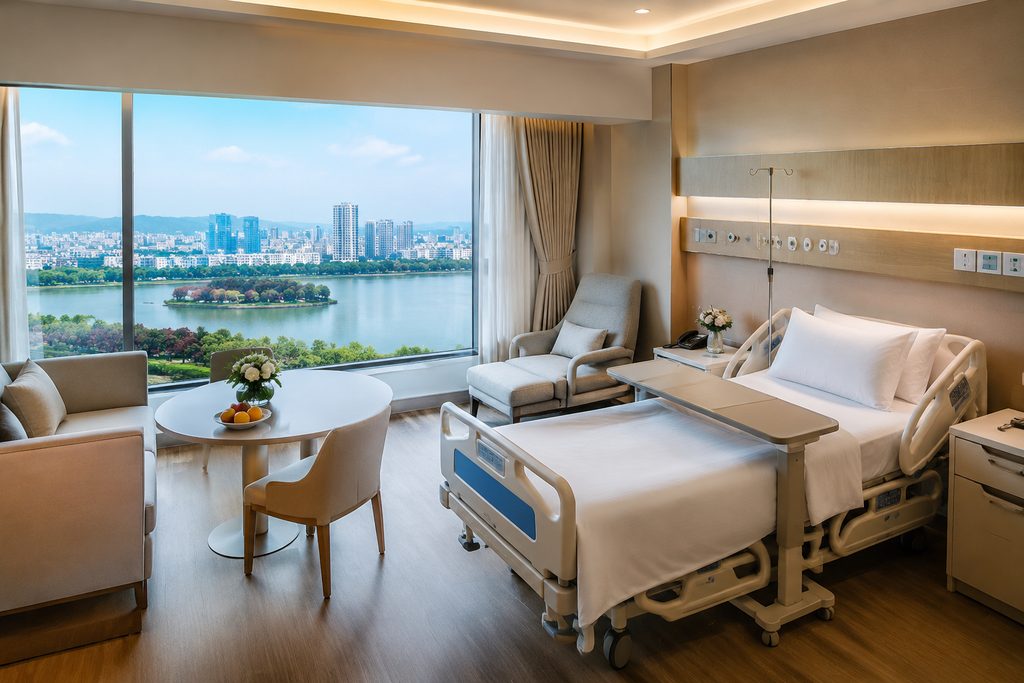
SRRSH is a public hospital. The International Medical Center is a dedicated wing with English-speaking staff, private rooms, and a patient coordinator. But the hospital’s public-facing registration system is built for Chinese citizens. Walking in alone without Mandarin fluency and without a pre-arranged connection to the international department will not work. These are the specific barriers:
- Visa Requirements: Medical treatment in China requires an S2 visa, which mandates an official invitation letter from the hospital. The hospital will issue this only after you have a confirmed appointment and treatment plan. You cannot obtain the visa without the hospital’s cooperation, and you cannot secure the hospital’s cooperation through the general public registration hotline. The international department must initiate the process.
- Payment Systems: The International Medical Center operates on a deposit-and-settlement model. You pay a deposit upon admission, and the final bill is reconciled at discharge. WeChat Pay and Alipay dominate China’s payment ecosystem. Foreign credit cards, while accepted at the international center, can trigger security blocks from your issuing bank. Wire transfers are common but slow. The hospital requires payment before discharge, not 30 days later after an insurance claim processes.
- Medical Records and Imaging: Chinese hospitals require a specific format for medical records. Your home country’s MRI report, even if translated, may not be accepted at face value. The hospital will often require a repeat scan on their own equipment, read by their own radiologists. This is not a revenue-generating tactic. It is a medico-legal requirement. The attending physician needs imaging that meets local diagnostic standards before cutting.
How We Help You Navigate This
These barriers are not malicious. They exist because the system was designed for a domestic patient population. We exist to retrofit that system for international patients. Our process starts with a free consultation. You tell us what procedure you need. We review your medical records and imaging. We present your case to the International Medical Center at SRRSH and obtain a preliminary treatment plan and a Sir Run Run Shaw hospital international patient price list tailored to your specific case. No generic estimates. No vague ranges. A concrete, line-item proposal based on your diagnosis.
Once you approve the plan, we handle the invitation letter for your S2 visa. We coordinate your admission date so you fly in, rest, and proceed directly to your pre-operative consultation without delay. Our bilingual medical companion meets you at the hospital entrance. This person handles registration, queues for payments, translates every conversation with your attending physician, and stays with you through the admission process. During your inpatient stay, the companion visits daily to ensure communication remains clear. After discharge, we coordinate follow-up appointments and physiotherapy sessions before you fly home. The goal is continuity: one team, one point of contact, from the moment you land in Hangzhou to the moment you board your return flight.
Frequently Asked Questions
Technically, yes. The International Medical Center accepts direct inquiries. In practice, the process requires submitting medical records in Chinese, negotiating a treatment timeline, and handling the financial logistics from overseas. Most patients find the administrative friction overwhelming. We do not insert ourselves as a middleman taking a hidden commission. We charge a transparent coordination fee, and we ensure the hospital’s international department receives your records in a format they can act on immediately.
The package typically bundles the surgeon’s fee, anesthesiologist’s fee, private room charges, standard nursing care, implant costs, and basic post-operative medications. It does not include your airfare, visa fees, accommodation before admission, or extended physiotherapy beyond the initial inpatient stay. The final price varies by case complexity. A straightforward primary hip replacement will fall at the lower end of the range. A complex revision surgery with significant bone loss will cost more. We ensure you receive a binding quote before you travel.
SRRSH operates a full intensive care unit with 24/7 intensivist coverage. The hospital’s mortality rates for elective joint replacement are comparable to international benchmarks. No surgeon can guarantee a complication-free outcome. What we can confirm is that the hospital has the infrastructure to manage complications—cardiac events, post-operative infections, deep vein thrombosis—onsite and immediately. This is not a boutique clinic that transfers emergencies to another facility. It is a 2,000-bed tertiary hospital with a full spectrum of medical and surgical specialties available for consultation.
No. The clinical teams are the same senior attending physicians who work in the public wards. What changes is the environment and the access. You get a private room, shorter wait times for imaging and surgery scheduling, and a dedicated English-speaking coordinator. You are paying for logistical priority and communication clarity, not for a different standard of surgical care. The public wards deliver excellent clinical outcomes. But for a foreigner who speaks no Mandarin, navigating those wards alone is a recipe for confusion and medical error.
Your Next Step
The cost of hip replacement at Sir Run Run Shaw hospital represents a fraction of the US price, but the real value is the care model. A Western-managed, attending-led system inside a high-volume Chinese academic medical center is a rare combination. It addresses the two biggest fears international patients have about surgery in China: safety and communication. The hospital’s JCI accreditation and Loma Linda legacy provide the structural answer to the safety question. The International Medical Center provides the communication bridge.
You do not need to decide today. You need accurate information specific to your case. A preliminary treatment plan and price list costs you nothing. It gives you a concrete basis for comparison against your local options. Request a free consultation with our team. We will walk you through the process, answer your questions, and help you determine if SRRSH is the right fit for your needs.
For more medical information and treatment options in China, visit chinamedservices.com (China Medical Services).
