Australia China Medical Second Opinion: PUMCH and Ruijin Hospital Remote Case Assessment
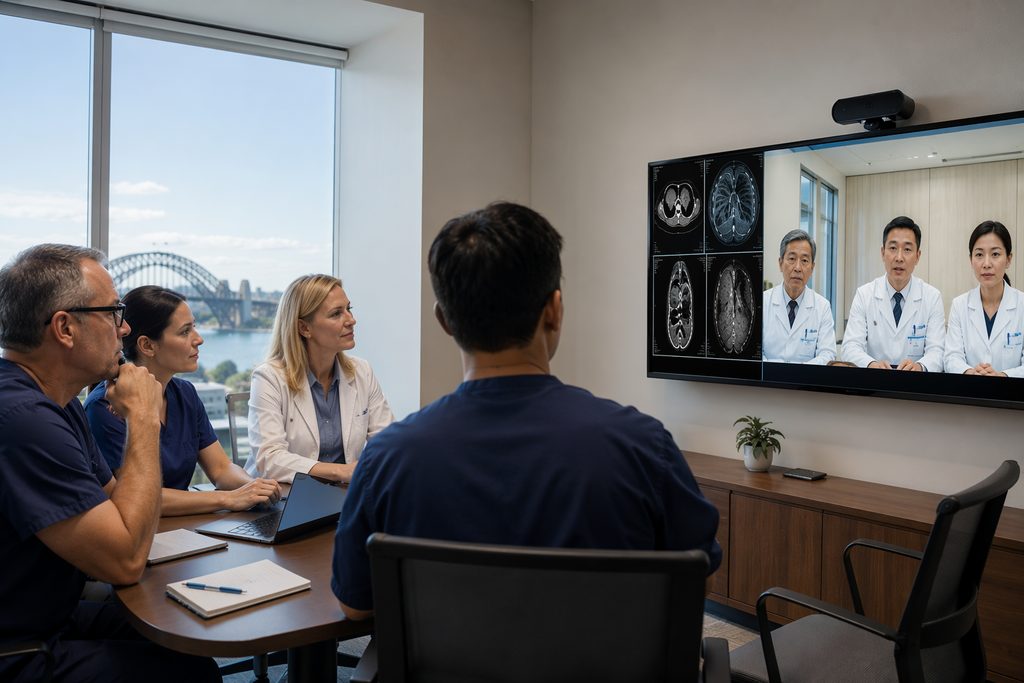
Key Takeaways
- Remote second opinions from China’s top hospitals like PUMCH and Ruijin typically cost $300–$800 for a written assessment — a fraction of what repeat diagnostic workups cost in Australia.
- PUMCH and Ruijin handle enormous patient volumes in their specialty departments, which means their senior specialists see rare presentations and complex cases at a scale most Australian clinicians never encounter.
- Language barriers, medical record translation, and hospital communication protocols make DIY remote consultations extremely difficult — most international patient departments do not accept direct inquiries from overseas individuals without a local coordinator.
- A credible remote second opinion requires properly translated and formatted medical records, not just emailed PDFs. Without this step, the assessment is worthless.
The Problem: Waiting Months for Certainty While Anxiety Compounds
Australia’s public health system delivers excellent care. But for complex or rare conditions, the diagnostic pathway can stretch across months. A 2023 Australian Institute of Health and Welfare report noted that median wait times for elective surgery in public hospitals reached 49 days, with some specialties exceeding 200 days. That number does not include the time spent waiting for initial specialist appointments, imaging, or multidisciplinary reviews.
For a patient with a newly discovered lung nodule, an ambiguous neurological presentation, or a cancer diagnosis where treatment protocols vary between institutions, months of uncertainty are not just stressful. They are clinically dangerous. Some cancers double in volume within weeks. A second opinion that takes four months to obtain is not a second opinion at all. It is a delayed primary opinion with extra steps.
Private sector wait times in Australia are shorter, but out-of-pocket costs for complex diagnostics and multi-specialist reviews can easily exceed $5,000 before any treatment begins. And even then, the patient is drawing from the same pool of clinical expertise within one national system. The value of a truly independent second opinion comes from stepping outside that system entirely.
That is where China’s top-tier hospitals enter the conversation. Not as a replacement for Australian care, but as a parallel source of high-volume, high-expertise clinical assessment. And the mechanism that makes this possible — remote case assessment — is far more accessible than most Australian patients and GPs realize.
Who We Are
We are China Medical Services. We are not a hospital, not a clinic, and we do not provide medical treatment or clinical diagnoses. What we do is solve the logistical puzzle that stands between an Australian patient and a meaningful remote second opinion from hospitals like Peking Union Medical College Hospital and Ruijin Hospital. We translate and format medical records to the standards Chinese hospital international departments require. We navigate the communication protocols. We coordinate the assessment, deliver the translated opinion, and if the patient chooses to travel for treatment, we handle the on-ground logistics — visas, appointments, bilingual medical companions, and recovery support. We are the bridge. Nothing more, nothing less.
Why a PUMCH Remote Second Opinion Cost for Australians Represents Extraordinary Value
The PUMCH remote second opinion cost for Australians typically falls between $300 and $500 for a written assessment by a relevant specialist. That is not a typo. For roughly the price of a single specialist consultation in Australia’s private system, a patient gains access to clinical thinking shaped by case volumes that are difficult to comprehend from outside China’s healthcare ecosystem.
Let us put that in context.
Clinical Volume That Reshapes Diagnostic Instinct
Peking Union Medical College Hospital is consistently ranked in the highest tier of China’s Fudan Hospital Rankings. Its outpatient volume exceeds 2.26 million visits annually. A senior respiratory physician at PUMCH may review more interstitial lung disease cases in a single month than a typical Australian respiratory specialist sees in two years. That volume does not guarantee a better opinion, but it does mean the specialist has almost certainly encountered a presentation similar to yours — including the rare variants, the unusual progressions, and the cases that do not fit textbook descriptions.
Ruijin Hospital in Shanghai operates at comparable scale. Its endocrinology and hematology departments are national referral centers, drawing complex cases from across China’s eastern provinces. When an Australian patient sends records to Ruijin for a remote assessment, those records are reviewed by clinicians who work in departments that manage patient cohorts numbering in the tens of thousands for specific disease categories.
This is not a theoretical advantage. A 2020 study published in The BMJ found a significant positive correlation between hospital procedure volume and patient survival rates across multiple surgical and medical disciplines. Volume builds pattern recognition. Pattern recognition catches what others miss.
Structural Cost Advantages Without Quality Compromise
Why is the PUMCH remote second opinion cost for Australians so much lower than equivalent services in the US or even Australia? The answer lies in structural economics, not quality differentials.
China’s top public hospitals operate on enormous scale with significantly lower labor costs for administrative and support functions. A senior specialist’s time, while highly valued, is not priced at the stratospheric levels seen in Western private healthcare markets. Hospital international departments are government-supported operations designed to facilitate cross-border medical exchange — they are not profit centers in the way a Western private hospital’s international patient office might be.
The cost of living in Beijing and Shanghai, while rising, remains substantially lower than in Sydney or Melbourne for equivalent professional roles. These savings flow through to the pricing of remote consultation services without touching clinical quality. The specialists reading your scans and pathology reports are the same ones treating China’s most complex in-person cases.
This creates an unusual value proposition: a genuinely independent second opinion from a high-volume, top-ranked institution for less than the cost of a single private specialist appointment in Australia.
How Does Ruijin Hospital Online Consultation Work for International Patients?
Understanding how does Ruijin Hospital online consultation work for international patients requires discarding assumptions built from Australian telehealth experiences. This is not a video call booked through a patient portal.
Ruijin Hospital’s International Medical Center handles all remote case assessments for overseas patients. The process begins with medical record submission — but not in the format most Australian patients expect. The hospital requires translated, chronologically organized records that follow a specific structure: summary of presenting complaint, diagnostic timeline, imaging reports with key findings highlighted, pathology results, current treatment regimen, and specific questions the patient wants addressed. Sending a stack of untranslated PDFs from My Health Record will result in silence or rejection.
Once records are accepted and formatted correctly, the International Medical Center routes the case to the relevant department head or senior specialist. The review is conducted asynchronously — the specialist examines the records, consults with colleagues if needed, and produces a written opinion. This opinion is then translated into English and returned to the patient or their coordinating service.
Video consultations are available at a higher tier — typically $500 to $800 for a session with a top specialist — but these require additional scheduling coordination and are not always necessary. For many cases, the written opinion provides sufficient clinical insight to guide treatment decisions back in Australia.
The critical point: Ruijin Hospital does not accept direct inquiries from individual overseas patients for remote assessments. The International Medical Center works through approved coordination channels. Attempting to email the hospital directly will almost certainly fail. This is not a policy choice — it is a capacity reality. The center handles thousands of international cases annually and lacks the staffing to manage fragmented, untranslated, improperly formatted submissions from individuals.
Ruijin vs PUMCH Second Opinion Price Comparison China
This happens in roughly one in five complex cases, and it is precisely why you seek a second opinion. The contradiction is not a crisis. It is data. You now have two expert perspectives that diverge. The next step is understanding why they diverge — is it different clinical guidelines, different available therapies, different interpretation of imaging, or different weighting of risk factors? A good coordinating service will help you identify the source of the divergence so you can discuss it productively with both teams. You remain in control of your treatment decisions.
Medicare does not cover overseas second opinions. Some Australian private health insurers offer international second opinion benefits, but this varies widely by policy. Contact your insurer directly and ask specifically about “international remote second opinion coverage” — not general overseas treatment coverage, which is a different benefit category. The out-of-pocket cost for a written PUMCH or Ruijin opinion is low enough that many patients choose to pay directly rather than navigate insurer bureaucracy for a $300–$500 claim.
PUMCH and Ruijin International Medical Centers assign cases to department heads or senior attending physicians — not residents or junior staff. The written opinion carries the reviewing specialist’s name and departmental title, which you can verify against the hospital’s published faculty listings. These are the same specialists who lead clinical teams for in-person patients. The hospital’s reputation depends on the quality of these opinions, and both institutions treat international second opinions as a core function, not a sideline.
Your Next Step
A remote second opinion from PUMCH or Ruijin Hospital costs less than most Australian patients expect and delivers clinical perspective shaped by case volumes that are genuinely difficult to find within Australia’s healthcare system. The barrier has never been cost or quality. It has been navigation — the unglamorous, essential work of translating records, formatting submissions, and managing communication across language and institutional boundaries. That is the work we do. If you are facing a complex diagnosis and want an independent, high-volume perspective before committing to a treatment path, the door is open. We can help you walk through it.
Frequently Asked Questions
Yes. The hospitals we partner with, like BenQ Medical Center, are JCI-accredited and follow the same international safety standards as top hospitals in the US and Europe. Surgical teams perform high volumes of procedures — often more than their Western counterparts — which studies show leads to better outcomes.
Costs vary by procedure and hospital, but international patients typically save 40-80% compared to US prices — even when factoring in travel and accommodation. A consultation with our team will give you an exact, all-inclusive quote with no hidden fees.
Contact Fenglin International. We handle everything from hospital selection and appointment scheduling to visa assistance and post-operative recovery planning. Your medical records are reviewed by the specialist before you even book a flight.
For more medical information and treatment options in China, visit chinamedservices.com (China Medical Services).
