Endoscopic Spine Fusion China: Minimally Invasive TLIF & OLIF Surgery Cost & Guide
Key Takeaways
- Endoscopic spine fusion cost in China typically ranges from $18,000 to $35,000 USD—a 60-70% reduction compared to US prices that often exceed $100,000.
- Muscle-sparing techniques like endoscopic TLIF and OLIF preserve the multifidus muscle, often allowing patients to walk within hours of surgery and return to light activities in 2-4 weeks.
- Navigating China’s public hospital system alone is extremely difficult: outpatient appointments are not bookable from overseas, and language barriers can compromise safety during critical pre-op evaluations.
- You need to understand the difference between standard public pathways and VIP International Medical Centers before committing to travel—access to top surgeons depends on this distinction.
The Problem: When Back Surgery Costs More Than a House
Chronic lumbar pain from degenerative disc disease or spondylolisthesis does not just destroy mobility. It dismantles your life. You stop playing with your kids. Work becomes impossible. Sleep evaporates. And then you receive the surgical quote. In the United States, a single-level lumbar fusion routinely costs between $80,000 and $150,000. Even with insurance, high deductibles and out-of-network charges can leave patients with $30,000 to $50,000 in personal debt. In the UK or Canada, the price is not measured in dollars but in months—12 to 18 months of waiting while nerve damage potentially worsens. Approximately 1 in 3 patients report that their quality of life deteriorated significantly while simply waiting for a surgical slot.
That is a brutal reality. You need a solution that does not require mortgaging your future or risking permanent nerve damage while languishing on a waitlist. This is precisely where the intersection of advanced Asian surgical volume and drastic cost arbitrage becomes relevant.
Who We Are
We are China Medical Services. We are not surgeons and we do not operate a hospital. We are a specialized patient navigation team based in China, bridging the logistical chasm between international patients and China’s top-tier orthopedic and neurosurgery departments. Our database covers 340+ top-ranked hospitals across 37 cities. We handle the architecture of your medical journey—hospital matching, appointment coordination through formal VIP channels, bilingual medical interpretation, and visa guidance—so you can focus entirely on recovery.
Demystifying the Terminology: What Is Muscle-Sparing Endoscopic Spine Fusion?
Spine surgery has a frightening reputation, largely built on old-school open procedures. A traditional open posterior fusion involves a long midline incision, stripping the paraspinal muscles off the bone to expose the spine. That stripping causes significant blood loss, muscle death, and scarring. The result is often “failed back surgery syndrome”—where the post-op pain is worse than the original problem.
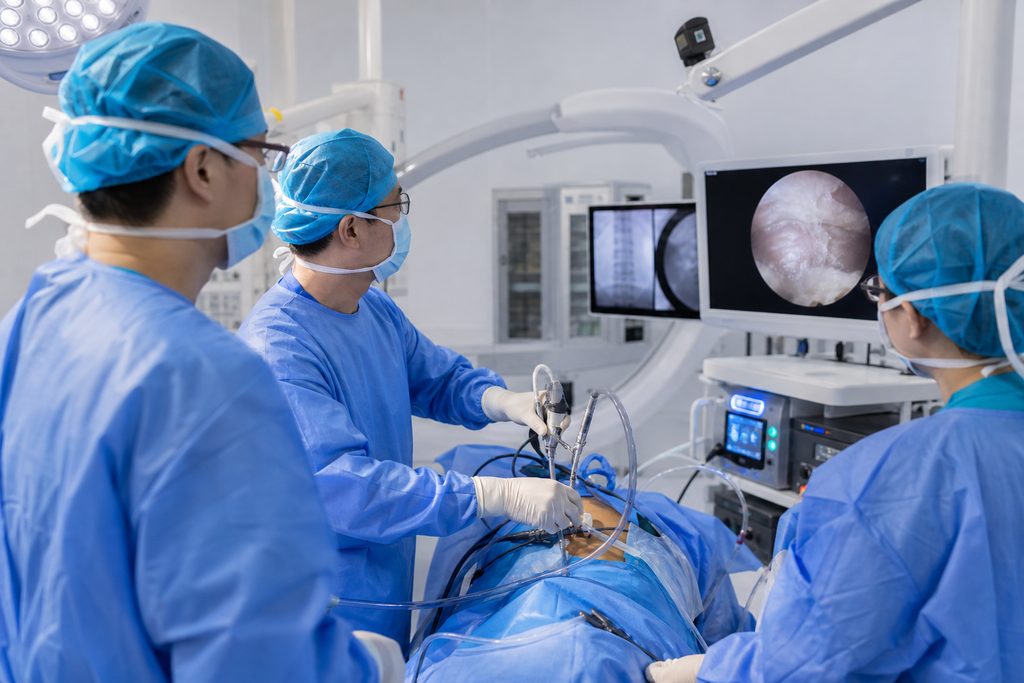
Muscle-sparing techniques reject that logic entirely. Minimally invasive TLIF (Transforaminal Lumbar Interbody Fusion) and OLIF (Oblique Lumbar Interbody Fusion) use tubular retractors or natural anatomical corridors to sneak between muscles rather than cutting through them. The “endoscopic” component adds a high-definition camera, allowing the surgeon to perform the decompression and fusion through a portal no bigger than a keyhole. You are not having your back “opened up.” You are having a precision intervention that respects your anatomy.
Why Endoscopic Spine Fusion in China Delivers Superior Value
International patients often assume lower cost implies inferior technology or skill. That assumption fails when you look at the structural economics of Chinese healthcare and the sheer volume of complex cases handled by top surgeons here.
Clinical Volume: The Unbeatable Teacher
Surgical mastery is a numbers game. A busy US spine surgeon might perform 50 to 80 fusions per year. At high-volume centers in China, a dedicated endoscopic spine surgeon often completes 300 to 500 procedures annually. This is not hyperbole. A 2019 study published in World Neurosurgery analyzing the learning curve for endoscopic lumbar fusion noted that Chinese centers were accumulating case volumes that allowed them to reduce operative time and complication rates at a pace unmatched in lower-volume Western settings. When a surgeon has seen 2,000 variations of the same anatomical problem, very little surprises them in the operating room. That predictability leads to shorter anesthesia time, less blood loss, and faster wake-ups.
Technology Without the Red Tape
China’s top-tier hospitals—specifically those in the Fudan University Hospital Ranking top 5%—invest aggressively in intraoperative navigation and neuromonitoring. Systems like the O-arm intraoperative CT and StealthStation navigation are standard in the orthopedic departments of hospitals like Peking University Third Hospital or Shanghai Changzheng Hospital. These are not experimental gadgets. They provide real-time 3D visualization of screw placement, reducing the risk of nerve root injury to near zero. The critical difference is operational efficiency. In a Chinese VIP international center, a patient can often get a pre-op MRI, CT scan, and specialist consultation completed within 24 to 48 hours. In a fragmented Western outpatient system, that diagnostic workup often drags on for weeks.
The Structural Reason for the Cost Gap
How safe is endoscopic spine fusion in China when it costs a fraction of the US price? The safety does not come from cutting corners. The cost gap exists because of structural economic factors. The average daily hospital room rate in a Chinese international VIP ward is $200 to $400—not $2,000. The cost of a anesthesia team and nursing staff is lower because the cost of living in China is lower, not because the training is inferior. Implants—cages, screws, and rods—are increasingly manufactured by domestic Chinese orthopedic giants like Weigao or Double Medical, which meet FDA or CE-equivalent standards but cost 40% to 50% less than imported Stryker or Medtronic hardware. You are paying for the clinical expertise and the implant, not the bloated administrative overhead of a Western hospital system.
Endoscopic Spine Fusion Cost China: A Transparent Breakdown
The primary search that brings patients to us is straightforward: what is the actual endoscopic spine fusion cost in China? We believe in full transparency. The figures below reflect the all-inclusive pricing at a public hospital VIP International Center for a single-level procedure. This covers surgeon fees, anesthesiologist fees, implant costs, operating room charges, and a private inpatient room for 3 to 5 days.
| Procedure Type | Average Cost in China (USD) | Average Cost in USA (USD) | Typical Hospital Stay |
|---|---|---|---|
| Endoscopic TLIF (1-Level) | $22,000 – $28,000 | $90,000 – $120,000 | 3 – 4 days |
| Endoscopic OLIF (1-Level) | $25,000 – $35,000 | $100,000 – $150,000 | 2 – 4 days |
| Complex Multi-Level Fusion | $35,000 – $50,000 | $150,000 – $250,000+ | 5 – 7 days |
What Is Muscle Sparing Spine Surgery Recovery Time Really Like?
Recovery time is the second most urgent question we hear. Patients want to know when they can hold their grandchild, sit at a desk, or board a plane home.
Because the multifidus muscle is not detached from the spine during an endoscopic TLIF or OLIF, the immediate post-operative pain is dramatically lower. Our partner hospitals typically mobilize patients within 4 to 6 hours after surgery. Standing and walking the corridor on day zero is the expectation, not the exception. For a sedentary desk job, many patients resume remote work within 2 weeks. Driving is usually cleared at 3 to 4 weeks. The fusion itself takes 6 to 12 months to become solid bone, but the functional recovery—the part patients actually care about—is compressed into weeks, not months.
A 2022 meta-analysis in The Spine Journal comparing open TLIF to MIS-TLIF confirmed that the minimally invasive approach reduced post-operative pain scores by 40% at the one-week mark and shortened hospital stays by an average of 2.5 days. That data aligns exactly with what we observe in Chinese high-volume centers.
Finding the Best OLIF Surgeons in China
Searching for the “best OLIF surgeons in China” from outside the country is daunting. Google will give you marketing pages. We give you a framework. The surgeons you want are typically attached to university hospitals with a dedicated spine surgery division—not general orthopedics. Look for departments that publish in Spine, European Spine Journal, or Journal of Neurosurgery: Spine. In practical terms, top-tier OLIF expertise concentrates in a few key institutions in Shanghai, Beijing, and Guangzhou. These surgeons often trained in Germany or South Korea for advanced endoscopic techniques before returning to China, where their case volume exploded.
We maintain relationships with these departments through formal hospital-to-international patient channels. We do not claim that a single surgeon is “the best”—that is a subjective claim no ethical navigator can make. We can tell you which surgeons have the deepest experience with the specific approach you need, based on their publication record and annual surgical volume.
How to Book a Spine Surgery Package in China Without Getting Lost
You cannot simply email a Chinese public hospital and book a surgery slot. The system does not work that way. When patients try to book a spine surgery package in China independently, they hit three immovable walls.
The Outpatient Wall
China’s public hospital system operates on a real-time, walk-in outpatient model. Specialist appointments are released in batches and disappear within seconds on hospital apps that are entirely in Mandarin. You cannot secure a surgery date from overseas. You must first be physically present for a face-to-face consultation. This is the iron rule of Chinese public healthcare. The only way to bypass this is through the International Medical Center, which functions as a parallel private system within the public hospital, with its own appointment schedulers and English-speaking coordinators.
The Imaging and Payment Friction
Chinese hospitals operate on a pre-payment deposit system. Upon registration, a deposit of $5,000 to $10,000 USD is typically required. Payment is almost exclusively via WeChat Pay, Alipay, or UnionPay bank cards. Foreign credit cards are frequently declined at hospital terminals, even in major cities. Without a local payment intermediary, you can be standing at the admission desk with a wallet full of platinum cards and no way to check in.
The Language Barrier in Informed Consent
Signing a surgical consent form in a language you do not read is a recipe for disaster. The consent details the risk of nerve injury, dural tear, implant failure, and anesthesia complications. We have seen independent patients nod politely and sign, having understood nothing. Our bilingual medical companions ensure you understand every line before you touch the pen.
How We Navigate This for You
Our process is designed to convert a chaotic, opaque system into a linear, predictable timeline. It starts with your medical records. We translate and format your MRI reports and clinical history for review by a specific spine surgery department. We do not send your case to a generic “international department.” We send it to the surgeon who actually performs the procedure you need.
Once the surgeon confirms surgical indication, we lock in a consultation and surgery window. We coordinate the S2 medical visa invitation letter, which the hospital issues directly—this is the only document that legally permits you to enter China for medical treatment. Your accompanying family member receives the same S2 visa. Upon arrival, our team meets you at the airport, escorts you to the hospital for pre-op clearance, and remains with you through admission, surgery, and post-op discharge. We handle the deposit payment, the pharmacy runs, and the discharge summary translation. You focus on walking again.
Frequently Asked Questions
This is a legitimate concern. The top-tier VIP centers we work with offer a choice. You can opt for imported implants from Johnson & Johnson (DePuy Synthes), Medtronic, or Stryker—the exact same hardware used in the US or Europe. Alternatively, you can choose domestically manufactured implants that hold Chinese NMPA (National Medical Products Administration) approval and often carry CE marks. The domestic option reduces your implant cost significantly. The surgeon will discuss the biomechanical pros and cons of each, and the final choice is yours.
We establish a direct line of post-operative communication before you leave China. Your surgeon will typically schedule a video follow-up at 2 weeks and 6 weeks. We facilitate these calls with translation support. In the rare event of a surgical site infection or implant complication, your surgeon will provide a detailed medical summary and imaging interpretation for your local physician. We cannot guarantee that a local surgeon will accept responsibility for another surgeon’s complication—that is a universal truth of medicine, not specific to China. What we ensure is that you are not abandoned. The Chinese surgical team remains available for remote consultation.
Volume does not mean an assembly line. The VIP International Centers cap daily surgical loads explicitly to maintain quality. Surgeons operating in these centers typically handle 2 to 4 major spine cases per day, with dedicated time for pre-op planning and post-op rounds. This is actually a lighter load than many high-volume US surgeons who bounce between multiple ambulatory surgery centers. The difference is that in China, the surgeon is full-time in one hospital, with a dedicated nursing team that specializes exclusively in spine. You are not a widget. You are a patient on a focused, specialized unit.
No. We need to be blunt here. This is major spinal surgery, not dental veneers. Post-operatively, you will be on strict activity restrictions. No prolonged sitting, no lifting luggage, no tour buses. We recommend you plan to rest in your hotel or serviced apartment for at least one week after discharge before boarding a long-haul flight. Walking is encouraged; tourism is not. Come for the surgery. Come back for the Great Wall later.
Your Next Step
Living with a spine condition that demands fusion is hard enough. The financial and logistical barriers should not make it harder. China’s combination of high-volume, muscle-sparing surgical expertise and a rational cost structure offers a genuine alternative to waiting in pain or drowning in medical debt.
If you have recent MRI images and a clear diagnosis, we can put a concrete plan in front of you within days—not weeks. It starts with a conversation about your specific case and what you hope to get back: walking, working, living.
Reach out to our team for a free, no-pressure consultation. We will review your case and let you know honestly if China is the right fit for you. Get a free consultation now.
For more medical information and treatment options in China, visit chinamedservices.com (China Medical Services).
