Dr Gu Yudong Hand Surgeon China: Shanghai Huashan Hospital Brachial Plexus Pioneer
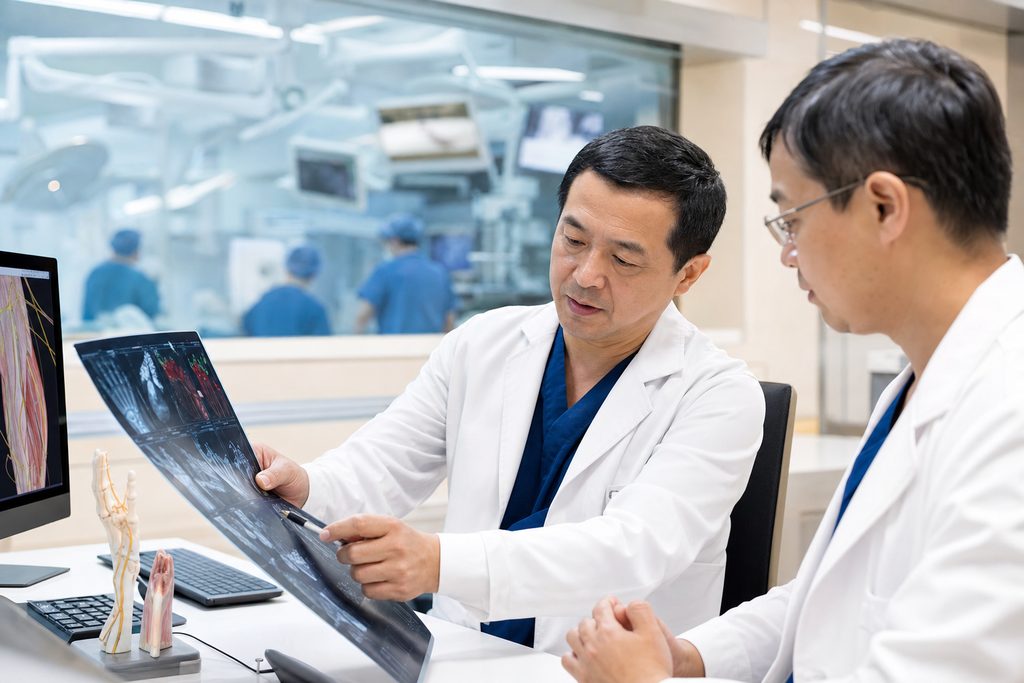
When 42-year-old Michael first heard the diagnosis — a complete brachial plexus avulsion from a high-speed motorcycle crash — his surgeon in Manchester was direct. The window for nerve reconstruction was closing. Maybe six months. And the microsurgical expertise needed for a functional recovery was concentrated in a handful of centers worldwide, with waitlists stretching past that deadline. Michael had never heard of Shanghai Huashan Hospital. He had never imagined flying to China for surgery. But within three weeks, he was in an operating room there, under the care of a team that performs more than 2,000 peripheral nerve procedures annually.
That volume is not an accident. It is the result of decades of focused work by one surgical lineage.
Key Takeaways
- Shanghai Huashan Hospital‘s hand surgery department handles over 2,000 peripheral nerve cases yearly — a surgical volume that reshapes what “experienced” means.
- Dr Gu Yudong pioneered the contralateral C7 nerve transfer technique, now adopted globally for severe brachial plexus injuries once considered untreatable.
- Direct access to Huashan’s public outpatient system is nearly impossible for international patients without Mandarin fluency and local navigation support.
- Total surgical costs for brachial plexus reconstruction in Shanghai typically range from $18,000 to $35,000 — roughly one-fifth to one-third of comparable US fees.
The Problem: Brachial Plexus Injuries Demand a Race Against Time
Brachial plexus injuries affect approximately 1 in every 1,000 live births for obstetric cases, and an estimated 4.2 per 100,000 adults annually from trauma — motorcycle accidents, high-speed collisions, industrial machinery incidents. When the network of nerves connecting the spinal cord to the shoulder, arm, and hand is torn or avulsed, the downstream result is devastating. Loss of motor function. Chronic neuropathic pain. A limb that simply will not respond.
Time is the enemy. After a complete avulsion, the neuromuscular junction begins irreversible degeneration within 12 to 18 months. Patients in the UK, Canada, and Australia routinely wait 6 to 12 months just for a first surgical consultation at a specialized peripheral nerve center. That math does not work. It is why families start searching for alternatives — and why the name Gu Yudong surfaces so quickly in patient forums and medical literature alike.
But searching for a surgeon is one thing. Understanding what makes a particular center worth traveling across the world for — that requires looking at the data, not just the reputation.
Who We Are
We are not a hospital. We do not provide medical treatment, offer clinical diagnoses, or make promises about surgical outcomes. Our team functions as your logistical architects — we bridge the gap between you and China’s top-tier medical expertise. We handle hospital matching, appointment coordination through official international channels, bilingual medical companion services, visa guidance, and post-operative recovery logistics. We exist because navigating a 4,000-bed hospital where registration forms are Mandarin-only and the daily outpatient volume exceeds 10,000 visits is not something anyone should attempt alone.
Why Shanghai Huashan Hospital’s Hand Surgery Department Delivers Results
A Surgical Lineage That Changed Peripheral Nerve Surgery Worldwide
Professor Gu Yudong did not just build a department. He fundamentally altered what is surgically possible after a brachial plexus avulsion. In the 1980s, while most centers were still debating whether surgical intervention for total root avulsions was worth attempting, Gu’s team at Huashan was developing the contralateral C7 nerve transfer. The concept was audacious: harvest the healthy C7 nerve root from the unaffected side of the patient’s neck and transfer it to reinnervate the paralyzed limb. Critics called it reckless. Long-term outcome studies proved otherwise.
Today, the contralateral C7 transfer is a standard part of the peripheral nerve surgeon’s armamentarium, taught in fellowships from the Mayo Clinic to the Royal National Orthopaedic Hospital. Huashan’s Hand Surgery Department, which Gu chaired and where his protégés continue to practice, has published over 800 peer-reviewed papers on peripheral nerve repair. The department handles more than 2,000 peripheral nerve surgeries annually — a caseload that simply does not exist at any single center in North America or Western Europe.
Volume matters in microsurgery. A 2022 study in the Journal of Hand Surgery (European Volume) found that centers performing more than 100 brachial plexus reconstructions per year had significantly lower rates of failed nerve coaptation compared to lower-volume centers. Huashan exceeds that threshold by a factor of five or more.
How Does Dr Gu Yudong Treat Brachial Plexus Injury: The Clinical Philosophy
Although Professor Gu is now in his 80s and no longer performs every surgery personally, the treatment protocols he established remain the department’s backbone. The approach is aggressive on timing and meticulous on microsurgical technique. For a complete avulsion, the typical protocol includes early exploration — ideally within 3 to 6 months post-injury — followed by a combination of nerve transfers, nerve grafting, and in select cases, free functioning muscle transfers.
The contralateral C7 transfer remains a signature procedure. A sural nerve graft, harvested from the patient’s calf, is used as a bridge. The healthy C7 root is connected to the injured side’s target nerves, often the median nerve or musculocutaneous nerve, depending on functional priorities. Elbow flexion and shoulder stability are typically prioritized. Hand function is harder to restore, and the department is candid about that limitation — no center in the world reliably restores intrinsic hand function after a pan-plexus avulsion.
What distinguishes the Huashan approach is the sheer volume of cases informing intraoperative decision-making. When a surgeon has seen 500 variations of a C5-C6 rupture, the recognition of subtle fascicular anatomy becomes second nature. That is hard to replicate in a center doing 20 such cases a year.
Is Huashan Hospital Good for Hand Nerve Surgery? The Evidence
Huashan Hospital is consistently ranked among China’s top-tier hospitals by the Fudan University hospital ranking system, the country’s most authoritative assessment. Its hand surgery department is recognized within the top 10 nationally for orthopedics, with a specific reputation for peripheral nerve work that draws patients from across Asia, the Middle East, and increasingly, Europe and North America.
The hospital itself is a public tertiary-A institution — part of Fudan University’s medical system — with over 4,000 beds and a daily outpatient volume that can exceed 12,000 visits. It is not a boutique international hospital. The corridors are crowded. The systems are designed for scale, not comfort. But the clinical outcomes in peripheral nerve surgery are what bring international patients here. A 2019 long-term follow-up study from the department reported that 78% of patients who underwent contralateral C7 transfer for total brachial plexus avulsion regained useful elbow flexion (M3 or greater on the Medical Research Council scale), and 62% achieved functional shoulder abduction. Those numbers are comparable to or exceed published outcomes from major Western centers.
What You Need to Know Before Going Alone
- Public Outpatient Access Is Not Designed for International Patients: Huashan’s standard outpatient registration system operates in Mandarin only. Appointments are released in batches and often claimed within minutes. Walk-in registration requires a Chinese ID or local phone number. Without a bilingual coordinator or access to the hospital’s international medical service channel, securing a consultation with the hand surgery department is extremely difficult.
- Visa Requirements Are Specific: Medical treatment in China requires an S2 visa with a notation indicating the purpose of medical care. Family members accompanying a patient also need S2 visas. The M visa, commonly used for business travel, is not valid for medical treatment — a mistake that can result in denied entry. Application processing times vary by embassy, and documentation from the receiving hospital is required.
- Payment Is Prepaid, Not Post-Service: Chinese public hospitals require a deposit before surgery, typically covering the estimated total cost. International insurance is rarely accepted for direct billing at public hospitals — patients pay upfront and seek reimbursement afterward. The hospital’s international department can provide itemized receipts and translated medical records for insurance claims, but the cash flow burden falls on the patient first.
How We Help You Navigate This
These barriers are structural, not malicious. Huashan Hospital’s core mission is to serve China’s domestic population of 1.4 billion — the international patient pathway is an overlay, not the default. Our job is to make that overlay work smoothly.
Before you travel, we coordinate directly with the hospital’s official international medical service channel to schedule consultations and secure surgical slots. We do not promise to book a specific surgeon on a specific date — that is not how public hospitals operate, and any service claiming otherwise is being dishonest. What we do promise is to use established institutional relationships to move your case through the system as efficiently as possible, and if we cannot secure the appointment you need, our coordination fee is refunded in full.
On the ground in Shanghai, a bilingual medical companion handles registration, payment deposits, queue navigation, and real-time translation during consultations. After surgery, we coordinate follow-up visits, rehabilitation therapy scheduling, and accommodation for family members. The logistical burden shifts from you to us. You focus on recovery.
For patients who want to understand their options before committing to travel, we arrange written second opinions from Huashan specialists. These include a review of your existing imaging and medical records, a detailed treatment recommendation, and a candid assessment of expected outcomes — for reference only, not as a prescription. The cost for a written second opinion from a top-tier specialist ranges from $300 to $500. And if you decide to proceed with surgery in Shanghai within 90 days, that fee is credited in full toward our on-the-ground coordination service.
Is Huashan Hospital good for hand nerve surgery? The data says yes — for the right patient, with the right injury, at the right time. The question is whether you can get through the door. That is where we come in.
Frequently Asked Questions
Total surgical costs for brachial plexus reconstruction at Shanghai Huashan Hospital — including surgeon fees, operating theater charges, anesthesia, a standard hospital stay of 7 to 14 days, and basic rehabilitation initiation — typically range from $18,000 to $35,000. Complex multi-stage procedures involving free functioning muscle transfers can reach $40,000 to $50,000. These figures vary by case complexity, implant selection, and length of stay. For comparison, equivalent procedures in the United States frequently exceed $120,000, and European centers typically charge €60,000 to €90,000. All costs are prepaid, and the hospital’s international department provides documentation for insurance reimbursement.
Professor Gu Yudong is now in his 80s and no longer maintains a full surgical schedule. However, the hand surgery department he built includes multiple senior surgeons trained directly under him who continue his protocols. Securing an appointment through the public registration system independently is extremely difficult without Mandarin fluency. The hospital’s international medical service channel is the appropriate pathway for foreign patients, and appointments can be coordinated through that channel with proper documentation. We handle this coordination — but we never guarantee a specific surgeon. We guarantee we will use every established channel to secure your consultation, and if we cannot, the coordination fee is refunded.
This is the hardest question, and it deserves a direct answer. No peripheral nerve surgeon in the world can guarantee functional recovery after a complete brachial plexus avulsion. The Huashan team’s published long-term outcomes — 78% achieving useful elbow flexion after contralateral C7 transfer — mean that 22% do not. For those patients, secondary procedures exist: tendon transfers, joint fusions, and in some cases, free functioning muscle transfers can provide salvage function. The department’s approach includes planning for failure from the start. The initial surgery preserves donor sites and nerve options for potential revision. Rehabilitation is continuous, and the team typically follows patients for two to five years post-operatively. We help coordinate that long-term follow-up, including remote consultations and return visits when needed.
Plan for a minimum of three to four weeks in Shanghai. The timeline typically includes: initial consultation and pre-operative imaging (2 to 3 days), surgery and acute hospital stay (7 to 14 days), and initial post-operative rehabilitation and wound checks (7 to 10 days after discharge). Some patients stay longer to begin structured hand therapy at Huashan’s rehabilitation department before flying home. Your surgical team will clear you for air travel based on wound healing and thrombosis risk — usually around 10 to 14 days post-surgery for uncomplicated cases.
For peripheral nerve surgery specifically — and brachial plexus reconstruction in particular — Huashan’s hand surgery department is among the highest-volume centers in the world. The department’s outcomes, published in peer-reviewed international journals, are comparable to or exceed those of major Western peripheral nerve centers. The difference is not necessarily in technical capability — top surgeons in the US, UK, and Germany achieve excellent results — but in case volume, cost, and wait times. A patient who might wait 9 months for surgery in Canada or the UK can often be operated on within 2 to 4 weeks at Huashan, once the consultation is secured. That time advantage matters when nerve degeneration is progressive. The trade-off is navigating a foreign healthcare system with different language, payment, and cultural norms. That is a genuine friction point. It is also solvable with proper coordination.
Your Next Step
A brachial plexus injury rewrites a life in an instant. The search for the right surgeon, the right center, the right timing — it is exhausting, and the clock is always ticking. Shanghai Huashan Hospital’s hand surgery department has spent four decades building the clinical volume and technical expertise to offer real functional recovery to patients who have run out of options at home. The path there is navigable. It just requires a guide who knows the system.
If you want to understand whether Huashan is a viable option for your specific injury — without committing to anything — start with a free consultation. We will review your case, explain the likely pathway and costs, and give you an honest assessment. No pressure. No promises we cannot keep. Just clarity on what is possible.
For more medical information and treatment options in China, visit chinamedservices.com (China Medical Services).
