Spine Surgery China for Russians: Complex Fix with a Bilingual Companion
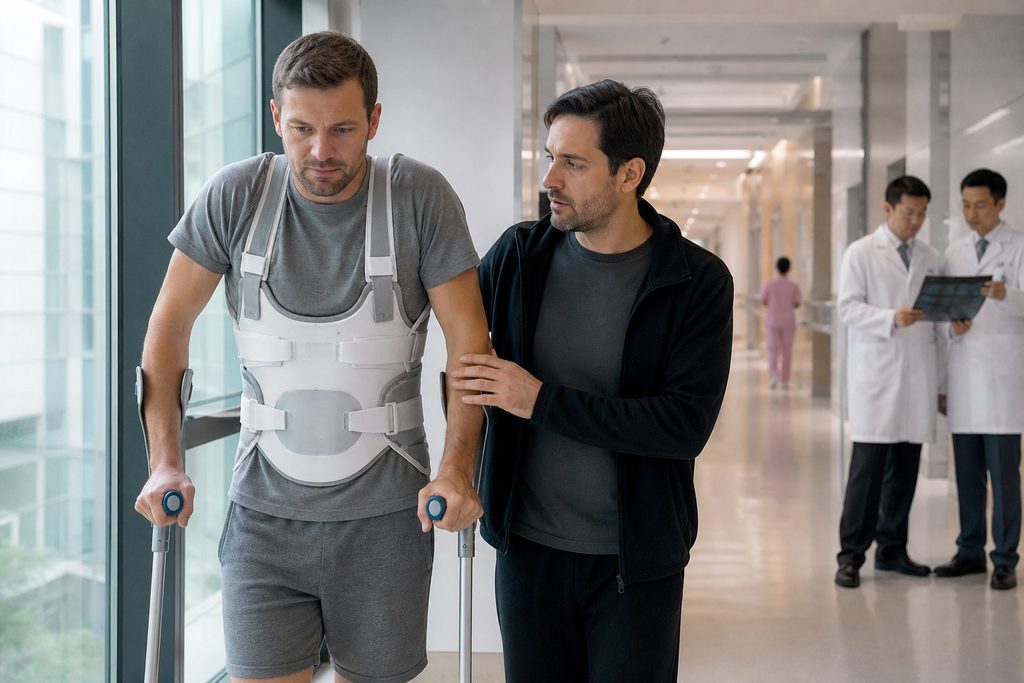
A complex spinal diagnosis changes everything. The words “severe scoliosis,” “failed back surgery,” or “multi-level fusion” don’t just describe a medical condition. They describe a future suddenly filled with uncertainty, pain, and a desperate search for the right hands to trust. For many Russian patients, that search leads beyond the borders of their own excellent, yet sometimes overburdened, healthcare system. It leads to China. Not because the care at home is lacking, but because the sheer scale of clinical experience in China, paired with a transparent cost structure, can offer a path forward that feels otherwise closed. The spine surgery cost China for Russian patients is often a starting question, but the real conversation is about accessing high-volume, specialized surgical teams without a two-year wait.
Key Takeaways
- Top Chinese orthopedic centers perform over 5,000 spine surgeries annually, creating deep expertise in complex deformities rarely matched elsewhere.
- The all-inclusive spine surgery cost China for Russian patients typically ranges from $35,000 to $65,000, roughly 30-50% of comparable Western European or American fees.
- A dedicated Russian-speaking medical companion is not a luxury—in a system where you cannot read a sign or fill a form, it is the single factor that determines whether your care journey is calm or chaotic.
- No reputable international medical service can guarantee a surgical outcome, but you can and should demand complete transparency on surgeon volume, hospital infection rates, and the exact logistics before you travel.
The Problem: When a Complex Spine Needs More Than a Standard Fix
Spinal fusion, deformity correction, and revision surgeries are not routine. A study in the *European Spine Journal* found that the rate of complications in complex adult spinal deformity surgery can reach 20-40%, with reoperation rates near 20%. Those numbers aren’t meant to scare. They are meant to clarify the stakes. The surgeon’s annual volume, the team’s familiarity with your specific deformity pattern, and the hospital’s perioperative protocols all directly influence your outcome.
For a Russian patient, the domestic path might involve a long wait to see a top specialist in Moscow or St. Petersburg. Even then, navigating the administrative hurdles, securing a surgery slot, and managing post-operative rehabilitation can feel like a full-time job. Flying abroad adds another layer of complexity. But it also opens a door to hospitals where a single spine department performs more complex deformity cases in a month than many centers do in a year. This volume isn’t just a number. It translates into refined surgical technique, well-rehearsed operating room teams, and a lower rate of the complications that keep patients awake at night.
Why China’s Spine Centers Deliver Results for Complex Cases
Clinical Volume That Builds Unshakeable Confidence
Surgeons get better at what they do every day. A senior spine surgeon at a top-tier Chinese orthopedics hospital may perform 300-400 major spinal reconstructions annually. Compare that to the average US spine surgeon, who performs around 50-70 fusions per year. For a Russian patient with a 70-degree scoliotic curve or a failed previous fusion, that volume gap matters. It means the surgical team has seen your anatomy before. They have managed the intraoperative surprises. They have refined their post-operative pain protocols through thousands of cycles of feedback. When you ask about the best spine hospital China for complex deformities, you are really asking about this depth of focused, repetitive experience.
Technology Deployed at Scale and Speed
China’s top orthopedics hospitals do not just buy advanced technology; they integrate it into high-throughput surgical workflows. Intraoperative CT navigation, robotic-assisted pedicle screw placement, and neuromonitoring are standard in centers like Peking University Third Hospital or Shanghai’s Changzheng Hospital. These are not experimental tools used on a handful of patients. They are used daily on dozens of cases. This means the surgical team is not learning the technology on you. They are using it to make a procedure they already know well even safer. The combination of high volume and integrated tech is the structural reason outcomes for complex spine surgery at these centers are competitive with the best global benchmarks.
Cost Advantage Rooted in Structural Economics
The spine surgery cost China for Russian patients is lower not because corners are cut, but because the economic model is different. Hospital construction costs, physician salaries, and the price of domestically manufactured implants are all significantly lower than in Western Europe or the US. A complex multi-level fusion with instrumentation that might cost $120,000 in Germany can often be performed in a top-tier Chinese public hospital’s international wing for $45,000 to $65,000. That price typically includes the surgeon’s fee, anesthesia, implant hardware, a private recovery room, and in-hospital rehabilitation. It is a transparent, value-driven model. The quality of the implant itself—often from the same global manufacturers like Medtronic or Johnson & Johnson—is identical. The difference is the system around it.
What a Russian-Speaking Medical Companion Actually Does
This is not about having a friendly translator by your side. A bilingual medical companion is the operational backbone of your entire trip. China’s top public hospitals are vast, efficient, and almost entirely Chinese-language environments. Signage, registration forms, pre-surgical checklists, and post-operative instructions—it is all in Mandarin. You cannot rely on a phone app for a conversation about surgical consent.
Your companion meets you at the airport. They handle the hospital registration, translating your existing Russian medical records into the precise clinical Chinese that the surgical team needs. During the consultation, they do not just translate words; they translate meaning, ensuring the surgeon understands your history of conservative treatment and your specific goals for surgery. When you are in a hospital bed, recovering from a major operation, they are the person who communicates your pain levels, requests adjustments to your medication, and explains the rehabilitation exercises the physiotherapist demonstrates. A medical tourism China spine surgery package with Russian translator isn’t a “package” in the tourist sense. It’s a safety and communication scaffold built around a serious medical event.
How Much Is Scoliosis Surgery in China for Foreigners? A Real Cost Breakdown
The question how much is scoliosis surgery in China for foreigners deserves a straight answer. There is no single price, but there is a consistent range. The final figure depends on the curve magnitude, the number of vertebral levels fused, the type of instrumentation, and the hospital tier.
Here is what you can expect for a typical complex adolescent or adult scoliosis correction at a top-tier public hospital’s international department:
| Cost Component | Estimated Range (USD) |
|---|---|
| Pre-operative imaging and full workup | $1,500 – $3,000 |
| Surgeon and surgical team fee | $8,000 – $15,000 |
| Implant hardware (pedicle screws, rods) | $15,000 – $25,000 |
| Hospital stay (7-14 days, private room) | $5,000 – $10,000 |
| Anesthesia and operating room | $3,000 – $6,000 |
| In-hospital rehabilitation and medication | $2,000 – $4,000 |
| Total Estimated Package | $34,500 – $63,000 |
This estimate reflects the all-inclusive cost for the hospital portion. It does not include flights, accommodation for a family member, or the bilingual companion fee, which typically starts from $200 per day. A comparable procedure in the US often exceeds $150,000. In Western Europe, you might pay $80,000 to $110,000. The spread is significant, and it is the reason many Russian families find the math compelling enough to explore further.
Is Spinal Fusion Safe in China for International Patients? Understanding the Risk Calculus
Safety is not a binary question. It’s a calculus of surgeon volume, hospital protocols, and your own health status. The question is spinal fusion safe in China for international patients should be reframed: is it safe for *you*, in *this* hospital, with *this* surgical team?
Top-tier Chinese hospitals that cater to international patients operate under rigorous standards. Many are JCI-accredited, meaning their infection control, surgical safety checklists, and medication management meet the same international benchmarks as hospitals in Singapore or Germany. The infection rate for instrumented spinal fusion in these centers is typically reported between 0.5% and 2%, consistent with global best practices.
But the risk is never zero. Major spinal surgery carries inherent dangers: nerve injury, blood clots, implant failure, and the possibility that the fusion does not heal. A high-volume surgeon reduces the probability of technical error. A sophisticated neuromonitoring setup reduces the risk of intraoperative nerve damage. Your own health—smoking status, bone density, nutritional state—heavily influences the outcome. A responsible international medical service will not tell you the surgery is safe. It will show you the surgeon’s complication rates, the hospital’s outcome data, and the exact steps taken to mitigate each specific risk. Then you decide.
Practical Considerations: Documentation, Visas, and Logistics for Russians
Planning a major surgery abroad feels overwhelming. Breaking it down into concrete, solvable steps makes it manageable.
First, your medical records. You will need a complete set translated into English or Chinese: full-spine standing X-rays, a recent MRI (within 3 months), a CT scan if you have had previous surgery, and a detailed summary from your treating physician. The surgical team will want to see the curve angles, the rotation, the bone quality, and any evidence of spinal cord compression.
Second, the visa. Russian citizens traveling to China for medical treatment apply for an S2 visa. This is a short-term private affairs visa, and your invitation letter from the hospital is the critical supporting document. The visa typically allows a stay of 30 to 90 days. For a complex fusion, you should plan for at least 4-6 weeks in China: a week for pre-op evaluation, the surgery itself, 2-3 weeks of in-hospital recovery, and then a period of near-hospital rest before you are cleared to fly. Your accompanying family member applies for the same S2 visa.
Third, payment. International patients pay a deposit upfront, typically via wire transfer. The hospital will provide a detailed cost estimate before you travel. Final settlement happens at discharge. Chinese public hospitals do not bill international insurance directly in most cases; you pay and seek reimbursement from your insurer. Confirm this with your provider before committing.
Fourth, communication. Even in the international wing, nurses and junior staff may speak limited English. Russian is almost non-existent in the clinical setting. This is the practical reality that makes a bilingual companion essential. They bridge every gap, from ordering the right meal to clarifying a midnight symptom with the attending nurse.
Frequently Asked Questions
Yes, but with a clear understanding of what “fast-track” means. It does not mean skipping the queue unethically. It means using the hospital’s official international VIP channel. When you work with a coordination service to book complex spine surgery Beijing fast track, you are paying for the administrative work of rapid record translation, priority review by the surgical team, and scheduling within a condensed timeframe—often 2-4 weeks from confirmation, rather than the standard multi-month wait. The clinical process itself is never rushed. Your pre-operative workup remains thorough. The fast track applies to logistics, not to surgery.
Revision spine surgery is significantly more complex than a primary fusion. Scar tissue, altered anatomy, and the need to remove old hardware make these operations longer and riskier. This is precisely the kind of case where China’s high-volume deformity centers excel. Surgeons at hospitals like Peking University Third Hospital routinely handle failed back surgery syndrome and complex revisions. You must send all previous operative notes and implant records. The surgeon needs to know exactly what hardware is in your spine to plan the extraction.
This is the hardest question, and the answer must be honest. Your surgical team in China will provide a detailed discharge summary and post-operative protocol in English. You will have a point of contact for follow-up questions via email or video consultation. However, day-to-day post-operative care, wound checks, and long-term rehabilitation will be managed by your local doctors in Russia. Before you travel, you must establish a relationship with a local spine surgeon or orthopedist who agrees to handle your follow-up care. The Chinese team can communicate with your local doctor directly if needed. A responsible coordination service will help you structure this handoff plan before you ever board the plane.
Your Next Step
A complex spinal condition does not define you, but the decision about where and how to treat it will shape your next decade. The information here is a starting point, not a substitute for a surgical evaluation. Our team at China Medical Services helps Russian-speaking patients navigate this exact path: we translate your records, connect you with the appropriate high-volume spine center, and coordinate the logistics from visa to discharge. We are not a hospital, and we do not provide medical advice or diagnose conditions. What we do is remove the barriers so you can focus entirely on your recovery. For a transparent discussion about your specific case and the realistic costs involved, you can reach our team through our free consultation page. The first conversation is simply that—a conversation. No pressure, just clarity.
For more medical information and treatment options in China, visit chinamedservices.com (China Medical Services).
