Heart Angiogram Cost China: Do You Really Need This Test?
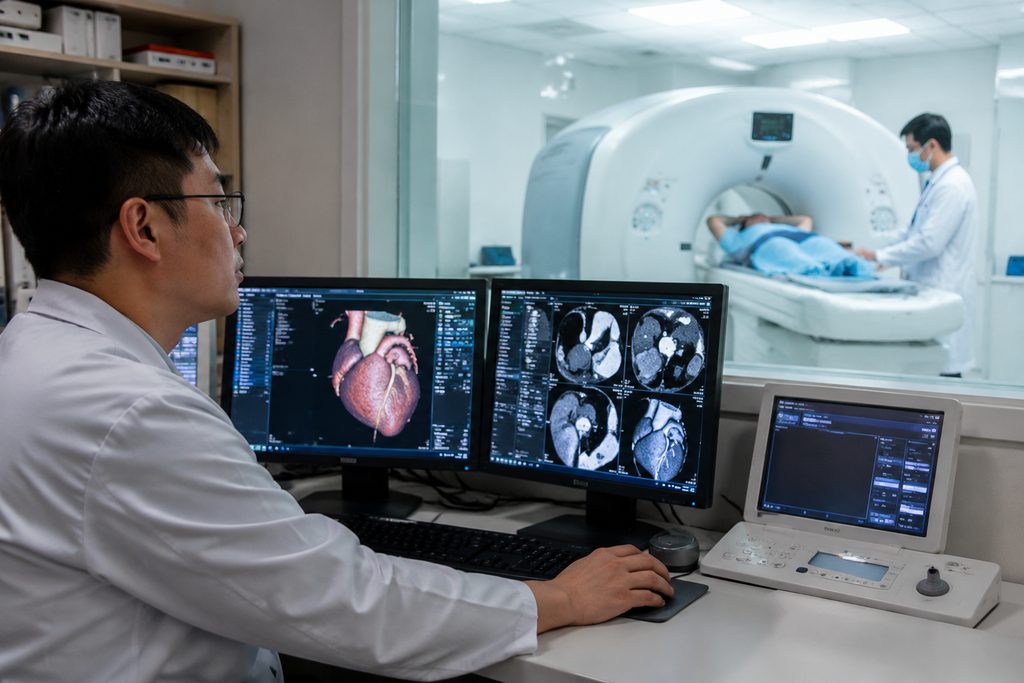
When 54-year-old Daniel from Manchester felt a dull pressure in his chest climbing two flights of stairs, his GP ordered a stress test. The result was borderline. His cardiologist in London then mentioned a coronary angiogram — a camera look inside the heart’s arteries. Daniel had questions. Would it hurt? What if he didn’t need it? And then he saw the quote: £4,800 privately. That’s when he started searching for alternatives, including the heart angiogram cost China. Our team fields questions like Daniel’s every week from international patients trying to figure out whether this invasive test is truly necessary and what it should cost.
How Do I Know If I Need a Heart Angiogram: The Short Answer
You likely need a coronary angiogram if you have symptoms suggesting significant coronary artery blockage — chest pain that worsens with exertion, unexplained shortness of breath, or a stress test that came back abnormal. A 2023 study in the Journal of the American College of Cardiology found that roughly 40% of elective angiograms performed in the U.S. show no obstructive disease, meaning many patients undergo an invasive test they could have avoided. The decision hinges on your symptoms, risk factors, and non-invasive test results. No single number decides it.
That said, the test is not a screening tool. You should not get one “just to check.” The catheter enters an artery in your wrist or groin and travels to your heart. Contrast dye lights up blockages on X-ray. It carries real risks — bleeding, vessel damage, rare stroke or heart attack. The benefit must outweigh those risks.
Who This Is Right For — and Who It Isn’t
Cardiologists generally recommend angiography when the probability of significant blockage is high enough that the information will change treatment. That includes stenting, bypass surgery, or medication adjustments.
You are typically a good candidate for a heart angiogram if you have:
- Chest pain that limits daily activity and has not responded to medication
- A stress test or CT coronary angiogram showing moderate to severe ischemia
- Symptoms after a prior stent or bypass procedure
- Heart failure with suspected ischemic cause
- Survived a cardiac arrest or dangerous arrhythmia with unclear origin
You should probably not pursue an invasive angiogram if:
- Your only concern is a family history of heart disease with no personal symptoms
- You have atypical chest pain and a normal stress test
- Your symptoms are well controlled on medication
- You have advanced kidney disease where contrast dye poses serious risk
- You are pregnant or have an active bleeding disorder
If you fall in that second list, a CT coronary angiogram — a non-invasive scan — may provide enough information. Many patients asking about heart angiogram cost China actually need the CT version first, which is cheaper and lower risk.
The Options, Compared
When patients contact us about cardiac catheterization price Shanghai or elsewhere in China, they usually compare three paths: staying in their home country, traveling to a private international hospital in China, or using a top public hospital’s international department. Here is how those stack up for a diagnostic coronary angiogram.
| Option | Typical Cost (USD) | Wait Time | Language Support | Who It Suits |
|---|---|---|---|---|
| U.S. private hospital | $8,000–15,000 | 1–3 weeks | Native English | Insured patients, no travel |
| U.K. private hospital | $5,500–9,000 | 2–6 weeks | Native English | Insured or self-pay, no travel |
| China public hospital (international dept.) | $1,500–3,500 | 3–10 days | English-speaking coordinators | Self-pay, comfortable traveling |
| China private international hospital | $2,500–5,000 | 2–7 days | Native-level English staff | Self-pay, Western-style care |
| Thailand / India private hospital | $2,000–4,500 | 1–2 weeks | English widely used | Self-pay, regional travel |
For patients without insurance coverage for the procedure, the cost gap is stark. A diagnostic angiogram at a top Chinese public hospital’s international department often runs one-fifth to one-third of the U.S. private price. But cost is not the only factor. If complications arise, being close to home and your established cardiologist has real value. For straightforward diagnostic cases with low complication risk, the savings can justify travel.
Is Heart Angiogram Safe in China? What the Volume Data Shows
This is the question every patient asks after seeing the price difference. And it deserves a straight answer.
China’s top cardiac centers perform enormous volumes of these procedures. Fuwai Hospital in Beijing — the national cardiovascular center — performs over 14,000 cardiac surgeries annually and tens of thousands of catheterization procedures. Volume matters in interventional cardiology. Studies consistently show lower complication rates at centers performing high numbers of procedures. A 2021 analysis in Circulation: Cardiovascular Interventions found that hospitals performing more than 400 percutaneous coronary interventions per year had significantly lower in-hospital mortality than low-volume centers.
But volume is not the whole story. You need to choose the right hospital. The top-ranked hospitals in China — those on the Fudan University hospital rankings — meet international standards for catheterization labs, sterile protocol, and emergency backup. Many also hold JCI accreditation. Our team only works with hospitals in that top tier.
Risks remain the same as anywhere: bleeding at the access site, allergic reaction to contrast dye, kidney strain, and the rare but serious risk of stroke or heart attack during the procedure. No hospital can eliminate those. What changes is how quickly and competently the team responds if something goes wrong.
Best Heart Hospital for Angiogram China: Where Patients Actually Go
If you decide to pursue the test in China, your shortlist should include centers with dedicated international departments, high cath lab volume, and English-speaking coordination. Based on Fudan rankings and our own coordination experience, the most common choices for international cardiac patients are:
- Fuwai Hospital, Beijing — China’s national cardiovascular center, highest procedure volume in the country, dedicated international ward
- Zhongshan Hospital, Fudan University, Shanghai — top-ranked cardiac surgery and cardiology, strong international department
- Ruijin Hospital, Shanghai — comprehensive tertiary center with JCI accreditation and established international patient services
- West China Hospital, Chengdu — massive volume, strong cardiology department, lower cost of living during recovery
Each hospital has its own process for international patients. You cannot simply book a heart angiogram package China online and show up. You need medical records reviewed first, then a consultation with the cardiology team, then scheduling. That’s where coordination support makes a difference.
What It Costs: Breaking Down the Heart Angiogram Cost China
Let’s get specific. For a diagnostic coronary angiogram — no stent, no intervention — at a top Chinese public hospital’s international department, expect to pay between $1,500 and $3,500 total. That typically includes the procedure itself, contrast dye, one night of observation, and basic nursing care. It does not include your flights, accommodation, visa fees, or any additional treatment if a blockage is found and stented immediately.
If the cardiologist finds a significant blockage during the diagnostic angiogram and places a stent in the same session — which happens in roughly 30–40% of diagnostic cases — the cost rises to $5,000–10,000 depending on the number of stents and whether drug-eluting stents are used. Ask before the procedure whether your consent covers same-session stenting and what that would cost.
At private international hospitals like United Family or Jiahui in Shanghai, the diagnostic angiogram runs $2,500–5,000. You pay more for Western-style amenities, direct insurance billing, and guaranteed English-speaking staff throughout. For some patients, that premium is worth it. For others, the public hospital international department offers the same medical quality at a lower price with coordinator support.
Compare that to the U.S., where the same diagnostic procedure averages $8,000–15,000 for self-pay patients, and the appeal of the heart angiogram cost China becomes clear. Even adding $2,000–3,000 for flights and a week of accommodation, the total is often half the U.S. price or less.
Practical Considerations: Records, Visa, and What Comes After
Before you book anything, gather your medical records. You will need recent ECG results, stress test reports, any prior CT coronary angiogram images, blood work including kidney function, and a referral letter from your cardiologist explaining why angiography is being considered. Chinese cardiologists will review these before accepting you as a patient.
Visa is the next step. For medical treatment in China, the applicable category is the S2 visa, which covers short-term private affairs including medical treatment. Your accompanying family member also applies for an S2. The hospital’s international department will issue an invitation letter and treatment confirmation to support your application. Processing times vary by embassy, so start at least 3–4 weeks before your intended travel date. We provide guidance on this through our patient coordination service, but final approval always rests with the consulate.
Payment at Chinese public hospitals is upfront. You pay a deposit before the procedure, and the balance is settled on discharge. Insurance reimbursement depends on your policy — most international insurers will reimburse treatment at JCI-accredited hospitals, but you must confirm before traveling. Private international hospitals in China often bill insurers directly, which simplifies things if your plan covers treatment abroad.
Follow-up after returning home matters. You will need a local cardiologist to review the angiogram images and report. Ask the Chinese hospital for a copy of the procedure report and the actual images on a CD or USB drive before you leave. Most will provide this. Your home cardiologist can then continue your care without missing information.
Language is the friction point most patients underestimate. Public hospital staff — even in international departments — may not speak fluent English during every interaction. That’s why bilingual coordination exists. You are not buying access to a doctor; you are paying for someone to translate your records, explain your symptoms accurately, and make sure nothing gets lost between languages. At China Medical Services, that coordination is what we do.
Frequently Asked Questions
A CT coronary angiogram is non-invasive and often sufficient to rule out significant blockage. If the CT shows moderate or severe narrowing, or if your symptoms strongly suggest blockage despite a normal CT, an invasive angiogram is the next step. Your cardiologist decides based on your risk profile and test results. Do not push for an invasive test if your doctor says it is not indicated.
Prices are similar across top-tier cities. In Shanghai, a diagnostic angiogram at a public hospital international department typically runs $1,800–3,500. Beijing is comparable, usually $1,500–3,200. Private international hospitals in Shanghai trend slightly higher than Beijing due to operating costs. The hospital you choose matters more than the city — Fuwai in Beijing and Zhongshan in Shanghai both offer excellent cardiac care at similar price points.
You cannot book a procedure directly without a prior consultation. Chinese public hospitals require a face-to-face or video consultation with the cardiology team before scheduling any invasive procedure. What you can arrange in advance is the consultation itself, record review, and a tentative procedure window. The hospital confirms the date after the cardiologist approves the plan. Anyone promising a guaranteed procedure date before medical review is not being honest with you.
Yes, in most cases. If the cardiologist finds a blockage suitable for stenting during the diagnostic angiogram, they will usually proceed in the same session, provided you gave prior consent. This is actually more efficient and avoids a second catheterization. But it also means your bill increases significantly in that moment. Discuss this scenario with the hospital before the procedure and confirm the additional cost range in writing.
At top-tier hospitals with high procedure volumes and international departments, the safety profile is comparable to good centers in the U.S. or Europe. The key variables are hospital selection and communication. Choose a hospital with documented high cath lab volume and JCI accreditation or Fudan ranking. Bring complete medical records. Use a coordinator who can translate accurately. These steps reduce the specific risks that foreign patients face — miscommunication and incomplete history — more than any medical factor.
Your Next Step
If you are weighing whether to travel for a heart angiogram, start with your records and an honest conversation with your home cardiologist about whether the test is truly indicated. If it is, and you want to explore the heart angiogram cost China option, our team helps international patients navigate the process — hospital matching, record translation, consultation scheduling, and on-the-ground bilingual support. We are not a hospital and we do not provide medical advice or diagnoses. We connect you with cardiologists who do. When you are ready to understand your options, request a free consultation and tell us your situation. We will help you figure out if this path makes sense for you.
Daniel, by the way, ended up getting a CT coronary angiogram first. It showed mild plaque but no significant blockage. He never needed the invasive test. Sometimes the best answer to “do I need this?” is a cheaper test that tells you no.
For more medical information and treatment options in China, visit chinamedservices.com (China Medical Services).
