Surgery Day in Chinese Hospital: Pre-Op to Recovery Room Walkthrough
While patients in Canada wait a median 27.4 weeks between specialist consultation and orthopedic surgery, surgeons at Beijing Jishuitan Hospital routinely perform over 300 joint replacements per month. The volume gap is staggering. But volume means nothing if you don’t know what happens when you walk through those hospital doors on surgery day.
That’s what this article covers.
Not the marketing version. Not the glossy brochure. The real sequence of events from pre-op check-in to the moment you’re cleared for discharge. We’ve coordinated this process for patients from over 30 countries at hospitals across our network of 340+ top-ranked institutions. Here’s what we’ve learned — and what you need to know before you pack your bags.
How This Actually Works, Step by Step
The morning of surgery starts early. Most Chinese hospitals admit surgical patients between 6:30 and 7:30 AM. You’ll have received a specific time during your pre-admission consultation. Don’t be late. Operating room schedules are tight, and missing your slot can mean a full-day delay.
Here’s the actual sequence:
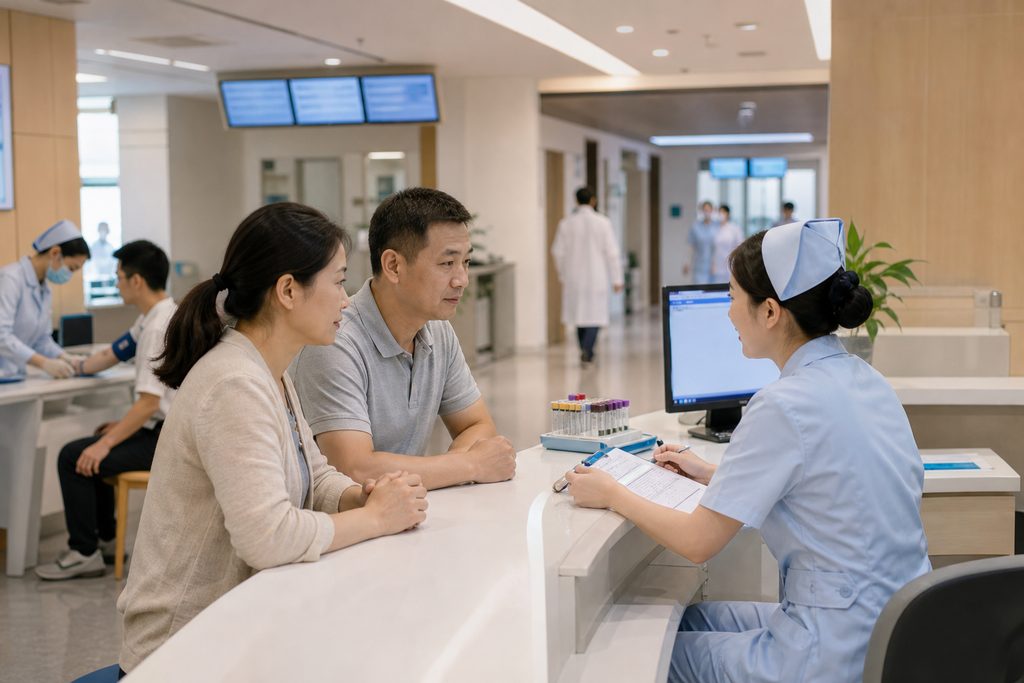
You arrive at the hospital’s inpatient admission desk. If you’re going through the international medical center or VIP department — which is how most foreign patients access care — you’ll be met by a coordinator who speaks English. They’ll verify your passport, your signed surgical consent forms, and your pre-payment receipt. Chinese public hospitals require a deposit before admission. The amount varies by procedure. A cardiac surgery deposit at a top-tier hospital might run $8,000 to $15,000. A knee replacement, closer to $5,000 to $10,000. These are deposits against the final bill, not the final cost.
After registration, you’re taken to your room. Most international departments offer private rooms with an ensuite bathroom, a sofa bed for a family member, and basic amenities. Not luxury. Functional. Clean. Comparable to a good European private hospital.
A nurse takes your vitals. Blood pressure, temperature, oxygen saturation. They’ll confirm when you last ate or drank. This matters. Anesthesia guidelines in Chinese hospitals are strict: typically no solid food for 8 hours, no clear liquids for 2 hours before surgery. Violate this and your surgery gets postponed. No exceptions.
Then the surgical team checks in. Usually a resident or fellow first, then the attending surgeon. They’ll mark the surgical site with a pen — on your skin — and have you confirm the procedure in your own words. This is a World Health Organization surgical safety checklist protocol. Chinese hospitals accredited by JCI or ranked on the Fudan Hospital list follow it rigorously.
An anesthesiologist visits separately. They’ll review your airway, ask about allergies, previous anesthesia reactions, and explain whether you’re getting general or regional anesthesia. If you have questions about anesthesia safety, this is the moment to ask them.
A nurse starts an IV line. You change into a hospital gown. Your belongings go into a locked cabinet or stay with your companion.
Then you wait. Sometimes 30 minutes. Sometimes two hours. Operating room turnover between cases takes time. The staff won’t always explain the delay. This is where having a bilingual medical companion — someone who can ask the nurses what’s happening and relay it to you — makes a tangible difference in anxiety levels.
When your turn comes, you’re transferred to a gurney and wheeled to the operating theater. Family members stop at the red line. The OR doors close.
What “Surgery Day in Chinese Hospital What to Expect” Really Means for Foreign Patients
The physical environment will feel different from what you’re used to. Not worse. Different.
Chinese operating rooms are cold. Deliberately. Temperature is kept between 18-22°C (64-72°F) to reduce infection risk. The surgical team wears caps, masks, and sterile gowns identical to any Western OR. The equipment — anesthesia machines, monitors, surgical instruments — is often the same brands you’d see at Mayo Clinic or Charité in Berlin. Siemens, Philips, Stryker, Medtronic. China’s top hospitals invest heavily in hardware.
But the workflow has cultural fingerprints.
Surgical teams in Chinese hospitals tend to be larger. A major procedure might have two attending surgeons, a first assistant, a second assistant, a scrub nurse, two circulating nurses, and an anesthesiologist with a resident. The hierarchy is more visible. Junior staff defer to senior staff in ways that can seem formal to Western observers. This isn’t inefficiency. It’s a different operating rhythm — one that produces clinical outcomes that, for many high-volume procedures, match or exceed international benchmarks.
A 2023 study published in *The Lancet* examining surgical outcomes across 28 countries found that China’s 30-day postoperative mortality rate for elective procedures at tertiary hospitals was 0.47%, compared to a global average of 0.71% at comparable institutions. The data exists. The outcomes are measurable.
What you won’t see: small talk in the OR. Chinese surgical teams are famously focused during procedures. The pre-op briefing happens outside the room. Once inside, it’s work.
After surgery, you’ll wake up in the post-anesthesia care unit (PACU). This is universal. A nurse monitors your vitals as the anesthesia wears off. You’ll be groggy. Possibly nauseous. Tell them. Chinese PACU nurses are responsive to patient-reported symptoms — but you need to speak up, or have someone who can speak up for you.
Once you’re stable — usually 1 to 3 hours — you’re transferred back to your room. The surgeon or a senior team member will brief you or your companion on how the procedure went. Ask for specifics: estimated blood loss, any unexpected findings, whether the plan changed intraoperatively. Good surgeons welcome these questions.
A Realistic Timeline
Here’s what the full surgical episode actually looks like for an international patient. This isn’t the optimistic version. This is the version that accounts for document translation, hospital administrative processes, and the immutable fact that Chinese public hospitals run on their own clock.
| Phase | What Happens | Typical Duration |
|---|---|---|
| Pre-arrival preparation | Medical records translated into Chinese, imaging uploaded, case reviewed by target hospital department | 1-3 weeks |
| Visa processing | S2 visa application with hospital invitation letter; embassy processing time varies by country | 1-4 weeks |
| Arrival and first consultation | In-person specialist evaluation, additional diagnostics if needed, surgical plan finalized | 2-5 days |
| Pre-operative clearance | Blood work, ECG, chest X-ray, anesthesia evaluation; results typically available same-day or next-day | 1-3 days |
| Surgery day | Admission, procedure, PACU recovery, return to room | 1 day |
| Inpatient recovery | Daily rounds, wound care, pain management, physiotherapy if indicated; discharge criteria vary by procedure | 2-14 days |
| Post-discharge local stay | Follow-up wound check, suture removal, final consultation before travel clearance | 3-10 days |
| Total in-country time | From landing to departure with medical clearance | 2-6 weeks |
The longest variable is almost always the pre-arrival preparation. Hospitals need complete, translated records before they’ll commit to a surgical date. Rushing this step creates downstream delays. Get the documents right the first time.
Visa processing is the second bottleneck. The S2 visa — which is the correct category for short-term medical treatment in China — requires an invitation letter from the hospital. Some hospitals issue these quickly. Others take two weeks. Embassy processing times in your home country add another layer. Plan for the worst case, not the best.
What Can Go Wrong — and What Happens Then
We need to talk about this directly. Surgery anywhere carries risk. Surgery in a country where you don’t speak the language, understand the system, or have local support carries additional layers of risk. Pretending otherwise helps no one.
The most common failure mode we see: incomplete pre-operative workup. A patient arrives with imaging from home that the Chinese surgical team deems insufficient. Maybe the MRI slice thickness was wrong. Maybe the sequence protocol doesn’t match what the surgeon needs for planning. The solution is a repeat scan in China, which adds 1-3 days and $200-$800 to the timeline and budget. Not catastrophic. But frustrating if you weren’t expecting it.
A more serious scenario: intraoperative findings that change the surgical plan. A planned laparoscopic procedure converts to open surgery. A tumor resection reveals more extensive disease than imaging suggested. Chinese surgeons are trained to make these judgment calls in real time. They’ll inform your companion afterward. The consent form you signed covers this possibility. The clinical outcome is usually still good. But recovery time and cost may increase.
Then there’s the administrative failure mode: insurance complications. Most Chinese public hospitals don’t do direct billing with foreign insurers. You pay upfront. You submit for reimbursement later. If your insurer requires pre-authorization for the procedure and you haven’t obtained it, you’re carrying the full cost until the dispute resolves. This can take months.
What about medical errors? They happen everywhere. China’s top hospitals have incident reporting systems and root-cause analysis protocols. The better ones are transparent about complications. But the medicolegal framework is different from what you’d encounter in the US or UK. Malpractice litigation is less common. Hospital-mediated compensation is more common. If you’re concerned about this, ask the international department directly about their complication disclosure policy before committing to surgery. A reputable hospital will answer.
The practical safeguard: work with an organization that has boots on the ground. Someone who can walk into the hospital administration office and advocate for you in Mandarin. Not hypothetically. Actually. This is the difference between a delay that resolves in hours and a delay that ruins your trip.
How to Prepare for Surgery in Shanghai and Other Major Medical Cities
Shanghai, Beijing, Guangzhou — these are the destinations where most foreign patients land. Each city has its own medical ecosystem, and preparation looks slightly different depending on where you’re going.
Shanghai’s top surgical hospitals cluster in the former French Concession and Xuhui districts. Zhongshan Hospital, Huashan Hospital, and Ruijin Hospital are all within 30 minutes of each other. This matters because you’ll likely stay near the hospital for pre-op appointments and the early recovery period. The area around Zhongshan Hospital has serviced apartments that cater to medical travelers. Book one with a kitchen. Hospital food in China is functional, not enjoyable, and post-surgical nutrition matters.
Beijing’s medical infrastructure concentrates in the Dongcheng and Haidian districts. Peking Union Medical College Hospital sits near Wangfujing. Fuwai Hospital, the world’s highest-volume cardiac surgery center with over 14,000 procedures annually, is in Xicheng. Beijing traffic is unpredictable. On surgery day, stay within walking distance or arrange a driver who knows the hospital campus layout. Some hospital complexes are enormous — multiple buildings, multiple gates, and your admission desk might be in Building 3, not Building 1.
The preparation checklist that applies regardless of city:
Bring every imaging study you’ve ever had. Not just the report. The actual DICOM files on a CD or USB drive. Chinese radiologists will re-read the images themselves.
Bring a medication list with generic names, not brand names. Chinese pharmacies stock different brands. The generic name is what the hospital pharmacy needs.
Bring a companion. This isn’t optional. You need someone to handle logistics, communicate with staff, and advocate for you when you’re groggy or in pain. If you can’t bring someone from home, arrange for a bilingual medical escort. The cost — from $200 per day — is trivial compared to the cost of a preventable complication from miscommunication.
Bring patience. Chinese hospitals are efficient once you’re in the system. Getting into the system takes time. The corridors are crowded. The administrative processes are paper-heavy. None of this reflects on the quality of the surgical care. It reflects a system processing patient volumes that would overwhelm most Western hospitals.
Is It Safe to Have Surgery in China? The Data and the Nuance
The short answer: at a top-ranked Chinese hospital, for an elective procedure, with proper preparation, yes. The data supports this. The nuance matters.
China’s hospital system is bifurcated. The hospitals in our network — the top 5% of the country’s 35,000+ institutions, ranked by the Fudan University hospital ranking system or accredited by JCI — operate at international standards. They publish research in *The New England Journal of Medicine* and *The Lancet*. Their surgeons train internationally. Their infection control protocols are audited.
The other 95% of Chinese hospitals? Quality varies. This is why hospital selection is the single most important decision you’ll make in this process. A surgeon at Fuwai Hospital who performs 200 cardiac valve replacements per year has a different skill profile than a surgeon at a provincial hospital who performs 20. Volume drives outcomes. This is a universal truth in surgery, not specific to China.
Safety also depends on procedure type. China excels at high-volume, technically demanding procedures where repetition breeds expertise. Cardiac surgery. Orthopedic joint replacement. Laparoscopic gastrointestinal surgery. Tumor resection. These are the procedures where Chinese surgical teams have volume advantages that translate into outcome advantages.
For rare procedures or conditions requiring highly subspecialized multidisciplinary care, the calculus shifts. The best hospital in China for your specific condition might be world-class. Or it might not. This requires case-by-case evaluation.
The infection risk question comes up constantly. Chinese hospitals report surgical site infection rates to national surveillance systems. A 2022 meta-analysis in the *Journal of Hospital Infection* found that SSI rates at Chinese tertiary hospitals averaged 2.1% for clean-contaminated wounds, comparable to US and European benchmarks. The top hospitals run lower.
Antibiotic stewardship is improving but remains an area of active reform. Chinese hospitals historically overused perioperative antibiotics. National guidelines now mandate single-dose prophylaxis for clean procedures and 24-hour coverage for clean-contaminated procedures. Compliance at top hospitals is high. At lower-tier hospitals, less so.
The honest assessment: safety at a top Chinese hospital is comparable to safety at a good Western hospital for the procedures China does most. The risks are different, not necessarily greater. The mitigation strategies are different too — and they depend more on preparation and local support than on the technical skill of the surgical team.
Practical Considerations: Records, Visas, Payment, and Follow-Up
Let’s get concrete about what you need to have in order before you book a flight.
Medical records must be translated into Chinese. Not summarized. Translated. Every relevant page. Radiology reports, pathology reports, operative notes from previous surgeries, discharge summaries, current medication lists. Professional medical translation costs $30-$80 per page depending on complexity and turnaround time. A full surgical case file might run 20-50 pages. Budget accordingly.
The S2 visa requires an invitation letter from the admitting hospital. This letter states your diagnosis, the planned procedure, and the expected duration of treatment. Hospitals issue these only after they’ve reviewed your case and agreed to treat you. You cannot apply for the visa before the hospital commits. This creates a chicken-and-egg problem that catches many patients off guard. The hospital wants to see you in person before final commitment. The visa requires a hospital commitment. The practical solution is a written second opinion or video consultation first — which costs $300-$800 — followed by the hospital issuing an invitation letter based on that preliminary assessment.
Payment is upfront. Chinese hospitals don’t bill you after discharge. You deposit funds before admission. The hospital draws down the deposit as charges accrue. If the deposit runs low during your stay, you’ll be asked to top it up. At discharge, any remaining balance is refunded. This system feels foreign to patients from countries where post-treatment billing is the norm. It’s not negotiable. Budget for the full estimated cost plus a 20% buffer for contingencies.
Insurance reimbursement requires documentation. Request an itemized bill in both Chinese and English. Request translated operative notes and discharge summaries. Get these before you leave the hospital — obtaining them remotely is far harder. Most international departments understand what foreign insurers need and can provide it. Ask explicitly.
Follow-up care at home needs to be arranged before you travel. Identify a local physician who will accept post-operative care responsibility for a patient who had surgery abroad. Not all doctors will. Ask directly. Send them the Chinese surgeon’s contact information and the planned procedure details. This isn’t a courtesy. It’s a safety requirement.
Frequently Asked Questions
Will the surgical team speak English?
At international medical centers and VIP departments within top-tier Chinese hospitals, the attending surgeons often speak functional to fluent medical English. Many trained or completed fellowships in the US, UK, Germany, or Japan. Nursing staff English proficiency is more variable. The anesthesiologist may or may not speak English. For critical communication — confirming the procedure, discussing allergies, understanding post-op instructions — a bilingual companion or hospital-provided interpreter removes the uncertainty. Don’t rely on assumptions.
Can my family member stay with me in the hospital room?
In international department private rooms, yes. One family member can usually stay overnight on a sofa bed. In standard public hospital wards — which foreign patients rarely use — family members typically cannot stay overnight and visiting hours are restricted. Confirm this with the specific hospital before booking, as policies vary between institutions and even between departments within the same hospital.
What if I need to book a surgical procedure in Beijing fast track — is that realistic?
The phrase “fast track” needs translation into Chinese hospital reality. You cannot skip the line simply by paying more. What exists is the international medical center pathway, which offers coordinated scheduling, English-speaking staff, and shorter administrative delays compared to navigating the standard public
For more medical information and treatment options in China, visit chinamedservices.com (China Medical Services).
