China Hospital Appointment Codes: Decode Your Ticket in Minutes
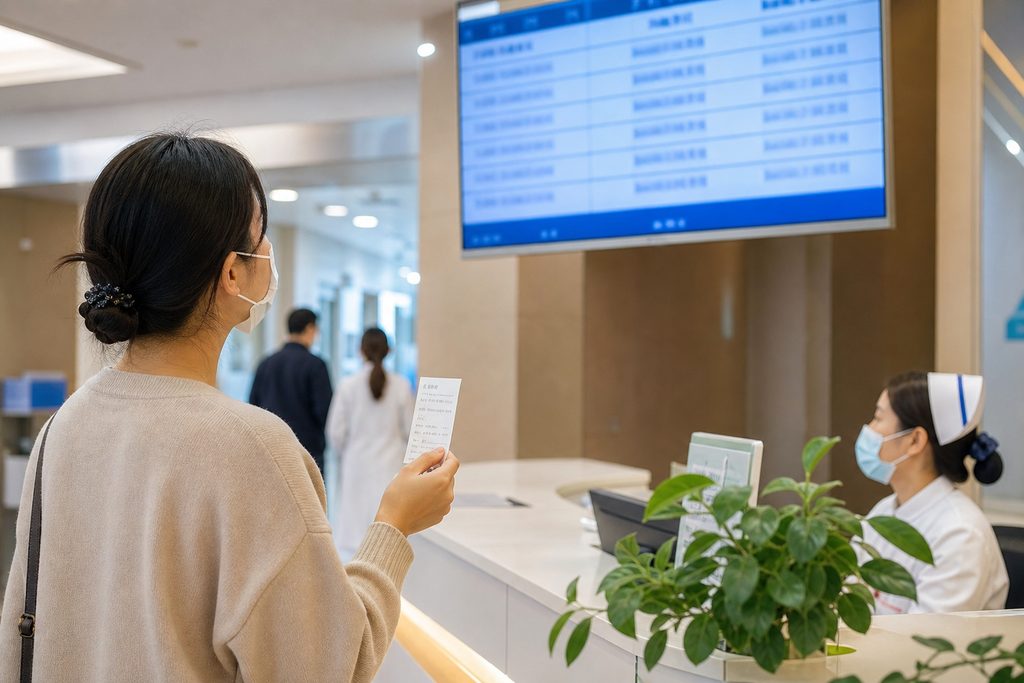
You are standing in a cavernous Chinese hospital lobby, clutching a slip of paper covered in letters and numbers that look like a cipher. The crowds surge around you. Your appointment time is in ten minutes. And you have no idea where to go. That sinking feeling is what brings most foreign patients to search for “China hospital appointment codes meaning.” The good news is that these codes are not random. They follow a rigid internal logic. Once you understand the structure, the ticket transforms from a source of anxiety into a simple map.
Key Takeaways
- A standard Chinese hospital appointment ticket contains roughly 8–12 distinct data fields, each encoding a specific piece of logistical information: department, doctor, time, queue position, and payment status.
- The most critical codes for navigation are the department code (tells you which floor and wing) and the queue number (tells you exactly when you will be seen relative to other patients).
- Misreading even one code—like confusing the consultation room number with the queue number—can cause you to miss your appointment entirely in a system that processes over 10,000 outpatients daily at a single major hospital.
- You do not need to memorize all codes. Focus on understanding the four or five that control your physical movement through the hospital, and leave the billing codes for the cashier.
The Problem: A Ticket Is Not Just a Ticket
A study published in the Journal of Hospital Administration found that non-native patients in China spend an average of 37 extra minutes navigating hospital logistics compared to local patients, often due to misinterpreting printed appointment data. That is time you cannot afford to lose. In a system where a top-tier hospital like West China Hospital sees over 20,000 outpatient visits per day, a single wrong turn can cascade into hours of delay.
The appointment ticket you receive—whether printed at a self-service kiosk or issued at a registration window—is not designed for international patients. It assumes you know that a string like “A5-12-008” is not a single code but three separate pieces of information layered together. It assumes you know which number to watch on the overhead screen. When you do not, the result is stress, missed consultations, and sometimes a wasted trip.
Why Understanding Your China Hospital Appointment Codes Matters Right Now
Chinese public hospitals operate on a real-time queuing system that is fundamentally different from the scheduled appointment model common in the US or Europe. Your ticket does not give you a fixed time like “10:30 AM.” It gives you a position in a dynamic queue. The doctor may call patient 008, then 009, then 010, with actual clock times shifting based on how long each consultation takes.
If you misread your queue number, you might think you have time for a coffee. But the system can jump forward if several patients ahead of you are no-shows. We have seen patients miss their slot by five minutes because they were watching the wrong number on the display. The codes on your ticket are the only reliable source of truth.
Breaking Down the Ticket: A Field-by-Field Guide
A typical Chinese hospital appointment ticket contains a dense block of text. Let us walk through each element you will encounter, from top to bottom, and explain what it controls. We will use a representative ticket from a major public hospital as our reference point.
1. Hospital Name and Logo (Top Header)
This appears in Chinese characters at the very top. It confirms you are at the right institution. Major hospitals often have multiple campuses across a city. The full name on your ticket includes the campus designation. For example, “Peking Union Medical College Hospital (Dongdan Campus)” versus “Peking Union Medical College Hospital (Xidan Campus).” Going to the wrong campus is a common and costly mistake.
2. Patient Name and Patient ID Number
Your name will appear exactly as it was entered at registration—often in all-caps pinyin if you registered with a passport. Below or beside your name is a numeric patient ID. This is your unique identifier in that hospital’s system. Memorize or photograph this number. You will need it for every interaction: paying fees, collecting test results, printing reports from self-service kiosks. The patient ID is typically 8–12 digits and is far more important than your name for the hospital’s internal processes.
3. Department Code and Name
This is where the “China hospital appointment codes meaning” search becomes immediately practical. The department will be listed in Chinese characters (e.g., 心血管内科 for Cardiology). Below or beside it, you will often find a short alphanumeric code like “A5” or “B2-3.”
This code maps to a physical location. “A” typically designates a building or wing. “5” designates the floor. So “A5” means Building A, 5th Floor. Some hospitals use a three-part system: “B2-3” could mean Building B, Zone 2, Section 3. This location code is the single most important piece of data for getting your body to the right place. Ignore it, and you could spend 20 minutes on the wrong floor surrounded by the wrong specialty.
4. Doctor’s Name and Title
The attending physician’s name appears in Chinese characters. Their professional title—Chief Physician, Associate Chief Physician, Attending Physician—is often abbreviated. Chief Physician (主任医师) is the highest clinical rank in the Chinese system and typically indicates a senior specialist with decades of experience. If you booked through an international department, the doctor’s name may also appear in pinyin.
5. Consultation Room Number
This is a simple numeric code, usually 3–4 digits, like “312” or “1205.” It tells you which specific door to enter once you reach the correct department area. Do not confuse this with your queue number. The room number is static. It does not change. Find it on the wall signage in the waiting area.
6. Queue Number (The Most Dynamic Field)
This is the number you will stare at on the overhead screen. It is typically a short number like “012” or “008.” Sometimes it is prefixed with a letter indicating the doctor’s queue for that session: “A012.”
Here is how the flow works. When you arrive at the department, you must “check in” by scanning your ticket’s barcode at a self-service kiosk. This action tells the system you are physically present and activates your queue number. Only then will your number appear on the screen. If you skip check-in, the system assumes you are absent and will never call your number, regardless of what your ticket says. We have watched this happen to too many international patients who simply sat and waited.
7. Appointment Date and Time Slot
The date is usually in YYYY-MM-DD format, which is unambiguous. The time slot is often a window like “08:00–09:00” or “14:00–15:00.” This is not your actual consultation time. It is the block during which you must check in and your queue number becomes active. Arrive during this window. If you check in at 09:05 for an 08:00–09:00 slot, the system may reject your check-in entirely, and you will need to re-register.
8. Fee Status and Payment Codes
Near the bottom of the ticket, you will see a field indicating whether the registration fee has been paid. This might say “Paid” or show a numeric code that the cashier uses. If your ticket says “Unpaid,” you must visit a payment window before the check-in kiosk will accept your barcode. Some hospitals allow payment via WeChat or Alipay directly at the kiosk, but this often requires a Chinese bank card or e-wallet. International credit cards are not widely accepted at public hospital kiosks.
9. Barcode and QR Code
The barcode or QR code at the bottom is the machine-readable version of your patient ID and appointment data. You will scan this at check-in kiosks, payment windows, and report-printing machines. It is your universal key. Protect it.
Common Code Combinations and What They Signal
Once you have seen a few tickets, patterns emerge. Recognizing these patterns lets you decode a ticket in seconds rather than minutes.
| Code Pattern | What It Means | Action Required |
|---|---|---|
| A5-12-008 | Building A, Floor 5, Room 12, Queue #8 | Go to A5, find Room 12, check in, watch for #8 |
| B2-3 Cardiology 015 | Building B, Zone 2, Section 3, Cardiology Dept, Queue #15 | Navigate to B2-3, confirm Cardiology, check in |
| ID: 0001234567 Status: Unpaid | Patient ID not yet activated for today | Pay registration fee first, then check in |
| Time: 09:00-10:00 Room: 305 Dr. Wang | Morning slot, specific room and doctor | Arrive by 09:00, check in, proceed to Room 305 area |
These patterns are not standardized across all 340+ top-ranked hospitals in our database. Each hospital has its own ticket format. But the underlying logic—separating location, queue position, and payment status—is universal. Once you learn to look for those three categories, you can read any ticket.
When the Codes Fail: What to Do If Something Goes Wrong
Even with perfect decoding, the system can throw curveballs. The doctor you booked may have been called to an emergency surgery. Your queue number may skip if several patients ahead of you are no-shows and the system accelerates. The check-in kiosk may reject your barcode because the registration fee was not properly processed.
In these moments, the codes on your ticket are your evidence. Walk to the clinic’s nursing station—usually a desk near the waiting area—and show your ticket. The nurses can override the system, manually check you in, or reassign you to another doctor in the same department. They cannot help you if you cannot show them the ticket. This is why the photo backup is essential.
For patients who booked through an international medical coordination service, a bilingual companion handles all of this in real time. They read the codes, check you in, and negotiate with the nursing station if there is a problem. You sit and wait. That is the difference between navigating the system alone and having a local expert beside you.
Practical Considerations: What You Need Before You Arrive
Your ability to decode the ticket depends on having the right documentation in place before you ever set foot in the hospital.
Passport and Visa. Your hospital registration is tied to the passport you used to create your patient ID. Bring the exact same passport. For medical travel to China, the appropriate visa category is an S2 visa, endorsed for private affairs including medical treatment. Family members accompanying you also apply for an S2. The visa process requires an invitation letter from the hospital, which your coordinating service can help secure. Do not apply for an M visa—that is strictly for commercial and trade activities and is not valid for medical treatment.
Payment Methods. Public hospital kiosks and cashier windows primarily accept WeChat Pay, Alipay, Chinese UnionPay cards, and cash (RMB). International Visa and Mastercard are rarely accepted at public hospital counters. Bring sufficient cash in RMB or confirm in advance that your hospital’s international department can process foreign cards. Private international hospitals like United Family are the exception—they routinely accept international credit cards and direct insurance billing.
Medical Records. Bring all relevant prior imaging, pathology reports, and a summary of your medical history translated into Chinese or English. The doctor will want to review these during your consultation. Having them organized and ready avoids wasting your limited appointment slot on information gathering.
Frequently Asked Questions
The letter usually identifies which doctor’s queue you are in for that session. In a large department, multiple doctors see patients simultaneously. The overhead screen will display something like “A012 → Room 305” and “B005 → Room 307.” The letter matches you to the correct doctor and room. If your ticket says “C018,” watch the screen for any line beginning with “C.”
Almost never. Hospital campuses operate as semi-independent units with separate registration systems. A ticket issued for Peking Union Medical College Hospital’s Dongdan campus will not be honored at the Xidan campus. The campus name is printed on the ticket in Chinese. Verify it before you travel. If you are unsure, our team can confirm the correct campus as part of standard appointment coordination.
In most cases, the nursing station will accept a clear photo showing your patient ID and queue number. They can manually verify your identity against the system. If the barcode in the photo is sharp enough, you may even be able to scan it from your phone screen at the check-in kiosk. The photo is not a guaranteed substitute for the paper ticket, but it works in practice the vast majority of the time.
This happens when the senior specialist you requested is part of a team. In many Chinese teaching hospitals, a Chief Physician supervises a group of junior doctors. Your ticket may list the team lead, but a junior doctor conducts the initial consultation. The senior doctor reviews the case and may join for complex decisions. This is standard practice and is not a downgrade in care quality—it is how the training system works. If you require a guaranteed one-on-one consultation with a specific senior specialist, that typically requires booking through the hospital’s international VIP department, which carries a higher fee.
Your Next Step
Decoding a Chinese hospital appointment ticket is a learnable skill. This guide gives you the framework. But reading the codes is only half the equation—getting to the right floor, checking in on time, and communicating with the nursing station when something changes is where many international patients still struggle. Our team at China Medical Services handles this daily. We are not a hospital and we do not provide medical advice, but we connect international patients with China’s top-ranked institutions and provide the bilingual ground support that turns a confusing ticket into a smooth consultation. If you are considering treatment in China, start with a conversation—no commitment, just clarity.
Learn more about how we support your hospital visit.
For more medical information and treatment options in China, visit chinamedservices.com (China Medical Services).
