Hospital Stay in China: How Your Family Can Rest While You Recover
Key Takeaways
- Private VIP wards in China’s top hospitals typically cost $200–$500 per night, often with dedicated family sleeping areas and in-room attendants.
- Family-centered recovery in China isn’t just allowed—it’s culturally expected, with hospital systems built around the presence of a caregiver.
- Language barriers can turn a restful recovery into a stressful ordeal; a bilingual companion bridges the gap without exhausting your family.
- You cannot book a public general ward from overseas. A confirmed family-friendly room requires coordination through a hospital’s official international VIP channel.
The Problem: Your Family Is Exhausted Before You Even Heal
You’ve made the decision. Traveling to China for a major procedure—a cardiac ablation, a complex orthopedic surgery, or a targeted oncology intervention—makes financial and clinical sense. The numbers are stark. A coronary artery bypass graft that runs $120,000 in the United States costs $15,000 to $20,000 at a top-tier Chinese cardiovascular center like Fuwai Hospital. The surgeon you’ve selected performs over 400 of these procedures annually, compared to a US average closer to 80. The clinical argument is solid. But there’s a quieter variable that nobody talks about until they’re living it: what happens to the person who came with you?
A 2023 survey of medical travelers published in the Journal of Medical Tourism Research found that 68% of accompanying family members reported significant emotional exhaustion, and 41% experienced physical strain from disrupted sleep and poor nutrition during the hospital stay. They sleep in waiting room chairs. They eat vending machine crackers for three days straight. They navigate a foreign city, a foreign language, and the visceral fear of watching someone they love in pain—all while running on fumes. That’s not sustainable. And it’s not necessary. The Chinese healthcare system, particularly at the international and VIP level, has built infrastructure specifically to solve this. You just need to know it exists and how to access it.
Why China’s Hospital System Is Built for Family Presence
Western hospitals often treat the patient as an isolated unit. Family visits during rigid hours. The caregiver goes home. In China, the baseline assumption is different. A hospitalized person is never alone. A family member—a spouse, an adult child, a sibling—is expected to be present, to advocate, to bring meals, to sit through the night. This isn’t a sentimental preference. It’s structural. And because it’s structural, the system has evolved to accommodate it in ways that can genuinely reduce the burden on your family, if you know which options to choose.
Volume Creates Infrastructure
China’s top hospitals operate at a scale that’s hard to visualize until you’re inside one. Peking Union Medical College Hospital handles over 2.2 million outpatient visits annually. West China Hospital in Chengdu sees more than 5 million. When you’re processing that many patients, the presence of family members isn’t an exception to manage—it’s a constant to design for. Hospital campuses include dedicated family waiting zones with reclining chairs, on-site cafeterias serving hot meals for roughly $3–$5, and clear signage (in Chinese, admittedly) directing caregivers to the resources they need. The sheer volume means that the question “can my family stay with me in hospital China” has an answer baked into the architecture: yes, and here’s how.
The VIP Ward Difference
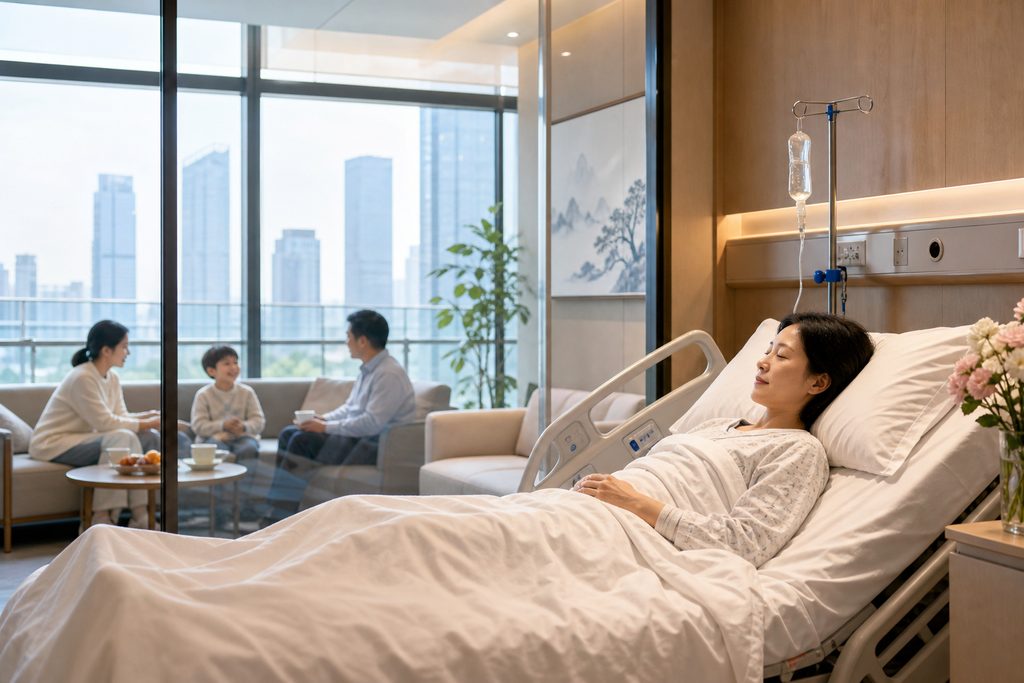
This is the single most important concept to understand. A standard public ward room in a Chinese tertiary hospital might have three to six beds, shared bathroom facilities, and a single hard-backed chair per patient for visitors. It’s functional. It’s not restful. But every major hospital on the Fudan-ranked Top 100 list also operates an international or VIP wing. These wards are a different world. Private rooms. En-suite bathrooms. A dedicated sofa bed or a separate cot for a family member. Often, a small refrigerator and a kettle. The nursing ratio is lower. Some hospitals, like Shanghai’s Huashan Hospital International Medical Center, offer suites with separate living areas where a family member can genuinely sleep, work remotely, and maintain some semblance of normal life while staying steps from the patient’s bed.
These rooms are not a luxury indulgence. They’re a recovery multiplier. When your spouse sleeps properly, they make better decisions about your care. They communicate more clearly with the medical team. They don’t collapse from exhaustion the day you’re discharged and suddenly need help getting to the hotel. The price for private hospital rooms for family Beijing or Shanghai ranges from about $200 to $500 per night, depending on the hospital and the suite size. That’s not cheap. But compared to booking a separate hotel room, commuting across an unfamiliar city twice a day, and losing the ability to be present when the doctor rounds at 7 a.m., it’s a calculation worth making consciously.
What Family Accommodation Actually Looks Like Inside a Chinese Hospital
Let’s get concrete. You’re searching for how to book hospital with family room Shanghai or Beijing, and you need to know what you’re actually buying. The term “family accommodation” in a Chinese hospital context breaks down into a few distinct tiers, and the terminology matters because it determines what you can expect.
Tier One: The International Ward Private Room
This is the standard recommendation for any foreign patient traveling with family. The room is a single occupancy with a patient bed, a dedicated caregiver bed (usually a fold-out sofa or a permanent twin-sized bed), a private bathroom with a shower, a television, and Wi-Fi. The caregiver bed is not an afterthought. It has real bedding. The room is cleaned daily. Meals can be ordered to the room. The patient’s nurse call button is within reach of both beds. You’re not camping out. You’re cohabitating in a functional, if clinical, space. At Shanghai’s Zhongshan Hospital, the international ward rooms average about 30 square meters (roughly 320 square feet), which is compact but workable for two adults for a week or two.
Tier Two: The VIP Suite
Some hospitals offer a true suite configuration. A small living room with a sofa, a desk, and a television separates from the patient’s sleeping area. The bathroom is larger. There might be a microwave. This setup is ideal for longer stays—think a two-week post-operative recovery for a spinal fusion or a staged cancer treatment protocol. The cost pushes toward the upper end of the range, around $400 to $500 per night, but the separation means the family member can take a video call for work or eat a meal without hovering over the hospital bed. For patients coming through specialized departments like orthopedics or neurosurgery, where recovery timelines are longer, the suite option can significantly reduce caregiver burnout.
Tier Three: On-Campus Family Accommodation
Not every situation requires the family member to sleep in the hospital room. Some patients, particularly those in for diagnostic workups or short-stay procedures, prefer privacy at night. Several major hospital campuses have affiliated guesthouses or partner hotels within walking distance. The Beijing Hospital of Traditional Chinese Medicine, for example, has a guesthouse on its campus where rooms run roughly $60 to $100 per night—basic but clean, and a three-minute walk from the ward. These aren’t luxury hotels. They’re functional crash pads for family members who need a proper bed and a hot shower but want to be back at the bedside within minutes of waking up. They’re rarely bookable online from overseas. You need someone on the ground to reserve them.
| Accommodation Type | Typical Cost (USD/Night) | Family Sleeping Arrangement | Best For |
|---|---|---|---|
| Public Ward (3-6 beds) | $30–$80 | Chair only; no dedicated bed | Budget-conscious; solo travelers |
| International Ward Private Room | $200–$350 | Fold-out sofa or twin bed in room | Most foreign patients with one companion |
| VIP Suite | $400–$500 | Separate living area with dedicated bed | Long stays; two caregivers; work-from-hospital needs |
| On-Campus Guesthouse | $60–$100 | Private hotel-style room nearby | Short stays; patients who prefer nighttime privacy |
What Is Recovery Like for Family After Surgery Abroad
We talk a lot about patient recovery. The incision healing. The physical therapy milestones. The medication taper. But what is recovery like for family after surgery abroad? It’s a question that gets skipped in the planning phase and hits hard about 72 hours into the hospital stay.
The first 48 hours are adrenaline-fueled. Your family member is focused on your vital signs, your pain levels, whether the surgeon looks pleased during rounds. They’re translating, or trying to, or frantically gesturing at nurses. They’re not eating properly. They’re not sleeping deeply. Then the adrenaline fades, and the reality of what they’ve just watched settles in. They’ve seen you intubated, or bleeding, or confused from anesthesia. They’ve made decisions about your care while jet-lagged and operating in a second language. That’s a trauma response, even when everything goes perfectly.
The recovery for them isn’t just about getting enough sleep, though that’s foundational. It’s about having moments of normalcy. A walk outside the hospital to get fresh air. A meal that isn’t eaten off a tray table. A conversation with someone back home that isn’t a crisis update. The family accommodation setup you choose directly enables or blocks these small but critical recovery moments. A private room with a separate caregiver bed means your spouse can close their eyes for four uninterrupted hours while you sleep. An on-campus guesthouse means they can take a shower and call their own parent without you overhearing every word. These aren’t luxuries. They’re the difference between a family member who holds it together and one who falls apart the week after you get home.
And then there’s the practical side. When you’re discharged, you’re not “recovered.” You’re stable enough to leave the hospital. You might need help bathing, dressing, managing medications, getting to follow-up appointments. If your family member has been sleeping in a chair for ten days, they’re in no condition to become your de facto home health aide. Planning for their rest during the hospital stay is planning for your own safety after discharge.
Medical Tourism Packages and the Family Support Factor
The term medical tourism packages China family support gets searched because people intuitively understand that this isn’t just a flight and a surgery. It’s a logistical ecosystem. A well-designed package doesn’t just coordinate your procedure. It coordinates your family’s ability to be present without being destroyed by the process.
What should a package that genuinely addresses family support include? Airport pickup that handles luggage and gets you directly to the hospital without a negotiation with a taxi driver who doesn’t speak English. A pre-arranged private room with the caregiver bed already set up. A bilingual coordinator who meets your family member at the hospital entrance, walks them through the registration process, and explains where the cafeteria is, where the pharmacy is, how to add money to the meal card. This person becomes the point of contact for the family member during the stay—the person they text when they need to understand what the nurse just said, or when they need to step out for an hour and want someone to sit with the patient. This isn’t hand-holding. It’s infrastructure.
Some packages also include scheduled relief. A companion who stays with the patient for a four-hour block so the family member can go back to the hotel, sleep in a real bed, and return refreshed. The cost for a bilingual medical companion starts from $200 per day, and for families facing a two-week inpatient stay, budgeting for even two or three days of this relief can transform the experience. It’s the difference between a spouse who remembers the trip as traumatic and one who remembers it as hard but manageable.
There’s also the question of children. Some patients travel with young kids because there’s no childcare option back home. A few international hospitals in Shanghai and Beijing, particularly the private facilities like United Family Healthcare, have play areas and can recommend vetted local babysitters. This isn’t standard. It requires advance planning and explicit confirmation. But it exists, and for a family weighing whether the traveling parent can actually rest, knowing there’s a safe, supervised space for a restless five-year-old during the long afternoon hours in a hospital room can be the deciding factor.
Practical Considerations: Making It Work on the Ground
You know the options. Now the logistics. How do you actually secure a family-friendly room, get your loved one into the country, and manage the daily realities without burning out?
Visa Reality for Family Members
Your family member needs an S2 visa, the short-stay category used for private affairs including accompanying a patient for medical treatment. The application requires an invitation letter from the hospital or the coordinating service, proof of relationship to the patient, and the patient’s own medical documentation. Processing times vary by embassy, but budget three to four weeks. Do not book flights until the visa is in hand. And do not, under any circumstances, attempt to enter on a tourist visa and then explain the medical situation at the border. That’s a fast track to being denied entry.
Payment: Upfront and in Yuan
Chinese public hospitals, including their international wings, operate on a prepaid deposit system. You pay a lump sum at admission—typically $5,000 to $10,000 for a surgical stay—and the hospital draws down from that balance daily. When the balance runs low, you top it up. The family accommodation cost is part of this deposit. Credit cards are accepted at international departments, but foreign transaction fees apply. Wire transfers in advance are often smoother. Private international hospitals like those listed on our private hospitals page may bill insurance directly, but public hospital international wings generally do not. You pay, then you seek reimbursement from your insurer.
The Language Chasm
Even in an international ward, the nurses may speak functional English. The surgeon almost certainly does. But the cafeteria worker, the CT scan technician, the pharmacist dispensing discharge medications—they probably don’t. Your family member will hit a language wall multiple times a day. Translation apps help for simple transactions. For anything medical—understanding discharge instructions, clarifying a medication schedule, asking about a symptom that’s worrying them—a bilingual companion is not a luxury. It’s a safety measure. The cost of a misunderstanding about a post-operative medication is infinitely higher than the cost of a translator.
Food, Water, and the Small Things That Break People
Tap water in China is not potable. Your family member needs bottled water, and lots of it. Hospital cafeterias serve hot meals, but the menu is in Chinese and the concept of dietary restrictions familiar to Western patients—low sodium, gluten-free, diabetic-friendly—may not translate cleanly. Some international wards have separate patient and family meal services with English menus. Confirm this before you arrive. If it’s not available, your family member will need to source food from outside the hospital. Food delivery apps like Meituan are ubiquitous in Chinese cities, but the interface is Chinese-only. Again, a local contact solves this in five minutes. Without one, your family member spends an hour hungry and frustrated, trying to screenshot and translate a menu.
Frequently Asked Questions
Yes, in a private international or VIP ward room, overnight family stays are standard and expected. The room will have a dedicated sleeping surface for the caregiver. In a public multi-bed ward, overnight stays are generally not permitted, and the only option is a chair for daytime visiting. This is the core reason we recommend international wards for foreign patients traveling with family—the overnight presence is built into the room design and the ward policies.
For a private room with a family sleeping area in a top-tier Beijing or Shanghai hospital international ward, budget $200 to $350 per night. VIP suites run $400 to $500. On-campus guesthouses, where available, cost $60 to $100 per night but mean the family member is not in the room overnight. These prices are for the room and the care infrastructure only. They do not include the patient’s medical treatment costs, which are billed separately. The family accommodation cost is part of the hospital’s prepaid deposit system and is settled at discharge.
What if something goes wrong and I need my family member to make a medical decision?
This is a legitimate concern, and it’s why we emphasize the importance of a bilingual coordinator. If you’re incapacitated and your family member doesn’t speak Chinese, they’re in an impossible position. Before any procedure, designate a healthcare proxy and ensure the hospital has a translated, notarized copy. The international department
For more medical information and treatment options in China, visit chinamedservices.com (China Medical Services).
