Preventing Spouse Burnout During an Extended Medical Stay in China: A Practical Guide
Preventing Spouse Burnout: The Short Answer
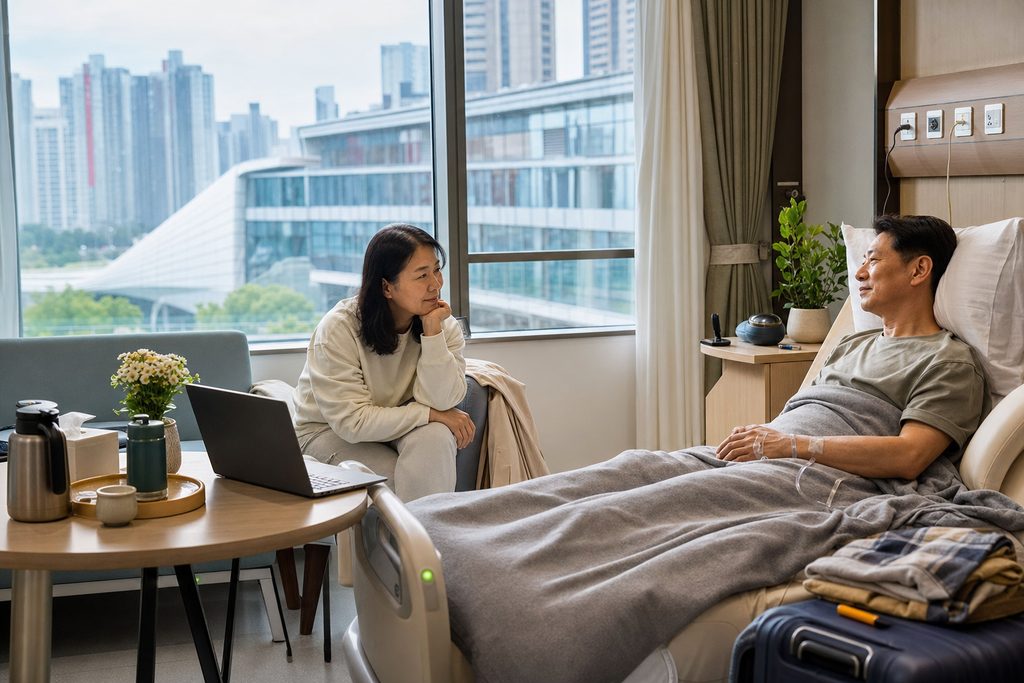
The spouse who travels as caregiver faces a grueling dual role: emotional anchor and logistics manager in an unfamiliar country. Burnout during a multi-week medical stay is not a possibility. It is a probability. The most effective prevention combines the right accommodation—a medical hotel for spouse China extended stay or serviced apartment—with structured, daily non-negotiable breaks and a clear division of labor that leverages local bilingual support for the hospital-side tasks. You cannot pour from an empty cup, and in a foreign medical system, the cup drains faster than anyone expects.
The caveat is that “rest” looks different here. It is not about finding a spa. It is about removing the grinding, low-level friction that erodes a caregiver’s resilience: the language barrier at the pharmacy, the three-hour queue to pay a bill, the hunt for edible food after a bad night. Solve the friction, and you solve the burnout before it starts.
Who This Is Right For — and Who It Isn’t
Planning a caregiving structure around a long term apartment rental near Beijing hospitals for families or Shanghai’s medical district makes sense for spouses who are physically healthy, emotionally steady under pressure, and willing to delegate tasks they would normally handle themselves. It works when the treatment plan is measured in weeks, not days, and when the patient’s condition allows the caregiver to leave the bedside for blocks of two to three hours.
It is the wrong model for spouses who insist on being present for every doctor interaction despite not speaking Mandarin, or who view accepting help as a personal failure. It is also a poor fit if the caregiver has their own unmanaged health condition, or if the patient requires constant one-to-one physical assistance that a single person cannot safely sustain alone. In those situations, bringing a second family member or hiring a rotating local caregiver is not a luxury—it is a baseline safety requirement.
The Options, Compared
Where you sleep and how you recharge are not separate questions. They are the same question. Here are the real choices for a spouse supporting a patient through an extended stay, measured against what actually matters for preventing burnout.
| Accommodation Type | Proximity to Hospital | Per-Night Cost (USD) | Kitchen Access | Privacy & Rest Quality | Best For |
|---|---|---|---|---|---|
| Standard Hotel Room | Variable; often 15–30 min by taxi | $60–120 | None | Moderate; daily housekeeping interruptions | Stays under 10 days |
| Medical Hotel / Extended-Stay Suite | Often walking distance to major hospitals | $80–150 | Kitchenette in suite | High; separate living area, minimal disturbance | Stays of 2–6 weeks; caregiver needs real downtime |
| Serviced Apartment (1-Bedroom) | 5–20 min by taxi or metro | $70–130 | Full kitchen, washer/dryer | Highest; residential building, no lobby traffic | Stays over 4 weeks; caregiver cooking for patient |
| Hospital-Adjacent Guest Room (where available) | On campus or across the street | $40–90 | None or shared | Low; clinical atmosphere, limited escape | Critical-care phases where 5-minute response matters |
For most spouses facing a treatment timeline of three weeks or more, the extended stay suites for medical patients family China or a serviced apartment wins on the metric that matters most: the ability to cook familiar food, sleep without interruption, and mentally step away from the hospital without being geographically stranded. The medical hotel option adds a layer of practical support—some have bilingual front desks, hospital shuttle schedules, and staff who understand why you are there. That context removes the exhaustion of explaining yourself repeatedly.
What “Supporting Your Spouse” Actually Requires on the Ground in Shanghai
Yes, but not through standard residential channels. Most Beijing landlords want 12-month leases. The workaround is serviced apartments and extended-stay hotels in areas like Dongcheng (near Peking Union Medical College Hospital) or Chaoyang (near United Family and the embassy district). These properties are built for exactly this use case—long term apartment rental near Beijing hospitals for families—and offer monthly rates with utilities and WiFi included. Expect to pay $2,500–4,000 for a one-month stay in a clean, well-located one-bedroom. Book through a platform that specializes in medical stays or through a local coordinator who knows the hospital-adjacent inventory.
This is a contingency that must be planned for. International hospitals like Raffles Medical in Shanghai or Beijing United Family can see a foreign patient on short notice, with English-speaking doctors. Have that hospital’s address saved on your phone. If the caregiver is incapacitated, the backup plan is the bilingual companion service—most can scale from half-day support to full-day or even overnight hospital sitting. This is not a theoretical risk. Caregivers in a foreign country get sick at higher rates due to stress, poor sleep, and unfamiliar food. Have the backup number programmed before you need it.
Watch for three specific markers: the caregiver stops eating regular meals, stops leaving the hospital building entirely (not even for ten minutes), or begins experiencing physical symptoms—headaches, chest tightness, uncontrollable tearfulness. Any one of these is a signal to immediately increase support. By the time the caregiver admits they are struggling, they have usually been struggling for days. The patient’s medical team is not monitoring the spouse. No one will intervene unless you ask. Ask early.
Your Next Step
Preventing spouse burnout is not about willpower. It is about architecture—the right room, the right help, the right boundaries between hospital and rest. The spouses who fare best are the ones who arrive with a plan that treats their own wellbeing as a non-negotiable part of the treatment protocol, not an afterthought.
Our team at China Medical Services works with families to build that architecture before they travel. We are not a hospital and do not provide medical advice or diagnoses. What we do is map the logistics—accommodation near your chosen hospital, bilingual companion schedules, visa documentation support—so that the spouse can focus on being a spouse. If you are planning a medical stay measured in weeks rather than days, reach out for a free consultation. We will help you think through the support structure that makes a long treatment stay sustainable for both of you.
Frequently Asked Questions
Yes. The hospitals used for international patients are JCI-accredited and follow the same international safety standards as top hospitals in the US and Europe. Surgical teams perform high volumes of procedures — often more than their Western counterparts — which studies show leads to better outcomes.
Costs vary by procedure and hospital, but international patients typically save 40-80% compared to US prices — even when factoring in travel and accommodation. A consultation with our team will give you an exact, all-inclusive quote with no hidden fees.
Send us your existing medical reports to get started. We handle everything from hospital selection and appointment scheduling to visa assistance and post-operative recovery planning. Your medical records are reviewed by the specialist before you even book a flight.
For more medical information and treatment options in China, visit chinamedservices.com (China Medical Services).
