Bringing Chinese Meds Home: Customs Rules That Actually Work
Key Takeaways
- Over 90% of customs seizures involving Chinese medicine stem from incomplete documentation, not banned substances. A physician’s letter and original packaging solve most problems before they start.
- Customs officers in the US, UK, EU, and Australia share one common trigger: undeclared pills in unlabeled bags. Declare everything. The form takes 30 seconds. The alternative can take months of legal correspondence.
- Traditional Chinese Medicine containing CITES-listed species—musk, bear bile, certain orchids, seahorses—can result in confiscation, fines, and in some jurisdictions criminal charges. Know your formula’s ingredients before you fly.
- Most countries allow a 30- to 90-day personal supply of prescription medication. The key word is “personal.” Quantities that look commercial invite scrutiny regardless of legality.
The Problem: A Suitcase Full of Medicine and No Clear Rules
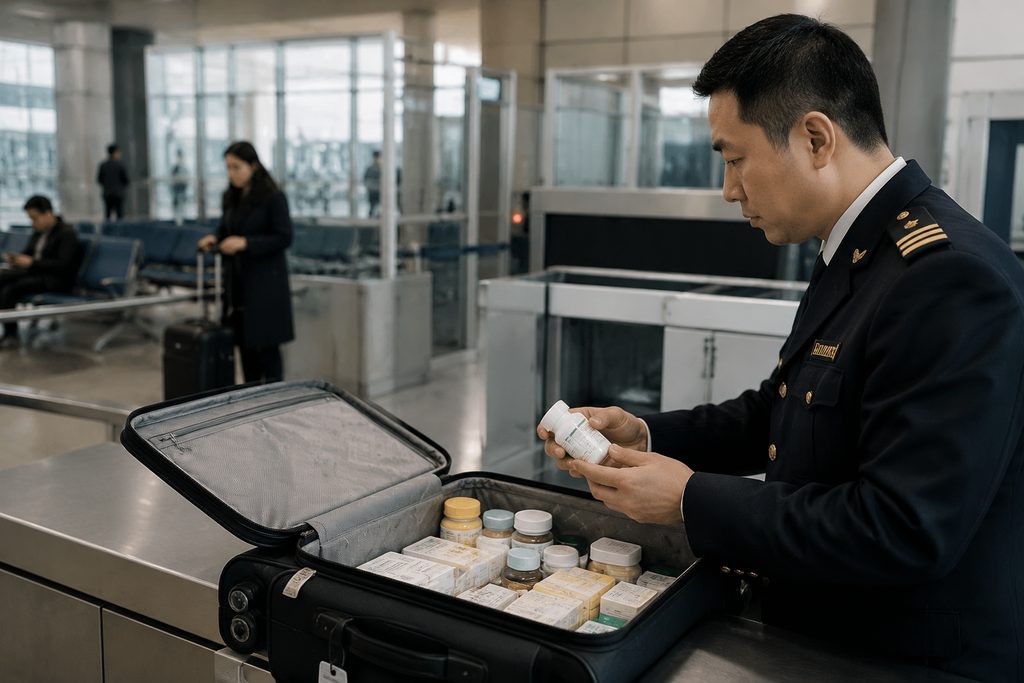
You have just completed treatment at a top-ranked Chinese hospital. Your doctor has prescribed a three-month course of medication—perhaps a combination of Western pharmaceuticals and Traditional Chinese Medicine herbal formulas. You pack everything carefully. At the arrival airport, a customs officer pulls your bag aside. The questions start. You do not have the right paperwork. The medicine gets detained. This happens more often than anyone admits.
Customs agencies globally are tightening pharmaceutical import rules. The US Food and Drug Administration reported a 47% increase in detained personal medication shipments between 2019 and 2023. Australia’s Therapeutic Goods Administration flags undeclared Chinese herbal products as one of its top five passenger compliance issues. The United Kingdom’s Medicines and Healthcare products Regulatory Agency issues specific guidance on importing traditional herbal remedies—and prosecutes violations.
None of this means you cannot bring your medication home. It means preparation matters more than luck. The rules exist. They are navigable. Most travelers simply do not know what they are until it is too late.
Why Customs Rules on Chinese Medicine Catch Travelers Off Guard
A substance classified as a dietary supplement in China may be classified as an unlicensed medicine in the European Union. Reishi mushroom powder sits on a health food shelf in Shanghai. The same powder, undeclared at Heathrow, violates the UK Human Medicines Regulations 2012 if presented as treating any condition. The difference is not the substance. It is the claim. Customs officers are trained to look for therapeutic language on packaging. If your herbal formula’s label says “for cardiovascular health,” you have just imported an unlicensed drug in the eyes of UK and EU law.
This is not theoretical. In 2022, German customs authorities issued a public advisory specifically naming Chinese herbal products as a growing compliance risk, citing classification confusion as the primary driver of detentions. The products themselves were not dangerous. The paperwork was wrong.
CITES and Endangered Species Restrictions
Some Traditional Chinese Medicine formulas contain ingredients derived from species protected under the Convention on International Trade in Endangered Species of Wild Fauna and Flora. Musk from musk deer, bear bile, seahorses, certain ginseng varieties, and orchids like Dendrobium all require CITES permits for international transport. Without those permits, possession at the border is a violation—regardless of whether the product was legally purchased in China. Penalties range from confiscation to criminal charges depending on the jurisdiction and the species involved.
The World Customs Organization’s 2023 Illicit Trade Report identified medicinal products containing endangered species as a persistent enforcement priority across 182 member countries. A single undeclared seahorse in a herbal soup mix can trigger a full baggage search and potential legal exposure. Most patients have no idea these ingredients are in their formulas. Ask your prescribing doctor explicitly. Get the ingredient list in English. Check it against the CITES appendices before you fly.
Quantity Thresholds and the “Commercial Supply” Problem
Most countries permit a 30- to 90-day personal supply of prescription medication for personal use. The exact threshold varies. The US Customs and Border Protection guideline is 90 days. Australia’s is three months. Canada’s is a single course of treatment or 90 days, whichever is shorter. The European Union defers to member states, but 90 days is the most common benchmark.
But “personal supply” is a judgment call. A customs officer looking at 300 unlabeled pills in six plastic bags sees something different from 300 pills in three original pharmacy bottles with prescription labels. The quantity is identical. The perception is not. Packaging signals legitimacy. Original containers with pharmacy labels, accompanied by a physician’s letter, transform a suspicious bulk quantity into a documented medical supply. This single step prevents more customs problems than any other action you can take.
What You Actually Need to Clear Customs with Chinese Medication
The documentation package that works across most jurisdictions is straightforward. Bring these four items. Do not check them in luggage. Keep them in your carry-on so you can present them immediately if asked.
First, a physician’s letter on hospital letterhead. It must state your diagnosis, the names of all prescribed medications—in English, using both generic and brand names where applicable—the dosage, the duration of treatment, and a clear statement that these medications are for your personal use only. For Traditional Chinese Medicine formulas, request that the prescribing doctor list each ingredient in English. This is not standard practice in Chinese hospitals. You will need to ask for it specifically. Our team routinely assists patients with obtaining properly formatted documentation before departure—it is one of the most requested services we provide during the discharge coordination phase.
Second, original pharmacy packaging for every medication. Do not consolidate pills into a single bottle. Do not remove labels. Do not transfer powders into unmarked containers. Customs officers are trained to treat unlabeled substances as highest-risk. Original packaging with pharmacy labels, lot numbers, and expiration dates signals a legitimate medical supply chain.
Third, copies of your prescriptions—both the Chinese original and a certified English translation. The translation does not need to be notarized in most cases, but it must be accurate. Google Translate printouts do not inspire confidence at the border. A hospital-stamped translation or one prepared by a professional medical translation service carries far more weight.
Fourth, a completed customs declaration form for your destination country. Declare the medication. Do not try to slip through the nothing-to-declare lane hoping no one asks. If you are selected for inspection and have not declared prescription medication, the undeclared status alone can justify detention—even if the medication itself is perfectly legal. Declaring it upfront establishes good faith. Most declarations result in a quick visual check and a wave through. The ones that cause problems are the ones that look hidden.
Country-Specific Rules: The Differences That Actually Matter
The broad principles above apply everywhere. The specifics vary by country in ways that can trip up even well-prepared travelers. Here is what changes at the border depending on where you land.
| Country | Personal Supply Limit | TCM-Specific Rules | Documentation Required |
|---|---|---|---|
| United States | 90 days | TCM formulas classified as dietary supplements if no therapeutic claims made on label; otherwise treated as unapproved drugs | Physician letter, original packaging, prescription copies |
| United Kingdom | 3 months | Herbal medicines must comply with Traditional Herbal Registration scheme if sold; personal import permitted with documentation | Physician letter specifying ingredients, original packaging |
| Australia | 3 months | TGA requires declaration of all herbal products; some TCM ingredients restricted under CITES or biosecurity rules | Physician letter, prescription, ingredient list in English |
| Canada | 90 days or single course | Natural health product regulations apply; some TCM formulas may require import permit | Physician letter, prescription, original packaging |
| European Union | Varies by member state; 90 days typical | Traditional Herbal Medicinal Products Directive applies; individual member states enforce differently | Physician letter, prescription, ingredient translation |
One detail that surprises many travelers: Australia’s biosecurity rules add an extra layer beyond pharmaceutical regulations. Herbal products containing plant material may be subject to agricultural inspection regardless of their medical classification. Loose dried herbs, roots, and bark are particularly likely to trigger biosecurity review. The Australian Border Force recommends declaring all plant-based medicinal products on your Incoming Passenger Card and presenting them for inspection. Failure to declare can result in fines starting at AUD 2,664.
The United States presents a different challenge. The FDA’s personal importation policy is technically a guidance document, not a binding regulation. It describes the agency’s enforcement discretion—meaning customs officers have significant latitude to allow or deny entry. The policy states that FDA will generally not object to personal importation of a three-month supply of an unapproved drug if the product is for a serious condition, no effective treatment is available domestically, and the product does not pose an unreasonable risk. Traditional Chinese Medicine formulas often fall into a gray area here. Documenting the medical necessity clearly in the physician’s letter becomes critical.
How to Declare Chinese Herbal Medicine at the Airport Without Triggering a Search
The moment of declaration is where anxiety peaks. It does not need to. Customs officers process thousands of medication declarations daily. What triggers a secondary inspection is not the declaration itself. It is inconsistency between what you declare and what they see.
Declare the medication on your customs form under the category that matches your destination country’s terminology. In the US, this is typically “commercial merchandise” or “items to declare”—medication falls under goods subject to FDA oversight. In Australia, tick “medicines, steroids, or illegal drugs” on the Incoming Passenger Card. In the UK, use the red channel and declare “medicines for personal use.” The exact wording varies. The principle does not: if in doubt, declare.
When the officer asks what you are declaring, state clearly: “I am carrying prescription medication and herbal medicines from medical treatment in China, for my personal use only. I have a physician’s letter and the original packaging.” Hand over the documentation. Do not explain the entire medical history. Do not volunteer information about what the herbs treat unless asked. Answer the questions asked, nothing more. This is not deception. It is efficient communication with an officer who processes hundreds of passengers per hour and wants clear, concise answers.
If the officer asks to inspect the medication, open your bag calmly and present each item with its corresponding documentation. Keep similar items together—all the Western pharmaceuticals in one clear bag, all the TCM products in another. This makes the inspection faster and demonstrates organization. Disorganization reads as suspicious. A ziplock bag of mixed pills, loose herbs, and unlabeled jars reads as a problem waiting to be found.
A practical tip that experienced international patients swear by: carry a one-page summary sheet. On it, list every medication in your bag with its generic name, dosage, prescribing doctor, and a one-sentence description of its purpose. Hand this to the officer with your physician’s letter. It answers every question before it is asked. It shows you have thought about compliance. It makes the officer’s job easier. That is the entire strategy—make compliance easy for the person whose job is to find non-compliance.
Practical Considerations: Documentation, Timing, and What Cannot Be Brought
Some medications and ingredients face absolute prohibitions that documentation cannot override. Know these before you pack.
Controlled substances require special permits in every jurisdiction. Opioid painkillers, certain anxiety medications, and stimulant-based treatments prescribed in China may be classified as controlled drugs in your home country. Carrying them without prior authorization from your home country’s drug regulatory agency can result in criminal charges. This is not a paperwork issue. This is a legal one. Check your home country’s controlled substances list against every medication you plan to carry. If a medication appears on that list, contact the relevant agency before you travel. Do not assume a Chinese prescription provides legal protection abroad—it does not, in most cases, for controlled substances.
CITES-listed ingredients in Traditional Chinese Medicine formulas require export permits from China and import permits from your destination country. Obtaining these permits takes weeks, sometimes months. If your formula contains musk, bear bile, seahorse, pangolin scale, certain ginseng species, or orchids like Dendrobium, you face a choice: leave the product behind, or begin the CITES permit process well before your departure date. Most patients choose the former. The permit process is burdensome and the approval rate for personal-use imports of CITES-listed medicinal products is low across most Western countries.
Raw or unprocessed plant material faces additional scrutiny under agricultural biosecurity rules in Australia, New Zealand, the United States, and Canada. Dried whole herbs, roots, bark, seeds, and fungi can introduce plant pathogens or invasive species. These countries may require phytosanitary certificates or may prohibit entry outright regardless of documentation. Processed forms—powders, extracts, pills, decoctions—generally face fewer agricultural restrictions than whole plant material. If your TCM prescription includes whole dried ingredients, ask your doctor whether a processed equivalent is available.
Temperature-sensitive medications like insulin, some biologics, and certain injectables require cold-chain transport. Most airlines permit small medical coolers with gel packs in carry-on luggage. Declare these at security screening. A physician’s letter explaining the medical necessity of the cooler and its contents helps at both security and customs. Do not check temperature-sensitive medication. Cargo holds freeze. A frozen biologic is a ruined biologic.
Frequently Asked Questions
Can I bring Chinese medicine through customs if it was prescribed by a hospital rather than purchased over the counter?
Yes, and hospital-prescribed medicine actually clears customs more reliably than over-the-counter products. The hospital prescription establishes medical necessity and personal use, which are the two criteria customs officers evaluate. Bring the hospital prescription, the physician’s letter, and the original pharmacy packaging. Hospital-dispensed medication typically includes printed labels with your name, the prescribing doctor, dosage instructions, and lot numbers—exactly the documentation customs officers want to see.
What happens if customs confiscates my Chinese herbal medicine at the airport?
Confiscation is the most common outcome for documentation failures, and in most cases it ends there. You will receive a seizure notice explaining the reason. For non-controlled, non-CITES substances, the matter typically closes with the confiscation. You can request a review of the seizure in most jurisdictions, but the process is slow and rarely successful for personal-use quantities. If the confiscated items include controlled substances or CITES-listed species, the outcome can escalate to fines or legal proceedings. The seizure notice will indicate whether further action is anticipated. If it does not mention penalties, the matter is likely closed.
Do I need to declare Chinese patent medicines that are sold as over-the-counter health products?
Yes. Over-the-counter status in China has no bearing on classification in your home country. Many Chinese patent medicines—Yunnan Baiyao, Nin Jiom Pei Pa Koa, various herbal cold remedies—are classified differently abroad. Some are treated as dietary supplements, some as unlicensed medicines, and some contain ingredients subject to import restrictions. Declare them. The worst outcome from declaring is a brief inspection. The worst outcome from not declaring is confiscation, a fine, and a notation in your customs file that can affect future travel.
How do customs regulations for bringing prescription drugs from China differ from bringing herbal medicine?
Western pharmaceuticals in original packaging with pharmacy labels typically clear customs with minimal scrutiny, provided they are not controlled substances and quantities are consistent with personal use. The regulatory framework for pharmaceutical pills is well-established and customs officers are trained on it. Herbal medicine faces more ambiguity because it straddles categories—is it medicine, food, a dietary supplement, or raw agricultural material? The answer depends on the specific product, its presentation, and the destination country’s classification system. This ambiguity means herbal products are more likely to be pulled for secondary inspection, even when perfectly legal. Better documentation compensates for the higher scrutiny.
Can I mail my leftover Chinese medication home instead of carrying it through customs?
Mailing prescription medication internationally is subject to the same import rules as carrying it personally, plus additional postal and courier restrictions. Most countries require the sender to complete a customs declaration form listing the contents and their value. The package will be inspected. If the documentation is incomplete, the medication will be seized or returned—and unlike at the airport, you will not be present to explain. Carrying medication personally, with documentation in hand, gives you far more control over the outcome than entrusting it to international mail. If you must ship medication, use a courier service that specializes in pharmaceutical logistics and can advise on the specific documentation required for your destination country.
Your Next Step
The difference
For more medical information and treatment options in China, visit chinamedservices.com (China Medical Services).
