Emergency Contact Family Home Doctor During China Treatment: A Practical Coordination Guide
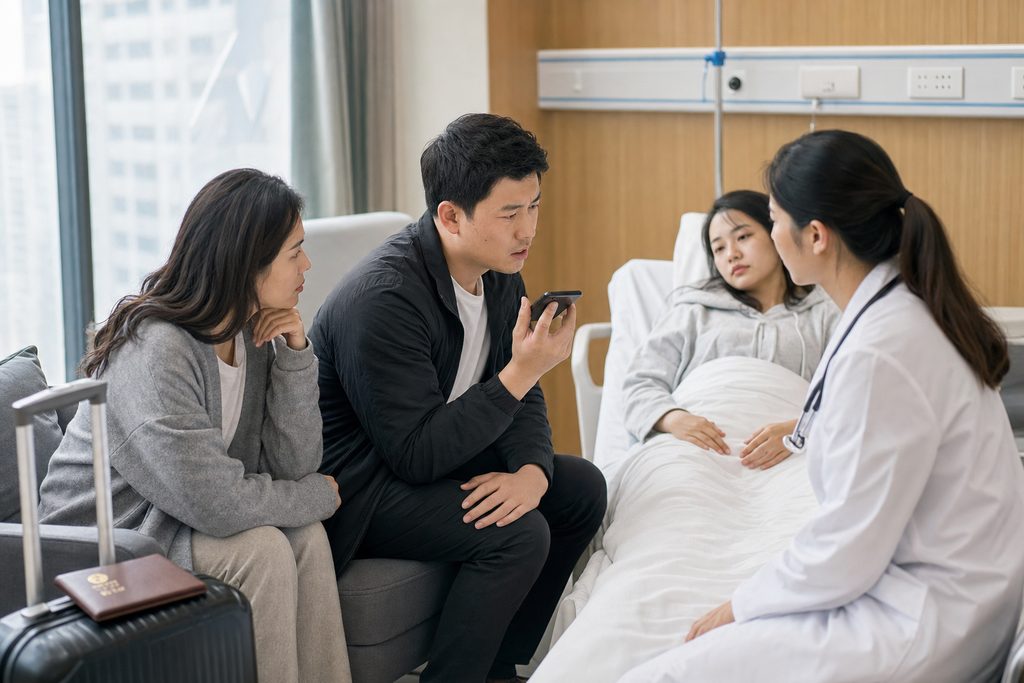
How This Actually Works, Step by Step
You are not just a case file. Your medical history didn’t start the day you landed in a new country, and your family doctor back home holds pieces of the puzzle that no new specialist can immediately see. When you search for “family doctor contact during medical treatment China,” you’re really asking something deeper: Will the medical team here understand my full story? Can my doctor at home weigh in if something doesn’t feel right? The answer is yes — but the mechanics aren’t automatic. They require deliberate coordination, and that’s where the gaps usually appear.
Here’s the actual sequence. Before you travel, you authorize your home physician to share records. Our team collects those — not just the summary letter, but the granular data: imaging reports, lab trends over time, medication adjustment logs. These get translated into clinical Chinese by medical translators, not machine tools. The receiving specialist at a hospital like Peking Union Medical College Hospital in Beijing reviews everything before you arrive. This pre-arrival file transfer is the foundation. Without it, your family doctor’s knowledge stays locked overseas.
During your stay, the communication channel stays open. If a treatment decision hinges on something ambiguous — say, a reaction you had to a specific drug class three years ago — the Chinese attending physician can request a written consultation with your home doctor. We facilitate that loop: secure document transfer, time-zone coordination, and bilingual summary so both sides understand the clinical question. This isn’t a casual phone call between doctors. It’s a structured, documented exchange. And it works because both physicians have a clear, narrow question to answer.
The final piece happens after discharge. Your Chinese medical team prepares a detailed treatment summary and follow-up protocol. We ensure that document reaches your family doctor in a format they can use — translated, with lab reference ranges converted to the units your home system expects. This closes the loop. Your local physician can then take over ongoing management with full context.
Why Your Family Doctor’s Input Matters More Than You Think
A top-ranked Chinese specialist can interpret a CT scan with extraordinary precision. But they cannot know that your persistent cough started after a mold exposure in your basement in 2019. They won’t see the three medication changes your GP tried before finding one that didn’t trigger your migraines. These details live in the longitudinal relationship you have with your family doctor. When you’re hospitalized abroad, that context becomes clinical gold.
Consider a real scenario we’ve seen. A patient from the UK traveled to Shanghai for a complex orthopedic procedure. The pre-op assessment flagged a borderline cardiac finding. The Chinese anesthesiology team needed to know: was this a new development, or a known stable condition? The patient’s NHS GP had ten years of ECG trends showing it was unchanged. That single data point, retrieved through a structured family doctor contact during medical treatment China, prevented a surgery delay and avoided unnecessary cardiac testing that would have cost time and money.
This isn’t about second-guessing the Chinese medical team. It’s about giving them the complete dataset. The best clinical decisions come from the fullest picture. Your home doctor holds brushstrokes that fill in the background.
A Realistic Timeline
Coordination across continents doesn’t happen in hours. Here’s what to expect when you need to involve your family doctor before, during, or after treatment in China. These ranges reflect our experience across hundreds of cases — not optimistic best-cases.
| Stage | What Happens | Typical Duration |
|---|---|---|
| Records request from home doctor | Patient signs release; home clinic processes request | 3–10 business days |
| Medical translation (English → Chinese) | Full records translated by medical linguists; imaging reports included | 2–5 business days |
| Pre-arrival specialist review | Chinese specialist examines translated history before patient travels | 3–7 business days after translation |
| Mid-treatment consultation request | Chinese attending sends specific question to home doctor via our coordination | 24–72 hours for written response |
| Post-discharge summary transfer | Chinese treatment summary translated, converted, sent to home doctor | 5–10 business days after discharge |
The longest wait is almost always at the start — getting records released from a busy family practice. We’ve learned to build that buffer into every timeline. Rushing this stage means incomplete records, which defeats the purpose.
What Can Go Wrong — and What Happens Then
Let’s be direct about the failure modes. They exist, and pretending otherwise doesn’t help anyone.
Your home doctor refuses to engage. Some physicians are uncomfortable consulting on care delivered in a system they don’t know. They may worry about liability or simply lack the bandwidth. When this happens, we pivot. We can arrange a video consultation between you and a China-based specialist who reviews the same records and provides an independent pre-treatment assessment. It’s not identical to having your own doctor in the loop, but it fills the gap with clinical rigor.
Time zones create dangerous delays. A question arises during evening rounds in Shanghai. It’s 3 a.m. in London. Your GP won’t see the message for hours. For non-urgent queries, this is manageable. For anything urgent, the Chinese attending makes a clinical decision based on available data. That’s the reality of international care. We mitigate this by front-loading as much history as possible — so fewer mid-treatment surprises arise.
Records are incomplete or contradictory. Sometimes the home doctor’s notes reference a test result that was never scanned into the file. Or the medication list doesn’t match what the patient reports taking. We flag discrepancies before translation, so the Chinese team knows what’s confirmed versus what’s patient-reported. This honesty prevents clinical errors downstream.
Language barriers corrupt the message. A poorly translated medical phrase can change a diagnosis. “History of chest pain” versus “history of cardiac-origin chest pain” are worlds apart. Our translators are medical professionals who understand these distinctions. But when patients try to self-translate or use generic services, the risk is real. We’ve corrected mistranslations that would have led to unnecessary cardiac workups.
What to Look for in a Medical Concierge Service China Hospital Stay
Not all coordination services operate the same way. If you’re evaluating options for a medical concierge service China hospital stay, here’s what separates genuine clinical coordination from a glorified translator with a business card.
First, ask who handles the medical translation. Are they clinicians, or general bilingual staff? A service that can’t tell you the qualifications of their translators is one that will miss clinical nuances. Second, ask about their protocol for urgent mid-treatment consultations. A good answer includes specific turnaround times, escalation paths, and what happens when the home doctor is unreachable. A vague answer means they’ve never actually managed one.
Third, check whether they provide post-discharge summary conversion. This is the step most services skip. They hand you a Chinese discharge document and wish you luck. A proper service converts lab values to your home country’s units, translates the follow-up protocol, and delivers it in a format your family doctor can actually use. If they don’t mention this, they’re not doing it.
Also worth noting: some international hospitals in China have in-house international patient departments that handle parts of this coordination. Hospitals like those on our private international hospitals page often employ English-speaking case managers. But their scope typically ends at the hospital door. They won’t chase down your GP in Manchester for records, and they won’t convert discharge summaries for your home system. That’s the gap a dedicated coordination service fills.
Practical Considerations: Records, Consent, and Payment
Before any family doctor contact during medical treatment China can happen, you need a signed records release. This sounds obvious. You’d be surprised how many patients arrive without one, assuming a phone call will suffice. It won’t. Most Western medical practices require written authorization — sometimes notarized — to share records with an overseas entity. Get this done early.
Visa timing interacts with the records timeline. An S2 visa for medical treatment typically requires supporting documents from the receiving Chinese hospital. That hospital, in turn, often wants to review your records before issuing the invitation letter. So the sequence is: records release → translation → hospital review → invitation letter → visa application. Each step depends on the previous one. Start the records request the moment you decide to pursue treatment in China.
Payment for coordination services is separate from hospital charges. Our case management fees cover the translation, liaison work, and communication loops described here. Hospital treatment costs are paid directly to the hospital. Most Chinese public hospitals require upfront deposit payment; private international hospitals may bill insurance directly. Your home doctor’s time — if they charge for consultation letters — is your responsibility. Some GPs provide this as part of ongoing care. Others bill for it. Clarify this before the first request goes out.
Insurance rarely covers the coordination service itself. It may cover the treatment, depending on your policy and whether the Chinese hospital is recognized by your insurer. Check this. We can provide the documentation your insurer needs, but we don’t file claims on your behalf.
Frequently Asked Questions
For clinical emergencies, the Chinese attending physician makes decisions immediately — there is no waiting for overseas input. For urgent but non-life-threatening questions where your home doctor’s knowledge is critical, our team can facilitate a written consultation within 24 to 72 hours. This requires your home doctor to be responsive. If they aren’t, the Chinese team proceeds with the data available.
Technically, yes. Practically, it’s rare. Time zone differences, licensing concerns, and the Chinese physician’s schedule all create friction. Written consultation is far more common and usually more useful — it gives both doctors time to formulate precise questions and answers. A 24/7 doctor hotline for international patients China exists in some private international hospitals, but these connect you to on-call hospital staff, not your personal physician back home.
This happens. When it does, we help structure the disagreement into specific clinical questions. “I disagree with the approach” isn’t actionable. “I’m concerned about Drug X because this patient showed elevated liver enzymes on it in 2022 — can we discuss alternatives?” is. We translate that concern precisely and facilitate the exchange. Ultimately, the treating physician in China makes the final call. You can decline treatment at any time.
No. Your family doctor isn’t practicing medicine in China — they’re providing historical clinical context and opinion to you and, with your consent, to the Chinese medical team. This is consultation, not licensure-dependent practice. That said, some doctors are uncomfortable with even this role. Respect their boundaries and have a backup plan.
Your Next Step
Coordinating family doctor contact during medical treatment China isn’t complicated, but it is detail-intensive. The difference between a smooth loop and a broken one is usually preparation — records requested early, translations done properly, and clear expectations set with both medical teams before you travel. Our team handles this coordination as part of the broader case management we provide for international patients. We don’t practice medicine. We build the bridge between the doctors who do — on both sides of the world. If you’re considering treatment in China and want to understand how we’d manage the communication with your home physician, reach out for a conversation. No commitment, just clarity on what’s possible.
For more medical information and treatment options in China, visit chinamedservices.com (China Medical Services).
