Remote Pediatric Case Review: Get Your Child’s Case to Chinese Specialists
Have you ever lain awake at night, staring at the ceiling, wondering if the diagnosis you received for your child is truly correct?
That question haunts more parents than you might think. One 2023 study published in the Journal of Evaluation in Clinical Practice found that second opinions changed diagnoses in 21% of pediatric cases reviewed. Nearly 1 in 5. And when the stakes involve a developing brain, a growing heart, or a rare tumor, that statistic stops being academic. It becomes the only thing that matters. For many families, the idea of getting a remote second opinion Chinese children’s hospital cost estimate and sending records overseas feels like a lifeline—but the process seems opaque. It does not have to be.
Key Takeaways
- Top Chinese children’s hospitals handle volumes that are hard to grasp—Beijing Children’s Hospital alone sees over 3 million outpatient visits annually, giving specialists exposure to rare presentations most Western clinicians might see once in a career.
- A written remote pediatric case review from a top-tier Chinese specialist typically costs between $300 and $800, with 90 days to apply that fee toward in-person coordination if you later decide to travel.
- Language and documentation barriers are real. Without properly translated records and a clear clinical question, even the best specialist cannot give a useful opinion.
- Remote reviews provide direction, not prescriptions. They clarify options, confirm or challenge a diagnosis, and suggest treatment paths—but the final medical decisions always remain with your treating physician at home.
The Problem: When Your Child’s Diagnosis Leaves Too Many Questions Unanswered
Beijing Children’s Hospital, affiliated with Capital Medical University, is the largest pediatric hospital in the world. It handles over 3 million outpatient visits per year. The cardiac surgery team at Fuwai Hospital performs more than 14,000 operations annually—the highest volume of any heart center globally. Shanghai Children’s Medical Center runs one of the busiest pediatric oncology programs anywhere.
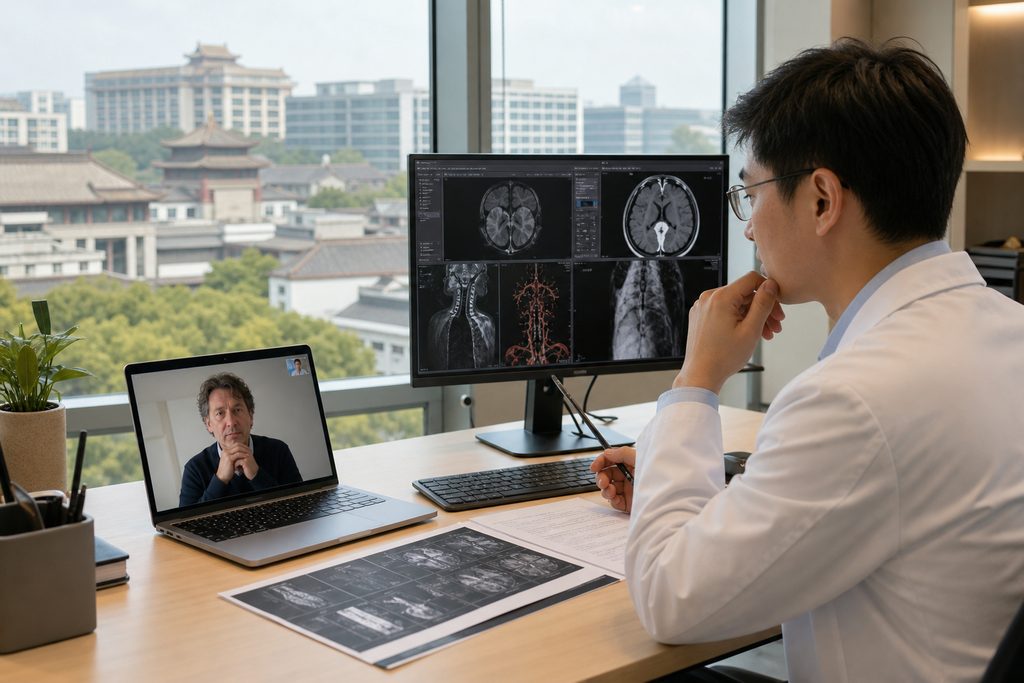
What does volume mean for a remote case review? It means the specialist reading your child’s MRI has likely seen that exact pattern before. Not something similar. The same thing. A pediatric neuroradiologist at a top Chinese hospital might review 50 brain MRIs in a single morning. That kind of exposure builds diagnostic instincts that are hard to replicate in lower-volume settings. When you ask can Chinese doctors review my child’s MRI online, the answer is yes—and the depth of experience behind that review is the real value.
Subspecialty Depth That Matches Any Western Academic Center
The Fudan University hospital rankings, China’s most authoritative medical ranking system, evaluates 45 clinical specialties separately. In pediatric surgery, pediatric neurology, pediatric oncology, and pediatric cardiology, the top-ranked Chinese hospitals compete at a global level. They publish in The Lancet, NEJM, and JAMA Pediatrics. They run international multicenter trials. They are not “good for China”—they are good, period.
This matters for a remote review because the subspecialist you need exists. A pediatric epileptologist who focuses exclusively on drug-resistant childhood epilepsy. A pediatric orthopedic oncologist who only treats bone tumors in children. These are not generalists giving an educated guess. They are the same caliber of expert you would seek out at Boston Children’s or Great Ormond Street—reviewing your child’s case from a different clinical tradition, which often yields different insights.
The Cost Equation: Structural Reasons, Not Quality Tradeoffs
Let us address the elephant in the room directly. A remote second opinion Chinese children’s hospital cost runs between $300 and $800 for a written report from a top-tier specialist. A comparable service through a major US academic center’s international program might cost $2,500 to $5,000. The difference is not about quality. It is about economics.
Chinese specialist physicians earn salaries, not fee-for-service billings. Hospital overhead is lower. The entire medical economy operates on a different cost basis. A cardiac bypass that costs $120,000 in the US runs $12,000 to $20,000 at a top Chinese public hospital. The same structural factors that make treatment affordable make remote consultations affordable. You are not buying a discount opinion. You are buying a world-class opinion priced for a different market.
What the Remote Review Process Actually Looks Like, Step by Step
Parents researching how to get my child’s case reviewed by China pediatric specialist often expect a bureaucratic nightmare. The reality is more straightforward—but it demands preparation. Here is what happens from the moment you decide to pursue a remote review.
You start by gathering everything. Not just the latest MRI report—the actual DICOM files on a CD or USB drive. Not just a summary of the pathology—the full pathology report with staining details. The specialist in Beijing or Shanghai needs to see exactly what your local doctors saw. No summaries. No filtered interpretations. Raw data.
You also need a clear clinical question. “What is wrong with my child?” is too broad. “My 4-year-old son has been diagnosed with medulloblastoma based on MRI and biopsy. The local team recommends surgery followed by craniospinal radiation. Before proceeding, we want confirmation of the diagnosis and opinion on whether proton therapy might reduce long-term neurocognitive risks given his age.” That is a question a specialist can sink their teeth into.
Once records and questions are prepared, they are translated into Chinese by a medical translator—not a general translator, not Google Translate. Medical terminology does not forgive mistakes. The translated package goes to the relevant department at the chosen hospital. A specialist reviews it. Within 5 to 10 business days, you receive a written report in English, often with annotated imaging findings and specific treatment recommendations.
If you want to book online case review Beijing Children’s Hospital or another top center, the pathway is through the hospital’s international department. These departments exist specifically to handle overseas patients. They assign English-speaking coordinators. They know what foreign families need. You do not navigate the chaotic main registration hall. You work through a structured channel designed for exactly this purpose.
Choosing the Right Hospital and Specialist for Your Child’s Condition
Not all excellent children’s hospitals excel in every specialty. A hospital that is world-class for pediatric cardiac surgery may be average for pediatric epilepsy. This is where the Fudan specialty rankings become invaluable.
For best pediatric neurology remote consultation China, the top-ranked programs cluster in a few institutions. The pediatric neurology department at Peking University First Hospital consistently ranks among China’s top three, with particular strength in refractory epilepsy and neurometabolic disorders. Xinhua Hospital in Shanghai runs a dedicated pediatric neurology center with deep expertise in neurogenetic conditions. For brain tumors, Beijing Tiantan Hospital‘s pediatric neurosurgery team operates at a volume few centers worldwide can match.
Oncology is another area where Chinese pediatric programs bring distinctive strengths. The China pediatric oncology expert second opinion price typically falls in the $400 to $800 range for a written review, depending on the complexity of the case and the seniority of the reviewing specialist. Sun Yat-sen University Cancer Center in Guangzhou and the pediatric oncology program at Shanghai Children’s Medical Center both run large clinical services with strong outcomes data in leukemia, lymphoma, and solid tumors.
One caution: do not shop for the answer you want. A remote review works best when you genuinely want an honest second look—not when you are hoping a Chinese specialist will contradict your local team and validate a path you have already chosen. The value lies in fresh perspective, not confirmation bias.
| Pediatric Specialty | Top-Ranked Chinese Hospital | Estimated Written Review Cost | Typical Turnaround |
|---|---|---|---|
| Pediatric Neurology | Peking University First Hospital | $400–$700 | 7–10 business days |
| Pediatric Neurosurgery | Beijing Tiantan Hospital | $500–$800 | 5–10 business days |
| Pediatric Oncology | Shanghai Children’s Medical Center | $400–$800 | 7–14 business days |
| Pediatric Cardiac Surgery | Fuwai Hospital | $400–$700 | 5–10 business days |
| Pediatric Orthopedics | Beijing Jishuitan Hospital | $300–$600 | 7–10 business days |
These figures are ranges. Final cost depends on the complexity of the case, the number of imaging studies to review, and whether multiple specialists need to weigh in. A multidisciplinary review—involving, say, a pediatric oncologist, a radiation oncologist, and a pediatric surgeon all reviewing the same case—costs more but delivers a more comprehensive opinion.
This is also where the 90-day credit policy matters. If the remote review leads you to pursue treatment in China, every dollar you spent on the consultation applies toward the coordination service fee. It is not a sunk cost. It is a down payment on a larger decision, should you choose to make one.
Practical Considerations: Records, Language, and What Happens After You Receive the Report
Getting a useful remote review depends on getting the right materials to the right person. The biggest mistake parents make is sending incomplete records. A specialist cannot give a meaningful opinion on a brain tumor if they only receive the radiology report and not the actual images. They cannot assess a leukemia case without the full flow cytometry and cytogenetic data.
Here is what you typically need, depending on the case type:
- Imaging: DICOM files on CD/DVD or uploaded to a secure portal—not JPEG screenshots, not printed films photographed with a phone. The specialist needs to manipulate the images, measure lesions, and compare sequences.
- Pathology: The complete pathology report, including immunohistochemistry staining results and, ideally, the actual pathology slides if a second read is requested.
- Clinical summary: A timeline of symptoms, treatments tried, responses observed. Dates matter. Drug doses matter.
- Specific questions: Three to five focused clinical questions the specialist should address. This focuses the review and ensures you get actionable answers.
Translation quality makes or breaks the process. A medical translator must understand that “seizure” translates differently depending on whether it is focal or generalized, that chemotherapy regimens have standard Chinese names that do not resemble their English acronyms, and that a “contrast-enhancing lesion” has a precise equivalent that a general translator will not know. This is not a corner to cut.
After you receive the report, read it with your local doctor. A remote review is not a replacement for your treating physician—it is a consultation document meant to inform your local team’s decision-making. The Chinese specialist may recommend a treatment approach that is standard in China but less common in your home country. Your local doctor needs to evaluate whether that approach is available, appropriate, and compatible with local standards of care.
If the review recommends coming to China for treatment, the visa pathway is through an S2 short-stay visa, with the hospital providing an invitation letter confirming the medical purpose. Family members accompanying the child apply for S2 visas as well. The hospital’s international department typically guides this process. It is not fast—plan for several weeks—but it is well-established.
Frequently Asked Questions
How do I know the Chinese specialist reviewing my child’s case is truly qualified?
Stick to hospitals ranked in the Fudan specialty top 10 for the relevant pediatric subspecialty. These specialists hold professorships at major medical universities, publish in international journals, and many have trained or practiced abroad. Their credentials are verifiable. The hospital’s international department can provide the reviewing specialist’s CV and publication list before you commit. Do not accept an anonymous review. You have the right to know who is reading your child’s scans.
What if the remote review contradicts my local doctor—who do I trust?
This happens more often than you might expect, and it is exactly why you sought a second opinion. The goal is not to pick a winner. The goal is to understand why the opinions differ. Is the Chinese specialist working from different clinical guidelines? Have they seen more cases of this specific subtype? Are they interpreting the same imaging differently? A good remote review explains its reasoning. Take both opinions to your local doctor and discuss the discrepancies openly. Sometimes the truth sits somewhere in the middle. Sometimes one perspective is clearly more grounded in evidence. Your job is not to adjudicate—it is to make sure all relevant perspectives are on the table before you make a treatment decision.
Can we do a live video consultation instead of just a written report?
Yes. Most top hospitals offer a video consultation option where you and your local doctor can speak directly with the Chinese specialist through an interpreter. This costs more—typically $500 to $800 for a top-specialist video session—but allows real-time questions and discussion. For complex cases where the written report is likely to generate follow-up questions, starting with a video consultation can be more efficient than going back and forth over email. The same 90-day credit toward in-person coordination applies.
Is my child’s medical data secure when sent to China?
Hospital international departments use encrypted portals for record transfer and are subject to Chinese medical privacy laws. That said, data protection standards differ from GDPR or HIPAA. Ask explicitly about the hospital’s data handling policies before sending records. Reputable international departments will provide clear answers. If they cannot or will not, choose a different hospital.
Your Next Step
Getting a remote pediatric case review from a Chinese children’s hospital is not about distrusting your local medical team. It is about leaving no stone unturned when the stakes are this high. The process works best when you come prepared—with complete records, clear questions, and realistic expectations about what a remote review can and cannot do. Our team at China Medical Services helps families navigate this process: identifying the right hospital and specialist for the specific condition, coordinating medical translation, and managing the logistics so you can focus on your child. We are not a hospital and we do not provide medical advice. We are the bridge between your family and the expertise you are seeking. When you are ready to explore whether a remote review makes sense for your situation, reach out for a conversation. No pressure. Just clarity.
For more medical information and treatment options in China, visit chinamedservices.com (China Medical Services).
