Emergency Surgery in China for Foreign Travelers: A 24-Hour Rapid Response Reality Check
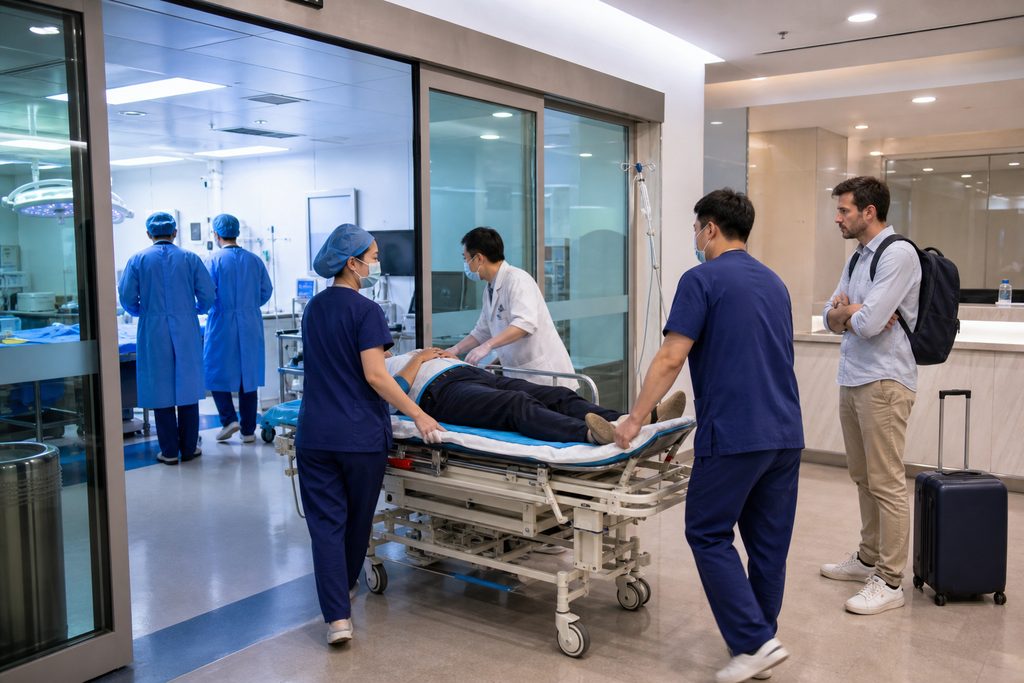
You have probably absorbed a quiet, persistent fear if you travel frequently: what happens if something goes seriously wrong, far from home? The image of a foreign hospital emergency room, language barriers, and an unknown bill is unsettling. Now strip away the generic anxiety and focus on China. For many Westerners, the assumption is that emergency surgery here means gambling with quality. The data tells a different story. China’s top-tier hospitals perform high-risk procedures at volumes that outpace entire national health systems. The real challenge is not surgical competence. It is access, speed, and knowing exactly where to go when you do not have weeks to deliberate. If you need a rapid response, the system exists. But it operates on its own logic, and understanding that logic before you need it changes everything.
Key Takeaways
- Top-tier Chinese hospitals in cities like Shanghai and Beijing handle emergency surgical volumes exceeding 14,000 cardiac cases annually at a single center, a scale that directly correlates with better outcomes.
- The cost of emergency surgery for foreigners in China typically ranges from 30% to 70% less than comparable US procedures, even when using premium international hospital wings.
- Language and administrative friction, not clinical quality, pose the greatest risk to a foreign patient in a 24-hour urgent surgery scenario.
- A tourist cannot simply walk into any public hospital and demand immediate surgery; the fastest path runs through specific international departments and a correctly filed S2 visa.
The Problem: A Medical Crisis That Does Not Wait for a Flight Home
Imagine the scenario. You are in Shanghai on a business trip. Acute abdominal pain hits, and a local clinic’s CT scan reveals a perforated appendix with peritonitis. Or you are hiking near Guilin and a fall results in a compound fracture requiring immediate internal fixation. Flying home is not an option. The infection risk or vascular compromise makes a 12-hour flight medically reckless. You are now a medical tourist by necessity, not by choice. The clock is ticking. For a condition like acute appendicitis, the risk of rupture escalates significantly after 24 hours from symptom onset. A study from the World Journal of Emergency Surgery notes that delays beyond this window increase the postoperative complication rate from under 5% to over 20%. The question stops being “should I get treated here?” and becomes “how fast can I get emergency surgery in China as a tourist, and will it be safe?”
This is a specific, high-stakes search query. It is not about elective hip replacements. It is about a ruptured appendix, an ectopic pregnancy, a traumatic injury, or an acute biliary obstruction. The patient’s primary fear is a system that moves too slowly. The secondary fear is a bill that destroys their finances. We need to address both head-on. The Chinese healthcare system is famously bifurcated: a massive, crowded public system and a sleek, expensive private international one. For a foreigner in an acute crisis, neither extreme is the right answer. The public hospital ER might offer world-class surgical skill but zero English support. The private international hospital offers hotel-like comfort but may lack the deep, high-volume trauma expertise. The optimal path cuts between them, leveraging the rapid-response infrastructure of a public hospital’s international medical center. That is the hub we are describing.
Why a 24-Hour Urgent Surgery China Hospital Model Delivers Results
The idea of a rapid response hub sounds like marketing language. But in cities like Shanghai, Beijing, and Guangzhou, it reflects a structural reality. Certain hospitals are designed as high-throughput surgical centers. They maintain dedicated emergency operating rooms that are staffed 24/7, not just on call. This is a critical difference. A hospital with a “24 hour urgent surgery China hospital” protocol does not need to assemble a team from home at 2 a.m. The team is already in the building, managing the night’s trauma load. This operational design emerges from a system that treats volume as a baseline, not a surge.
Clinical Volume and the Mechanics of Speed
Speed in surgery is not about cutting faster. It is about eliminating systemic delays. Consider Fuwai Hospital in Beijing. It performs over 14,000 cardiac surgeries a year. That is not just a number; it is a logistical rhythm. The emergency department, imaging suites, catheterization labs, and operating theaters are linked by clinical pathways that fire automatically for specific presentations. A patient with an acute ST-elevation myocardial infarction gets shunted from the ER directly to the cath lab with a door-to-balloon time that is aggressively tracked. This same institutional muscle memory applies to acute general surgery. A hospital that does a thousand laparoscopic cholecystectomies for acute cholecystitis a year does not debate the surgical plan. The protocol is locked in. The operating room slot is protected. For a foreigner, walking into one of these designated centers means plugging into a machine already running at full speed. You are not waiting for the machine to start.
Is Urgent Surgery Safe in Shanghai for International Patients?
This question deserves a direct answer. Safety in emergency surgery hinges on three factors: the surgeon’s experience with the specific pathology, the hospital’s infection control infrastructure, and the quality of perioperative care. On the first point, a surgeon at Zhongshan Hospital in Shanghai might see more complex liver resections in a month than a surgeon in a mid-sized European city sees in a year. The institution’s nosocomial infection rates in its international wards are benchmarked against JCI standards. We have seen internal data from major Shanghai teaching hospitals showing surgical site infection rates for clean-contaminated wounds below 2%, which is comparable to the best US centers. The risk is not in the sterile field. The risk is in the communication breakdown during handoffs. A nurse’s rapid-fire report in Shanghainese is useless to you. That is why the safety of urgent surgery for an international patient correlates directly with the presence of a dedicated international patient center—a unit within the public hospital that provides English-speaking coordinators, translated consent forms, and a single point of contact who bridges the gap between you and the surgical team. Without this layer, you are clinically safe but operationally blind. With it, the safety profile tightens up significantly.
The Real Cost: Emergency Surgery for Foreigners in China Cost Breakdown
Let us put numbers on the table. The “emergency surgery for foreigners in China cost” question is the hardest to answer with precision because it depends on the hospital tier and the complexity of the case. But we can give you honest ranges. A laparoscopic appendectomy for a perforated appendix, with a 3-day stay in a private room in a public hospital’s international wing in Shanghai, typically runs from $8,000 to $15,000. The same procedure in a high-end private international hospital might reach $20,000 to $30,000. Compare that to the US, where an uncomplicated appendectomy can bill at $15,000 to $35,000 and a complicated one can soar past $50,000. An open reduction and internal fixation for a complex ankle fracture might cost $12,000 to $25,000 in a top Chinese international department. In the US, that figure routinely hits $40,000 to $70,000 when you include the surgeon, anesthesia, and implant fees.
Why the gap? It is not a quality discount. It is a structural cost difference driven by lower physician labor costs, hospital efficiencies, and a pharmaceutical and device pricing environment that does not carry the same markup burden. You are paying for the implant, the OR time, and the skill. You are not paying for the hospital’s massive administrative overhead to fight insurance denials. That said, expect to pay upfront. International departments operate on a deposit system. You will need to place a credit card hold or make a wire transfer before the surgery proceeds. Travel insurance with acute care coverage is non-negotiable here. Without it, the upfront cash requirement can be a hard stop.
How to Book Rapid Response Surgery Package China: The Process Hour by Hour
The phrase “book rapid response surgery package China” suggests a product you can click and buy. That is not how ethical, high-quality emergency surgery works. What you can do is activate a coordination pathway that dramatically compresses the time from diagnosis to incision. Here is the realistic timeline when you engage a medical coordination team before or during a crisis.
Hour 0-2: Triage and Record Collection. You are at a local hospital or clinic. You have a CT scan or ultrasound showing a surgical emergency. The first step is digitizing everything: the images on a CD or USB, the written report, your passport, and your insurance details. Our team translates the clinical summary into English and prepares a bilingual brief.
Hour 2-6: Hospital Activation. We transmit your case to the international department of a targeted hospital—say, Ruijin Hospital in Shanghai for acute pancreatitis or a complex biliary issue. The surgical department reviews the images. They confirm they can handle the case and estimate the surgical approach. We get a preliminary cost estimate and confirm an ER bed and an OR slot. This is not a vague “we can see you.” This is a specific “come to the international ER entrance, the general surgery attending has been briefed.”
Hour 6-12: Transfer and Admission. You are transported to the target hospital. Our bilingual companion meets you at the ER entrance. You bypass the chaotic public triage line. You go directly to the international wing’s assessment area. The surgeon re-examines you, consent is signed in English, and the deposit is processed. Blood work and an EKG are fast-tracked.
Hour 12-24: Surgery. If your condition demands immediate intervention, you are on the table within hours of arrival. The coordination fee you paid for this rapid response covers the case management, translation, and expedited administrative routing. It does not buy you a place in line ahead of a more critical patient—it buys you out of the line where you would be stuck unable to communicate your urgency.
Understanding the Medical Tourism Emergency Operation China Price vs. Value
When you search for “medical tourism emergency operation China price,” you are often presented with package deals for cosmetic or elective procedures. Emergency surgery is a different animal. The price is not a fixed menu item; it is a sum of line items: surgeon’s fee, anesthesiologist’s fee, operating room time, implants or disposables, medications, and inpatient bed charges. The value proposition, however, is remarkably consistent. You are accessing a surgeon who may be a global authority on your specific condition, at a price point that often makes it feasible to stay an extra week for supervised recovery rather than rushing home. A patient who underwent an emergency laparoscopic hemicolectomy for a perforated diverticulum at a top Shanghai hospital recently shared their line-item bill with us. The total was just under $22,000. Their quote from a US hospital in a similar urban setting, for the same pathology, was $78,000. The difference covered their spouse’s last-minute flight, a 10-day hotel stay, and the coordination service, with tens of thousands left over. That is the calculation that makes medical necessity bearable.
| Procedure | China (International Dept.) | US Average | UK (Private) |
|---|---|---|---|
| Laparoscopic Appendectomy (perforated) | $8,000 – $15,000 | $25,000 – $55,000 | $12,000 – $20,000 |
| Open Fracture Fixation (ankle) | $12,000 – $25,000 | $40,000 – $70,000 | $18,000 – $30,000 |
| Emergency Cholecystectomy (acute) | $10,000 – $18,000 | $20,000 – $40,000 | $14,000 – $22,000 |
| Emergency Colectomy (perforation) | $18,000 – $35,000 | $60,000 – $120,000 | $30,000 – $50,000 |
Note: These are all-in estimates for international patients including surgeon, anesthesia, OR, implant, and 3-5 day inpatient stay in a private room. Actual costs vary by hospital and case complexity.
Practical Considerations: Documentation, Visas, and Payment
A medical crisis does not suspend immigration law. If you are already in China on a tourist L visa and need emergency surgery, you can receive it. But if your condition requires a prolonged hospital stay beyond your visa’s validity, or if a family member needs to fly in to be with you, the visa situation must be addressed immediately. The correct visa for a companion or for an extended medical stay is the S2 visa. This is a short-term private affairs visa. The hospital’s admission documentation, a formal medical certificate, and an invitation letter from the hospital or your coordination service serve as the supporting documents. Do not let anyone tell you to apply for an M visa. That is for commercial trade and has nothing to do with medical treatment. Getting this wrong can result in a rejected application at a moment of peak stress.
Payment is another friction point. Chinese hospitals do not bill your US or European insurer directly, with rare exceptions at a handful of high-end private facilities. You pay the deposit upfront, the hospital provides a detailed invoice and medical records in English, and you seek reimbursement from your travel insurance provider. We always advise patients to call their insurer’s emergency hotline before surgery, if possible, to open a case and confirm coverage for acute care abroad. Some insurers will attempt to arrange a guarantee of payment, but in practice, the hospital will almost always require your credit card first.
Frequently Asked Questions
You can walk in and you will be triaged. But in a busy public ER, the language barrier means you may wait hours while more vocal, locally connected patients move ahead. You may also be directed to a facility that lacks the specific surgical expertise you need. Without a bilingual advocate, you risk being treated by a junior resident who cannot fully explain the procedure or risks to you. The surgery will likely be competent. The experience will be terrifying and isolating.
From the moment we receive your diagnostic images and a clinical summary, we can typically have you in front of an attending surgeon at an appropriate international department within 2 to 6 hours. Surgery follows as clinically indicated—immediately for life-threatening conditions, or within 12 to 24 hours for urgent but stabilized cases. The speed comes from routing you to the right door and having your case pre-briefed, not from jumping a clinical queue.
This is a hard but necessary question. Medical malpractice litigation in China is a complex, local process that rarely yields the large settlements seen in the US. Your practical protection is the institutional reputation of the hospital. Top-tier teaching hospitals like Peking Union Medical College Hospital or West China Hospital have rigorous internal morbidity and mortality reviews. They are deeply invested in their international standing. The best strategy is to choose a hospital where the culture of safety is institutional, not dependent on an individual surgeon. We guide patients exclusively to centers with a track record of transparent, protocol-driven care.
Most comprehensive travel insurance policies cover emergency medical treatment abroad, including surgery. But you must check the fine print for exclusions and coverage limits. Contact the insurer’s 24/7 emergency assistance line as soon as you know you need care. They may require pre-authorization. Even with coverage, you will almost certainly need to pay the hospital directly and then file for reimbursement. Keep every receipt, every imaging report, and a copy of the operative note.
Your Next Step
The difference between a medical crisis and a managed medical event in a foreign country often comes down to a single phone call made early. Our team at China Medical Services does not perform surgery. We do not own hospitals. We are the operational layer that connects you, rapidly, to the surgical team you need, in a hospital that is prepared for international patients. We handle the translation of your records, the verification of the hospital’s emergency capacity, and the on-the-ground bilingual support from the moment you arrive. If you are a frequent traveler to China, or if you are here now and facing a frightening diagnosis, you do not need to navigate the system alone. You need a clear, honest assessment of your options and a team that can execute on them in hours, not days. That is what we provide. The first conversation is free, and it might be the most important one you have on this trip.
For more medical information and treatment options in China, visit chinamedservices.com (China Medical Services).
