How Chinese Hospital Wards Work: A Foreign Patient’s Room Guide
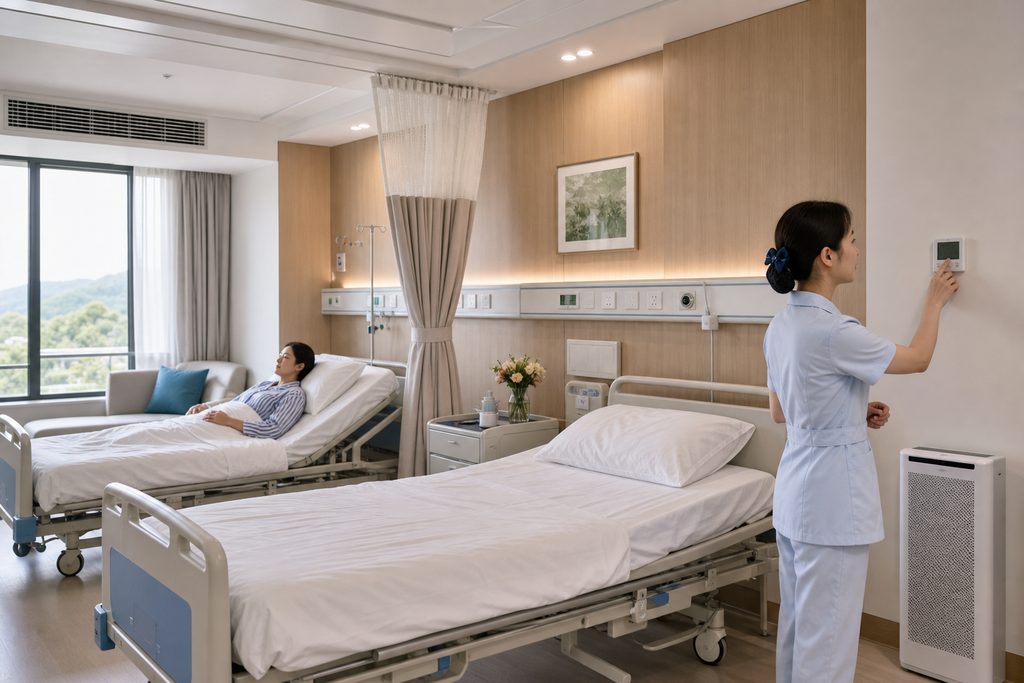
When Sarah landed in Shanghai for a scheduled surgery, the clinical part didn’t worry her. She had researched the surgeon. She had sent her imaging. What kept her up the night before admission was a simpler, more human question: what would her room actually look like? Would she share a bathroom with three strangers? Would her husband be allowed to stay? The medical details were handled; the lived experience was a complete unknown. If you are searching for what to expect from a Chinese hospital ward, you are likely in a similar headspace. The answer is more layered than a simple “private or shared.” China’s hospital room system operates on a tiered structure that directly ties cost to comfort, and understanding the categories before you arrive puts you back in control.
Understanding Hospital Ward Tiers: The Short Answer
Most Chinese public hospitals classify inpatient rooms into distinct bands. You will typically see multi-bed general wards, semi-private rooms with two or three beds, and a separate category of self-pay suites often called VIP or International Department wards. The private hospital room cost in China can range from roughly $80 USD per night in a basic single room to over $500 USD per night in a top-tier VIP suite. The price gap is not arbitrary. It reflects a fundamental difference in how the hospital serves you: a general ward bed might cost $15 a night, but it comes with limited visitor access and shared facilities. The VIP suite includes a private bathroom, space for a family member to sleep, and often a dedicated nursing station. You are paying for the environment, not just the bed.
Who This Is Right For — and Who It Isn’t
Booking a private or VIP room is not automatically the right move for every international patient. It depends entirely on your recovery needs and your tolerance for a very different cultural environment.
A private room or VIP suite tends to suit you if:
– You have a family member traveling with you who needs to stay overnight. Many VIP wards include a sofa bed or adjacent resting area.
– Your recovery requires strict infection control or privacy that a shared space cannot provide.
– You do not speak Mandarin and need a buffer zone where English-speaking nursing staff are more readily available.
– You are paying out-of-pocket or have international insurance that reimburses you directly.
A general or semi-private ward might be acceptable if:
– You are having a short, uncomplicated stay of one or two nights.
– You are traveling on a very tight budget and the cost savings are essential.
– You are culturally comfortable in dense, communal spaces and genuinely do not mind the lack of privacy.
But let’s be direct. If you have significant post-operative pain, require frequent bathroom access, or are sensitive to noise, a multi-bed general ward will be difficult. The lights stay on late. Families might be present. The rhythm is communal, not private. We have seen patients choose the cheapest option to save money, only to request an upgrade on day one. That upgrade is not always possible if the VIP floor is full.
The Options, Compared
The physical environment varies wildly between hospital tiers. To give you a concrete sense of what your money buys, the table below compares the three most common categories a foreign patient will encounter.
| Feature | General Ward (Class A/B) | Semi-Private (Double Room) | VIP / International Suite |
|---|---|---|---|
| Occupancy | 3 to 6 patients | 2 patients | 1 patient |
| Bathroom | Shared, down the hall | Shared between 2 rooms | Private, en-suite |
| Visitor Policy | Strict, limited hours | Flexible, daytime only | Open, overnight family stay allowed |
| Nurse Call Response | Shared ward nurse station | Shared floor nurse station | Dedicated VIP nursing team |
| English Support | Rare | Occasional | Standard in International Dept. |
| Cost per Night (USD) | $15 – $50 | $60 – $120 | $150 – $500+ |
| Booking Certainty | Not guaranteed pre-arrival | Possible via coordination | Reservable via International Dept. |
The jump from a semi-private room to a VIP suite is the single biggest quality-of-life upgrade you can make. For a patient coming from a Western healthcare system where private rooms are standard, the general ward can be a shock. The VIP ward price Beijing hospital patients pay, for instance, might look high on paper. But compare it to a private room in a U.S. hospital, where the facility fee alone can exceed $2,000 a night before any treatment is added, and the value proposition becomes obvious.
What Do Hospital Rooms in China Look Like Inside a VIP Ward?
This is the question behind the search. You have seen the prices. You want to know what the space actually feels like.
Walk into a standard VIP suite at a major teaching hospital like Ruijin Hospital in Shanghai or Peking Union Medical College Hospital in Beijing, and your first impression is that it resembles a business-class hotel room more than a hospital bay. The bed is a proper electric hospital bed, but the frame is often wood-paneled. The flooring is laminate or wood, not cold institutional linoleum. There is a flat-screen television, a small refrigerator, and a sitting area with a sofa that converts into a bed for your companion. The bathroom is private, with a shower that has grab rails and a non-slip floor. You will find a closet for your belongings, something general wards simply do not offer.
The best hospital ward for foreigners in Shanghai, typically found in the international departments of Huashan Hospital or Zhongshan Hospital, takes this further. These wards are built specifically for a mixed domestic and international patient load. The nursing staff rotates through English-language training. The menu includes Western meal options. The front desk can help your family with logistics, from SIM cards to hotel extensions. It is a controlled, quieter environment inside a hospital that might be seeing 10,000 outpatient visits a day on the public side. That contrast is the point. You are buying separation from the volume.
But let’s keep it real. This is still a Chinese hospital. The bed might be slightly harder than you are used to. The room temperature settings might feel different. The nursing workflow follows a Chinese schedule. The VIP ward smooths the edges significantly, but it does not transplant a Western hospital into Shanghai. Expecting that will only frustrate you.
How to Get a Private Room in a Chinese Hospital Before You Travel
This is where the system differs most from what you know. In many Western countries, you are admitted and assigned a private room based on availability and medical need. In China’s public system, the general ward allocation happens after you arrive, and you get what is available. You cannot simply call the hospital switchboard and book international patient room China reservations months in advance on your own.
The workaround is the International Medical Department or VIP clinic. These are semi-autonomous units within the public hospital that operate on a different model. They accept direct bookings from overseas patients, typically through a coordinator. The process works like this: your medical records are reviewed, a treatment plan and admission date are confirmed, and the room is reserved as part of that admission package. You are not just reserving a bed; you are reserving a slot in a specific consultant’s care pathway.
If you attempt to arrive at a public hospital’s general registration desk without this pre-arrangement, you will join the public queue. You might be offered a bed in a six-person room. You might be told to wait. The VIP channel is not a luxury add-on; it is functionally the only way to lock in a specific room type before you step off the plane. The VIP ward price Beijing hospital administrators set includes this predictability. You know where you will recover before you leave home.
What It Costs: Breaking Down the Private Hospital Room Cost in China
Let’s put real numbers on this. The figures below are drawn from current rates at top-tier public hospital international departments in Beijing, Shanghai, and Guangzhou. They are ranges because the final charge depends on the specific hospital, the size of the suite, and the length of stay.
A standard private room in a respected but not top-brand hospital might start at $100 to $150 per night. Move to a flagship institution like Fuwai Hospital’s international wing, and a deluxe suite can reach $400 to $600 per night. These sums include the physical room and the standard VIP nursing ratio. They do not include the procedure itself, the surgeon’s fee, anesthesia, medications, or consumables.
What drives the price higher? Three things. First, location: Shanghai and Beijing command a premium over cities like Guangzhou or Hangzhou. Second, the hospital’s brand: a room at a hospital ranked in the top tier of the Fudan University hospital rankings will cost more. Third, the level of suite: a “deluxe” or “presidential” suite with a separate living room and guest bathroom can push past $800 per night.
Is this worth it? Compare it to the alternative. A general ward bed might cost $20 a night. Over a five-day stay, you save perhaps $2,000. But you lose privacy, your partner cannot stay, and you navigate the experience without English support. Most international patients we work with decide that the private room cost is not an extravagance. It is the foundation of a tolerable recovery.
Practical Considerations: Payment, Insurance, and the Visa Reality
Money moves differently in Chinese hospitals than you might expect. The international department will typically require a deposit upfront before admission. This deposit is calculated to cover the estimated room charges, procedure fees, and a buffer for complications. You pay it via wire transfer, credit card, or sometimes Alipay or WeChat Pay if you have set those up. The hospital draws down from this deposit daily. If the balance runs low, you will be asked to top it up. This is not a sign of mistrust; it is the standard operating procedure across the entire system.
Insurance adds another layer. Most Chinese public hospitals, even VIP wards, do not do direct billing with foreign insurance companies. You pay the hospital, you get a detailed invoice and medical report, and you submit the claim to your insurer yourself. A few private international hospitals like United Family Healthcare or Jiahui International Hospital do offer direct billing, and their room rates are comparable to the high-end VIP public hospital suites. If seamless insurance processing is your top priority, private hospitals deserve a close look. If access to a specific top-ranked specialist is the priority, the public hospital VIP ward is often the better path.
Then there is the visa. You cannot enter China on a tourist visa for planned medical treatment. The correct visa is an S2 visa, annotated for private affairs including medical treatment. Your family member accompanying you also applies for an S2. The hospital’s international department will issue an invitation letter and a confirmation of the admission schedule, which you submit with your visa application. No hospital document, no S2. And no, an M visa will not work. That is strictly for commercial and trade activities. Using the wrong visa category can get you refused at the border.
Frequently Asked Questions
Can I book a private room directly with the hospital without going through a coordinator?
It is technically possible but practically very difficult from overseas. The international department phone lines are often answered in Mandarin. The email response times can be slow. More critically, the room reservation is tied to a doctor’s admission schedule. Without a local contact to bridge the clinical review and the administrative booking, the process stalls. A coordinator does not own the room inventory; they navigate the system on your behalf. If you are already in China and speak Mandarin, walking into the international department in person is a viable path.
What happens if I book a VIP room but need to extend my stay unexpectedly?
The hospital will try to accommodate you, but the room is not yours indefinitely. If another patient has a confirmed booking for that suite, you may need to move to a different room, potentially of a different grade. This is rare but it happens. The international department staff will manage the move, but it underscores a reality: flexibility is required. You are in their system, on their terms.
Are the nurses in the VIP ward actually fluent in English?
Some are. Many have functional medical English. The head nurse on the floor is usually the strongest English speaker. Do not expect every bedside nurse to hold a fluent conversation about your diagnosis, but they will understand “pain,” “bathroom,” “water,” and “doctor.” For complex discussions, the attending physician will either speak English or bring a junior doctor who does. The language gap narrows significantly in the VIP ward compared to the general floors, but it does not disappear entirely. Having a translation app ready is still wise.
Is the private hospital room cost in China negotiable?
Not for individual patients staying a standard length of time. The rates are set by the hospital’s pricing bureau. If you are self-paying for an extended stay of several weeks, the international department may have a packaged rate, but this is not a bazaar. You are paying the posted price. The value lies in what that price gets you relative to your home country, not in haggling it down by fifty dollars a night.
Your Next Step
Choosing a hospital ward in a foreign country is not just a budget decision. It is a recovery decision. The room you wake up in after surgery determines whether your family can be with you, whether you can communicate your needs, and whether you can rest. The private hospital room cost in China, when weighed against the alternative of a sleepless, stressful shared ward, is usually money well spent.
Our team at China Medical Services helps international patients match with the right hospital and the right room tier for their specific situation. We are not a hospital. We do not offer medical advice or diagnoses. What we do is handle the logistics: translating your records for the hospital’s review, confirming the admission schedule, reserving the VIP suite, and making sure someone who speaks your language is with you when you check in. If you want to understand your options before you commit to anything, a conversation costs nothing. We will tell you what is realistic and what is not.
Request a free consultation to discuss your hospital preferences and get a clear, no-pressure picture of available room options for your treatment dates.
For more medical information and treatment options in China, visit chinamedservices.com (China Medical Services).
