Chinese vs Western Nursing Roles: What Foreign Patients Actually Notice
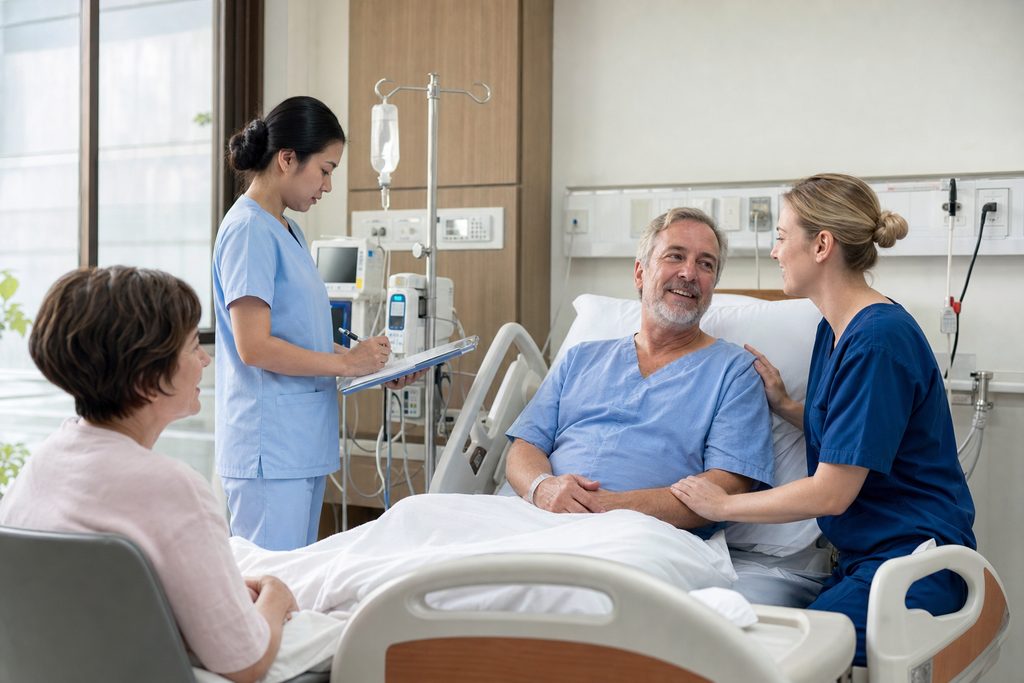
According to a 2024 report by the International Healthcare Research Collaborative, nearly 67% of foreign patients treated in Chinese hospitals identified nursing interactions as the single most disorienting part of their stay—more than language barriers, more than food, more than the sheer scale of the facilities. That statistic catches people off guard. They brace for translation problems. They don’t brace for a fundamentally different model of who a nurse is and what a nurse does. Chinese nursing care vs Western nursing standards is not a question of better or worse. It’s a question of role design. And the gap between expectation and reality is where frustration—or relief—actually lives.
Our team has spent years coordinating care for international patients across China’s top-tier hospitals. We’ve heard the same three observations repeated by patients from London, Dubai, Houston, and Manila. This article walks through exactly what those observations are, why the differences exist, and how to navigate them without losing your mind—or your recovery momentum.
The Short Answer: Task Execution vs. Whole-Patient Ownership
Western patients expect their nurse to be a clinical guardian—someone who monitors vitals, certainly, but also someone who advocates, educates, and coordinates. In most Western systems, the registered nurse owns the patient’s bedside experience. In China, the nurse owns a set of discrete clinical tasks. That’s the core shift. A Chinese nurse will start your IV with remarkable speed. They will administer medications on a precise schedule. They will document everything. But they are far less likely to ask how you’re feeling emotionally, explain your lab results unprompted, or coordinate with physical therapy on your behalf. Those functions either don’t exist in their job description or belong to someone else—often a family member.
This isn’t negligence. It’s structural. Chinese nursing education emphasizes technical proficiency and efficient task completion within a system where patient-to-nurse ratios can run 8:1 or higher on general wards. The Western model of holistic nursing assessment simply isn’t built into the workflow at most public hospitals. What foreigners notice, then, is not poor care but a different distribution of care responsibilities.
Who This Is Right For — and Who It Isn’t
Some patients thrive in this environment. Others struggle badly. Knowing which camp you fall into matters more than any hospital ranking.
You’ll likely adapt well if:
- You’re independent by nature and comfortable self-advocating
- You’re traveling with a family member who can act as your bedside coordinator
- You’re receiving a procedure with a well-defined recovery protocol (orthopedic surgery, cardiac catheterization, specific cancer treatments)
- You’ve arranged for a private companion or bilingual medical escort who fills the communication and coordination gaps
You should think carefully—and possibly reconsider—if:
- You have complex comorbidities requiring constant interdisciplinary coordination
- You rely heavily on nursing staff for emotional support and bedside education
- You’re traveling alone and have limited mobility post-procedure
- You expect the nursing model to mirror what you’d receive at a Mayo Clinic or Charité ward. It won’t. And the mismatch can erode trust fast.
Being honest about this upfront prevents the kind of mid-stay distress that no clinical outcome can compensate for.
The Options, Compared: Nursing Models Across Chinese Hospital Tiers
Chinese nursing care vs Western nursing standards isn’t a single comparison. It varies dramatically by hospital tier. Here’s what you’ll actually encounter:
| Factor | Public Hospital General Ward | Public Hospital VIP/International Wing | Private International Hospital |
|---|---|---|---|
| Patient-to-nurse ratio | 8:1 to 12:1 | 3:1 to 5:1 | 2:1 to 4:1 |
| English proficiency | Rare; basic phrases at most | Moderate; some nurses trained for international patients | Standard; English-speaking staff is a core service feature |
| Nursing role scope | Task-based: medications, vitals, IV management, wound care | Expanded: includes some patient education and coordination | Closer to Western model: holistic assessment, education, coordination |
| Family expected to assist? | Yes—family handles feeding, bathing, toileting, emotional support | Reduced; some support provided by nursing assistants | Minimal; nursing staff covers most bedside care |
| Private nursing allowed? | Yes, at additional cost; hospital can often recommend agencies | Rarely needed but sometimes permitted | Not typically necessary |
| Cost per day (nursing-related portion) | Included in ward fees ($50–150/day total) | $200–500/day (all-inclusive room and nursing) | $500–1,200/day (all-inclusive) |
Most international patients who come through our coordination service land in the middle column—public hospital VIP or international wings. You get the clinical expertise of a top-tier institution with nursing ratios and language support that feel closer to what you’re used to. The cost is higher than a general ward but still a fraction of what equivalent care costs in the US or Western Europe.
What Foreigners Notice First: Three Patterns That Repeat
After coordinating care for patients from over 40 countries, certain observations surface again and again. These aren’t complaints, exactly. They’re moments of cultural friction that catch people unprepared.
Pattern one: The family is part of the care team. In a Chinese public hospital, it is completely normal for a family member to sleep in the room, handle meals, assist with toileting, and communicate patient needs to the nursing station. This is not a sign of understaffing—though staffing ratios are tighter than in the West. It’s a cultural expectation. The nurse administers clinical interventions. The family handles everything else. Western patients who arrive alone often feel abandoned until they understand this framework. Then they either call a family member or hire a private companion. The expectation doesn’t change. The response to it does.
Pattern two: Questions are received differently. A Western patient might ask, “Why am I receiving this medication?” and expect a brief educational exchange. In a busy Chinese ward, that same question may be met with a polite but brief response—or a referral to the doctor. Nurses are not socialized to provide clinical rationale at the bedside. It’s not hostility. It’s role boundaries. Patients who understand this shift their questions to the attending physician during rounds and use nursing staff for operational needs: “When is my next dose?” not “What does this drug do?”
Pattern three: Technical skill is genuinely excellent. This is the part that surprises people. IV insertions are fast and clean. Wound dressings are meticulous. Medication timing is precise. Chinese nurses perform high volumes of clinical procedures daily—far more than the average Western nurse, simply because of patient volume. The technical execution is often superb. It’s the surrounding communication and emotional support that feel thin. Once patients separate these two dimensions, they can appreciate the skill while compensating for the gaps.
Private Nursing Cost in China: What You’re Actually Paying For
The family’s role. Most Western patients are stunned to see relatives sleeping on cots in hospital rooms, feeding patients, and acting as de facto nursing assistants. This is standard practice across Chinese public hospitals and is not a reflection of neglect. Also unexpected: the sheer speed and volume of clinical tasks nurses perform. A Chinese nurse on a general ward may administer medications to 30 patients in a single shift. The efficiency is impressive. The bedside manner is correspondingly brief.
Yes, but not every hospital offers this. Private international hospitals—United Family, Jiahui, Parkway, Raffles—employ English-speaking nursing staff as a standard feature. Public hospital international wings also typically have English-capable nurses, though proficiency varies by shift and individual. General public wards rarely have English-speaking nurses. If language support is non-negotiable for you, your hospital selection narrows to the international and VIP tiers. Our hospital matching service starts with exactly this filter: which facilities can actually communicate with you at the bedside, not just in the consultation room.
This happens, and it’s manageable if you act quickly. First, communicate your concern to the head nurse on the ward—they have more authority and often more experience with international patients than floor staff. If that doesn’t resolve it, escalate to the hospital’s international patient center. Most major hospitals have one. If you’re working with a coordination service, they should be your first call—a bilingual advocate who can intervene in real time is worth more than any complaint filed after discharge. Practical note: requesting a room transfer or a different nursing team is sometimes possible, sometimes not. It depends on capacity and the specific issue. But silence guarantees no change.
Your Next Step
The nursing model in China is not a mystery to be solved from abroad. It’s a known structure with predictable gaps and reliable strengths. Once you understand where the gaps live—communication, emotional support, the expectation of family involvement—you can plan around them. That might mean bringing a family member. It might mean budgeting for a private nurse. It might mean choosing a hospital tier where the ratios and language support more closely match your needs.
Our team at China Medical Services does not provide medical care, make diagnoses, or operate any hospital. What we do is help international patients match with the right facility, prepare the right documentation, and arrive with a clear picture of what to expect—including at the bedside. If you’re considering treatment in China and want to talk through the practical realities before committing, you can reach us here. No pressure. Just the information you need to make a clear-eyed decision.
Frequently Asked Questions
Yes. The hospitals used for international patients are JCI-accredited and follow the same international safety standards as top hospitals in the US and Europe. Surgical teams perform high volumes of procedures — often more than their Western counterparts — which studies show leads to better outcomes.
Costs vary by procedure and hospital, but international patients typically save 40-80% compared to US prices — even when factoring in travel and accommodation. A consultation with our team will give you an exact, all-inclusive quote with no hidden fees.
Send us your existing medical reports to get started. We handle everything from hospital selection and appointment scheduling to visa assistance and post-operative recovery planning. Your medical records are reviewed by the specialist before you even book a flight.
For more medical information and treatment options in China, visit chinamedservices.com (China Medical Services).
