Chinese Hospital Beds vs Western Standards: What International Patients Actually Experience
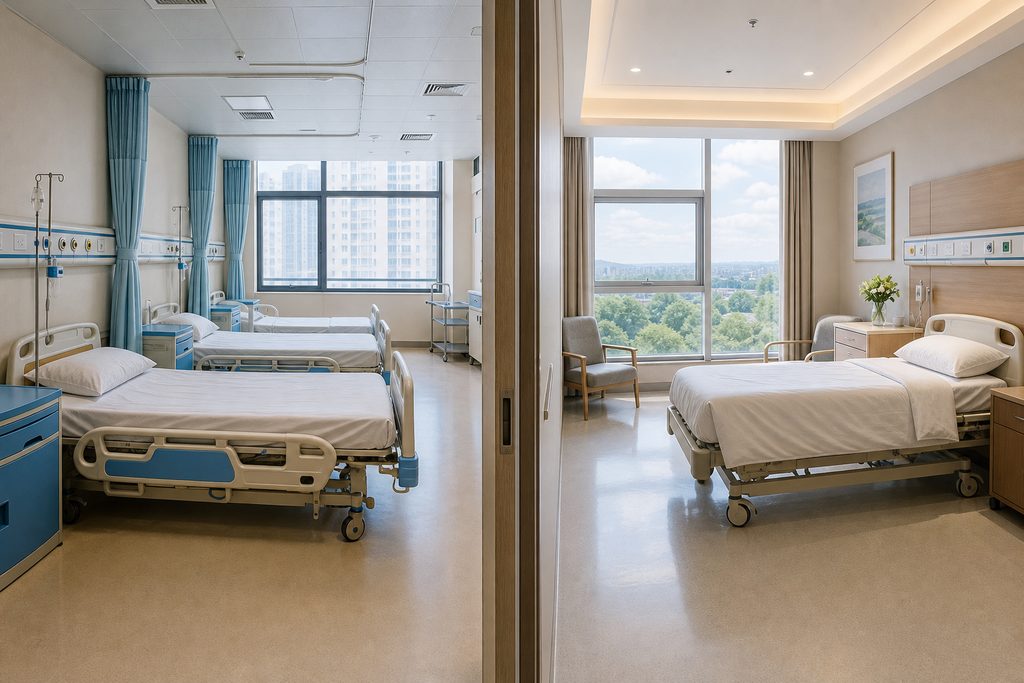
Walking into a Chinese hospital room for the first time, most international patients have the same reaction. It’s not what they expected.
Some are surprised by how modern the VIP suites look. Others are caught off guard by the standard ward setup — three or six beds to a room, family members coming and going, a level of bustle that feels foreign if you’re used to the quiet privacy of a Western hospital. Both reactions are valid. And both point to the same truth: the gap between Chinese and Western hospital accommodations isn’t about “better” or “worse.” It’s about different systems, different expectations, and knowing which option you’re actually booking.
The VIP hospital room cost Beijing vs USA comparison tells the story in numbers. A private suite in a top Beijing public hospital’s international department runs roughly $300 to $800 per night. Comparable accommodations in a major American hospital? Easily $2,000 to $4,000 per night before insurance negotiations. That price difference — often 75% to 85% less — is what makes patients curious. But price only matters if the room meets your standards for cleanliness, privacy, and care quality.
Our team has walked through these rooms. We’ve accompanied patients into the marble-floored VIP wings of Fuwai Hospital and the quiet private suites at Shanghai’s Jiahui International Hospital. We’ve also sat with patients in standard six-bed wards at public hospitals, translating nurse instructions while a patient’s daughter peeled fruit at the bedside. The full picture is more nuanced than any single data point.
Here’s what you need to know before you decide.
How This Actually Works, Step by Step
You don’t just show up and pick a room. The process starts weeks or months before you board a plane.
First, you send your medical records. Imaging, lab reports, physician notes — translated into Chinese, ideally by someone who understands medical terminology. Our team handles this. The records go to the international department of the hospital you’re considering.
Second, the hospital reviews your case. A department head or senior specialist looks at your file and determines whether they can treat you. They also confirm which ward you’d be admitted to — standard, VIP, or international. This isn’t like booking a hotel. The medical team decides the appropriate unit based on your condition, not your preference.
Third, you receive a treatment plan and cost estimate. This includes the proposed room category. If you’ve requested a private suite and it’s medically appropriate, the estimate reflects that. The VIP hospital room cost Beijing vs USA difference becomes concrete here — you’ll see a line item for accommodation that’s a fraction of what you’d pay at home.
Fourth, you apply for your visa. Medical travelers use an S2 visa, with supporting documents from the hospital confirming your treatment purpose. Processing takes one to three weeks depending on your home country and the local Chinese consulate’s current workload.
Fifth, you arrive. A bilingual coordinator meets you at the airport, takes you to your accommodation, and walks you through what happens next. The first hospital visit is usually outpatient — you meet the specialist, undergo any additional tests they require, and get a final admission date.
Sixth, admission day. You check into your room. This is when the photos you saw online become real. The private suite at Peking Union Medical College Hospital‘s international department has wood-paneled walls, a sofa for visitors, a private bathroom, and English-speaking nursing staff. It feels closer to a good business hotel than a hospital ward. A standard public ward room feels different — functional, clean, but shared. We’ll get into that.
What Chinese Hospital Rooms Actually Look Like: The Three Tiers
Most Western patients imagine a single standard when they think of a hospital room. China doesn’t work that way. You’re choosing between three fundamentally different experiences.
Standard public wards are the baseline. A room holds three to six patients, separated by curtain partitions. Bathrooms are shared, usually at the end of the hall. Family members often stay overnight on fold-out cots — it’s culturally expected that someone stays with the patient. The nursing staff handles medical care. Families handle feeding, bathing assistance, and comfort. Cleanliness is maintained, but the sheer volume of people moving through means it won’t feel sterile in the way a Western private room does. These wards cost very little — often under $50 per night — but they’re not what most international patients choose.
VIP and international department wards are the middle tier. These exist within public hospitals but operate as separate units. Think of it as a hospital within a hospital. You get a private room or a shared room with only one other patient. The bathroom is en-suite. Nursing ratios are better. Some staff speak English. The decor varies — some hospitals have genuinely luxurious VIP floors with hardwood floors and flat-screen TVs, while others are simply clean, modern, and private. Prices range from $150 to $500 per night depending on the hospital and city. This is where most of our patients land.
Private international hospitals represent the top tier. Facilities like United Family Healthcare, Jiahui International Hospital, and Parkway Health were built from the ground up to Western standards. Private rooms come standard. The hallways are quiet. Nurses speak English fluently. Insurance direct billing is available. The entire experience mirrors what you’d expect in a private hospital in London or Singapore. A JCI accredited hospital private room Shanghai at Jiahui, for instance, looks nearly identical to a private room at Cedars-Sinai — down to the pressure-relief mattresses and the patient entertainment system. Prices run $500 to $1,200 per night. Still less than comparable Western rooms, but no longer dramatically cheaper.
So when patients ask are Chinese hospital rooms as clean as Western, the honest answer depends entirely on which tier you’re in. A VIP suite at a top-tier public hospital? Yes. A private room at a JCI-accredited international hospital? Absolutely. A standard six-bed ward? It’s cleaned regularly, but the foot traffic and family presence create a different standard than what you’re used to. Clean enough for safe care. Not what you’d call pristine.
A Realistic Timeline
People underestimate how long the room-related logistics actually take. Here’s the full sequence, with the waiting steps nobody mentions.
| Stage | What Happens | Typical Duration |
|---|---|---|
| Week 1-2 | Medical records collected, translated, and submitted to target hospital’s international department | 7-14 days |
| Week 3-4 | Hospital reviews case, confirms treatability, provides treatment plan and room category options | 5-14 days depending on specialist availability |
| Week 4-6 | Patient reviews cost estimate including room charges, decides whether to proceed | Variable — patient’s decision timeline |
| Week 5-8 | Visa application with hospital invitation letter; consulate processing | 7-21 days |
| Week 7-9 | Travel to China, initial outpatient consultation, any required pre-admission testing | 2-5 days |
| Week 8-10 | Hospital admission; patient checks into assigned room | Admission day |
The gap between “I want a private room” and actually lying in that bed is rarely less than six weeks. Sometimes eight or ten. The bottleneck isn’t room availability — VIP wards rarely run at full capacity. The bottleneck is the medical review and visa processing. Plan accordingly.
What Can Go Wrong — and What Happens Then
We’ve seen the failure modes. They’re predictable. Knowing them in advance spares you the shock.
The most common problem: the hospital assigns you to a standard ward instead of the VIP room you requested. This happens when the specialist determines your case requires monitoring equipment that’s only available on a specific unit, or when the international department is unexpectedly full. The recourse is limited. You can ask to be transferred once a VIP bed opens, usually within a day or two. You can’t demand it on admission day if the bed simply isn’t there.
Another scenario: the room looks different from the photos. Hospitals update their websites slowly. The “renovated VIP suite” you saw online might be one of ten rooms, and you got an older one that hasn’t been refreshed yet. The amenities are the same. The aesthetics aren’t. If this matters to you, ask for recent photos during the consultation phase. Not the marketing photos. Real ones.
The third issue is cultural, not medical. In standard wards, family presence is constant. Even in some VIP units, visitors come in groups. The quiet solitude of a Western hospital room isn’t the norm here. If you need silence to recover, specify this during booking. Some international hospitals enforce strict visiting hours. Public hospital VIP wards are more relaxed about it.
And then there’s the payment reality. Public hospitals require a deposit upfront — typically the full estimated cost of your stay plus treatment. If your room category changes during your stay, your bill adjusts accordingly. You settle the difference at discharge. Insurance reimbursement comes later, from your insurer back home. Private international hospitals can bill your insurer directly if they have an agreement in place. Confirm this before you travel.
How Do Chinese Hospital Beds Compare to American Standards: The Actual Bed
Forget the room for a moment. The bed itself is a different conversation.
American hospital beds are standardized around electric controls, pressure-relief surfaces, and side rails that meet FDA specifications. The mattress is typically 5 to 7 inches thick, designed to prevent pressure ulcers in bed-bound patients. Nurses are trained in bed safety protocols that assume the patient is alone overnight.
Chinese hospital beds vary enormously. In a VIP or international ward, you’ll find electric beds from brands like Hill-Rom or Paramount — the same manufacturers supplying American hospitals. The mattress quality is comparable. The controls work the same way. When patients ask how do Chinese hospital beds compare to American standards, the answer for these units is: very similarly. You won’t notice a difference.
In standard wards, the bed is more basic. Manual crank adjustments are still common in older hospitals. The mattress is thinner — maybe 3 to 4 inches of foam. Family members are expected to help reposition the patient, so nursing protocols around bed safety are less rigid. The bed functions. It’s not unsafe. But it’s not what an American patient would recognize as standard.
One practical difference worth noting: Chinese hospital beds in all tiers tend to be slightly firmer than their Western counterparts. This reflects a cultural preference for firm sleeping surfaces. If you have back issues or pressure-sensitivity concerns, mention this during your consultation. Some hospitals can add a pressure-relief overlay. Others can’t. It’s better to know before admission day.
Practical Considerations: Booking, Paying, and What to Bring
You can’t book luxury hospital suite China through a website like you’d reserve a hotel room. The hospital’s international department controls room assignments, and they won’t confirm a specific room until they’ve reviewed your medical file. What you can do is request a room category — VIP private suite, international department single room — and get a cost estimate for that category. The final assignment happens at admission.
Payment works differently depending on where you go. Public hospital international departments require a deposit that covers your estimated room charges plus treatment costs. For a two-week stay in a VIP suite with surgery, expect to deposit $15,000 to $30,000 upfront. Any unused portion is refunded at discharge. Private international hospitals may accept direct billing from your insurer — United Family and Jiahui both have extensive insurance networks — but confirm your specific plan’s coverage before you assume anything.
What to bring: toiletries, comfortable clothes for recovery, entertainment, and any specialty dietary items you rely on. Hospital food in Chinese VIP wards has improved dramatically, but it’s still Chinese hospital food. If you need specific Western comfort foods during recovery, pack them or arrange for delivery.
Language is the invisible factor. Even in international departments, not every staff member speaks fluent English. The lead physicians usually do. The nursing staff might speak functional English. The administrative staff handling your room assignment might not. A bilingual coordinator bridges these gaps — handling the room request, confirming the category at check-in, and resolving any issues during your stay.
When you compare private ward prices China and UK, the numbers are stark. A private room at a London NHS private patient unit runs £500 to £1,200 per night. A comparable VIP suite at Ruijin Hospital in Shanghai runs $300 to $600. The UK room might have slightly more predictable English-language service. The Shanghai room might have more family involvement in care. Neither is universally better. The choice depends on what you value — and what you’re willing to pay for.
Frequently Asked Questions
In VIP wards and international hospitals, yes. Daily cleaning protocols are comparable to Western standards, and JCI-accredited facilities follow the same infection control requirements you’d find in a US or UK hospital. In standard public wards, cleanliness is maintained but the higher patient volume and family presence mean surfaces aren’t always pristine between cleanings. If cleanliness is a top concern, book a VIP or international department room.
Not exactly. You can request a room category — VIP private suite, for example — and receive a cost estimate for that category. The hospital confirms the actual room assignment at admission based on medical appropriateness and availability. Some international hospitals let you specify preferences (corner room, extra space for a family member) during the consultation phase. Public hospital VIP wards assign rooms based on what’s open on admission day.
You can request a transfer. If a room in your preferred category opens up — usually within 24 to 48 hours — the hospital can move you. There may be an administrative fee. If you want to upgrade from a standard ward to a VIP suite mid-stay, the hospital will recalculate your bill from the transfer date. Transfers aren’t guaranteed, but they’re common enough that asking is worth it.
Yes, in most VIP and international department rooms. A sofa or fold-out bed is usually provided for one family member. In standard wards, family members often stay on cots beside the patient’s bed — it’s culturally expected. Private international hospitals may have more restrictive visitor policies, especially overnight. Confirm the specific hospital’s policy during your consultation.
It depends on your plan. Some international insurance policies cover semi-private rooms but not luxury suites. Others cover any medically necessary accommodation. Most US domestic plans don’t cover international hospital stays at all unless you have a specific travel or expatriate rider. Private international hospitals in China can often bill your insurer directly if they have a network agreement. Public hospital international departments typically require you to pay upfront and seek reimbursement yourself.
Your Next Step
The room you recover in matters. It affects your stress levels, your sleep quality, and how supported you feel during a vulnerable time. Chinese hospitals offer options across the full spectrum — from basic shared wards to private suites that rival any Western facility — at price points that make the math compelling for international patients.
Our team handles the logistics so you don’t have to navigate room categories, cost estimates, and admission paperwork in a system you’re encountering for the first time. We don’t practice medicine. We don’t make treatment decisions. What we do is connect you with the right hospital, secure the room category that fits your needs and budget, and ensure someone who speaks your language is with you at check-in.
If you’re considering treatment in China and want to understand what your actual experience would look like — the room, the bed, the daily routine — reach out for a free consultation. We’ll walk you through the options based on your specific case, your destination city, and what you’re willing to spend. No pressure. Just clarity.
For more medical information and treatment options in China, visit chinamedservices.com (China Medical Services).
