Chinese vs Western Nurse Communication: What to Expect at the Bedside
The Short Answer
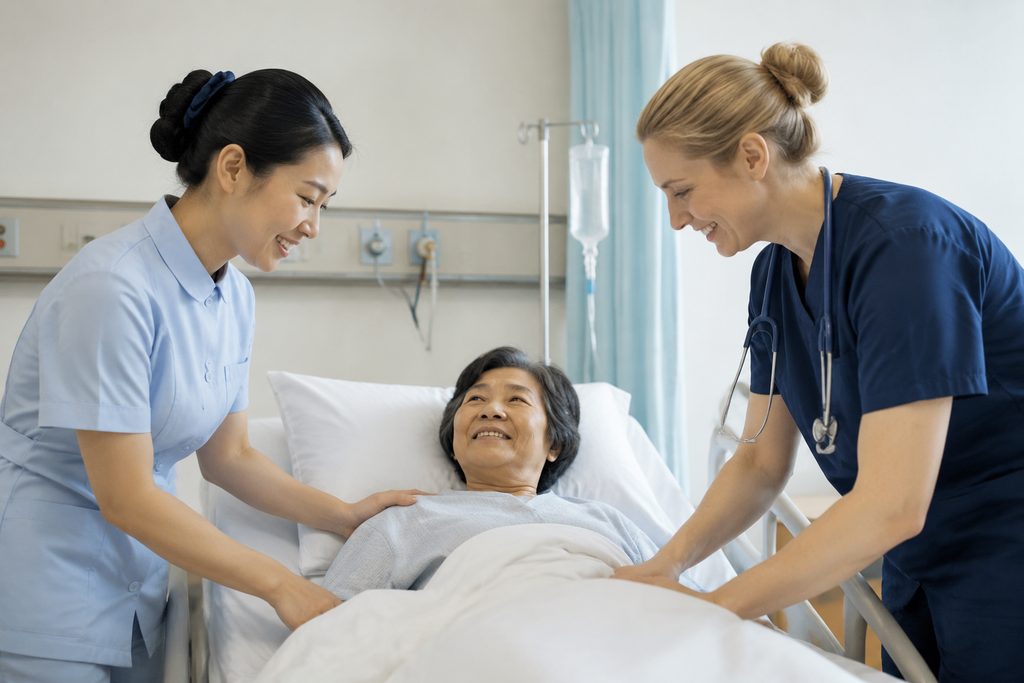
A 2022 study in the Journal of Transcultural Nursing found that 68% of international patients in Chinese hospitals initially rated nurse communication as “unexpectedly direct” compared to Western care. The nurse communication style China vs West differs in three measurable ways: verbal warmth, information delivery, and family involvement. Chinese nurses tend to be task-focused, clinically direct, and rely heavily on family members for emotional support and translation. Western nurses typically lead with rapport-building, explain procedures in more detail unprompted, and address the patient directly.
That is the surface-level difference. The deeper reality is more nuanced. A nurse at a top-tier international ward in Shanghai may communicate more like a nurse in Singapore or London than one in a crowded public hospital in a smaller Chinese city. The setting matters enormously. So does your preparation. A patient who understands the cultural framework behind the communication style will experience it very differently from one who interprets it through a purely Western lens.
Who This Matters To — and Who It Won’t Affect
This topic matters if you are considering a hospital stay in China longer than an outpatient visit. A 15-minute consultation with an English-speaking doctor tells you little about nursing communication. It is the hours on the ward, the night shifts, the medication rounds, and the post-operative checks where the differences surface. If you are coming for a procedure that requires a multi-day admission, nursing communication will shape your experience more than any other single factor.
Who should pay close attention:
- Patients accustomed to high-verbal-warmth nursing cultures, such as those in the US, Canada, Australia, and the UK
- Anyone traveling without a family member who speaks Mandarin
- Patients with high anxiety who rely on nurse reassurance as part of their coping strategy
- Those undergoing major surgery with an expected hospital stay of five days or longer
Who may not notice a significant difference:
- Patients who have previously received care in East Asian or Southeast Asian hospital systems
- Those staying exclusively in JCI-accredited international hospital wards with expatriate nursing staff
- Short-stay procedural patients discharged within 24 hours
- Patients traveling with a bilingual family member present at the bedside throughout the admission
The Options, Compared
Not all nursing environments in China are the same. The communication style you encounter depends almost entirely on which tier of hospital and which type of ward you choose. The table below compares what international patients actually report across three common settings.
| Factor | Public Hospital General Ward | Public Hospital VIP/International Ward | Private International Hospital |
|---|---|---|---|
| English-speaking nurses | Rare; limited to basic medical terms | 1-2 English-capable nurses per shift typical | Most nurses conversational or fluent |
| Bedside manner style | Task-focused, minimal small talk | Mixed; some rapport-building, varies by nurse | Western-style; verbal warmth expected |
| Information delivery | Brief; family expected to ask follow-ups | Moderate explanation; some proactive detail | Detailed; procedure explanations standard |
| Family involvement expected | High; family handles comfort, translation, advocacy | Moderate; nursing staff more autonomous | Low; nursing team manages most patient needs |
| Per-day nursing cost (USD) | Included in room charge ($50-150/day) | $200-500/day all-inclusive | $500-1,200/day all-inclusive |
Most international patients seeking high-acuity care at China’s top-ranked public hospitals end up in the middle column. The clinical expertise is concentrated in these institutions. A cardiac surgeon at Fuwai Hospital performs more complex procedures in a month than many Western surgeons do in a year. The trade-off is that nursing communication will not mirror what you receive at a Cleveland Clinic or a Charité Berlin. The private international hospitals in the third column offer a familiar communication style, but their specialty depth is narrower. For complex oncology, neurosurgery, or organ-specific procedures, the expertise resides in the large public institutions.
What “Bedside Manner” Actually Means in a Chinese Hospital
Western patients often ask us: what is bedside manner like in China? The honest answer is that it is a different construct. In a Chinese nursing framework, competence is demonstrated through efficiency, not conversation. A nurse who takes your vitals, administers medication, checks your IV, and leaves without unnecessary words is performing her role correctly by local standards. She is not being cold. She is being professional as her training defines it.
This creates a predictable friction point. A British patient might interpret silence as indifference. The nurse interprets her own behavior as respectful non-intrusion. Neither is wrong. But the gap is real.
Cultural differences nurse communication China reveal themselves in small moments. A Chinese nurse may not ask “How are you feeling today?” as a conversational opener. She will check your chart, look at your drainage output, and ask “Pain level?” while already reaching for the medication record. Western patients sometimes describe this as abrupt. Chinese patients often describe it as reassuring — the nurse is focused on clinical data, not social performance.
There is also the matter of touch. Chinese nurses use therapeutic touch less frequently than their Western counterparts during routine interactions. A 2023 observational study in BMC Nursing comparing nurse-patient interactions across five countries found that Chinese nurses initiated non-procedural touch in only 12% of bedside encounters, compared to 41% in Australian settings and 38% in American ones. This is not a deficit. It is a cultural norm. Knowing this ahead of time prevents the patient from feeling isolated or neglected.
Do Chinese Nurses Speak English in Hospitals?
The question “do Chinese nurses speak English in hospitals” is the one our team fields most often before a patient travels. The answer depends on the hospital, not the nurse’s individual ambition.
In a public hospital general ward, English capability among nursing staff is limited. A nurse may understand “pain,” “toilet,” “water,” and medication names. She will not conduct a conversation about your symptoms or explain discharge instructions in English. That is not her job as the system defines it. Doctors in these hospitals are far more likely to speak functional medical English than nurses are. The nursing curriculum in China historically emphasized reading comprehension of English medical literature over spoken communication.
In a public hospital international ward, the picture shifts. These wards are specifically designed for foreign patients and Chinese patients willing to pay a premium for upgraded amenities. Nursing staff are selected partly for language skills. You can expect at least one English-speaking nurse on duty during daytime hours. Night shifts may have more limited English coverage. Our team advises patients to keep key phrases written in Mandarin on their phone for the overnight hours, even in international wards.
In private international hospitals like United Family or Jiahui, English is the working language of the nursing staff. Many nurses have trained abroad or worked in international settings. Communication will feel familiar to a Western patient. The trade-off, again, is clinical scope.
What It Costs to Bridge the Gap
If you are staying in a public hospital ward where nursing English is limited, you have options. None are free, but all are less expensive than many patients anticipate.
A medical interpreter cost China hospital ranges from $200 to $400 per day for a professional with hospital experience. This is not a general translator. A medical interpreter understands clinical terminology in both languages and can accurately convey your symptoms, the nurse’s instructions, and the doctor’s explanations without distortion. Some hospitals have in-house interpreters available through their international patient department. Others allow external interpreters, which is where our bilingual medical companion service becomes relevant — starting from $200 per day for a half-day presence at your bedside.
For patients who do not need full-day interpretation but want a safety net, a video consultation interpreter can be arranged for $100 to $300 per session. This works well for pre-arranged conversations like discharge teaching or medication review, where you schedule the interpreter to join via tablet or phone at a specific time.
There is also the family factor. In Chinese hospitals, family members are expected to be present. They handle meals, comfort, mobility assistance, and communication with staff. If you are traveling alone, you will need to plan for this gap. A bilingual companion fills the role a Chinese family member would naturally occupy — not as a luxury, but as a practical necessity in a system designed around family presence.
Practical Considerations: Documentation, Payment, and Aftercare
Nursing communication extends beyond the bedside conversation. It shapes how discharge instructions are delivered, how medication schedules are explained, and how follow-up care is coordinated. If you do not speak Mandarin and your nurse does not speak English, you need a plan for each of these touchpoints.
Ask for written discharge instructions in English before you leave the hospital. This is not standard in all wards. In a public hospital general ward, English discharge summaries are typically not available unless arranged in advance through the international patient department. In international wards, English documentation is standard. Confirm this during admission, not at discharge when you are eager to leave.
Payment is another communication-heavy moment. Public hospitals in China operate on a prepaid deposit system. You load funds onto your hospital account at admission, and charges are deducted daily. When the balance runs low, a nurse or ward clerk will inform you — in Mandarin, unless you are in an international ward. If you do not understand the request and do not top up the deposit, medication and treatments may be paused. This is not punitive. It is how the system works. Having a bilingual companion or a family member who can handle these administrative moments prevents unnecessary stress.
Insurance adds another layer. Most Chinese public hospitals do not bill international insurers directly. You pay out of pocket and seek reimbursement later. The paperwork requires English-translated invoices and medical records. Some hospitals provide these routinely. Others require a specific request at the billing office. A medical companion who knows the hospital’s administrative geography can save you hours of walking between departments with a receipt in hand.
After you return home, nursing communication continues to matter. Your local doctor will need Chinese medical records translated accurately. Medication names, dosages, and follow-up instructions must be clear. We recommend requesting both the Chinese original and an English translation of your discharge summary before leaving the hospital. Do not rely on a verbal summary from a rushed resident on discharge day.
Frequently Asked Questions
In a general ward, probably not beyond basic words. Speaking slowly does not bridge a vocabulary gap. A nurse may recognize “pain,” “nausea,” or “dizzy,” but she cannot parse a sentence like “I feel a sharp pain on my left side when I breathe in.” In an international ward, a nurse with functional English can handle that sentence. In a private international hospital, the nurse will likely respond in fluent English. The setting determines everything.
This is a real concern. Night shifts in international wards typically have at least one staff member with basic English, but not necessarily a fully bilingual nurse on every floor. We advise patients to keep a translation app with an offline mode on their phone — Google Translate or a medical-specific alternative — and to have key emergency phrases saved in Mandarin. For planned admissions, our team can arrange a bilingual companion for overnight coverage, though this adds cost. Some patients find that having the companion present for the first two nights, when anxiety is highest and complications are most likely, is a reasonable middle ground.
Some are. Many are not. A review from a patient who stayed in a VIP international ward at a top-tier Beijing hospital will read very differently from one written by a patient in a general ward at a provincial hospital. Both are real experiences. Neither represents the whole picture. When reading international patient nursing care China reviews, look for specifics: which hospital, which ward type, what procedure, and whether the patient traveled with family. A review that omits these details tells you more about the reviewer’s expectations than about the nursing care itself.
You can request, but assignment is not guaranteed. Nursing schedules in Chinese hospitals are set by the head nurse based on staffing needs, not patient preference. In international wards, the head nurse typically assigns English-speaking staff to foreign patients as a matter of course. In general wards, there may simply be no English-speaking nurse on the roster that shift. Requesting is reasonable. Expecting is not.
There is no evidence that nursing communication style directly affects surgical outcomes or treatment efficacy in Chinese hospitals. The clinical training is rigorous. Medication administration, wound care, and vital sign monitoring follow protocols that are independent of bedside manner. What communication style does affect is your subjective experience — your anxiety level, your sense of control, and your understanding of what is happening to you. These matter for recovery. A patient who feels informed and supported heals differently from one who feels isolated and confused. The clinical outcome may be the same on paper. The human experience is not.
Your Next Step
Nursing communication in Chinese hospitals is not better or worse than in Western hospitals. It is different, and the difference is predictable once you understand the cultural framework. A patient who arrives expecting task-focused efficiency, limited small talk, and heavy family involvement will adapt quickly. A patient who arrives expecting the verbal warmth and autonomous information delivery of a Western nursing model will feel unsettled — not because the care is inferior, but because the communication style does not match the expectation.
Our team at China Medical Services helps international patients navigate these differences before they become problems. We are not a hospital. We do not provide medical care or make clinical recommendations. What we do is match you with the right hospital setting for your expectations and your budget, arrange bilingual companionship when needed, and ensure that language and cultural gaps do not compromise your experience. If you are considering treatment in China and want to understand what your day-to-day hospital experience will actually feel like — not just the clinical data — our free consultation is the place to start.
For more medical information and treatment options in China, visit chinamedservices.com (China Medical Services).
