Wheelchair Mobility Help China: Elderly Patient Arrangement Without Stress
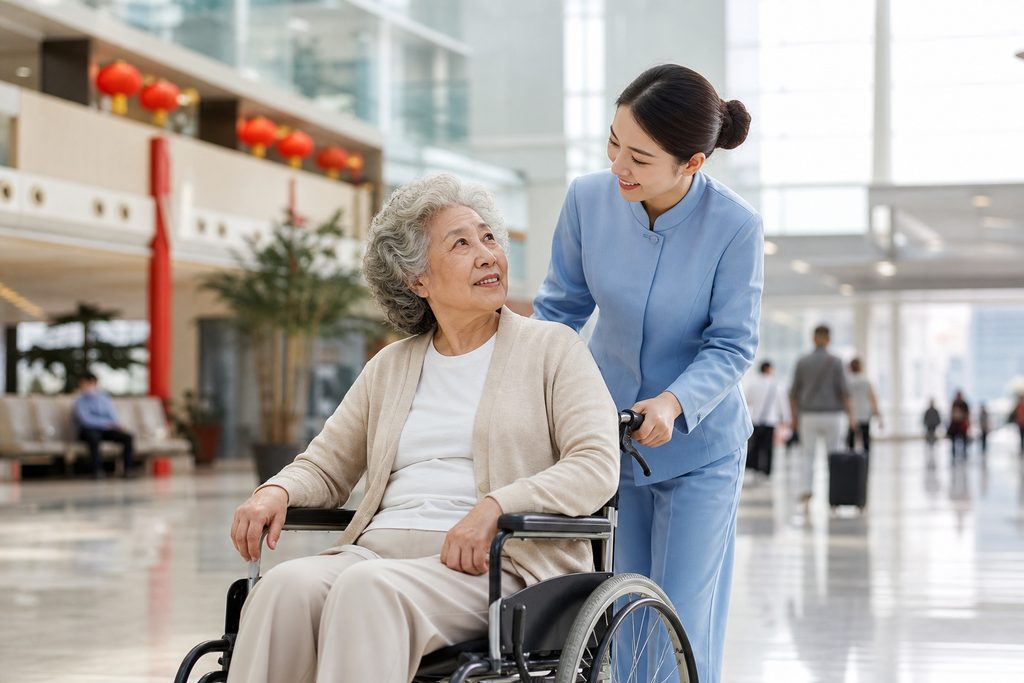
When 74-year-old Margaret considered joining her son in Shanghai for advanced orthopedic rehabilitation, her first thought wasn’t about the surgery. It was the logistics. How do you move a wheelchair-bound parent through a massive, unfamiliar hospital in a country where you don’t speak the language? Her anxiety is the rule, not the exception. We hear it constantly from families researching wheelchair accessible hospitals china cost and elderly patient arrangement. The physical infrastructure in China’s top-tier hospitals is often excellent—wide corridors, dedicated elevators, accessible restrooms. The real gap is operational. Without a plan, a 15-minute registration queue can turn into a two-hour ordeal for someone with limited mobility.
Key Takeaways
- China’s top-ranked hospitals feature modern infrastructure compliant with international accessibility standards, but navigating the sheer scale of these facilities requires advance logistical planning.
- Dedicated wheelchair transport and bilingual mobility assistance are available for foreign patients, with daily coordination costs starting from approximately $200.
- Public hospital international departments and private hospitals offer the smoothest experience, while standard public outpatient halls can be overwhelmingly crowded for elderly wheelchair users.
- Families should budget separately for clinical treatment and for non-medical mobility logistics—these are distinct line items that insurance rarely covers.
The Problem: A Single Step Can Block an Entire Medical Journey
China’s healthcare system treats over 8 billion outpatient visits annually. Many of the elite hospitals in our network, like those found on our top-hospitals page, handle upwards of 10,000 outpatient visits per day. For an elderly patient in a wheelchair, this volume translates into a physical gauntlet. The distance from the hospital drop-off point to the correct specialist’s consultation room can span several city blocks of indoor corridors. Signage is predominantly in Chinese characters. Queues for elevators can be 20 people deep during peak morning hours. We have seen a single broken wheelchair-accessible restroom stall derail an entire afternoon of pre-operative tests. This isn’t a reflection of medical quality. It’s a structural reality of high-volume, high-efficiency public institutions. The core issue is friction. Every transfer from a car seat to a wheelchair, every wait in a non-shaded outdoor queue, and every communication breakdown adds physical strain and emotional distress. When you search for how to arrange wheelchair assistance for elderly in china hospital, you are not just looking for a ramp. You are looking for a way to eliminate that friction.
Why China’s Model Delivers Results for Mobility-Limited Patients
The medical rationale for choosing China often centers on surgical volume and cost. But the infrastructure supporting disabled patients is a parallel, equally important story. It is not universally perfect, but in the right hospitals, it is world-class.
Infrastructure Designed for Volume and Access
Newer hospital wings, particularly in international departments and private facilities like those listed on our private-hospitals page, are built with wide, flat thresholds. You rarely encounter the charming but obstructive narrow doorways found in older European clinics. Beijing and Shanghai hospitals frequently feature centralized “one-stop” service centers. These are designed to minimize the distance between registration, phlebotomy, and ECG. For a wheelchair user, that means fewer transfers and less corridor navigation. The accessible restrooms are typically spacious, though we always advise carrying your own sanitizing supplies as a precaution.
The Cost of Specialized Mobility Logistics
This is where we need to be direct. When families budget for wheelchair accessible hospitals china cost, they often conflate the medical bill with the logistical bill. The clinical costs—a knee replacement, for instance—are structurally lower. You might pay $12,000 to $18,000 for a procedure that bills at $50,000 or more in the United States. But the non-medical mobility support is an additional, separate cost. Hiring a bilingual medical companion who is trained in safe patient transfer and wheelchair handling starts from $200 per day. Booking a private, wheelchair-accessible vehicle with a hydraulic lift for elderly patient transport services shanghai price typically runs between $80 and $150 per half-day, depending on distance and wait times. This is not a hidden fee. It is the reality of ensuring dignity and safety. You are paying for a person who knows exactly which elevator bank bypasses the congested main hall and can get you to the MRI suite without a 40-minute wait in a corridor.
Mapping Out the Wheelchair-Accessible Hospital Visit
You cannot simply hail an accessible taxi in most Chinese cities. Spontaneous mobility is difficult. Meticulous pre-arrangement is what makes the day successful. Here is how we structure a typical day for an elderly patient.
The process starts the night before. The vehicle and driver are confirmed, with the license plate sent to your phone. The companion reviews the next day’s appointment schedule: Lab at 8:30 AM, specialist consult at 10:00 AM. The companion identifies the closest accessible drop-off zone for each building. In the morning, the vehicle arrives. The companion assists with the transfer from the hotel lobby. At the hospital, while the patient waits in a quiet, pre-identified seating area, the companion handles the registration queue. When the electronic screen displays the patient’s number, they move together to the consultation room. This sequence—pre-positioning, queuing on behalf of the patient, and moving the patient only when needed—reduces physical exhaustion by an estimated 70% compared to navigating the system alone. This is the practical answer to the question, is wheelchair mobility help available for foreign patients in china. Yes, it exists. But it is a human service, not an automated kiosk.
Comparing Your Real Options for Elderly Mobility Arrangements
There are three distinct tiers of support. Which one you choose dictates the daily experience, and the cost. Do not assume that the most expensive hospital provides the best mobility support. Often, the mid-tier international department offers the smoothest ratio of clinical expertise to physical accessibility.
| Option | Mobility Experience | Estimated Non-Medical Logistics Cost | Best For |
|---|---|---|---|
| Standard Public Hospital | Extremely crowded; long elevator waits; no wheelchair assistance staff; family must handle all transfers. | $0 (but high physical and time cost) | Not recommended for wheelchair-dependent foreign elderly without a dedicated companion. |
| Public Hospital International Department | Dedicated elevators; wider corridors; some English-speaking nurses; can coordinate with external companion services. | $200–$350/day (companion + accessible vehicle) | Patients seeking top-ranked specialty care with manageable mobility support. |
| Private International Hospital | Hotel-like atmosphere; minimal crowding; in-house wheelchair provision; direct insurance billing. | $150–$250/day (often less external logistics needed) | Patients prioritizing comfort and convenience for routine procedures or check-ups. |
When you want to book wheelchair medical transport china for elderly, you are essentially choosing between option two and three. The vehicle itself is a commoditized service. The value lies in the person accompanying you. Can they smoothly lift a folded wheelchair into a trunk if the accessible van is delayed? Do they know the back entrance to the radiology department that avoids a flight of stairs? These micro-decisions define the day.
Practical Considerations: Documentation, Payment, and Physical Terrain
Bringing an elderly wheelchair user to China requires more than a passport and a visa. The physical reality on the ground demands specific preparation.
Medical records must be meticulously organized. We advise creating a single, tabbed binder. Tab one: a typed summary of the patient’s condition, allergies, and current medications (in English and Chinese). Tab two: recent imaging reports on a CD-ROM, as many Chinese hospitals still prefer physical media. Tab three: a copy of the patient’s travel insurance and a letter of medical necessity from the referring physician. This binder becomes the patient’s voice when fatigue sets in. For the visa, the patient and one accompanying family member will apply for an S2 visa, citing private affairs and medical treatment. The hospital’s invitation letter is critical here. It must state the nature of the treatment and the estimated duration.
Payment for the logistics—the transport, the companion, the coordination—is typically handled separately from the hospital bill. Hospitals accept credit cards or cash deposits. Mobility services often require a deposit via wire transfer or WeChat/Alipay. This can be a hurdle if you haven’t set up these digital wallets. We walk families through this. The physical terrain outside the hospital matters too. Hotel selection becomes a medical decision. A hotel 20 minutes away with a roll-in shower and a reliable elevator is better than a luxury hotel 5 minutes away with a single step at the entrance and a narrow bathroom door. We always scout the hotel room before the patient arrives, sending photos of the bathroom layout and the path from the lobby to the elevator.
Frequently Asked Questions
Major public hospitals often have a limited number of basic transit wheelchairs available for a small deposit, but these are frequently in high demand and may not be available when you need one. For a patient who depends on a wheelchair for postural support or comfort, we strongly recommend bringing your own customized chair. It is a piece of medical equipment, not just a convenience, and the airline will check it through without charge.
This is the single most important piece of information to communicate before arrival. Standard hospital transport vehicles do not have hydraulic lifts unless specifically booked. We arrange vehicles with lifts and a two-person assist team. The cost is higher—typically an additional $50 to $80 per trip—but it eliminates the risk of a fall during transfer. Never assume a standard accessible taxi can handle a non-ambulatory passenger.
Yes. The international departments of large teaching hospitals in Shanghai and Beijing are purpose-built for this. They see a higher volume of international patients and their corridors are designed with less congestion in mind. Private hospitals in the United Family Healthcare network are also consistently reliable for wheelchair accessibility, though their scope for complex multi-specialty care may be narrower than a top-ranked public general hospital.
You dial 120 for an ambulance. The dispatcher will likely speak Chinese. This is why having a local contact—whether a hotel concierge or a medical companion—is vital. We provide a card with the patient’s key medical details in Chinese characters, designed to be handed directly to paramedics. It lists diagnoses, allergies, and the admitting hospital’s contact information.
Your Next Step
Arranging care for an elderly parent from across the world is hard. The worry about physical comfort and dignity is often heavier than the worry about the surgery itself. We understand that because we coordinate these logistics every day. Our team does not provide medical care—we are not a hospital and we do not give diagnoses. We are the operational layer that connects your family to the right clinical team at the right time, without the physical exhaustion. If you are weighing the possibility of china medical tourism packages wheelchair accessible, start with a single conversation about your specific needs. The path forward becomes clear once the logistics are broken down into manageable pieces. You can reach us through our consultation page to begin that discussion.
For more medical information and treatment options in China, visit chinamedservices.com (China Medical Services).
