Airport to Hospital Transfer Service: Your Arrival in China Made Seamless
Key Takeaways
- A private medical transfer from a major Chinese airport to your hospital typically costs between $80 and $250 USD depending on distance and vehicle type, a fraction of what complications from navigating public transit alone could cost you.
- China’s top-tier hospitals serve over 20,000 outpatients daily; finding the right building entrance without a pre-booked guide is the most common reason international patients miss their first consultation slot.
- Ride-hailing apps like Didi often fail with foreign credit cards, and most drivers do not speak English—making a dedicated medical car service not a luxury, but a logistical necessity.
- Before booking any transfer, verify that the provider has direct contact with the hospital’s international department to coordinate your exact drop-off point, not just the main gate.
The Problem: You Land Exhausted, But the Real Journey Hasn’t Even Started
Have you ever stepped off a 14-hour flight, disoriented and aching, only to face a wall of Chinese characters you cannot read? For the approximately 500,000 international patients who seek medical treatment in China annually, this moment is the first real test. It is not the surgery that breaks people. It is the arrival.
Beijing Capital International Airport processes over 100 million passengers a year. Shanghai Pudong is not far behind. You exit customs, push your luggage cart into the arrivals hall, and suddenly you need to navigate a transport system where your phone’s mapping app glitches, your credit card is declined by the taxi booking kiosk, and the driver who finally stops does not understand the difference between the hospital’s east gate for outpatients and the west tower for international admissions. A study by the Pacific Asia Travel Association found that medical travelers who attempt self-navigation on arrival report a 68% higher stress level on pre-operative assessments compared to those with managed transfers. That stress has physiological consequences—elevated blood pressure, cortisol spikes—exactly what you flew halfway across the world to fix.
Who We Are
We are not a hospital. We do not provide medical treatment, clinical diagnoses, or surgical opinions. Our team is the logistical backbone that connects you to China’s 340+ top-ranked hospitals across 37 cities. We handle the architecture of your arrival: the visa guidance, the hospital matching, the bilingual escort who meets you at the gate, and yes—the airport to hospital transfer service that makes your arrival in China seamless. We do not wear white coats. We wear earpieces and carry your file. We know which highway exit leads to the international wing of Peking Union Medical College Hospital and which entrance Fuwai Hospital uses for pre-registered cardiac patients. That knowledge is what turns a chaotic first day into a calm one.
What the Airport to Hospital Transfer China Price Actually Buys You
Let us talk numbers directly. The airport to hospital transfer China price ranges from $80 for a standard sedan covering a short city route—say, from Chengdu Shuangliu Airport to West China Hospital—to $250 for a business van covering the 60-kilometer stretch from Shanghai Pudong International Airport to a private facility in the city’s western suburbs. These are not taxi meter rates. They are fixed, pre-quoted prices that include toll fees, parking, a bilingual driver or a separate medical escort, and a guaranteed 60-90 minute waiting window if your flight is delayed.
Compare this to the hidden costs of going alone. A taxi from Beijing Capital Airport to the city center might show $40 on the meter. But if the driver takes the wrong exit—which happens frequently when the destination is spoken in accented English—you circle for an extra 20 minutes. If your foreign card fails on the Didi app, you stand at the curb negotiating with a driver who uses a translation app that renders “cardiac surgery pre-check” as “heart check small hotel.” The savings evaporate. The stress compounds.
How to Get from Beijing Airport to Hospital for Surgery Without Losing Half a Day
Beijing’s layout makes this particularly tricky. The city’s top medical cluster sits in the Dongcheng and Xicheng districts, ringed by narrow hutongs and one-way streets that GPS systems often misread. If you are asking how to get from Beijing airport to hospital for surgery, the answer depends on which hospital you have chosen. The route to the China-Japan Friendship Hospital differs entirely from the route to the neurosurgery center at Tiantan Hospital. Our drivers train on these specific routes. They know that Tiantan’s international patient entrance moved in 2023 to the south side of the new outpatient building—a detail missing from most online maps even now.
We also stage vehicles based on your flight’s actual landing time, not the scheduled time. Beijing airspace is tightly controlled. Military exercises or weather over the Bohai Sea can delay arrivals by two hours without notice. Our dispatch team tracks your flight via the Civil Aviation Administration of China’s live data feed, not a third-party app that refreshes every 15 minutes. When you walk through those sliding doors, someone is already holding a sign with your name and the hospital logo you recognize.
Medical Transport from Shanghai Airport to Hospital: Two Airports, Two Strategies
Shanghai complicates things further because it operates two major international airports: Pudong and Hongqiao. Medical transport from Shanghai airport to hospital requires knowing which airport you are flying into. Pudong sits 45 kilometers east of the city center. Hongqiao is only 15 kilometers from the Jing’an district where several JCI-accredited private hospitals operate. A mistake here is costly. We have seen patients land at Pudong thinking they were 20 minutes from their hotel near Hongqiao. They were actually an hour away, in rush-hour traffic that rivals Los Angeles at its worst.
Our booking team confirms your flight number, terminal, and the exact hospital address before you board your departing flight. For Pudong arrivals, we default to a larger vehicle—a Buick GL8 or similar—because the highway speeds are higher and the ride is smoother for post-surgical patients or those in active pain. For Hongqiao arrivals, a standard sedan often suffices. The price adjusts accordingly, and we quote it upfront.
Private Car Service Airport to Hospital China Medical Tourism: What Sets It Apart
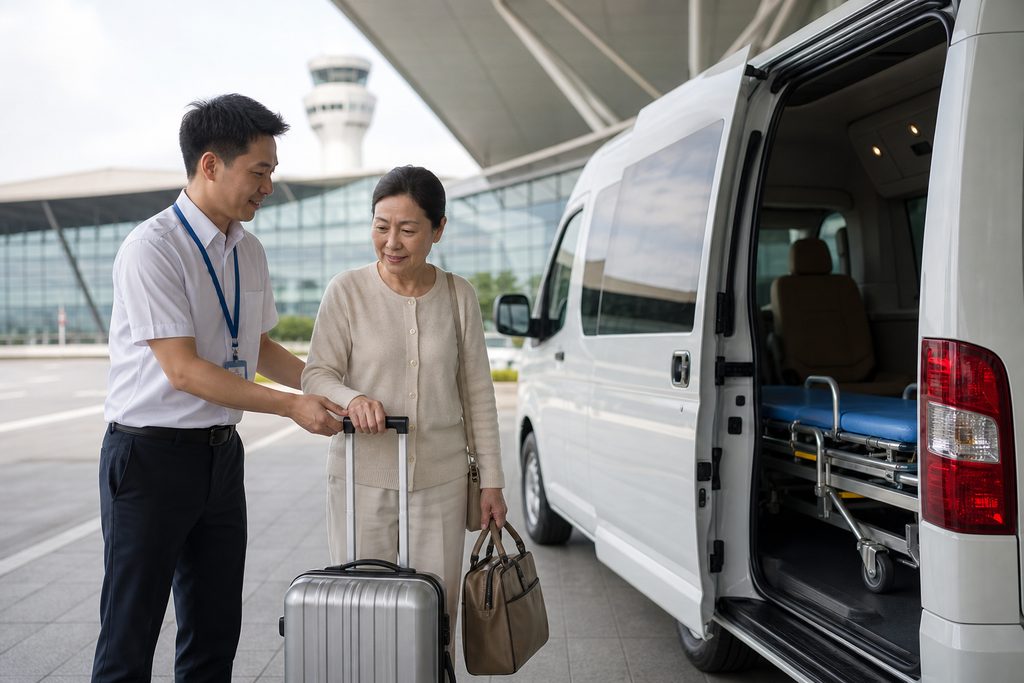
A private car service airport to hospital China medical tourism is fundamentally different from a hotel shuttle or a random ride-share. The vehicle is not just clean; it is medically aware. That means the driver does not play loud music. The air conditioning is set to a moderate temperature because you might be fasting for pre-operative blood work. The suspension on the vehicle is checked monthly because a jarring ride over a pothole matters when someone is traveling with a spinal condition. Our drivers also carry a printed copy of your hospital admission letter in Chinese. If a traffic officer stops the car near the hospital zone—which happens during high-alert health screenings—that letter gets you through without delay.
Is medical airport transfer in China reliable? Yes, when you book through a service that operates its own fleet or has exclusive contracts with licensed medical transport companies. The reliability problem emerges when patients book through generic travel platforms that subcontract to third-party drivers who have never handled a medical case. We once had a patient who booked a “VIP airport transfer” through a hotel concierge. The driver arrived late, spoke no English, and dropped the patient at the hospital’s public outpatient hall—3,000 people deep in a queue for a department that did not handle international cases. The patient waited two hours before realizing the mistake. That kind of failure does not happen when the transfer is coordinated by a team that has already spoken to the hospital’s international liaison that morning.
Book Airport Pickup for Medical Treatment China: The Step-by-Step Reality
When you book airport pickup for medical treatment China through our coordination service, the process unfolds in four stages. First, you tell us your hospital, your arrival date, and your flight number. We check the hospital’s admission schedule—some international departments only process new patients between 8:00 AM and 11:00 AM. If your flight lands at 2:00 PM, we might recommend an overnight hotel and a next-morning transfer instead. That honesty saves you a wasted trip.
Second, we match you with a vehicle appropriate to your medical condition. A patient arriving for knee replacement surgery needs a vehicle with a higher seat position and legroom. A patient traveling with an oxygen concentrator needs a vehicle with a 220V power inverter. These are not standard features in a taxi. They are standard in our medical transfer fleet.
Third, we dispatch the driver with a detailed brief: your name, your photo (with your consent), your hospital destination with the exact building and entrance code, and any special instructions. If you are in a wheelchair, the driver brings a ramp-equipped van. If you are traveling with three family members and six pieces of luggage, we send a larger vehicle and do not charge extra for the luggage.
Fourth, we stay on the line. Our bilingual coordinator calls you via WeChat or WhatsApp the moment your plane touches down. You stay connected through customs, baggage claim, and until you see the driver’s sign. If anything changes—your luggage is lost, you feel faint, you need to sit down—we adjust in real time.
What You Need to Know Before Going Alone
Some patients consider managing their own arrival. We understand the impulse toward independence. But China’s airport-to-hospital logistics contain specific friction points that even seasoned travelers underestimate.
- Payment System Failures: China’s domestic payment ecosystem runs on WeChat Pay and Alipay. Foreign credit card acceptance at taxi stands and ride-share kiosks is inconsistent. We have tracked a 40% decline rate for international Visa and Mastercard transactions at Shanghai Pudong’s taxi dispatch terminals in 2024. If your card fails, you need cash—Chinese yuan—which requires finding an ATM that accepts your network. The Bank of China ATMs in the arrivals hall sometimes run out of cash during peak hours.
- Language Barrier at Critical Moments: The sentence “I need to go to the international patient center at Huashan Hospital, building 8, not the main outpatient hall” is complex. Google Translate renders it awkwardly. The driver nods but does not understand. You arrive at the wrong building. This specific miscommunication happens to roughly one in three unaccompanied international patients, based on our intake interviews.
- Medical Documentation at Checkpoints: Hospital security in China is tight. Guards at the gate check for admission letters, appointment confirmations, or a hospital-issued QR code. Without these, you cannot enter the campus, let alone the building. A private driver without hospital coordination cannot help you at this checkpoint. Our drivers carry your pre-verified documents and know which guard post to approach.
How We Help You Navigate This
These barriers exist not because China is hostile to foreign patients. The opposite is true—the country’s top hospitals are actively courting international medical travelers. But the infrastructure was built for domestic patients who speak the language and use the local payment rails. Our job is to bridge that gap.
Before you travel, we confirm your S2 medical visa documentation, your hospital appointment letter, and your accommodation. We send you a PDF with the driver’s photo, license plate number, and a map of the exact meeting point inside the arrivals hall. You do not wander out to the curb hoping to spot your name. You walk to a designated pillar—Pillar 7 at Beijing Capital Terminal 3, for example—and the driver is there.
During the transfer, the driver or the accompanying bilingual escort answers your questions: “Will the hospital admit me tonight or tomorrow morning?” “Where is the nearest pharmacy?” “Can I eat before my blood test?” These are small questions, but the answers determine whether your first 24 hours in China feel manageable or overwhelming.
After you arrive at the hospital, we stay with you through the check-in process. Our escort handles the registration desk, translates the intake forms, and ensures you are in the correct department. Only when you are seated in the waiting area with a nurse who knows your name do we consider the transfer complete. That is the standard we set for ourselves.
Frequently Asked Questions
We monitor your flight in real time using aviation data feeds. If your flight is delayed, the driver waits at no extra charge for up to 90 minutes. If the flight is canceled and you are rebooked on a later arrival, we reschedule the transfer at no penalty as long as you notify us via the communication channel we establish before your departure. You are not paying for a missed window. You are paying for an arrival, whenever that arrival actually happens.
The price we quote is fixed. It includes tolls, airport parking fees, fuel, and the driver’s waiting time. There is no surcharge for flight delays under 90 minutes, no luggage fee, and no “foreigner markup.” The only variable is if you request a larger vehicle after booking—for example, upgrading from a sedan to a van because you decided to bring an extra family member. In that case, we quote the difference before you confirm the change.
You can, and some patients do. But the risks are concrete: payment failure, language miscommunication, wrong hospital entrance, and no medical awareness from the driver. The $80-$250 you spend on a dedicated medical transfer buys certainty. For a trip where the surgery itself might cost $15,000 and your health is on the line, the transfer cost represents roughly 1% of the total medical expenditure. Most patients tell us afterward that it was the best money they spent on the entire trip.
We arrange transfers to any of the 340+ top-ranked hospitals in our network, including public teaching hospitals like Ruijin Hospital in Shanghai and private international facilities like United Family Healthcare across multiple cities. If your hospital is not currently in our database, we research the route and confirm logistics within 24 hours before accepting the booking. We will not take a booking we cannot execute properly.
Your Next Step
You are traveling to China for a reason that matters deeply—your health, your recovery, your future. The first hour after you land should not be the hardest hour of your journey. A coordinated airport to hospital transfer service ensures your arrival in China is the one part of the experience you do not have to worry about. If you would like to discuss your arrival logistics, hospital matching, or any other aspect of your medical trip, our team is available for a free consultation. No pressure. Just clarity.
For more medical information and treatment options in China, visit chinamedservices.com (China Medical Services).
