Extended Treatment in China: Housing, Meals, and Daily Life Support for Long-Term Medical Stays
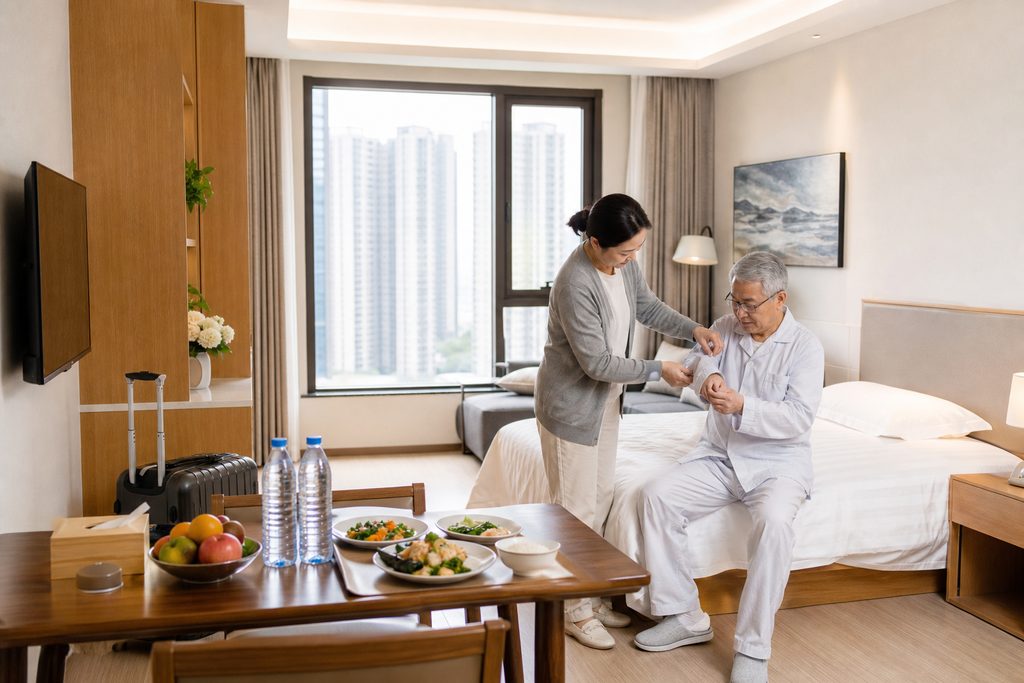
Have you ever tried to find a furnished apartment in a foreign city where you don’t speak the language, all while facing a serious medical diagnosis? The stress is real. It is a layer of exhaustion that no patient or family caregiver should have to carry alone. Our team at China Medical Services has spent years solving exactly this problem for international patients. We do not provide medical treatment. We are not a hospital. We are your logistical architects on the ground, ensuring that your focus remains squarely on treatment and recovery, not on navigating a foreign housing market. This guide breaks down exactly how housing, meals, and daily life work during an extended medical stay in China, and how our team makes it seamless.
Key Takeaways
- Securing a long term medical stay apartment rental Shanghai or Beijing requires navigating local platforms that are often Mandarin-only, with leases that rarely accommodate flexible medical timelines.
- While the cost of an extended stay hospital accommodation China cost is structurally much lower than in the West, the real value lies in proximity to top-tier specialists and integrated recovery support.
- The biggest barrier for most families is not clinical quality but daily logistics: language barriers during grocery runs, managing hospital cafeterias, and handling laundry during a neutropenic recovery phase.
- You should understand that a “medical tourism package” is not a standardized product in China’s top public hospitals; it is a custom-built service layer that must be assembled by a local team who understands both the healthcare system and the rental market.
The Problem: Why “Just Booking a Hotel” Fails for Extended Treatment
A standard hotel room is designed for a vacation, not for a bone marrow transplant recovery. When treatment stretches from weeks into months, the cost of a hotel becomes unsustainable. But the financial drain is only part of the problem. A study published in the *Journal of Clinical Oncology* found that logistical and financial toxicity significantly worsens quality of life for patients undergoing extended cancer care, sometimes more than the physical side effects of the treatment itself. You need a kitchen that allows you to manage a post-operative neutropenic diet. You need a washing machine when you are going through three changes of clothes a day. You need to know that the air filtration system is good enough to protect a compromised immune system in a dense urban environment like Shanghai. A hotel simply cannot check these boxes.
We see patients try to piece this together on their own. They rely on international booking platforms. They end up in serviced apartments designed for business travelers, paying a premium for a location that might be a 45-minute traffic jam away from Fudan University Shanghai Cancer Center. The disconnect between the housing market and the medical map is where the real friction lies. You are not just looking for a roof. You are looking for a sterile, comfortable, and functional recovery base that sits inside a critical radius of the hospital’s outpatient clinic.
Who We Are
We are a team of patient coordinators, bilingual logistics specialists, and former hospital administrators. We do not perform clinical assessments or provide medical advice. Our role is to bridge the gap between you and China’s top 5% of hospitals—the 340+ ranked institutions across 37 cities that meet rigorous Fudan and JCI standards. We handle the architecture of your stay: securing the right visa, matching you with the correct specialist, and building a daily life support system that covers housing, meals, and translation. We know the unspoken rules of the local rental market, and we use that knowledge to protect your recovery timeline.
Why a Structured Long-Term Stay Delivers Better Recovery Results
Recovery is not passive. It requires an environment that actively supports it. The difference between a stressful, improvised living situation and a structured medical stay often shows up in treatment adherence. When someone else handles the logistics, patients keep their appointments. They eat better. They rest. Here is what that structured support actually looks like on the ground.
The Reality of a Long Term Medical Stay Apartment Rental Shanghai
Shanghai’s medical district is not a single neighborhood. It is a network of specialized clusters. Finding a long term medical stay apartment rental Shanghai means you need to be close to the right cluster. If you are receiving proton therapy at the Shanghai Proton and Heavy Ion Center, you are in Pudong, a vast district where the wrong location can mean an hour-long commute each way. If you are under the care of a specialist at Huashan Hospital, you need to be in the dense, central Jing’an district, where short-term leases are fiercely competitive.
The local market operates on platforms like Anjuke and Beike. These are Mandarin-only. Listings often exclude service fees and do not clarify the landlord’s stance on “medical use” of the property. Some landlords are superstitious and refuse to rent to patients. Others are cooperative but require a local guarantor. Our team navigates these nuances. We secure apartments with flexible lease terms, often on a month-to-month basis, because we know a treatment plan can shift from 8 weeks to 12 weeks after a single blood test. We also ensure the apartment is equipped with a proper medical-grade refrigerator if you need to store specific medications.
What Is Included in Medical Tourism Long Stay Package China
This is a question we hear constantly: what is included in medical tourism long stay package China? The honest answer is that it varies drastically, and you should be skeptical of rigid, pre-packaged deals. In China’s top public hospitals, there is no official “package” sold by the hospital itself. The hospital provides the clinical pathway. The “package” is the service layer constructed around that pathway by a coordination team.
A properly constructed support system should not feel like a tour package. It should feel like a local support infrastructure. It typically includes a fully furnished apartment, bi-weekly cleaning with hospital-grade disinfectants, and a utility setup that you never have to think about. It also includes the daily operational support: a driver who knows the hospital drop-off points, a bilingual assistant who can read a Traditional Chinese Medicine prescription and direct you to the right dispensary, and a meal delivery system that understands dietary restrictions like low-iodine or low-bacteria diets. That is the real “package.” It is dynamic, not static.
Medical Recovery Residence with Meals China Price
Let’s talk about the medical recovery residence with meals China price. You are likely comparing this to the cost of a recovery facility in the US or Europe. The structural economics are different here. In Shanghai, a high-quality, fully furnished one-bedroom apartment near a major cancer center typically ranges from $2,500 to $4,500 per month. This is not a cheap city. But compare that to the $8,000 to $12,000 per month for a similar setup near the Texas Medical Center in Houston or a recovery suite in London.
The meal component is where the value deepens. You cannot rely on food delivery apps when you are on a neutropenic diet. Cross-contamination risks are too high. A specialized medical meal service, delivering three meals and two snacks daily, designed by a clinical nutritionist, typically costs between $25 and $45 per day in a city like Shanghai. That is roughly $750 to $1,350 per month. The total monthly operational cost for a fully supported recovery—housing, meals, transport, and a bilingual companion for 4 hours a day—often lands between $6,000 and $9,000. It is a significant investment, but it is a fraction of what the clinical procedure alone would cost in the West, and it is the single most effective way to reduce non-clinical stress during treatment.
Finding the Right Location: Beyond the Hospital Address
Proximity is not just about distance on a map. It is about walking time, traffic patterns, and elevator wait times in high-rise apartment blocks. When you are trying to find housing near hospital in Beijing for treatment, you are facing one of the most complex urban environments in the world. Beijing’s medical cluster in Dongcheng, home to Peking Union Medical College Hospital (PUMCH), is surrounded by traditional hutong alleyways and modern high-rises. The wrong choice means navigating narrow lanes in a wheelchair or dealing with a building that has no service elevator for medical equipment.
We map your housing to your specific treatment schedule. If you are doing daily radiation, you need to be within a 15-minute walk. The cumulative fatigue of a 40-minute car ride each way, five days a week for six weeks, can break a patient’s spirit. Also, we look at the floor level and window sealing. Beijing’s air quality can fluctuate, and a recovery apartment must have a fully sealed window system and a high-grade air purifier running 24/7. These are not amenities. They are non-negotiables for an immunocompromised patient. Our team physically inspects properties for these clinical-grade living standards before we ever send you a photo.
How to Book Furnished Apartment for Cancer Treatment Shanghai
The process to book furnished apartment for cancer treatment Shanghai is fundamentally different from a normal rental. You cannot just send a deposit and sign a standard contract. A standard contract in China often includes a clause penalizing early termination with two months’ rent. But your departure date is dictated by your white blood cell count, not a calendar. We negotiate medical termination clauses. This is a specific, legally binding addendum that states if the treating physician deems the patient fit to travel, the lease can be terminated with 14 days’ notice without penalty.
We also handle the payment layer. Chinese landlords typically demand three months’ rent upfront: one month’s rent, one month’s security deposit, and one month’s agency fee. Wiring this amount internationally to a personal landlord’s account is a nerve-wracking experience for most foreign families. We act as the intermediary, providing a secure payment channel and a bilingual contract that protects your deposit. We also document the pre-existing condition of the apartment with timestamped video, which is a standard local practice to prevent deposit disputes upon departure. You focus on your pre-treatment blood work. We focus on the lease terms.
Daily Life: The Invisible Logistics That Save Your Energy
Daily life during extended treatment is a series of small battles. It is the pharmacy run for a specific brand of sterile gauze. It is the need to eat a high-protein meal when you have no appetite and cannot stand the smell of cooking. It is the moment the hospital billing department hands you a stack of invoices in Chinese characters and you need to reconcile them for your insurance claim back home.
Our bilingual medical companions are the solution to these thousand small battles. They are not just translators. They are problem-solvers. They know which hospital canteen serves the best congee for a post-surgical gut. They know where to buy a shower stool within a two-hour delivery window. They can sit with you during a four-hour infusion, not just to translate the nurse’s questions, but to notice if the IV drip rate looks different from yesterday and flag it. This is the support layer that turns a foreign medical trip into a safe, sustainable recovery journey.
And then there is the food. We work with nutrition services that deliver medically tailored meals. If your oncologist says “soft, bland, high-calorie,” our partner kitchens execute that precisely. No MSG. No raw vegetables. No cross-contamination with shellfish. The meals arrive in sealed, temperature-controlled containers. It sounds simple, but for a patient with oral mucositis who has lost 15 pounds, a perfectly textured, nutrient-dense soup that they can actually swallow is a form of medicine.
Frequently Asked Questions
We do not rely on standard cleaning checklists. We specify a hospital-grade disinfection protocol before move-in, focusing on high-touch surfaces, air conditioner filters, and washing machine drums. We can also arrange for a professional deep-cleaning service that uses UV-C light sterilization for the bedroom and bathroom. You should request this even if you are renting a luxury serviced apartment, as standard hospitality cleaning is not designed for immunocompromised individuals.
This is one of the most common disruptions we manage. We always negotiate a right-of-first-refusal clause in your lease. This means if your treatment extends from six weeks to ten weeks, the landlord cannot lease the apartment to someone else as long as we notify them by a specific date. If the apartment is already booked, we activate a parallel search immediately, typically securing a comparable unit within the same residential compound to minimize disruption. We have never had a patient left without housing due to a treatment extension.
Yes, but it requires trade-offs. The extended stay hospital accommodation China cost can be reduced significantly if you move slightly further from the hospital core, to a well-connected suburb, and if you opt for a local-style apartment rather than an expat-oriented serviced complex. We can find clean, safe, and functional housing for around $1,800 per month in Shanghai. However, you will likely trade off some built-in amenities like an on-site gym or a bilingual front desk. We are transparent about what each budget tier buys you, and we help you prioritize location and cleanliness above all else.
Your Next Step
An extended medical stay in China is a logistical challenge that can be completely neutralized with the right local team. You should not have to choose between managing a difficult rental negotiation and supporting a family member through chemotherapy. The entire housing, meal, and daily life support system can be built for you, tailored to your clinical timeline and your personal comfort needs. If you are planning a treatment journey and the thought of finding a long-term apartment feels heavier than the treatment itself, reach out to our team. We can walk you through the specific neighborhoods, realistic budgets, and support structures available for your exact case.
Our coordination team is ready to build a personalized recovery plan that covers every detail from the moment you land. Request a free consultation to discuss your treatment timeline and housing needs with our patient support specialists.
For more medical information and treatment options in China, visit chinamedservices.com (China Medical Services).
