China Border Entry for Medical Treatment: Our Companion Service
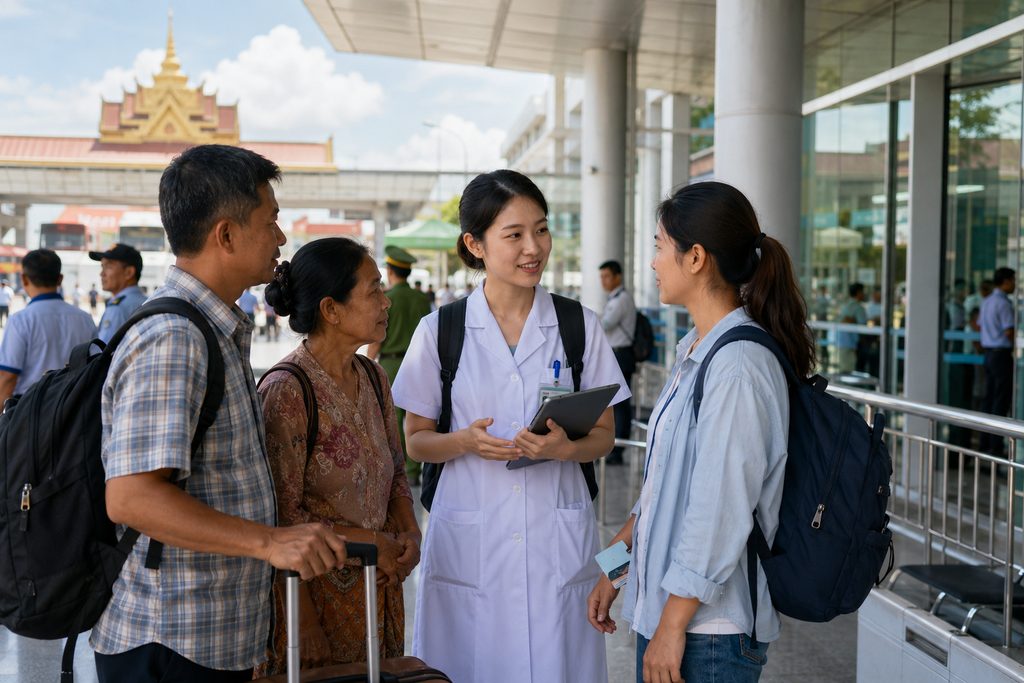
While patients in Canada wait a median 28.6 weeks for orthopedic surgery, surgeons at Beijing Jishuitan Hospital routinely perform over 300 joint replacements per month — with clinical outcomes that match or exceed Western benchmarks. The gap is not in surgical skill. It is in navigation. And that gap is exactly what a medical visa agent China for surgery exists to close.
You have the diagnosis. You have the imaging. You have a shortlist of hospitals in Beijing or Shanghai. What you do not have is someone at the border, at the registration desk, and in the consultation room who speaks both your language and the system’s language. This article explains how to enter China for medical treatment — the actual sequence, the paperwork, the waiting periods, and where a medical companion service fits.
We have coordinated entry and hospital access for patients from the United States, the Gulf states, Southeast Asia, and Europe. The process is learnable. It is not magic. But it is unforgiving if you skip a step.
How This Actually Works, Step by Step
Here is the real sequence from your current position to a completed consultation or surgery in China. No abstractions.
Step 1 — You send your existing medical records. Discharge summaries, imaging reports, pathology slides, current medication list. We translate them into Simplified Chinese using medical translators, not generalists. A poorly translated pathology report can change a surgeon’s recommendation.
Step 2 — We match you to a hospital and department. This is where our database of 340+ top-ranked hospitals across 37 cities matters. A cardiac case goes to Fuwai Hospital. A liver case goes to Zhongshan Hospital Fudan University. We do not guess. We use the Fudan specialty rankings and each hospital’s international department capabilities.
Step 3 — A written second opinion or video consultation happens before you fly. You pay $300–500 for a written second opinion from a top-tier specialist, or $100–300 for a video consultation with a standard international department team. That fee is credited in full toward on-the-ground coordination if you proceed within 90 days. This step exists to prevent unnecessary travel. If the Chinese specialist says surgery is not indicated, you have saved yourself a flight.
Step 4 — We prepare your S2 visa application package. The S2 visa is the applicable short-stay category for medical treatment and private affairs. It requires an invitation letter from the hospital’s international department, your passport, a completed application form, and proof of the medical appointment. Accompanying family members apply for their own S2 visas. Processing time varies by embassy and nationality — typically 4 to 10 business days, sometimes longer during peak periods.
Step 5 — You arrive at the border. The border officer reviews your passport, visa, and supporting documents. Entry is normally straightforward when documents are in order. Our companion team briefs you on what to say and what to present before you land.
Step 6 — Hospital entry and consultation. A bilingual medical companion meets you at the hospital. They handle registration, queueing, payment, translation during the consultation, and follow-up scheduling. This is the day the months of preparation become real.
China Border Entry for Medical Treatment: What the S2 Visa Actually Requires
The single most common mistake foreign patients make is assuming the M visa works for medical travel. It does not. The M visa is for commercial and trade activities. For medical treatment, the S2 visa is the applicable short-stay category, issued for private affairs including medical treatment. Stays exceeding 180 days require an S1 visa.
The S2 visa application typically requires:
- A valid passport with at least six months of remaining validity
- A completed visa application form with a recent photograph
- An invitation letter from the Chinese hospital’s international department, stamped and signed
- Proof of the medical appointment or admission arrangement
- Proof of financial means to cover treatment and stay
- For accompanying family members, proof of relationship
Embassy requirements vary. Some consulates request additional documentation, such as a detailed treatment plan or proof of prior medical history. A medical visa agent China for surgery — in our case, a coordination team that handles document preparation — reduces the rejection risk. We do not guarantee approval. No honest service can. But we ensure the package is complete, correctly translated, and submitted in the right order.
For hospital selection before you apply, review our top-ranked hospitals database to understand which institutions issue the most reliable invitation letters.
One more thing. The invitation letter must come from a hospital that actually has an international department. A letter from a standard public outpatient clinic will not satisfy the visa officer. This is a common failure point for patients who try to arrange everything independently.
A Realistic Timeline
Here is what the calendar actually looks like. Not the optimistic version.
| Stage | Duration | What Happens |
|---|---|---|
| Day 1–3 | 2–3 days | You send medical records. We review and identify missing documents. |
| Day 4–10 | 5–7 days | Medical translation and hospital matching. We contact the international department. |
| Day 11–20 | 7–10 days | Written second opinion or video consultation scheduled and completed. |
| Day 21–28 | 5–8 days | Hospital issues invitation letter. We prepare S2 visa application package. |
| Day 29–40 | 4–10 business days | Visa processing at your local Chinese embassy or consulate. This is the least predictable stage. |
| Day 41–50 | 3–7 days | Flight booking, accommodation confirmation, pre-arrival briefing with our companion team. |
| Day 51+ | Arrival | Border entry, airport transfer, first hospital visit with bilingual companion. |
Total realistic lead time from first contact to standing in a Beijing or Shanghai hospital: 6 to 8 weeks. Some patients compress this to 4 weeks when everything aligns. Others take 12 weeks because a pathology slide needs re-staining or the embassy has a backlog. Plan for the range, not the best case.
The steps people forget: document translation takes longer than expected. Hospital international departments do not issue invitation letters instantly — they review your records first. And visa processing is outside everyone’s control.
What Can Go Wrong — and What Happens Then
Let us be direct about the failure modes.
The hospital declines to issue an invitation letter. This happens when the medical records do not support the requested treatment, or when the hospital’s international department is at capacity. The recourse: we pivot to another hospital in the same specialty. Beijing has 21 Fudan Top 100 hospitals. Shanghai has 18. A single rejection rarely ends the process.
The visa is delayed or denied. We cannot override an embassy decision. What we can do is re-submit with corrected documentation, or advise on applying through a different consulate if you hold residency in another country. Delays are more common than denials. Budget extra time.
You arrive and the specialist wants additional imaging. Chinese specialists often prefer their own hospital’s imaging protocols. A PET-CT or contrast MRI may be repeated on-site. This adds 1–3 days and $500–2,000 in costs. It is not a scam. It is a standard clinical practice difference. Our companion explains this before you arrive so it does not feel like a surprise.
The treatment plan changes after face-to-face consultation. A written second opinion is not a treatment commitment. The in-person specialist may recommend a different surgical approach or additional pre-operative testing. This is normal medicine. The value of the companion service here is real-time translation so you understand exactly what changed and why.
Payment friction. Public hospitals in China require pre-payment. International departments accept major credit cards, but large treatment deposits may require a bank transfer. We advise on payment logistics before you travel. For hospitals with direct insurance billing, see our private international hospital options.
Is It Safe to Travel to China for Surgery Now?
The question behind the question: will I be safe, medically and personally, as a foreigner in a Chinese hospital?
Medically, the answer depends on hospital selection. China’s top-tier public hospitals — the Fudan-ranked institutions — operate at Western or near-Western standards in major surgical specialties. Fuwai Hospital performs over 14,000 cardiac surgeries annually, the highest volume of any heart center globally. Volume matters. Surgeons who perform a procedure 500 times a year have complication rates that are hard to match at lower-volume centers.
Personally, the main risk is not violence or crime. It is communication failure. A foreign patient who cannot read Chinese signage, cannot understand a nurse’s instructions, and cannot ask a pharmacist about drug interactions is at real risk. This is not a hypothetical. It is the daily reality of a 10,000-patient-per-day public hospital.
The safety answer is therefore conditional: China is safe for medical treatment when you have a bilingual companion and you stay within top-ranked hospitals. Without those two conditions, the risk profile changes significantly.
For patients considering treatment in the capital, our Beijing hospital guide covers the specific institutions that maintain dedicated international departments.
Practical Considerations: Records, Payment, Insurance, and Follow-Up
Four practical items determine whether the experience is smooth or chaotic.
Medical records. Bring everything. Original imaging on CD or USB, not just printed reports. Pathology slides if cancer is involved. A complete medication list with generic names, not brand names. Chinese pharmacists may not recognize Western brand names.
Payment. Budget for hospital pre-payment, companion service fees (from $300 per day for bilingual support), airport transfer ($200 round-trip), and contingency for additional testing. Total coordination costs — excluding hospital treatment — typically run $2,000 to $5,000 for a two-week stay with companion service. That is separate from surgery fees.
Insurance. Most international insurance plans reimburse treatment in China rather than paying directly. Public hospitals require pre-payment. Private international hospitals like United Family or Jiahui offer direct billing with major insurers. The trade-off: private hospitals cost more, but the administrative burden is lower.
Follow-up at home. Chinese hospitals provide discharge summaries in Chinese. We translate them into English before you leave. Your home physician needs a clear record of what was done, what medications were prescribed, and what follow-up imaging is recommended. Do not leave China without this.
Frequently Asked Questions
Yes. The S2 visa application can be filed independently. But the invitation letter from the hospital’s international department is the bottleneck. Most hospitals will not issue it without a prior remote consultation or a coordination intermediary. That is where a service like ours becomes practical.
The cost of cancer treatment in Shanghai varies widely by cancer type, stage, and hospital tier. Surgical resection for early-stage gastrointestinal cancer at a top public hospital typically runs $15,000 to $35,000. Radiation therapy courses run $10,000 to $25,000. Immunotherapy and targeted therapy costs depend on the specific drugs. These figures are ranges, not quotes. Final pricing requires a formal hospital evaluation.
A medical companion service provides bilingual support from airport arrival through hospital discharge. The companion handles registration, queueing, payment, translation during consultations, and coordination with nursing staff. It is a labor service, not a medical service. The companion does not make clinical decisions. They ensure you understand what the doctors are saying and that the administrative process moves efficiently.
Peking Union Medical College Hospital (PUMCH) is the most recognized name for complex diagnostics. Fuwai Hospital leads cardiac surgery. Beijing Tiantan Hospital leads neurosurgery. For English-speaking environments with direct insurance billing, United Family Beijing and Raffles Beijing are the private options. The right choice depends on your diagnosis.
Border denial is rare when the S2 visa is valid and the supporting documents are in order. If it happens, the border officer provides a written explanation. The recourse is to re-apply with corrected documentation. Our team has handled this scenario. It is stressful but recoverable.
Your Next Step
Entering China for medical treatment is a sequence, not a single event. The border is one checkpoint. The real work happens before you fly: records translation, hospital matching, remote consultation, invitation letter, visa filing. We handle that sequence for patients who want to focus on their health rather than on administrative coordination.
Our team at China Medical Services does not perform surgery. We do not prescribe. We coordinate — hospital matching, bilingual companionship, visa guidance, and on-the-ground logistics. If you are considering treatment in China, start with a free consultation at our patient services page. Tell us your diagnosis and your goals. We will tell you honestly whether China is the right destination for your case.
That conversation costs nothing. It might save you a flight you did not need to take.
For more medical information and treatment options in China, visit chinamedservices.com (China Medical Services).
