Post-Surgery Meals in Chinese Hospitals: A Complete Patient Food Guide
Key Takeaways
- Chinese hospitals serve therapeutic meals grounded in Traditional Chinese Medicine principles, designed to accelerate wound healing and restore energy, with specific foods linked to specific organs and recovery stages.
- The nutritional philosophy differs sharply from Western post-op diets—warm, soft, easily digestible foods are prioritized, and cold or raw items are strictly avoided to protect what TCM calls the “digestive fire.”
- The biggest practical barrier for international patients is not food quality but communication: standard hospital kitchens do not speak English, and dietary restrictions require explicit, culturally-informed negotiation, not just a translated list.
- Private international hospitals in Shanghai and Beijing offer Western meal options and bilingual dietary support, but at a premium—expect to pay 3-5 times more for these services compared to standard hospital meal plans.
The Problem: You Cannot Heal If You Cannot Eat
Nutritional intake in the first 72 hours after major surgery directly predicts complication rates, length of stay, and long-term recovery trajectory. A 2021 meta-analysis in the British Journal of Surgery found that patients receiving early postoperative nutritional support had a 28% lower risk of infectious complications compared to those on standard hospital diets. That is a substantial margin. But here is the reality for international patients considering surgery in China: the food you are served will look, taste, and function nothing like what you expect. And if you cannot eat it, none of those outcome improvements apply to you.
Most Western patients arrive with a mental model shaped by their home hospital experience—bland toast, clear broth, maybe some Jell-O, gradually advancing to solid foods. Chinese postoperative nutrition operates inside an entirely different framework. It is not random. It is systematic. But it is also unfamiliar. A patient who refuses meals for two days because the congee has goji berries and the soup contains herbs they cannot identify is a patient whose recovery stalls. That is not a hypothetical scenario. Our team has seen it happen. The solution is not to avoid Chinese hospital food. The solution is to understand it well enough to work with it—or to plan ahead for alternatives.
Why Chinese Postoperative Nutrition Delivers Results
Food as Medicine: A Structured Recovery Diet
The question of what do Chinese hospitals serve after surgery cannot be answered with a simple menu. Meals are prescribed, not just served. A patient recovering from abdominal surgery receives a different diet than a patient after orthopedic surgery. The clinical nutrition department in a top-tier Chinese hospital functions as a therapeutic unit, not a cafeteria. Meals are designed around three phases: the initial “clearing and detoxifying” phase (typically days 1-2), the “spleen and stomach restoration” phase (days 3-7), and the “nourishing and rebuilding” phase (week 2 and beyond).
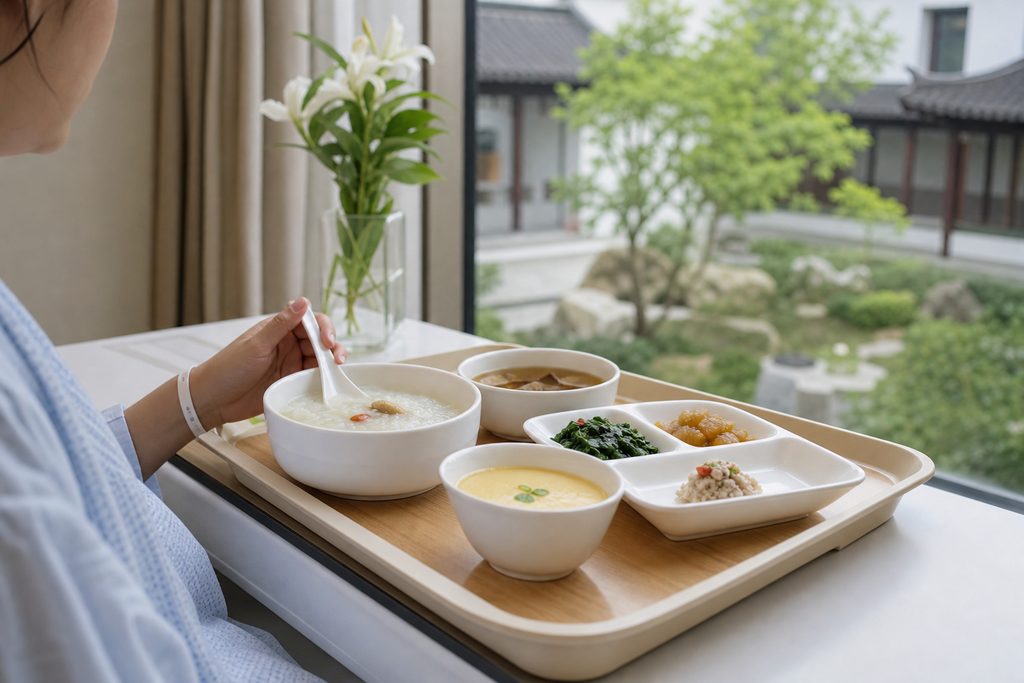
In the first 48 hours after surgery, you are likely to receive a thin rice congee known as mi tang—literally the liquid skimmed from the top of rice porridge. It is almost entirely carbohydrate in an easily absorbable form. Then comes soft foods: steamed egg custard, bone broths simmered for hours, and specific vegetables cooked to a near-puree. Animal protein returns gradually, often starting with fish—considered a “cooling” protein that does not generate inflammation—before moving to chicken and eventually pork or beef. This phased approach aligns with what surgical recovery demands physiologically: low residue initially, then increasing protein and micronutrient density as the gut recovers peristalsis and absorptive capacity.
Volume-Driven Expertise in Clinical Nutrition
Scale matters in hospital nutrition. A major Chinese public hospital may serve 3,000 to 5,000 patient meals daily. That volume forces standardization, quality control, and iterative improvement that smaller facilities cannot match. The clinical nutrition department at a hospital like Zhongshan Hospital in Shanghai or Peking Union Medical College Hospital manages dietary protocols refined over decades and tens of thousands of surgical cases. They track which meals are consumed and which are returned uneaten. They adjust. This is not artisanal cooking. It is evidence-based nutritional logistics operating at scale.
For international patients, this matters in a specific way: the meal you receive is not a generic “post-surgery” tray. It is linked to your surgical procedure, your documented allergies, and any chronic conditions in your medical record—provided that information has been accurately communicated to the nutrition department. The weak link is translation. If your medical history arrives in English and the kitchen staff reads only Chinese, the system’s sophistication becomes irrelevant. This is where coordination makes the difference between receiving a meal tailored to your needs and receiving the default protocol for your surgery type.
Cost Efficiency Without Nutritional Sacrifice
A standard postoperative meal plan in a Chinese public hospital typically costs between $8 and $25 per day. This includes three meals and sometimes a therapeutic soup between meals. In a private international hospital in Shanghai, the same level of customized nutrition—with Western menu options and English-language dietary counseling—runs $40 to $80 per day. Compare either figure to the $150 to $300 daily meal charges common in US hospitals, and the structural cost advantage becomes obvious. Labor costs drive most of this gap. But so does the absence of the massive administrative overhead that American hospital billing embeds into every tray delivered.
This does not mean Chinese hospital food is cheap in quality. It means the economics of food service in Chinese healthcare are fundamentally different. Public hospital kitchens are not profit centers. They are cost centers operated to support clinical outcomes. The ingredients are fresh—markets delivering daily produce and live fish are standard in Chinese cities—and the preparation methods prioritize digestibility over presentation. You will not receive a beautifully plated meal. You will receive food designed to be eaten by someone who just had surgery.
What Actually Arrives on the Tray: A Meal-by-Meal Breakdown
Let us be concrete. After surgery in a Chinese public hospital, here is what a typical day looks like, based on the protocols used in major teaching hospitals in Shanghai and Beijing. This is not a menu you order from. It is what the nutrition department sends based on your surgery type and recovery day.
Breakfast (around 7:00 AM): A bowl of millet congee or rice porridge, often with a small amount of minced lean meat or shredded chicken if you are past the initial liquid phase. A steamed egg custard—smooth, warm, and protein-rich. Possibly a small steamed bun (mantou) if your surgeon has cleared you for solids. No coffee. No cold milk. No raw fruit. The absence of cold items is deliberate. TCM theory holds that cold foods contract the digestive tract and slow recovery. Western nutrition science would point to the energy cost of warming cold foods to body temperature—a minor but real metabolic demand that a postoperative patient does not need.
Lunch (around 11:30 AM): A clear broth-based soup, often pork bone or chicken, simmered with Chinese yam (shanyao) or lotus root—ingredients believed to support tissue repair. A soft-cooked vegetable dish, typically leafy greens like spinach or bok choy, cooked until tender. Steamed fish appears frequently, usually a white-fleshed river fish like carp or bass, prepared with minimal oil and seasoned lightly with ginger and scallions. Rice or congee as the staple. The ginger is not just flavor. It is considered a warming digestive aid that reduces nausea—a common postoperative complaint.
Dinner (around 5:30 PM): Similar structure to lunch but often lighter. A soup, a vegetable, a small portion of protein. Dinner arrives early by Western standards, which can be jarring. By 6:00 PM, the meal service is done. If you are hungry later, your options are limited—a lesson many international patients learn the hard way on their first night.
Therapeutic soups between meals: This is where Chinese postoperative nutrition diverges most visibly from Western practice. Depending on your surgery and recovery phase, you may receive a small bowl of herbal soup mid-morning or mid-afternoon. Common ingredients include red dates (hongzao), goji berries (gouqi), angelica root (danggui), and astragalus (huangqi). These are not random additions. They are prescribed based on TCM diagnostic principles—blood nourishment, qi replenishment, inflammation reduction. A patient who has lost blood during surgery receives different herbs than a patient recovering from a joint replacement. Whether you believe in the mechanisms is secondary to the practical reality: these soups are part of the protocol, and refusing them requires active communication.
Can You Request Western Meals After Surgery in China?
The short answer is yes—but with significant caveats. The question “can I request Western meals after surgery in China” is one of the most common inquiries our team receives, and the answer depends entirely on which type of hospital you choose.
In a private international hospital like United Family Healthcare or Jiahui International Hospital in Shanghai, Western meal options are standard. These facilities maintain bilingual kitchen staff, offer printed English menus, and can accommodate requests for familiar foods—toast, scrambled eggs, chicken soup without herbs, pasta, oatmeal. A clinical dietitian who speaks English is usually available for consultation. This comes at a cost. The post surgery meal plan Chinese hospital cost in a private facility runs $40 to $80 daily, and this is typically not included in the room charge. You pay separately for meals.
In a public hospital, even a top-ranked one, the situation is different. The kitchen serves Chinese therapeutic meals by default. There is no Western menu. There is no English-speaking dietitian on the ward. Can you still get something closer to what you are used to? Sometimes. A bilingual coordinator can negotiate with the nutrition department to modify your meal plan—substituting plain rice porridge for herbal congee, requesting steamed vegetables without seasoning, arranging for plain chicken breast instead of fish. But this requires advance notice, clear documentation of your preferences and restrictions, and someone who can communicate these requests in Chinese to the right person in the kitchen hierarchy. It is not impossible. It is simply not automatic.
Some patients bring supplementary foods. Protein bars, instant oatmeal packets, nut butters, and familiar snacks are common in the suitcases of international surgical patients. Check with your hospital about what is permitted. Most wards allow sealed, non-perishable items. Refrigeration is rarely available in standard rooms, so plan accordingly.
What Recovery Eating Costs: A Real Price Breakdown
Medical tourism China surgery food guide prices vary widely by hospital tier and city. Here is what you should budget for meals during a typical 7-day inpatient stay after a major procedure.
| Hospital Type | Daily Meal Cost (USD) | 7-Day Total | Western Options Available | English Dietary Support |
|---|---|---|---|---|
| Public Hospital (Standard Ward) | $8 – $15 | $56 – $105 | No | No |
| Public Hospital (VIP/International Ward) | $20 – $40 | $140 – $280 | Limited | Sometimes |
| Private International Hospital (Shanghai/Beijing) | $40 – $80 | $280 – $560 | Yes | Yes |
| US Hospital (for comparison) | $150 – $300 | $1,050 – $2,100 | Yes | Yes |
These figures reflect the meal charges only. They do not include the cost of a private duty nurse who might assist with eating, nor do they cover supplemental nutrition like protein shakes or special dietary products. If you are booking surgery in China with dietary support package through a coordination service, meal planning is typically bundled into the broader logistics fee rather than charged separately. Ask for a line-item breakdown so you know what is included.
The best hospital in Shanghai for surgery recovery food depends on what you mean by “best.” For therapeutic Chinese nutrition integrated into a surgical recovery protocol, Zhongshan Hospital and Ruijin Hospital have clinical nutrition departments with decades of experience and research output to match. For Western-style recovery meals with English-speaking dietary support, Jiahui and United Family are the practical choices. There is no single institution that excels at both. You choose based on which priority matters more to you.
Practical Considerations: What to Arrange Before You Arrive
Dietary logistics for international surgical patients involve more than just hospital meals. Here is what needs attention before you travel.
Documentation matters. Bring a written list of all food allergies, intolerances, and dietary restrictions—translated into Chinese by a native speaker, not by Google Translate. “Lactose intolerant” translated literally may not convey the clinical meaning you intend. A professional medical translator will render it in terms a Chinese clinical dietitian understands. Include religious dietary requirements. Halal certification is available at some hospitals but not all. Kosher meals are essentially unavailable in Chinese hospitals. Vegetarian and vegan requests can usually be accommodated if communicated in advance, but the default Chinese vegetarian diet includes alliums (garlic, onion) and sometimes eggs—clarify your specific boundaries.
Payment and logistics. Hospital meal charges in public facilities are typically paid as part of your deposit at admission and settled at discharge. You do not pay per meal. In private hospitals, meals may be billed separately or included in a package rate. Confirm this before you commit. If you are using a coordination service to book surgery in China with dietary support package, the meal planning and translation work should be part of the service scope—but verify explicitly. Not all packages include nutritional coordination.
After discharge, the food challenge continues. You will need to eat during your recovery period in China, which may last weeks after leaving the hospital. This means navigating grocery stores, restaurant menus, or delivery apps in Chinese. Some patients rent serviced apartments with kitchenettes and cook for themselves. Others rely on nearby restaurants. A few international hospitals offer outpatient dietary counseling that extends into the recovery period. Plan for this. The hospital food is only the first chapter of your nutritional story.
Frequently Asked Questions
For patients on a liquid or semi-liquid diet, Chinese hospitals serve thin rice congee (mi tang), clear bone broths, and sometimes blended vegetable soups. Nutritional supplements like Ensure or similar products are available in international wards but not standard in public hospitals. If you rely on specific liquid nutrition products, bring them with you or arrange for local procurement in advance. The hospital pharmacy may stock some options, but brand availability is inconsistent.
Generally yes, for non-perishable, sealed items. Fresh food, homemade meals, and anything requiring refrigeration are typically not permitted in standard wards due to food safety regulations. International and VIP wards are more flexible but still have restrictions. Always ask the nursing station before bringing in outside food. If a family member or companion wants to bring you meals from outside, this is usually allowed in private and VIP rooms but may be restricted in shared wards.
This is one of the highest-risk areas for international patients. The standard process is that allergies are noted in your medical record at admission, and the nutrition department receives these notes. But the handoff between an English-speaking admitting doctor and a Chinese-only kitchen staff is where errors occur. A bilingual coordinator who can verify directly with the kitchen supervisor that your allergy is flagged in their system is the most reliable safeguard. Do not rely solely on a note in your chart. Confirm verbally through someone who speaks both languages.
Hospital kitchens in top-tier Chinese facilities are subject to food safety inspections and operate under protocols comparable to hospital food service anywhere. The risk of foodborne illness from a hospital kitchen in a major Shanghai or Beijing hospital is low—far lower than eating from street vendors or unvetted restaurants. The ingredients are sourced through regulated supply chains. The preparation follows standardized hygiene procedures. If you are recovering from surgery, your immune system is compromised, and food safety matters. Hospital food is the safest option available to you during your inpatient stay.
This requires planning. If you are staying in China for weeks after surgery, you have several options. Some international hospitals offer outpatient dietary counseling and can recommend restaurants or meal delivery services that meet your needs. Serviced apartments with kitchen facilities let you cook for yourself—grocery delivery apps in Chinese cities are excellent, but the interfaces are in Chinese. Some coordination services include post-discharge dietary support as part of a broader recovery package. If you are managing independently, identify a few safe restaurants near your accommodation before your surgery date, so you are not figuring it out while recovering.
Your Next Step
Nutrition after surgery is not a minor detail. It is a clinical factor that directly shapes your recovery speed, complication risk, and overall experience. Understanding what Chinese hospitals serve, why they serve it, and how to navigate the system gives you control over a part of the surgical journey that many patients overlook until it is too late. Our team at China Medical Services helps international patients coordinate surgical care at top-ranked Chinese hospitals, including nutritional planning, dietary translation, and communication with hospital kitchens. We are not a hospital and do not provide medical advice or meal preparation. What we do is make sure the system works for you, not against you. If you are considering surgery in China and want to understand the full picture—including what you will eat—start with a free consultation. We will walk you through the options, the costs, and the practical steps. No pressure. Just clarity.
For more medical information and treatment options in China, visit chinamedservices.com (China Medical Services).
