Navigate China Hospital Building When Signs Are Chinese: A Practical Guide for Foreign Patients
Key Takeaways
- China’s top-tier hospitals can see over 10,000 outpatient visits daily, and English signage is rare outside dedicated international wings — entering without a plan is disorienting.
- A bilingual medical companion costs from $200/day and solves the navigation problem entirely, while translation apps remain a free but fragile backup.
- International patient departments exist in most major hospitals but often require in-person registration — you cannot always book them remotely before arriving.
- Understanding the physical layout, the registration token system, and payment workflows before you walk through the door cuts stress by more than half.
The Problem: You Are Functionally Illiterate the Moment You Walk In
When 42-year-old Michael stepped into the main lobby of a Shanghai teaching hospital, he had his referral letter, his passport, and a folder of imaging reports. What he did not have was any way to read the directory. Every sign — department names, elevator banks, payment counters, pharmacy queues — was in Chinese characters. The information desk had a queue forty people deep. Nobody at the entrance spoke English. He had traveled 7,000 miles for a cardiology consultation and could not find the elevator to the third floor.
Michael’s experience is not exceptional. It is the baseline. China’s hospital system is built for volume: a single large public hospital can process 12,000 to 15,000 outpatient visits in one day. The signage, the workflow, the registration kiosks, the queuing logic — all of it assumes Chinese literacy. The international patient department, if one exists, is often in a separate building or on a dedicated floor. Finding it without help means navigating a campus that can span multiple city blocks.
This article is not about whether Chinese hospitals deliver good care. The clinical outcomes at top-ranked institutions speak for themselves. It is about the practical, physical problem of getting from the front gate to the right doctor’s door when you cannot read a single character. We will walk through the tools, people, and strategies that actually work — and the ones that do not.
Why the Physical Layout Creates a Maze Even Before You See a Doctor
Western hospitals tend to consolidate services under one roof with clear vertical zoning. Chinese public hospitals often operate as sprawling medical campuses — multiple buildings connected by covered walkways or outdoor paths, with different functions scattered across them. Outpatient registration might be in Building A, imaging in Building C, and the international clinic tucked away on the fifth floor of an administrative wing you would never guess houses clinical services.
The scale compounds the problem. West China Hospital in Chengdu, for example, covers a campus large enough that staff use electric carts to move between buildings. Peking Union Medical College Hospital in Beijing has outpatient volumes that make its main corridors feel like a busy train station at rush hour. Without reading the signs, you cannot distinguish the cardiology building from the laboratory building from the inpatient tower.
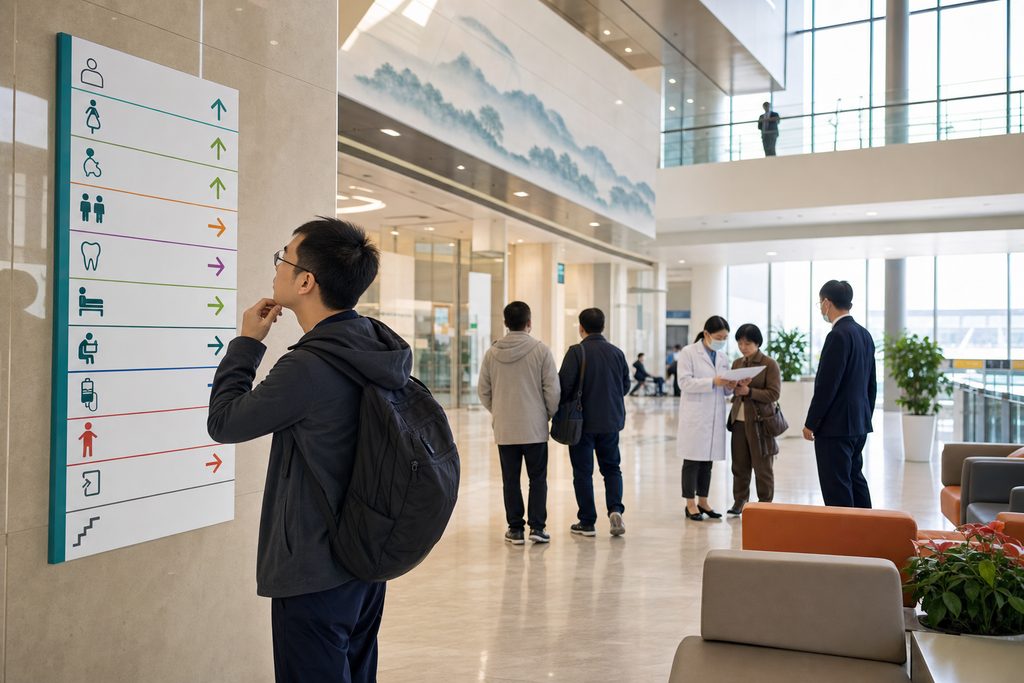
And the signs themselves follow a logic that assumes local knowledge. Departments are often listed by their full Chinese medical names, not simplified pictograms. Floor directories are dense grids of characters. Color-coding, where it exists, varies by hospital. There is no national standard for wayfinding in Chinese hospitals that a foreign visitor can rely on.
Can You Navigate a Beijing Hospital with Only English? Here Is What Happens
The short answer: you can physically walk through the doors. You will not be stopped. But you will hit a wall within minutes.
Registration is the first gate. Public hospital registration requires a hospital-issued medical card, which you get at a dedicated window by presenting your passport. That window’s location is almost never marked in English. The staff at that window almost never speak English. Once you have the card, you need to load funds onto it — a prepaid system that most international patients find confusing even with translation help. Then you need to find the right department’s registration machine or window, select the correct sub-specialty, and take a queue number.
Each of these steps involves reading Chinese. The machines have English-language options at some international hospitals, but in standard public hospital buildings, they do not. The queue number you receive will be called out in Mandarin over a loudspeaker. The digital display showing current queue numbers lists department names and doctor names in Chinese. Missing your number means starting over.
We have seen patients spend two hours just getting registered. Not because the system is broken — it works efficiently for the millions of Chinese patients who use it daily — but because it was never designed for someone who cannot read the interface.
How to Find the International Patient Department in a Chinese Hospital
Most top-tier hospitals in cities like Beijing, Shanghai, and Guangzhou maintain an international patient department or a VIP clinic. These are the spaces where English-speaking staff, shorter queues, and a more familiar care navigation experience exist. The challenge is that they are often physically separate from the main outpatient building.
At Huashan Hospital in Shanghai, the international clinic occupies its own building on the campus perimeter — you can walk past it without realizing it is part of the hospital. At Peking Union Medical College Hospital, the international medical services are on a dedicated floor of the main building, accessible through a separate entrance. At Fuwai Hospital, the international department handles foreign patients through a distinct registration pathway, but the signage to reach it is minimal.
Here is what works: before you travel, identify whether the hospital has an international department by searching its official website or contacting a service that maintains current hospital databases. Get the exact building name and floor number in Chinese characters. Have your hotel concierge write it on a card. Show that card to the first uniformed staff member you see at the hospital entrance — they may not speak English, but they can point.
Do not assume the international department handles walk-ins. Some require appointments booked days in advance. Some accept same-day registration but only during morning hours. Calling ahead from overseas is difficult because the phone lines are answered in Mandarin. This is where having someone on the ground — a bilingual companion or a coordination service — changes the entire experience from exhausting to straightforward.
China Hospital Building Map in English App: What Actually Works on the Ground
There is no universal “Google Maps for Chinese hospital interiors” with English labels. The expectation that one exists leads to a lot of frustrated searching in app stores. What does exist is a patchwork of tools that help in different ways.
WeChat mini-programs are the closest thing to a digital hospital navigator. Many large hospitals have their own mini-program within WeChat that includes floor maps, department locations, and sometimes real-time queue tracking. The catch: the interface is entirely in Chinese. If you can get someone to help you set it up and show you which buttons to press, it becomes a powerful tool. Without that initial help, it is inaccessible.
Baidu Maps offers indoor floor plans for some major hospitals in Beijing and Shanghai. The level of detail varies — some show department names in Chinese only, others include basic English labels for main buildings. It is worth downloading and checking before you go, but do not count on it as your sole navigation aid.
Translation apps with camera features — Google Translate, Baidu Translate, Microsoft Translator — can decode signs in real time by holding your phone up to them. This is genuinely useful for reading door signs, directory boards, and pharmacy labels. The translations are imperfect but usually enough to understand “Cardiology Department, Third Floor” or “Cashier Window.” The limitation is speed: in a crowded corridor, stopping to translate every sign slows you to a crawl. And some hospitals have patchy cellular reception that makes cloud-based translation unreliable.
Paper maps printed from the hospital’s website, with key locations circled in both English and Chinese, remain surprisingly effective. They do not need battery power. You can hand them to staff. They work when your phone does not.
Book a Hospital Interpreter in China Online: Options, Costs, and What to Expect
Booking a hospital interpreter before you arrive is possible, but the landscape is fragmented. Most Chinese public hospitals do not maintain a roster of freelance interpreters you can hire through their website. The interpreters who work inside hospitals are typically employed by the hospital’s international department and assigned to patients who register through that channel — they are not available for independent booking.
Third-party medical concierge services fill this gap. A bilingual medical companion — someone who meets you at the hospital entrance, handles registration, translates conversations with doctors, and guides you through every physical step of the visit — typically starts at $200 per day. This is not just a translator standing next to you. A good companion knows the hospital’s layout, understands the registration system, can argue with the pharmacy window when a prescription is misfiled, and recognizes when a doctor’s instructions need cultural translation, not just linguistic translation.
Video interpretation services exist as a backup option. You can connect to a remote interpreter via smartphone who guides you through the hospital over a video call. The cost is lower — often $30 to $60 per hour — but the experience is clunkier. The interpreter cannot physically take your documents to a window or read a screen that your camera is not pointed at. For a simple follow-up visit where you already know the layout, it can work. For a first-time visit to a massive public hospital, it is a compromise.
Some private international hospitals — United Family, Jiahui, Parkway — have English-speaking staff throughout their facilities and do not require a separate interpreter. The trade-off is that these hospitals are not the top-ranked specialty centers for complex procedures. For a routine consultation or a second opinion, they offer a frictionless experience. For advanced cardiac surgery or oncology treatment, you will likely want a public hospital’s clinical team — and that is where navigation support becomes essential.
English Speaking Hospital China Price List: What You Pay for Navigation and Care
Patients searching for an english speaking hospital china price list are usually trying to answer two questions at once: what will the medical care cost, and what will the language support cost? These are separate line items, and understanding the distinction prevents unpleasant surprises.
Medical care at a Chinese public hospital’s international department is typically priced 1.5 to 2 times higher than the standard domestic rate. A specialist consultation might run $100 to $300. An MRI could cost $500 to $800. A cardiac bypass surgery at a top center like Fuwai Hospital falls in the $12,000 to $20,000 range. These are the treatment costs — they are the same whether you navigate the hospital yourself or bring a companion.
Language and navigation support is separate. Here is a realistic breakdown of what international patients should budget for the non-medical coordination:
| Service | Typical Cost (USD) | What It Covers |
|---|---|---|
| Bilingual Medical Companion | from $200/day | Registration, queue management, payment processing, doctor-patient interpretation, physical navigation of hospital buildings |
| Written Second Opinion | $300–$500 | Translation of existing records, review by a top-tier specialist, written analysis and treatment recommendation |
| Video Consultation (Standard) | $100–$300 | Remote consultation with an English-speaking doctor at a public hospital international department |
| Top-Specialist Video Consultation | $500–$800 | Remote consultation with a senior specialist ranked in Fudan Hospital Rankings for their field |
| Hospital Appointment Coordination | from $300 | Pre-arrival scheduling, document preparation, registration setup; refunded if the appointment cannot be secured |
| VIP End-to-End Coordination | $5,000–$8,000 | Full case management from pre-arrival through post-discharge follow-up, including airport transfers, accommodation guidance, and dedicated bilingual support throughout treatment |
All prices vary by hospital, city, and case complexity. The key point: coordination and interpretation fees are not hidden surcharges — they are transparent services that replace the frustration of navigating alone. And any remote consultation fee is credited in full toward on-the-ground coordination if you proceed with treatment within 90 days.
Medical Concierge Service China for Foreigners Cost: Is It Worth the Investment?
Find a uniformed staff member — they are stationed at information desks, elevator banks, and department entrances. Show them your destination card. They will point or, occasionally, walk you there. Security guards are generally helpful with directions even if they cannot communicate verbally. If you are completely disoriented, look for the hospital’s main information desk, usually located in the central lobby of the largest building. They handle lost patients as a routine part of their day.
No single published price list covers all english-speaking hospitals in China. Treatment costs vary by hospital tier, city, and case complexity. International departments typically publish their consultation and basic procedure fees on their websites — but these are often in Chinese or only partially translated. For a realistic estimate of your specific treatment, you need to submit your medical records for review. A coordination service can then provide a cost breakdown based on the hospital’s current pricing. The figures in this article’s table reflect typical ranges based on current data, but your actual costs will depend on your diagnosis and chosen hospital.
That depends on your tolerance for friction and the complexity of your visit. A single consultation at a private international hospital like United Family requires almost no support — the staff speak English and the facility is designed for international patients. A complex surgical procedure at a top public hospital is a different proposition. You will navigate multiple buildings, interact with departments that have no English capability, and manage a payment and queuing system that assumes local knowledge. Many patients manage it alone and succeed. Many others find that the stress and time cost outweigh the savings. Neither choice is wrong — but go in with clear expectations about what each path requires.
Major Chinese cities have emergency medical services that can be reached by dialing 120. The dispatchers generally speak Mandarin only. If you are in a hotel, have the front desk call on your behalf and explain the situation. Private international hospitals in Beijing, Shanghai, and Guangzhou have emergency departments with English-speaking staff and can be reached directly — save their numbers in your phone before you travel. For non-life-threatening urgent issues, heading directly to an international hospital’s emergency department is faster than navigating the public ambulance system without language support.
Your Next Step
Walking into a Chinese hospital without a plan is the single biggest avoidable stressor in the medical travel experience. The clinical care is world-class — Fuwai Hospital performs over 14,000 cardiac surgeries annually, and hospitals across our network of 340+ top-ranked institutions deliver outcomes that rival or exceed Western benchmarks. But the physical navigation of these massive campuses requires preparation. Whether you choose to navigate independently with translation apps and printed cards, or engage a bilingual companion to handle the logistics, the key is arriving with a clear map — literal and mental — of where you are going and how each step works. Our team helps international patients match with the right hospital, coordinate appointments, and move through the system without the exhaustion of going it alone. If you would like to discuss your specific situation, you can reach us through our patient support page — there is no cost for the initial conversation, and no pressure to commit to anything beyond understanding your options.
Frequently Asked Questions
Yes. The hospitals used for international patients are JCI-accredited and follow the same international safety standards as top hospitals in the US and Europe. Surgical teams perform high volumes of procedures — often more than their Western counterparts — which studies show leads to better outcomes.
Costs vary by procedure and hospital, but international patients typically save 40-80% compared to US prices — even when factoring in travel and accommodation. A consultation with our team will give you an exact, all-inclusive quote with no hidden fees.
Send us your existing medical reports to get started. We handle everything from hospital selection and appointment scheduling to visa assistance and post-operative recovery planning. Your medical records are reviewed by the specialist before you even book a flight.
For more medical information and treatment options in China, visit chinamedservices.com (China Medical Services).
