Knee Replacement Surgery in China: Full Cost Breakdown with a Day-by-Day Companion
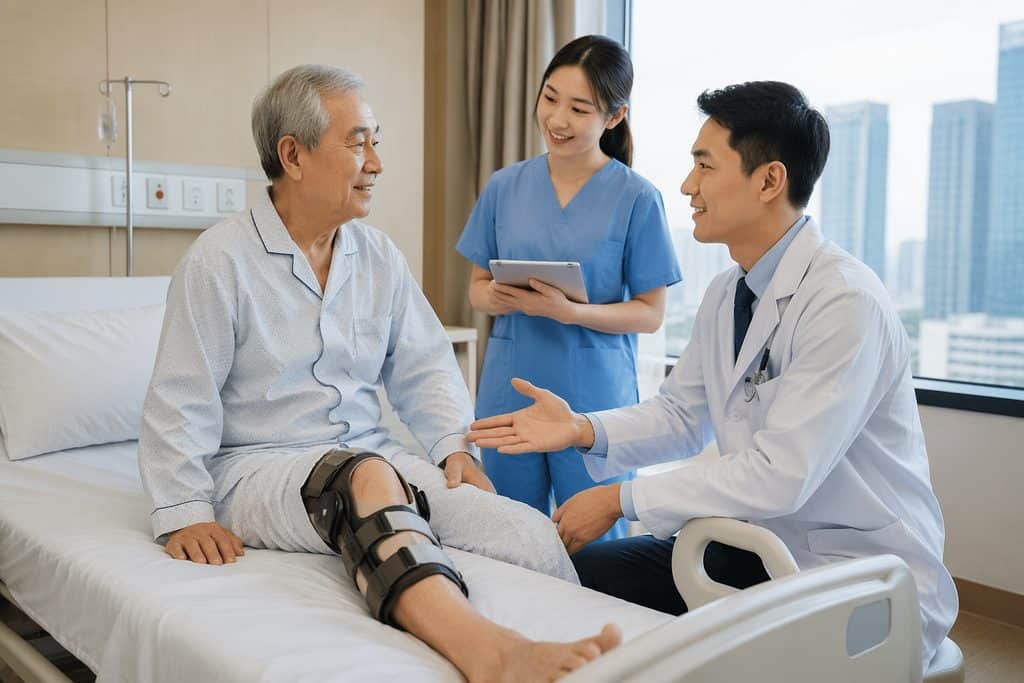
What does it actually cost to replace a knee in China—not just the surgeon’s bill, but everything from the moment you land to the day you walk comfortably again, with someone by your side the whole time? That’s the real question. The sticker price you see quoted on a website is rarely the number you end up paying. So let’s unpack the real total, line by line. We’ll look at the implant, the hospital stay, the rehabilitation, and the logistical scaffolding that makes it all possible when you’re traveling from abroad. The knee replacement surgery cost China with companion package isn’t a single figure you can pull from a menu. It’s a stack of decisions. This article breaks down that stack.
How This Actually Works, Step by Step
You don’t just book a surgery date online and show up. The sequence matters. Here’s what happens, from your first inquiry to your final follow-up.
You send us your existing medical records. That means recent X-rays, an MRI if you have one, and any notes from your orthopedist back home. Our team translates these documents into clinical Chinese. We forward them to the orthopedics department at a hospital that matches your profile—maybe a high-volume joint replacement center in Shanghai, or a top-ranked orthopedics hospital in Beijing. A senior surgeon reviews your file. You receive a written second opinion within about five to seven business days. This document confirms whether you’re a surgical candidate, outlines the recommended approach, and gives you a provisional cost estimate for the hospital portion.
If you decide to proceed, we coordinate a video consultation with the surgeon. You ask your questions directly. You see the face of the person who will operate on you. After that call, we lock in a surgical window. Then the visa process begins. You apply for an S2 visa, which is the short-stay category used for private medical treatment in China. Processing typically takes one to two weeks, depending on your home country’s Chinese embassy or consulate. Meanwhile, we arrange your airport transfer, your accommodation near the hospital, and your bilingual medical companion schedule.
You land. Your companion meets you at the airport. The next day, you go to the hospital for pre-operative testing—blood work, an ECG, a fresh set of X-rays. The surgeon does a physical exam. If everything checks out, you’re admitted. Surgery happens within a day or two. You stay in the hospital for roughly four to seven days post-op. Your companion is there every day, translating every conversation with nurses, physiotherapists, and the billing office. When you’re discharged, you’re not abandoned. Your companion helps you settle into your recovery apartment, coordinates outpatient physiotherapy sessions, and makes sure you have a clear discharge summary in English for your doctor back home.
What the Full Knee Replacement Price Breakdown Actually Includes for International Patients
Let’s get specific. The full knee replacement price breakdown China for international patients has more layers than a domestic patient’s bill. You’re not just paying for the implant and the operating room time. You’re paying for the infrastructure that lets a foreigner navigate a massive Chinese hospital system safely.
The hospital’s own charges usually fall into a few buckets. The implant itself—the metal and plastic components that replace your damaged joint surfaces—is a major variable. An imported prosthesis from a U.S. or European manufacturer like Zimmer Biomet or DePuy Synthes will cost more than a domestically manufactured implant of equivalent quality. The surgeon’s fee, the anesthesiologist’s fee, the operating room charge, the inpatient bed, the medications, and the in-hospital physiotherapy sessions all add up. For a standard total knee replacement at a top-tier public hospital’s international or VIP wing, the all-in hospital bill typically ranges from $15,000 to $25,000. That’s the hospital portion only.
Then there’s the companion and coordination layer. This is what transforms a daunting solo mission into a structured, supported experience. A bilingual medical companion costs from $300 per day. For a two-week stay that includes pre-op testing, surgery, and initial recovery, you might budget for eight to ten companion days. That’s $2,400 to $3,000. Airport transfers run about $200 round-trip. The video consultation with your surgeon before you travel costs between $500 and $800. The written second opinion is $300 to $500. If you want us to coordinate every logistical detail end-to-end—scheduling, accommodation, companion rosters, discharge planning—that VIP coordination service ranges from $5,000 to $8,000, depending on complexity.
| Cost Component | Typical Range (USD) | Notes |
|---|---|---|
| Hospital surgical package (implant, OR, surgeon, anesthesia, 4-7 day stay) | $15,000 – $25,000 | Varies by implant brand and hospital tier |
| Pre-operative testing (if not included in package) | $500 – $1,000 | Blood work, ECG, X-rays |
| Written second opinion | $300 – $500 | Credited toward coordination if you proceed within 90 days |
| Video consultation with surgeon | $500 – $800 | Also credited toward coordination within 90 days |
| Bilingual companion (per day) | from $300 | 8-10 days typical for a knee replacement episode |
| Airport transfers (round-trip) | $200 | Private vehicle |
| VIP end-to-end coordination | $5,000 – $8,000 | All logistics, scheduling, accommodation support |
| Post-discharge accommodation (2-3 weeks) | $1,500 – $3,000 | Serviced apartment near hospital |
| Outpatient physiotherapy (per session) | $50 – $100 | 6-12 sessions typical before flying home |
Notice that the remote consultation fees are not sunk costs. They’re credited in full toward your on-the-ground coordination service if you upgrade within 90 days. That means the $800 you spend on a video consult isn’t lost—it reduces your eventual coordination bill by the same amount. We built this structure so you can test the fit before committing to the full journey.
A Realistic Timeline
Timelines in medical tourism are always messier than the brochures suggest. Here’s what a knee replacement journey actually looks like, with the waiting periods people tend to forget.
| Stage | Duration | What Happens |
|---|---|---|
| Document collection and translation | 3 – 5 days | You gather X-rays, MRI reports, doctor’s notes; we translate into clinical Chinese |
| Surgeon review and written second opinion | 5 – 7 business days | Orthopedic specialist evaluates your case; you receive a written analysis and preliminary recommendation |
| Video consultation scheduling | 1 – 2 weeks | We align your time zone with the surgeon’s availability; you speak directly |
| S2 visa processing | 1 – 3 weeks | Varies by embassy; hospital invitation letter required |
| Travel and arrival | 1 – 2 days | Airport pickup; settle into accommodation |
| Pre-operative workup | 1 – 2 days | Hospital tests, surgeon physical exam, anesthesia clearance |
| Surgery and inpatient stay | 4 – 7 days | Operation day plus monitored recovery; physiotherapy begins in bed |
| Local recovery and outpatient physio | 2 – 4 weeks | Daily physiotherapy, wound checks, gradual mobilization; companion support tapers |
| Fit-to-fly clearance and departure | 1 day | Surgeon signs off; you receive English discharge summary and rehab protocol |
From first contact to flying home, plan for eight to twelve weeks. The surgical event itself is one morning. The rest is preparation and recovery. Rushing any of these stages is where complications breed.
What Can Go Wrong—and What Happens Then
Let’s be blunt. A deep vein thrombosis. A wound infection. An implant that doesn’t feel right. An unexpected cardiac event during surgery. These are not frequent outcomes—knee replacement has a high success rate—but they are real possibilities. The question isn’t whether things can go wrong. The question is what happens when they do.
If you develop a post-operative infection, the hospital’s infectious disease team gets involved. You stay longer. Your companion extends their schedule. Your insurance, if you have a policy that covers treatment abroad, gets notified immediately. If you don’t have insurance that covers complications in China, you pay out of pocket for the extended stay and additional treatment. This is not a theoretical risk. We advise every patient to secure medical travel insurance that explicitly covers surgical complications and extended hospitalization abroad.
What if the implant fails years later? You’re back home. Your local orthopedist handles the revision. This is why we ensure you leave China with a complete operative report in English, including the exact implant model, size, and lot number. Without that document, a revision surgeon is working blind. We don’t let that happen.
What if the surgeon you consulted with isn’t available on the day? This is rare at the international department level, but it can happen if the surgeon is called to an emergency. In that case, a colleague of equivalent seniority from the same department steps in. You’re informed before you’re wheeled in. You have the right to reschedule. Our companion is in the room to make sure you understand exactly who is operating and what the change means.
What Is Included in a Knee Surgery Medical Tourism Package in China—and What’s Not
There’s a persistent confusion about what the word “package” means. Some patients arrive expecting an all-inclusive resort experience. That’s not how Chinese hospitals work. So let’s draw the line clearly. What is included in knee surgery medical tourism package China varies by provider, but here’s what a well-structured coordination package should cover.
It should include the pre-arrival remote evaluation—the written opinion and the video call. It should include hospital appointment coordination, meaning someone physically goes to the hospital to register you, create your medical file, and schedule your pre-op tests. It should include a bilingual companion for the critical days: pre-op testing, admission day, surgery day, and at least the first few days of inpatient recovery. It should include translation of key documents—your discharge summary, your rehab protocol, your implant card. It should include airport transfers and guidance on nearby accommodation.
What it typically does not include: the actual hospital bill. Your flights. Your accommodation. Your meals. Your post-discharge physiotherapy sessions. Your medications. Any treatment for non-orthopedic conditions that arise during your stay. These are paid directly by you to the respective providers. A good coordination service makes these payments straightforward by accompanying you to the billing counter and ensuring you’re charged correctly. But the money flows from you to the hospital, not through a middleman.
Think of the coordination package as the operating system, not the hardware. It runs the logistics so the clinical work can happen smoothly. It doesn’t replace the clinical work itself.
How Much Does Knee Replacement Cost in China with Caregiver Support
If you’re bringing a family member instead of hiring a professional companion, the math shifts. But the need for support doesn’t disappear. How much does knee replacement cost in China with caregiver support is a question we hear from couples and adult children traveling with a parent.
Your spouse or child can stay with you in a private room at the international ward. They can help you to the bathroom, fetch water, and keep you company. What they can’t do: argue with the billing office in Mandarin when you’re charged for a test you didn’t receive. They can’t translate the physiotherapist’s instructions about weight-bearing restrictions with clinical precision. They can’t navigate the labyrinthine corridors of a 2,000-bed teaching hospital to find the radiology department on the third floor of Building 7. That’s where a companion earns their fee.
Some patients opt for a hybrid model. They bring a family member for emotional support and hire a companion for four or five key days—admission, surgery, discharge, and the first outpatient follow-up. This keeps the companion cost around $1,200 to $1,500 while still having a professional handle the high-stakes communication moments. The hospital bill doesn’t change whether you have a companion or not. The companion is a separate line item, paid to us, not to the hospital.
Best Knee Replacement Hospitals in China for Foreigners with Companion Support
Not every hospital that performs excellent knee replacements is equipped to serve international patients. The best knee replacement hospitals in China for foreigners with companion support share a few traits: a dedicated international medical department, English-speaking administrative staff, experience with foreign insurance paperwork, and a high annual volume of joint replacements.
Peking Union Medical College Hospital in Beijing runs one of the most established international medical services in the country. Their orthopedics department handles complex primary and revision knee replacements. The international ward has English-speaking nurses and a billing office accustomed to dealing with overseas patients. In Shanghai, Ruijin Hospital’s orthopedics department is consistently ranked among China’s top programs. Their international medical center provides a streamlined admission process that reduces the administrative friction foreigners otherwise face. For patients who prefer a Western-style environment, Jiahui International Hospital in Shanghai is a JCI-accredited private facility with direct insurance billing and native English-speaking orthopedic surgeons trained in the U.S. and Europe.
Each of these hospitals appears in our orthopedics department rankings, which draw on the Fudan University hospital reputation survey—China’s most authoritative hospital ranking system. You can browse orthopedic specialty rankings and filter by city on our top hospitals page. The right hospital for you depends on your implant preference, your budget, and whether you prioritize a public hospital’s clinical volume or a private hospital’s service model. Our team helps you weigh these variables during the initial consultation.
How to Book Knee Replacement Surgery in Shanghai with Day-by-Day Assistance
Shanghai is the most common entry point for international patients seeking orthopedic surgery in China. The city has direct flights from most major global hubs, a large expatriate community, and several hospitals with mature international departments. If you’re looking to book knee replacement surgery Shanghai with day-by-day assistance, the pathway is straightforward once you understand the sequence.
You don’t book the surgery directly. You book the evaluation. We send your records to the orthopedics department at a Shanghai hospital that fits your clinical profile. The surgeon reviews them. You speak with the surgeon via video. Only after that conversation do we coordinate a surgical date. This sequence protects you. It ensures you’re not flying across the world based on an assumption that you’re a surgical candidate. Some patients discover during the video consult that their knee pain is actually referred hip pain, or that their cardiac status makes elective surgery inadvisable right now. Better to learn that from your living room than from a hospital bed in a foreign country.
Once the surgeon confirms you’re a candidate and you decide to proceed, we handle the day-by-day coordination. Day 1: airport pickup and apartment check-in. Day 2: hospital registration, pre-op blood draw, ECG, chest X-ray. Day 3: surgeon physical exam, anesthesia consult, admission. Day 4: surgery. Days 5 through 10: inpatient recovery, daily physiotherapy, wound care. Day 11: discharge, transfer to recovery apartment. Days 12 through 25: outpatient physiotherapy every other day, wound checks, gradual mobilization. Day 26: final surgeon clearance, fit-to-fly letter. Day 27: airport drop-off. Your companion is with you on every hospital day and available by phone on rest days.
This is not a vacation. It’s a focused medical episode with a clear beginning, middle, and end. The structure is what makes it bearable.
Practical Considerations: Records, Visa, Payment, and Follow-Up
Before you book a flight, get your paperwork in order. You need a valid passport with at least six months remaining. You need your medical records—not just the reports, but the actual imaging files on a CD or USB drive. Chinese orthopedists want to see the raw images, not just
Frequently Asked Questions
Yes. The hospitals used for international patients are JCI-accredited and follow the same international safety standards as top hospitals in the US and Europe. Surgical teams perform high volumes of procedures — often more than their Western counterparts — which studies show leads to better outcomes.
Costs vary by procedure and hospital, but international patients typically save 40-80% compared to US prices — even when factoring in travel and accommodation. A consultation with our team will give you an exact, all-inclusive quote with no hidden fees.
Send us your existing medical reports to get started. We handle everything from hospital selection and appointment scheduling to visa assistance and post-operative recovery planning. Your medical records are reviewed by the specialist before you even book a flight.
For more medical information and treatment options in China, visit chinamedservices.com (China Medical Services).
