Pacific Medical Travel to China: A Full-Service Hub for Fiji, PNG, and Island Patients
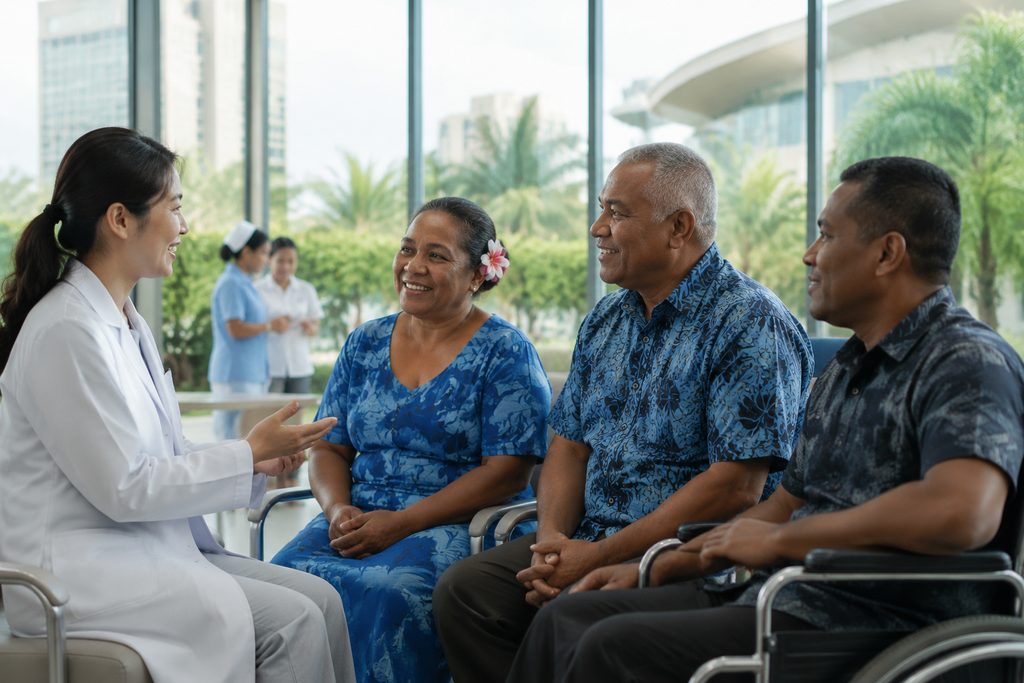
In Fiji, a patient needing complex cardiac surgery faces a stark choice: join a government-funded overseas referral list that can stretch past 18 months, or find upwards of FJD 80,000 for a private procedure in Australia or New Zealand. Meanwhile, at Fuwai Hospital in Beijing — a facility that performs over 14,000 cardiac surgeries annually — the same heart bypass surgery cost China for Fiji patients typically falls between USD 12,000 and 20,000. That is not a promotional figure. It is the documented price range at one of the world’s highest-volume cardiac centers, where outcomes are benchmarked against STS and EuroSCORE data. The gap between what is available locally and what is accessible with the right coordination is what brings patients from Suva, Port Moresby, and Honiara to our desk every month.
We do not perform surgery. We do not make medical promises. What our team does is close the information and logistics gap — connecting you with the specific Chinese hospital department that handles your condition, translating your records, and managing the ground-level details that make the difference between a stressful gamble and a planned medical journey. This article walks through exactly how that works for patients coming from the Pacific Islands.
How This Actually Works, Step by Step
Most Pacific Island patients who contact us have already been diagnosed. They have a report from Colonial War Memorial Hospital in Suva, or Port Moresby General, or a private clinic in Nadi. They know what they need. What they lack is a clear path to getting it done without spending a fortune or waiting a year.
Here is the sequence we follow, refined over hundreds of patient cases:
Step 1: You send us what you have. Discharge summaries, imaging reports, biopsy results, medication lists — whatever documents your local doctor provided. We need them in English, which for Pacific Island patients is rarely an issue. If anything is missing, we tell you exactly what to request from your referring physician.
Step 2: Our clinical team triages your case. We are not doctors, but we employ medical coordinators who understand which Chinese hospital departments handle which conditions. A knee replacement does not go to the same hospital as a spinal fusion. A pediatric brain tumor does not go to the same department as an adult glioblastoma. We match your specific diagnosis to the specific subspecialty team with published outcomes in that exact area.
Step 3: You choose your depth of evaluation. Some patients want a written second opinion first — the Chinese specialist reviews your file and provides a treatment recommendation in writing, typically within 5 to 7 working days. Others want a live video consultation where they can ask questions directly through our interpreter. Some are ready to proceed to treatment and want us to coordinate the full pathway. You decide the pace. We never push.
Step 4: If you proceed, we lock in dates. This is where most overseas patients hit a wall. Chinese public hospitals do not allow international patients to book surgery from abroad through their standard outpatient system. You must appear in person, see the doctor, and then get scheduled — which could mean weeks of waiting in-country with no guarantee. Our coordination works through each hospital’s official international department or VIP channel, securing a confirmed consultation slot and a provisional admission window before you ever board a plane. We cannot promise a specific surgeon will be available on a specific Tuesday. We can promise that if the agreed specialist is not available during your window, we refund the coordination fee in full.
Step 5: You travel, we receive you. Airport pickup, hotel or serviced apartment check-in, hospital registration, queue management, payment handling, real-time interpretation during every doctor interaction — our bilingual companion stays with you from arrival through discharge and follow-up. You focus on recovery. We handle the friction.
What Treatments Are Pacific Island Patients Actually Seeking in China?
The search queries that bring readers to this page tell a clear story. People are not browsing. They are researching specific procedures with specific price points and specific fears. Here is what we see in practice, and what the data says about each.
Cardiac surgery dominates inquiries from Fiji, Samoa, and Tonga. Rheumatic heart disease remains prevalent across the Pacific, and valve repair or replacement is often needed by middle age. The heart bypass surgery cost China for Fiji patients — typically USD 12,000 to 20,000 at a top-tier public hospital — compares against approximately USD 35,000 to 50,000 in India and well over USD 120,000 in Australia. The volume argument matters here too: Fuwai Hospital alone performs more bypass procedures in a month than most Australian cardiac units do in a year. Volume correlates with outcomes in cardiac surgery, and that correlation is well-documented in the surgical literature.
Orthopedic procedures — particularly knee and hip replacements — are the second most common request. Patients from Papua New Guinea and the Solomon Islands often face a painful choice: live with deteriorating mobility, or find USD 25,000 to 40,000 for surgery in Brisbane. The best hospital in Shanghai for knee replacement price inquiries typically lead us to recommend institutions like Shanghai Sixth People’s Hospital or Changzheng Hospital, where joint replacement packages run from USD 8,000 to 15,000 depending on implant choice and length of stay. These are high-volume centers where surgeons perform hundreds of replacements annually, using the same implant systems — Zimmer Biomet, DePuy Synthes, Stryker — that patients would receive in Melbourne or Auckland.
Spine surgery generates some of our most anxious inquiries. A patient in Fiji with a herniated disc causing nerve compression may be told the local wait for neurosurgical consultation is 6 to 12 months. They search for how to book spine surgery in China from Fiji and find fragmented information, outdated forum posts, and no clear pathway. Our process for spine patients is methodical: we require a recent MRI (within 3 months), we send it to a spine subspecialist at a hospital like Xuanwu or Huashan, and we get back a surgical recommendation with a firm price estimate — typically USD 10,000 to 18,000 for a single-level lumbar fusion, including implant, hospital stay, and surgeon fees.
Cancer treatment inquiries are the most emotionally weighted. A common search phrase we see: is cancer treatment in China safe for Pacific Islanders. The short answer is that safety depends on hospital selection, not nationality. China’s top cancer centers — Fudan University Shanghai Cancer Center, Sun Yat-sen University Cancer Center, Peking University Cancer Hospital — are ranked among Asia’s best by the Fudan Hospital Ranking and treat international patients routinely. They use NCCN-guided protocols, the same chemotherapy agents available in Singapore or Sydney, and linear accelerators for radiotherapy that are identical to Western models. The difference is cost and access. A course of immunotherapy plus chemotherapy for lung cancer that might cost USD 80,000 to 120,000 in Australia can run USD 25,000 to 45,000 at a top Chinese cancer hospital. Is it safe? When you are treated at a Fudan-ranked oncology department with published five-year survival data, the safety profile is comparable to any major OECD cancer center. The risk lies in choosing an unvetted facility — which is exactly what our hospital matching process prevents.
IVF and fertility treatment is a growing area of inquiry, reflected in searches for cheap IVF China Pacific island patients. We are careful with the word “cheap” — it implies cutting corners, and reproductive medicine is not where you cut corners. What patients find in China is competitive pricing at high-quality centers. A single IVF cycle at a reputable reproductive medicine department — Peking University Third Hospital, for instance, or Shanghai Ji Ai Genetics & IVF Institute — typically costs USD 4,000 to 7,000, compared to USD 10,000 to 15,000 in Australia or New Zealand. The lab standards are equivalent. The success rates, stratified by age, are published and comparable. For Pacific Island patients who have exhausted local options or who face prohibitive costs closer to home, this is a legitimate pathway — provided they understand that multiple cycles may be needed and that travel timing must align precisely with treatment protocols.
Across all these categories, the medical tourism package China from Papua New Guinea searches tell us something important: patients want a single point of contact. They do not want to coordinate a hospital, a visa, a flight, a hotel, and a translator separately. They want one entity that handles the chain. That is the service model we built.
A Realistic Timeline
Medical travel is not a weekend trip. From first contact to walking into a Chinese hospital, here is what a typical timeline looks like for a Pacific Island patient — with the waiting steps nobody mentions upfront.
| Stage | What Happens | Typical Duration |
|---|---|---|
| Day 1–3 | You submit medical records. Our team reviews for completeness and identifies missing items. | 1–3 days |
| Day 4–14 | Records translated (if needed) and sent to matched hospital department. Specialist reviews your case. | 5–10 working days |
| Day 15–21 | Written second opinion or video consultation scheduled and completed. Treatment plan confirmed. | 3–7 days for scheduling |
| Day 22–35 | Visa application. You apply for an S2 visa at the Chinese embassy or consulate serving your country — for Fiji, that is the Chinese Embassy in Suva; for PNG, the Embassy in Port Moresby. Processing typically takes 4–10 working days. We provide the invitation letter and hospital documentation. | 2–3 weeks including document prep |
| Day 36–50 | Travel to China. Airport pickup, hotel check-in, hospital registration, pre-operative testing. | 2–3 days on the ground before procedure |
| Day 50 onward | Procedure, inpatient recovery, discharge, follow-up consultation, clearance to fly home. | Varies by procedure: 3–5 days for IVF, 7–14 days for joint replacement, 10–21 days for cardiac surgery |
Total elapsed time: roughly 6 to 10 weeks from first inquiry to procedure. That assumes no major delays in record-gathering or visa processing. The most common bottleneck? Patients not having a current MRI or CT scan, requiring them to get one locally before we can proceed. We flag this on day one.
What Can Go Wrong — and What Happens Then
No honest medical travel service pretends everything always goes smoothly. Here are the failure modes we have seen, and what recourse actually exists.
The specialist changes their assessment after seeing you in person. A written second opinion is based on your records. When the surgeon examines you physically or reviews a new scan, the recommended approach may shift — from minimally invasive to open, from single-level fusion to two-level. This is not a bait-and-switch. It is medicine. What happens: the revised plan and updated cost estimate are discussed with you immediately, with interpretation. You decide whether to proceed. If you decline, you are only responsible for the consultation and coordination fees already incurred.
Visa delays or rejection. S2 visa applications are generally straightforward when supported by hospital documentation, but embassy processing times are outside our control. What happens: we provide complete documentation packages and can reschedule hospital dates if processing runs long. If the visa is denied — rare but possible — we refund the coordination fee minus any non-recoverable hospital administrative charges.
Post-operative complication requiring extended stay. This is the scenario every patient fears: you planned for 10 days in China and now need three weeks. What happens: we extend your accommodation, coordinate with the hospital, and help with visa extension if needed. The additional medical costs are between you and the hospital. We advise all patients to budget a 20% contingency above the quoted treatment price for exactly this reason.
You arrive and the hospital environment feels overwhelming. Chinese public hospitals are high-volume, high-efficiency machines. A top orthopedic department may see 5,000 outpatients in a single day. The corridors are crowded. The pace is fast. For a patient from a Pacific Island nation where the largest hospital handles a fraction of that volume, the sensory shock is real. What happens: our bilingual companion stays with you throughout, navigating the chaos so you do not have to. You sit in a designated waiting area while we queue, register, pay, and fetch results. The system works — but it works best when someone who knows it is running interference for you.
Choosing the Right Hospital: How to Evaluate Your Options
China has over 35,000 hospitals. Our database covers the top 340 — roughly the top 1%. That filtering is the most valuable thing we do. Here is how to think about hospital selection, whether you work with us or research independently.
For complex surgery, follow the Fudan rankings. The Fudan University Hospital Ranking is China’s most authoritative hospital evaluation system. The general hospital list grades the top 100 institutions from A++++ down to A, based on reputation and research output. The specialty rankings — covering 45 subspecialties — name the top 10 hospitals in each field. If you need cardiac surgery, you want a hospital ranked in the top 10 for cardiac surgery. If you need oncology treatment, you want a top-10 cancer hospital. This is not snobbery. It is risk management. A hospital that performs 2,000 Whipple procedures annually has complication management protocols that a hospital performing 20 cannot match.
For straightforward procedures, consider private international hospitals. A knee replacement or hernia repair does not necessarily require a Fudan-ranked academic center. Private international hospitals like United Family Healthcare or Jiahui International Hospital offer English-speaking staff, JCI accreditation, direct insurance billing, and a Western-style care environment. The surgeon may be the same specialist who operates at the public hospital — many top doctors split their time. The price will be higher, typically 1.5 to 2 times the public hospital rate. For some patients, the comfort and convenience justify the premium.
Verify, do not trust. Any hospital can claim to be “top-ranked.” Ask for the specific Fudan ranking category and year. Ask for published outcome data. If a provider cannot produce these, walk away. Our hospital database is built on verifiable rankings and direct institutional relationships — we do not list facilities we cannot vouch for.
Practical Considerations: Visas, Payment, Insurance, and Follow-Up Care
The medical questions are only half the picture. The logistics questions are where patients get stuck.
Visas. Medical treatment in China requires an S2 visa, which is the short-stay category for private affairs including medical visits. Your accompanying family member applies for the same S2 category. The Chinese Embassy in Suva or Port Moresby will require an invitation letter from the Chinese hospital, proof of accommodation, and a treatment plan. We provide the hospital documentation package. Processing takes 4 to 10 working days in most cases. Do not book non-refundable flights until the visa is in your passport. The M visa — which is for commercial and trade activities — has no relevance to medical travel and should never be applied for in this context.
Payment. Chinese public hospitals operate on a pre-payment model. You deposit funds upon admission, and the hospital draws down against that deposit as services are rendered. At discharge, you either receive a refund of the unused balance or pay the shortfall. Credit cards are accepted at international departments; cash is preferred at standard public hospital counters. Private international hospitals often bill insurance directly. We provide a detailed cost estimate before you travel, broken down by surgeon fee, anesthesia fee, implant cost (if applicable), room charges, and estimated length of stay. The final bill rarely deviates by more than 10% from the estimate unless complications arise.
Insurance. Most Pacific Island patients pay out of pocket. If you hold international health insurance, check whether your policy covers treatment in China and whether the specific hospital is in-network. We can provide the documentation your insurer requires for pre-authorization, but we do not handle claims. That is between you and your insurer.
Follow-up care at home. This is the most overlooked piece of the puzzle. You will have surgery in China, but you will recover in Fiji or PNG or Vanuatu. Before you travel, identify a local doctor who is willing to manage your post-operative care — suture removal, wound checks, medication adjustments. We provide a detailed discharge summary in English for your local physician. For orthopedic procedures, we also provide a rehabilitation protocol. For cardiac patients, we arrange a video follow-up with the Chinese surgeon at 4 to 6 weeks post-discharge. The continuity gap is real, and we do not pretend otherwise. But with planning, it is manageable.
Frequently Asked Questions
How do I know the Chinese hospital is actually good, and not just claiming to be?
Check the Fudan University Hospital Ranking — it is published annually, publicly available, and widely regarded as China’s most credible hospital evaluation. For a specific specialty, look
For more medical information and treatment options in China, visit chinamedservices.com (China Medical Services).
