Brain Aneurysm Clipping and Coiling Cost China: Full Service Pricing Guide
Key Takeaways
- Brain aneurysm clipping in a top Chinese neurosurgery center typically runs from $18,000 to $35,000, roughly one-fifth to one-tenth of the comparable US cost.
- China’s highest-volume neurovascular hospitals perform several times more aneurysm repairs annually than the average Western center, building deep procedural experience.
- Foreign patients cannot simply book a surgery date online; coordinating care requires navigating the hospital’s international VIP pathway for pre-arranged specialist access.
- Remote written evaluations and video consultations let you get a clear surgical plan and firm price quote before you ever book a flight.
The Problem: A Diagnosis That Comes With a Staggering Price Tag
Finding out you have an unruptured brain aneurysm is terrifying enough. Then the hospital billing department calls. In the United States, the total cost for aneurysm clipping—the open-skull microsurgical approach—or endovascular coiling often lands somewhere between $150,000 and $350,000, depending on the hospital and any complications. Even with solid insurance, a 20% coinsurance share can leave a family staring at a $40,000 bill. And if you are uninsured or on a high-deductible plan? The math simply does not work.
Wait times add another layer of stress. In Canada, the median wait from specialist consultation to neurosurgery can stretch to several months. For an aneurysm sitting in your brain, every week of waiting feels like a gamble. The fear is real. The financial pressure is crushing. But the underlying clinical reality is that aneurysm repair is a well-established procedure with high success rates when performed by an experienced team. The problem is not the surgery itself. It is the cost and the access.
Why China’s Neurovascular Centers Deliver Results
When our team speaks with patients researching the brain aneurysm clipping cost China option, the first question is always the same: “Is the quality actually comparable?” The honest answer sits in the data on surgical volume, technology adoption, and the structural economics of the Chinese hospital system. Let us walk through what that looks like on the ground.
Surgical Volume That Builds Deep Expertise
Neurovascular surgery is a high-stakes craft. The surgeon’s hands, the anesthesiologist’s monitoring, the interventional radiologist’s catheter precision—all of it gets sharper with repetition. A top-tier Chinese neurosurgery department, such as the one at Xuanwu Hospital in Beijing or Huashan Hospital in Shanghai, completes over 1,200 cerebrovascular surgeries each year. To put that in perspective, a busy US academic medical center might handle 200 to 400 aneurysm clippings and coilings annually. The sheer volume inside a single Chinese center means the attending neurosurgeon may see more complex aneurysm anatomies in one year than a Western colleague encounters in five. And that matters when the anatomy gets tricky.
Dual-Approach Capability Under One Roof
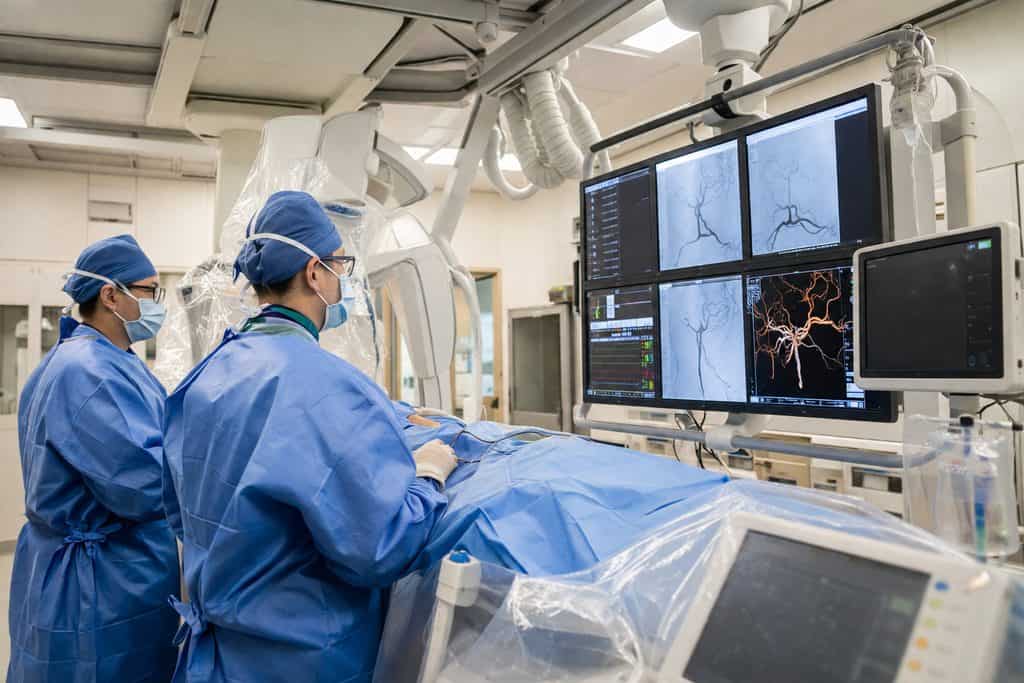
Not every aneurysm should be clipped. Not every aneurysm should be coiled. The right choice depends on the aneurysm’s size, neck width, and location. China’s leading neurovascular hospitals run integrated hybrid operating suites where open microsurgery and endovascular coiling are both available during the same procedure if needed. The team can start with a minimally invasive coiling attempt, and if the angiogram shows incomplete occlusion, convert to clipping without moving the patient. That is not standard everywhere. It is a structural advantage of large, well-funded public hospitals that treat neurosurgery as a flagship discipline.
Cost Advantage Without Quality Compromise
Let us address the elephant in the room directly. Lower cost does not mean lower quality. It means lower structural costs. Labor economics account for a large portion of the difference—a senior neurosurgeon’s salary in China is a fraction of the US equivalent, and that flows through to the hospital’s charge master. Hospital construction and operating costs are also lower. But the clinical tools are the same: Zeiss surgical microscopes, Stryker or Medtronic aneurysm clips, Siemens Artis angiography systems for coiling. The implants and devices are globally sourced, identical to what you would find in a Munich or Boston operating room. Our team has seen the invoices. A titanium aneurysm clip that costs $1,200 in the US is the exact same product used in Shanghai.
What does that mean for the final bill? For a straight-forward middle cerebral artery aneurysm clipping with a five-day inpatient stay, the all-inclusive hospital charge at a top public hospital’s international department generally lands between $18,000 and $28,000. More complex cases—giant aneurysms, posterior circulation locations, or cases requiring a bypass—can push the total to $35,000 or slightly above. Endovascular coiling, which uses platinum coils and sometimes a stent, is more expensive due to device costs. Expect $25,000 to $40,000 for a standard coiling procedure. These are real ranges based on actual international department price schedules, not estimates.
Clipping vs. Coiling: The Real Cost and Clinical Trade-offs
If you are researching how much does aneurysm coiling cost in China versus clipping, you need to understand why the numbers differ and what each approach actually means for your brain. This is not a simple “coiling is cheaper” or “clipping is safer” equation. The decision turns on your specific aneurysm anatomy.
| Factor | Microsurgical Clipping | Endovascular Coiling |
|---|---|---|
| Typical cost in China (international dept.) | $18,000 – $35,000 | $25,000 – $40,000 |
| Procedure | Craniotomy, titanium clip placed across aneurysm neck | Catheter through femoral artery, platinum coils packed into aneurysm sac |
| Hospital stay | 5–10 days | 3–5 days |
| Recovery time | 4–8 weeks before full activity | 1–3 weeks before full activity |
| Re-treatment rate (long-term) | Very low (~1–2% over 10 years) | Higher (~10–20% may need re-coiling, especially wide-neck aneurysms) |
| Best for | Younger patients, wide-neck aneurysms, MCA location, accessible anterior circulation | Older patients, narrow-neck aneurysms, posterior circulation, high surgical risk |
The cost inversion surprises many Western patients. In the US, coiling is often more expensive than clipping because of the disposable device costs—those platinum coils add up fast. The same dynamic holds in China. A single coil can cost $800 to $1,500, and a complex aneurysm might need six or eight coils plus a stent. That is $10,000 in devices before the hospital charges a single facility fee. Clipping uses one permanent titanium clip, a far less expensive implant. So the lower upfront cost of clipping comes with a longer recovery. The higher cost of coiling buys you a shorter hospital stay and faster return to normal life. There is no universally correct choice. There is only the right choice for your aneurysm.
Is Brain Aneurysm Surgery Safe in China? What the Evidence Shows
The blunt question patients ask us is is brain aneurysm surgery safe in China. The answer requires looking at what “safe” means in neurosurgery and what data we can actually verify.
China’s top neurosurgery centers publish their outcomes in international peer-reviewed journals. A 2023 study from a major Shanghai neurosurgery department reported a procedure-related complication rate for unruptured aneurysm clipping of under 3%, with a mortality rate well below 1%. Those numbers align with benchmarks from high-volume centers in Europe and North America. The International Society for Vascular Neurosurgery has recognized several Chinese centers as reference sites for complex cerebrovascular surgery.
But safety is not just about the operating room. It is about the entire system around the surgery. A foreign patient walking into a Chinese public hospital alone faces a language barrier that can turn a routine pre-op consultation into a dangerous game of charades. The hospital’s international department solves this. These are dedicated units within public hospitals—physically separate floors with English-speaking nursing staff, streamlined registration, and appointment systems designed for foreign patients. The neurosurgeon operating on you is the same chief surgeon who operates on local patients in the main hospital. You get the same hands, the same experience, but with an infrastructure built to handle international patients safely. That is the structural reason safety is achievable. It is not magic. It is organization.
What a Full-Service Neurovascular Surgery Package Actually Covers
The phrase medical tourism China brain surgery package gets thrown around loosely. Let us define what a coordinated care plan realistically includes when you are coming from abroad for aneurysm repair. This is not a vacation bundle. It is a logistical scaffold built around a serious surgery.
A properly structured plan starts weeks before you travel. It begins with a remote evaluation: you send your existing CT angiography, MR angiography, or digital subtraction angiography images and reports. A Chinese neurovascular team reviews them and provides a written second opinion. That document tells you whether they recommend clipping or coiling, what the specific surgical plan would be, and what the estimated cost looks like. Only after you have that in hand do you decide whether to proceed.
Once you commit, the coordination layer kicks in. The hospital’s international department schedules your pre-operative consultations, your anesthesia clearance, and your surgery date. Airport pickup, accommodation near the hospital, and a bilingual coordinator who accompanies you to every appointment—these are not luxuries. They are safety infrastructure. After discharge, you typically stay in the city for a follow-up CT angiogram about one week post-op to confirm the aneurysm is fully excluded from circulation. Then you fly home with a complete medical record in English and a discharge summary your local neurologist can read.
The total coordination cost for this level of support—the non-medical service layer—generally runs from $5,000 to $8,000 for end-to-end VIP coordination. That sits on top of the hospital’s surgical charges. It covers the case management, the bilingual companion, the logistics. It does not cover the surgery itself, your flights, or your hotel. But it means you never stand alone at a registration counter trying to explain a craniotomy in a language you do not speak.
Practical Considerations: Documentation, Visas, and Payment
Let us get concrete about what you will actually need to make this work.
Medical records. You need high-quality, recent imaging on a CD or via secure digital transfer. CT angiography with 3D reconstruction is the minimum. The Chinese neurosurgeon will want to see the aneurysm’s exact morphology before giving a surgical recommendation. Old scans, blurry scans, or missing reports will delay everything. Get your imaging organized before you reach out.
Visa. Foreign nationals traveling to China for medical treatment apply for an S2 visa, which covers short-term private affairs including medical visits. The hospital’s international department provides an official invitation letter and treatment confirmation that you submit with your visa application. Processing times vary by embassy, so plan for at least four to six weeks from invitation letter to visa in hand. A family member accompanying you applies for their own S2 visa. The M visa is for commercial activities and has nothing to do with medical treatment—do not let anyone tell you otherwise.
Payment. Chinese public hospitals, including their international departments, operate on a pre-payment model. You deposit the estimated surgical cost upfront, and the hospital draws down from that deposit as charges accrue. Any remaining balance is refunded at discharge. International wire transfers, major credit cards, and sometimes UnionPay are accepted. US health insurance generally does not provide direct billing to Chinese hospitals, so you pay first and seek reimbursement later. Some international insurance plans with out-of-network coverage may reimburse a significant portion. Check your policy’s fine print before you commit.
Language. The international department staff speak English. The neurosurgeon may speak some English but will typically rely on the department’s interpreter for detailed clinical discussions. This is normal and works smoothly when the interpreter is embedded in the neurosurgery team and understands the terminology. A freelance translator who does not know what a “wide-neck basilar tip aneurysm” means is worse than useless. The hospital’s own interpreters know the vocabulary.
Frequently Asked Questions
You cannot simply pick a date on a calendar and buy a plane ticket. The surgeon must review your imaging first, confirm the surgical plan, and then the international department schedules the procedure. That said, once the remote evaluation is complete and both sides agree on the approach, the surgery date is set before you travel. You are not flying to China hoping to get on a waiting list. You are flying to China with a confirmed surgical date, a fixed price, and a hospital room reserved. The remote evaluation is what makes this possible.
This is the hardest question, and it deserves a straight answer. The same neurosurgery ICU that manages post-operative patients from the main hospital manages international patients. Neurocritical care in top Chinese centers is protocol-driven and well-equipped. If a complication occurs—a vasospasm, a small post-operative bleed, an infection—the team manages it according to the same clinical pathways used in any advanced neurosurgery center. The international department keeps your family informed in English. What they cannot do is make complications impossible. No surgeon anywhere can promise that. What the volume data suggests is that complication rates at China’s busiest neurovascular centers are in line with international benchmarks. But zero risk does not exist in brain surgery, and any provider who tells you otherwise is not being honest.
This depends entirely on your relationship with your home neurologist. Before you even consider traveling, have a frank conversation with them. Explain that you are exploring treatment abroad for cost reasons. Ask directly: “If I have this done overseas and come back with a discharge summary and post-op imaging, will you manage my follow-up care?” Most neurologists will say yes—their duty is to the patient, not to the local hospital system. But some may refuse, and you need to know that before you go. The Chinese hospital will provide you with a detailed discharge summary in English, post-operative imaging on CD, and medication prescriptions that your home pharmacy can fill. You hand those to your local neurologist, and continuity of care continues.
This is where the specialty department rankings matter. The Fudan University hospital rankings, updated annually, publish a neurosurgery-specific reputation ranking. Hospitals like Xuanwu Hospital, Huashan Hospital, and West China Hospital consistently appear in the top tier. But “best” is not a single answer. One hospital may have the strongest microsurgical clipping program. Another may lead in flow-diverting stents for complex wide-neck aneurysms. The right hospital for you depends on what your aneurysm looks like. A written second opinion from two different centers can clarify which team’s approach aligns better with your specific anatomy. It costs a few hundred dollars. It is the most valuable money you will spend in this entire process.
Your Next Step
Deciding to travel abroad for brain aneurysm surgery is not a small decision. The cost savings are real—often $100,000 or more compared to US cash prices—but cost is only one variable. Clinical quality, logistical safety, and a clear plan matter more. Our organization exists to help you get that clarity. We are not a hospital, we do not employ surgeons, and we do not give medical advice. What we do is connect you with China’s top-ranked neurovascular departments, arrange remote evaluations so you can get a firm surgical recommendation and price quote, and handle the on-the-ground coordination if you decide to proceed. You get the information. You make the decision. If you want to understand what a real plan would look like for your specific case, request a free consultation. No pressure. Just the facts you need to make an informed choice.
For more medical information and treatment options in China, visit chinamedservices.com (China Medical Services).
