Emergency Surgery in Beijing as a Foreigner: Our 24-Hour Rapid Response
Have you ever felt a sudden, sharp pain in a foreign country and realized you have absolutely no idea where to go or who to call? That moment of panic is precisely what our team was built to handle. We are China Medical Services, and we specialize in bridging the gap between international patients and China’s top-tier hospitals. When a medical crisis hits without warning, the question of emergency surgery for foreigners Beijing cost and logistics becomes terrifyingly urgent. We get you from that moment of panic to a prepped operating room with a clear plan.
How This Actually Works, Step by Step
The process begins the moment you contact us, day or night. Our 24-hour hotline is manned by bilingual case managers who immediately triage your situation. You describe your symptoms and location. We do not provide medical advice, but we know exactly which emergency departments in Beijing are equipped for your specific crisis.
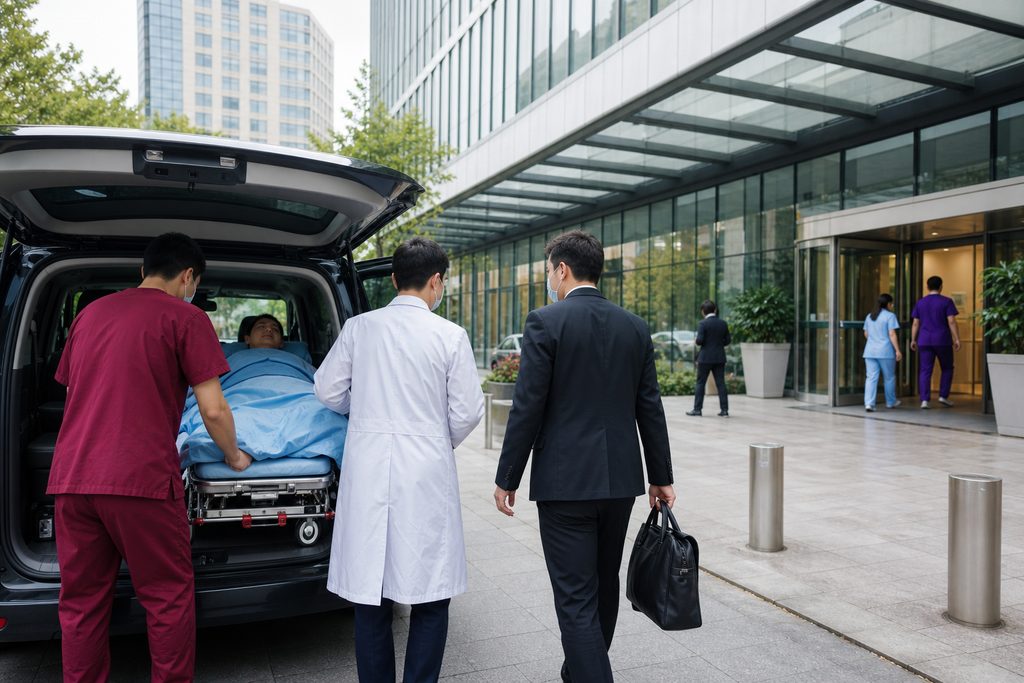
We simultaneously launch two parallel tracks. First, we dispatch a bilingual medical companion to your location—your hotel, your current hospital, or a meeting point. This person is your voice, your navigator. Second, our coordination team contacts the international patient center at the most appropriate hospital. For cardiac events, that often means Fuwai Hospital, which performs over 14,000 cardiac surgeries annually. For neurological emergencies, Xuanwu Hospital or Tiantan Hospital. We send your available medical records ahead while your companion helps you get into an ambulance or private car.
Your companion stays with you through triage, imaging, and the surgical consultation. They translate the surgeon’s explanation of the procedure and the risks. You are never alone with a consent form you cannot read. While this happens, our back office is verifying your insurance details and preparing a transparent cost estimate. The question of emergency surgery for foreigners Beijing cost is answered with a real quote, not a surprise bill weeks later. Once you consent, we handle the hospital deposit logistics and coordinate with the international VIP ward for post-operative recovery.
What the “24-Hour Rapid Response” Actually Delivers
The phrase “24-hour rapid response” gets thrown around loosely in medical tourism. Let us be precise about what it means and what it does not mean.
What it means is that within 24 hours of your first call, you will have had an in-person specialist consultation, a confirmed diagnosis via imaging or lab work, and a surgical plan with a cost breakdown. For a patient arriving at 2:00 AM with acute appendicitis, this typically means surgery is underway within 6 to 8 hours. For a complex orthopedic trauma that can wait 12 hours for swelling to reduce, the timeline stretches, but the decision-making is complete.
This is not a concierge shortcut that lets you skip the emergency room queue. Chinese hospitals run on triage. A level-one emergency—heart attack, stroke, severe trauma—goes straight to the resuscitation bay. Our role is to ensure you are triaged correctly and that no language barrier causes a dangerous delay. We have seen cases where a foreigner with severe abdominal pain was left sitting in a waiting area because they could not describe their symptoms to the triage nurse. That does not happen when our companion arrives with you or shortly after.
The 24 hour rapid response surgery Beijing price varies dramatically by procedure and hospital tier. At a public hospital’s international department, an emergency appendectomy ranges from $4,000 to $7,000. A cardiac stent placement can run from $15,000 to $25,000. These figures cover the hospital charges, surgeon fees, and the international ward stay. Our coordination fee starts from $300 for the rapid-response deployment and is credited in full if you later use our surgery coordination service.
A Realistic Timeline
People imagine an emergency surgery timeline as a straight line from pain to cure. Reality has waiting periods that no service can eliminate. Here is what to expect.
| Phase | What Happens | Realistic Duration |
|---|---|---|
| Initial Contact | You call our emergency line. We identify the nearest appropriate hospital and dispatch a companion. | 0–90 minutes |
| Hospital Arrival & Triage | Registration, vital signs, initial assessment by emergency physician. | 15–45 minutes |
| Diagnostic Workup | Blood tests, CT scan, MRI, or ultrasound. Results often available within 1–2 hours in a major Beijing emergency department. | 1–3 hours |
| Specialist Consultation | The surgeon reviews your case, explains the procedure, and obtains your consent with our translator present. | 30–60 minutes |
| Pre-Op Preparation | Anesthesiology assessment, IV placement, surgical site preparation. | 1–2 hours |
| Surgery | The procedure itself. | Varies by case |
| Post-Op Recovery | PACU observation, then transfer to international ward. | 2–24 hours before ward transfer |
| In-Hospital Recovery | Monitoring, pain management, early mobilization. | 1–7 days typical |
| Discharge & Follow-Up | Discharge summary in English, medication instructions, suture removal appointment. | 1–2 hours for paperwork |
The part most people forget is the visa situation. If you entered on a tourist visa and now require a prolonged hospital stay, your visa may need adjustment. An S2 visa is the correct category for private medical treatment. This process can take several business days through the Exit and Entry Administration. We handle the invitation letter from the hospital and guide you through the application, but the government’s processing time is not something we control. Plan for 5 to 7 business days if a visa extension or conversion becomes necessary.
What Can Go Wrong — and What Happens Then
Let us talk about the moments that test a system. These are the scenarios we prepare for, and they are the reason our model exists.
The most common failure point is incomplete medical history. A patient arrives unconscious or in shock. No one knows their blood type, allergies, or current medications. Our protocol in this situation is to immediately contact the patient’s emergency contact—the person listed on their phone’s emergency screen or in their passport. We also work with the embassy if necessary. The hospital proceeds with standard emergency protocols, but having a companion who can relay even fragmentary information to the surgical team changes the risk calculation.
Another scenario: the diagnosis shifts mid-process. What looked like a straightforward gallbladder attack turns out to be a bile duct obstruction requiring a more complex procedure. This happens in medicine everywhere. What changes in a foreign country is that the patient suddenly faces a larger surgery, a longer recovery, and a higher bill than initially quoted. Our case manager immediately updates the financial estimate and walks you through the revised consent. You are never handed a form in Chinese and told to sign.
A third scenario is the post-operative complication. A fever spikes. A wound looks concerning. You are discharged but feel unwell at your hotel. Our companion remains reachable for 48 hours after discharge. We can arrange a rapid readmission or an urgent follow-up consultation. The hospital’s international department also provides a direct line for post-discharge concerns. This safety net is not a guarantee of outcomes—no ethical service promises that—but it is a guarantee of access.
We have also seen insurance disputes. A patient assumes their travel insurance covers emergency surgery, but the policy has a clause excluding pre-existing conditions, and the hospital’s diagnosis note triggers that clause. We cannot resolve insurance coverage disputes, but we can provide the detailed English-language medical records and billing codes that make an appeal possible. We also connect you with medical billing advocates if needed.
How to Decide: Public Hospital International Department vs. Private International Hospital
This is the single most important decision you will make in an emergency, and the answer is not always obvious.
Beijing’s public hospital international departments—like those at Peking Union Medical College Hospital or China-Japan Friendship Hospital—offer something unique. You get the same senior surgeons who operate on the most complex cases in China, but with English-speaking nursing staff and private rooms. The emergency surgery for foreigners Beijing cost at these facilities is typically 1.5 to 2 times the local patient rate, which still lands at a fraction of Western prices. A hip fracture repair that costs $40,000 in the United States runs $8,000 to $12,000 here. The trade-off is that the environment is still a Chinese public hospital. The corridors are busy. The administrative processes can feel opaque. Our companion navigates this for you.
Private international hospitals like Beijing United Family Hospital or Raffles Hospital Beijing offer a Western-style experience. English is the working language. The rooms resemble hotel suites. Direct insurance billing is standard. The surgeons are often trained abroad and maintain international certifications. The trade-off is cost and, in some cases, surgical volume. For common emergencies like appendicitis or uncomplicated fractures, a private international hospital is an excellent choice. For a complex cardiac emergency or a rare vascular condition, the sheer case volume at a Fuwai Hospital or Anzhen Hospital becomes a decisive factor. A surgeon who performs 300 valve replacements a year operates with a different level of instinct than one who performs 30.
Here is a practical framework. Ask yourself: is this a condition where surgical volume and sub-specialization matter most? If yes, choose a public hospital international department. If the priority is a seamless, low-stress environment and the procedure is relatively standard, a private international hospital makes sense. Our team helps you make this call in real time, based on your specific diagnosis and the available surgeon rosters that day.
We also help patients understand what a “Beijing hospital emergency surgery foreigner package” actually includes. Some hospitals bundle the surgeon fee, anesthesia, operating room, and ward stay into a single quote. Others bill each line item separately. We clarify this before you commit. A package that looks cheaper on paper may exclude the anesthesiologist’s fee, which can be a significant line item. We ask these questions so you do not have to.
Practical Considerations: Records, Payment, and Getting Home
What should you have ready, ideally, before an emergency happens? A folder on your phone with a photo of your passport, your insurance card, a list of current medications, and any known allergies. This takes five minutes to prepare and can save hours in a crisis. If you have a chronic condition, include a brief summary from your home physician. We can translate this into Chinese in under an hour if it is not already available.
Payment works differently than you may expect. Public hospitals in China require a deposit before admission, even in emergencies. This is a cultural and systemic reality. The deposit amount varies—typically $3,000 to $10,000 for a surgical admission—and is adjusted based on the estimated procedure cost. Credit cards are accepted at international departments, but having a card with a sufficient limit is essential. We can sometimes coordinate with your insurer for a guarantee of payment letter, which may reduce or waive the deposit requirement. This takes time and is easier to arrange when you are conscious and able to authorize communication.
After discharge, the question of flying home arises. The surgeon will provide a fitness-to-fly assessment. For abdominal surgery, this is typically 7 to 10 days. For orthopedic procedures with casting, it may be sooner. We can arrange a medical escort if you need assistance during the flight. We also coordinate with the hospital to provide a discharge summary and imaging on a USB drive for your home physician. Continuity of care across borders is a gap in many medical tourism experiences. We close it by ensuring your home doctor receives a complete, translated record.
The visa question deserves a clear restatement. If you are in China on a tourist (L) visa and require emergency surgery, the hospital will treat you. That is not the issue. The issue arises if your recovery extends beyond your authorized stay. You must apply for an S2 visa, which is specifically for private medical treatment. Our team provides the hospital’s official invitation letter and guides you through the application at the Exit and Entry Administration. Do not ignore an expiring visa because you are in a hospital bed. The legal consequences compound quickly.
Frequently Asked Questions
Can a foreigner get emergency surgery in China without insurance?
Yes. Hospitals in Beijing will treat any patient in a genuine emergency, regardless of nationality or insurance status. The practical requirement is the ability to pay the hospital deposit. If you lack insurance, you will need to cover the cost out-of-pocket. The emergency surgery for foreigners Beijing cost is transparently quoted before the procedure, and we help you understand every line item. Some hospitals offer a slight discount for self-pay patients who settle the bill in full at discharge.
How do I get an emergency operation as a tourist in China if I do not speak Chinese?
This is the scenario our 24-hour rapid response service is built for. You call us. We send a bilingual medical companion to your location immediately. That person handles all communication with the hospital staff, from the emergency room triage nurse to the operating room surgeon. You focus on your health. We handle the language barrier. Our companion also manages the administrative steps—registration, deposit payment, and discharge paperwork—so nothing is lost in translation.
What is the real risk of a medical error due to language barriers?
The risk is real and well-documented in medical literature. Miscommunication during the handoff between emergency medical services and the hospital is a known source of adverse events. In a 2023 study published in the *International Journal for Quality in Health Care*, language barriers were associated with a higher rate of hospital readmission and longer emergency department stays. Our service exists specifically to mitigate this risk. The companion is not just a translator; they are trained to recognize when a clinical instruction seems inconsistent and to ask for clarification. That second layer of attention matters.
Does urgent surgery abroad through China medical tourism require a special visa?
If you are already in China and the surgery is truly urgent, you receive treatment under your current visa status. The hospital will not turn away a genuine emergency. However, if your recovery will extend beyond your authorized stay, you must apply for an S2 visa. This is the correct category for private medical treatment. Our team handles the hospital invitation letter and guides you through the application. If you are planning to travel to China specifically for surgery—not an emergency—you should obtain the S2 visa before departure. We assist with the documentation for that process as well.
What happens if I need follow-up care after returning home?
We provide a complete discharge package in English, including the operative report, pathology results if applicable, imaging on a USB drive, and a letter from the surgeon summarizing the procedure and recommended follow-up. This is designed to be handed directly to your primary care physician or specialist at home. If your home doctor has questions, we can arrange a brief video consultation with the Beijing surgeon. This follow-up consultation is billed at our standard video consultation rate of $100 to $300, which is credited in full if you later return to China for additional treatment with us.
Your Next Step
Medical emergencies abroad are disorienting and frightening. The system we have built exists to replace chaos with a clear sequence of actions. You call. We send someone who speaks both languages and knows both medical systems. You get a diagnosis, a transparent cost, and a surgical plan. That is the core of what we do.
We are China Medical Services, an independent coordination team. We do not employ surgeons or own hospitals. We connect you with the right hospital and surgeon for your specific emergency, and we stay with you until you are safely discharged. Our case managers have handled cardiac events, traumatic injuries, acute abdominal surgeries, and countless other urgent situations for patients from over 60 countries.
If you are reading this before a trip to China, save our contact information now. If you are reading this in the middle of a crisis, call us immediately. The consultation is free, and the rapid-response companion dispatch begins the moment we understand your location and situation. Visit our patient coordination page to learn more about how we work, or reach out directly for an urgent case assessment.
For more medical information and treatment options in China, visit chinamedservices.com (China Medical Services).
