MDT Care in China: How Top Hospitals Coordinate Complex Cases for International Patients
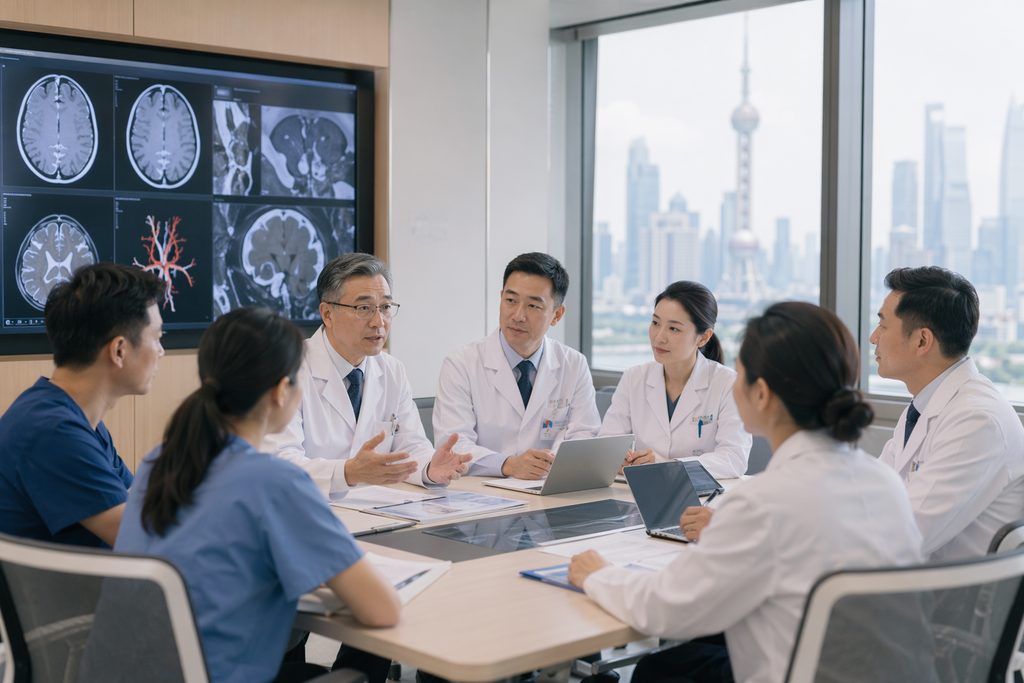
You have probably heard that navigating a complex diagnosis means months of shuttling between specialists, repeating your story to every new doctor, and waiting weeks for them to finally talk to each other. That is the reality for many patients in Western health systems. In China’s top-tier hospitals, the approach is structurally different. The default for a complicated case is not a sequence of isolated referrals. It is a single room, a single meeting, and every relevant specialist sitting at the same table reviewing your scans together. This is multidisciplinary team care — MDT — and it is not a premium add-on here. It is how complex medicine is practiced.
Key Takeaways
- China’s top 5% of hospitals — approximately 340 institutions ranked by Fudan University and JCI — routinely use MDT models that bring together oncology, surgery, radiology, pathology, and other specialties in a single coordinated session.
- For international patients, a formal multidisciplinary team consultation price in Beijing or Shanghai typically ranges from $1,500 to $2,000, a figure that is often 70-80% lower than equivalent private MDT services in the US or UK.
- MDT is not a universal guarantee of better outcomes — its effectiveness depends on hospital volume, specialist experience, and whether the team follows a genuinely integrated protocol rather than a superficial case review.
- Language barriers, visa requirements, and hospital payment systems create real friction for foreign patients attempting to access MDT care independently, which is why most successful cases involve a local coordination layer.
The Problem: Fragmented Care Creates Real Harm
A 2023 study published in BMJ Quality & Safety found that approximately 1 in 5 cancer patients in the United States received a treatment plan that was later revised after a multidisciplinary review — meaning the initial recommendation, made without coordinated specialist input, was incomplete or suboptimal. That is not a small margin. It is the difference between a targeted therapy and a generic chemotherapy protocol. The problem is not a lack of expertise. It is a lack of integration. A thoracic surgeon sees a surgical candidate. A medical oncologist sees a chemotherapy candidate. A radiation oncologist sees a radiation candidate. Each specialist is competent. But none of them sees the full picture alone.
MDT care is designed to solve exactly this fragmentation. Instead of sequential, siloed consultations, the radiologist, pathologist, surgeon, oncologist, and often a specialist nurse or palliative care physician review the case together. They debate. They reconcile conflicting interpretations of the same imaging. They arrive at a single, unified treatment recommendation — not three separate ones. The evidence supporting this model is substantial. A 2020 meta-analysis in The Lancet Oncology covering over 80,000 patients found that MDT-guided care was associated with a 12-18% improvement in overall survival for certain complex cancers, particularly lung, colorectal, and head and neck malignancies. The mechanism is straightforward: when specialists collaborate at the diagnostic stage, treatment sequencing improves, contradictory plans are eliminated, and patients avoid the delays that come from back-and-forth referrals.
But access to genuine MDT care varies enormously by country and by hospital. In many Western public health systems, MDT meetings exist on paper — weekly tumor boards where cases are discussed — but the meetings are often under-resourced, rushed, and limited to a narrow set of cancer types. Private MDT services exist but carry eye-watering price tags. A comprehensive private MDT evaluation at a leading London hospital can exceed £5,000. At a major US academic center, the uninsured cost can run to $10,000 or more. For patients who need this level of coordinated expertise but cannot afford those figures, the alternatives are limited. This is where China’s top hospitals enter the conversation — not as a budget option, but as a structurally different model with genuine clinical depth.
Who We Are
We are China Medical Services. We are not a hospital. We do not treat patients, make clinical diagnoses, or recommend specific therapies. What we do is connect international patients with the right MDT-capable hospitals in China and handle every logistical layer — from medical translation and visa guidance to in-person bilingual accompaniment — so that you arrive at your consultation with your case fully prepared and your questions clearly articulated. Think of us as your operational backbone. We do the navigating so you can focus on the medicine.
How Multidisciplinary Team MDT Care in China Actually Works
The workflow is standardized across most top-tier institutions. When a case is flagged as complex — typically by the first consulting physician who identifies that the patient’s condition crosses specialty boundaries — it is referred to the hospital’s MDT coordination center. A coordinator, usually a senior nurse or junior attending physician, gathers all relevant records: imaging, pathology slides, lab results, prior treatment history. These are digitized and shared with the MDT panel in advance. The panel composition depends on the case. A stage IV lung cancer patient with bone metastases might trigger a team that includes a thoracic surgeon, a medical oncologist, a radiation oncologist, an interventional radiologist, a pathologist, and an orthopedic surgeon. The meeting itself is not a brief huddle. It is a scheduled, documented session — typically 30-60 minutes per case — where each specialist reviews the evidence and presents their perspective. A preliminary report is generated within 24-48 hours. The final, consensus report follows within a week.
For international patients, the process has an additional layer. Your overseas medical records must be translated into Chinese — not just the summary, but the full imaging reports, pathology narratives, and treatment timelines. This is non-negotiable. A radiologist cannot review a CT scan meaningfully without understanding the clinical context, and that context is embedded in the written record. Once translated, the records are submitted through the hospital’s international patient center or VIP department, which schedules the MDT session. You attend either in person or via video link, with a bilingual medical interpreter present. The session itself is clinical and direct. Chinese specialists tend to be less conversational than their Western counterparts — they focus on the evidence, ask pointed questions, and reach conclusions efficiently. It can feel abrupt if you are expecting a lengthy bedside discussion. But the output is what matters: a single, unified treatment recommendation backed by multiple specialists who have reviewed your case together.
Is Multidisciplinary Care for Cancer Effective in China?
The short answer is yes, with important caveats. The effectiveness of MDT care depends less on the country and more on the specific hospital and the volume of cases that hospital’s MDT team handles. A thoracic oncology MDT at Fuwai Hospital or Shanghai Chest Hospital, both of which manage thousands of lung cancer cases annually, operates at a level of experience that is hard to match anywhere in the world. The specialists on those panels have seen more variants of a given cancer in a single year than many Western specialists see in a decade. That pattern-recognition depth matters. It is why Chinese cardiac surgeons at Fuwai perform over 14,000 cardiac surgeries annually — more than any other hospital globally — and why their complication rates for complex procedures are consistently below international benchmarks.
But not all MDT programs are equal. A hospital that runs one MDT session per week for a handful of cases is not delivering the same value as a hospital where MDT is embedded in the standard care pathway for every complex admission. The key metric to ask about is case volume per MDT session and the formal protocol for follow-up. Does the team reconvene if the initial treatment fails? Is there a structured process for revising the plan based on new imaging or biomarker results? The best hospitals in China have these processes in place. Others do not. This is where pre-travel research — or a coordination partner who has already done that research — becomes essential. Our database covers 340+ top-ranked hospitals across 37 cities, and we maintain current information on which institutions run genuine, high-volume MDT programs versus those where MDT exists more as a marketing label than a clinical reality.
What You Need to Know Before Going Alone
Accessing MDT care in China as an international patient is entirely possible. Doing it without local support is significantly harder than most people anticipate. The barriers are not insurmountable, but they are real, and underestimating them leads to wasted time, unnecessary costs, and occasionally, compromised care.
- Visa Requirements: Medical treatment in China requires an S2 visa, with specific documentation from the receiving hospital — an official invitation letter and treatment confirmation. This is not a tourist visa. You cannot arrive on a standard L visa and then convert to medical treatment status. The hospital’s international department must issue the invitation, and processing times vary. Family members accompanying you also need S2 visas. The M visa is for commercial business and is not valid for medical purposes.
- Payment Systems: Public hospitals in China operate on a prepayment model. You deposit funds before admission, and services are deducted from that balance. International credit cards are not universally accepted at public hospital counters. You will need a Chinese bank account, UnionPay card, or a local payment agent. Private international hospitals like United Family or Jiahui accept direct insurance billing and international cards, but they are not the institutions running the highest-volume MDT programs for complex cancers or rare conditions.
- Medical Records Translation: This is the single most underestimated barrier. A complete oncology record — imaging reports, pathology, genomic testing, treatment history — can run to 50-100 pages. Generic translation services will not suffice. The translator must understand medical terminology in both languages and accurately convey clinical nuance. A mistranslated pathology report can derail an entire MDT session. Professional medical translation is a specialized service, and it takes time. Plan for at least 5-7 business days for a full record.
How We Help You Navigate This
These barriers exist for structural reasons, not because the system is designed to exclude foreign patients. The Chinese healthcare system is built to serve a domestic population of 1.4 billion people. International patients are a tiny fraction of total volume, and the administrative infrastructure is not optimized for them. That is where we step in.
Before you travel, we handle the hospital matching process. Not every top-ranked hospital is the right hospital for your specific case. A hospital that excels in liver cancer MDT may not be the best choice for a rare sarcoma. We map your diagnosis against our database of 340+ institutions, cross-referencing Fudan University specialty rankings, JCI accreditation status, and real-world case volume data. We then coordinate directly with the hospital’s international patient center to confirm that an MDT session is appropriate and available. We manage the medical records translation — our translators are medically qualified and work to a standard that hospital MDT coordinators accept without revision. We guide you through the S2 visa documentation process, ensuring the hospital’s invitation letter meets consular requirements. And when you arrive, our bilingual medical companions are with you in the hospital — handling registration, payment deposits, navigation between departments, and real-time interpretation during the MDT session itself.
After the MDT session, the work continues. The consensus report is translated back into English, reviewed for clinical accuracy, and delivered to you with a clear explanation of the recommended treatment pathway. If the recommendation involves surgery, chemotherapy, or radiation therapy in China, we coordinate the scheduling, admission, and follow-up logistics. If the recommendation is a treatment plan that you will pursue in your home country, we ensure the report is formatted and detailed enough for your local physicians to act on directly.
The cost question is always front of mind. How much does multidisciplinary team care cost in China? For a formal MDT session at a top-tier public hospital’s international department, the consultation fee typically ranges from $1,500 to $2,000. This covers the full panel review, the session itself, and the consensus report. It does not include preliminary imaging or lab work if those are required before the MDT can proceed — those are billed separately by the hospital. It also does not include our coordination fee, which varies by case complexity. The important number to hold in mind is the comparison: an equivalent private MDT in the US or UK often costs $5,000-$10,000 or more. The structural reasons for this gap are straightforward — lower physician labor costs in China, higher patient volumes that spread fixed costs, and a hospital system that prioritizes throughput over margin per case. The clinical quality at the top 5% of Chinese hospitals is not lower. In many specialties, the case volume and subspecialist depth are higher than what most Western hospitals can offer.
For patients researching the best hospitals with an MDT approach in Shanghai, the conversation usually starts with a short list. Zhongshan Hospital at Fudan University runs one of China’s highest-volume liver cancer and cardiovascular MDT programs. Ruijin Hospital, affiliated with Shanghai Jiao Tong University, is a reference center for endocrine and hematologic malignancies. Shanghai Chest Hospital handles an enormous thoracic oncology caseload. Each of these institutions has a dedicated international patient center and experience managing foreign cases. The multidisciplinary team consultation price in Beijing is comparable — Peking Union Medical College Hospital, Cancer Hospital Chinese Academy of Medical Sciences, and Peking University Third Hospital all offer formal MDT pathways with English-capable coordination staff.
| MDT Service Component | Estimated Cost (USD) | Notes |
|---|---|---|
| MDT consultation fee (top public hospital, international dept) | $1,500 – $2,000 | Covers panel review, session, and consensus report |
| Medical records translation (full oncology record) | $300 – $800 | Varies by page count and complexity |
| Bilingual medical companion (per day) | from $200 | Half-day or full-day; handles navigation and interpretation |
| Video consultation (pre-MDT, single specialist) | $100 – $300 | Used to determine if MDT is appropriate |
| VIP end-to-end coordination | $5,000 – $8,000 | Full-service package for complex multi-step cases |
One structural detail worth understanding: any consultation or coordination fee you pay to us is credited in full toward on-the-ground coordination services if you proceed to treatment in China within 90 days. This is not a discount on hospital charges — those are separate and paid directly to the hospital. It is a credit on our coordination fee, designed so that the exploratory phase is not a sunk cost if you decide to move forward. We mention this because it matters for financial planning, not as a sales tactic.
Frequently Asked Questions
How much does multidisciplinary team care cost in China compared to the US?
A formal MDT consultation at a top Chinese public hospital’s international department typically costs between $1,500 and $2,000. In the United States, a comparable private-pay MDT evaluation at a major academic center can range from $5,000 to over $10,000. The cost difference reflects structural factors — physician labor costs, hospital overhead, and patient volume economics — not a difference in clinical rigor. At China’s top-ranked hospitals, the specialists on an MDT panel are often handling case volumes that exceed their Western counterparts by a factor of five or more.
Is multidisciplinary care for cancer effective in China, or is it just a cost-saving option?
The effectiveness of cancer MDT care in China is well-documented at high-volume centers. Hospitals like Fuwai, Zhongshan, and Cancer Hospital Chinese Academy of Medical Sciences publish outcomes data that are comparable to or better than international benchmarks for their specialty areas. The key variable is hospital selection. A top-100 Fudan-ranked hospital with a dedicated MDT program and high case volume will deliver genuine multidisciplinary integration. A lower-tier hospital that convenes an occasional tumor board will not. This is not a China-specific issue — it is true of MDT programs everywhere. The advantage in China is that the top institutions concentrate enormous clinical volume, which drives pattern recognition and procedural proficiency.
What happens if the MDT recommendation is not what I expected?
You are under no obligation to accept the recommended treatment plan, and you are not committed to receiving treatment in China simply because you had an MDT consultation there. The output of the session is a consensus report — a detailed clinical document that you can take to your home-country physicians for review and second opinions. Some patients use the Chinese MDT report to inform treatment decisions back home. Others proceed with treatment in China because the recommended approach is not available or is prohibitively expensive in their home country. The report is yours. What you do with it is your decision, made in consultation with your trusted doctors.
Can I book complex case management in China without traveling there first?
Yes, partially. The initial stages — hospital matching, records translation, and a preliminary video consultation with a lead specialist — can all be done remotely. This remote phase helps determine whether an in-person MDT is warranted and which hospital is the best fit. However,
For more medical information and treatment options in China, visit chinamedservices.com (China Medical Services).
