Jiangsu Province Hospital Nanjing Cardiology: Interventional Heart Disease and Electrophysiology
When 42-year-old Michael first heard the diagnosis—persistent atrial fibrillation with a recommendation for catheter ablation—he did what anyone would do. He sat in his car outside the clinic in Manchester and searched his options. The earliest available slot was seven months out. The out-of-pocket estimate, even with insurance gaps, hovered near $28,000. He started typing into Google late that night: “best interventional cardiology hospital China.”
Michael is not alone. Cardiovascular disease remains the leading cause of death globally, affecting approximately 1 in 3 adults over their lifetime. For patients facing structural heart disease or complex arrhythmias, the twin barriers of cost and waiting time can feel insurmountable. That search for alternatives leads a growing number of international patients to one specific destination: the Department of Cardiology at Jiangsu Province Hospital in Nanjing.
Our team has coordinated care for dozens of patients walking this exact path. We are not physicians. We do not treat heart disease or perform ablations. We are the logistical architects who bridge the gap between you and China’s top-tier cardiology expertise. We handle the visa paperwork, the hospital registration, the language barrier, and the thousand small frictions that make seeking care abroad feel impossible to navigate alone.
Key Takeaways
- The cardiology department performs over 6,000 interventional procedures and more than 1,200 electrophysiology studies annually, placing it among China’s highest-volume heart centers.
- Total cost for a complex cardiac ablation at Jiangsu Province Hospital typically ranges from $8,000 to $15,000—a fraction of the $25,000–$50,000 charged in the United States or United Kingdom.
- Language, medical visa requirements, and hospital registration systems create genuine barriers for independent international patients; attempting to navigate these alone often results in delays or denied access to specialist care.
- All international patients should understand that Chinese public hospitals require in-person specialist evaluation before scheduling any interventional procedure—advance remote booking for surgery is not possible through standard channels.
The Problem: When Your Heart Needs Intervention and Your System Says Wait
Cardiac care in Western healthcare systems has become a study in paradox. The technology exists. The specialists are trained. But access has calcified. In Canada, the median wait time for elective cardiac surgery stretches to approximately 13 weeks. In the United Kingdom’s NHS, patients routinely wait 18 weeks or longer for interventional cardiology procedures. For someone with symptomatic atrial fibrillation—where every episode feels like a fish flopping inside the chest—waiting half a year is not a minor inconvenience. It is a daily erosion of quality of life.
The financial picture is starker still. A single electrophysiology study with catheter ablation in the United States averages $26,000 to $32,000 for uninsured or underinsured patients. Complex cases involving 3D electroanatomic mapping push higher. Even insured patients face deductibles that exceed the total cost of receiving the same procedure abroad. This is not a theoretical comparison. Our team has seen itemized bills from both systems. The gap is real and it is widening.
What happens if nothing changes? For arrhythmia patients, persistent tachycardia gradually remodels the heart muscle. Stroke risk climbs. Exercise tolerance drops. The condition does not politely wait for a scheduling slot to open.
Who We Are
We are China Medical Services—a medical concierge organization that connects international patients with the resources of China’s top-tier hospital system. We maintain a database of 340+ top-ranked hospitals across 37 cities, representing the top 5% of China’s 35,000+ medical institutions as ranked by the Fudan University hospital rankings and JCI accreditation standards. We are not a hospital. We do not provide medical treatment or clinical diagnoses. What we do is eliminate the friction that stands between you and expert cardiology care: the visa confusion, the registration gauntlet, the language wall, and the logistical uncertainty that makes seeking treatment abroad feel like stepping off a cliff in the dark. We have walked this path before. We know where the handrails are.
Why Jiangsu Province Hospital Nanjing Cardiology Delivers Results
Clinical Volume That Builds Uncommon Expertise
The Cardiology Department at Jiangsu Province Hospital—also known as the First Affiliated Hospital of Nanjing Medical University—is not a small specialized clinic. It is one of the largest cardiovascular centers in eastern China, performing more than 6,000 interventional procedures and over 1,200 electrophysiology studies and ablations each year. Volume matters in interventional cardiology. Study after study published in journals like Circulation and the Journal of the American College of Cardiology has demonstrated a direct inverse relationship between procedural volume and complication rates. A center that handles complex left atrial appendage occlusions or ventricular tachycardia ablations every single week develops a muscle memory—a depth of pattern recognition—that lower-volume centers simply cannot replicate.
Consider the numbers in context. The average electrophysiologist in a Western community hospital might perform 50 to 80 atrial fibrillation ablations annually. At Jiangsu Province Hospital, the electrophysiology team handles that volume in a slow month. This is the difference between competence and mastery. For a patient, it translates to shorter procedure times, lower fluoroscopy exposure, and a reduced likelihood of complications like cardiac tamponade or pulmonary vein stenosis.
Technology Infrastructure Without the Bureaucratic Lag
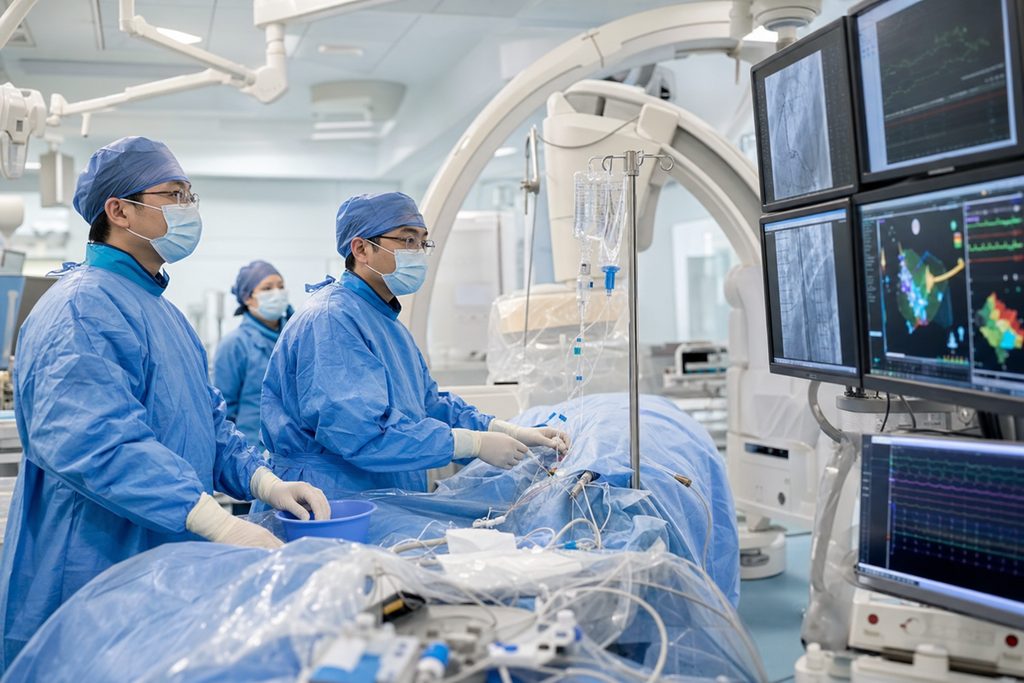
Walk into the cardiac catheterization laboratories here and you will find the same equipment you would see at the Cleveland Clinic or the German Heart Center Munich. The department operates multiple catheterization suites equipped with the latest-generation 3D electroanatomic mapping systems—Carto and EnSite platforms—that allow operators to create high-resolution, real-time maps of cardiac electrical activity without heavy reliance on fluoroscopy. This is not “good enough” technology. This is the current global standard, deployed at scale.
But the real difference is operational, not technological. In many Western hospitals, cath lab time is a fiercely contested resource. Scheduling conflicts, anesthesia availability, and administrative bottlenecks stretch wait times. Jiangsu Province Hospital runs its interventional cardiology service with an efficiency born of sheer demand. The hospital sees over 10,000 outpatient visits daily across all departments. The cardiology service has adapted to this volume with streamlined patient flow, dedicated electrophysiology teams, and protocols refined through relentless repetition. For the international patient, this means that once you are in the system, things move.
Understanding Jiangsu Province Hospital Nanjing Cardiology Price
The question every patient asks first: what will this cost? The Jiangsu Province Hospital Nanjing cardiology price structure reflects the broader economics of Chinese public healthcare—highly competitive by Western standards, with costs driven down by volume and a fundamentally different labor market. For an international patient accessing care through the hospital’s international medical service channel, here is what the numbers look like:
| Procedure | Estimated Cost at Jiangsu Province Hospital (USD) | Typical US Cost (USD) | Typical UK Private Cost (USD) |
|---|---|---|---|
| Diagnostic Electrophysiology Study | $2,500 – $4,500 | $8,000 – $15,000 | $6,000 – $10,000 |
| Atrial Fibrillation Catheter Ablation | $8,000 – $15,000 | $25,000 – $50,000 | $18,000 – $30,000 |
| Coronary Angioplasty with 1 Drug-Eluting Stent | $6,000 – $10,000 | $28,000 – $45,000 | $14,000 – $22,000 |
| Complex VT Ablation (3D Mapping-Guided) | $12,000 – $18,000 | $35,000 – $60,000 | $25,000 – $40,000 |
These are all-in estimates for the hospital portion—procedure fees, device costs, room charges, and standard medications during the stay. They do not include travel, accommodation, or our coordination service fees. And they vary by case complexity. A straightforward paroxysmal atrial fibrillation ablation in a patient with a structurally normal heart costs less than a persistent AF case requiring extensive substrate modification. The final Jiangsu Province Hospital Nanjing cardiology price is always confirmed after in-person evaluation.
Does lower cost mean lower quality? This is the objection every rational patient should raise. The answer lies in understanding why the gap exists. Chinese cardiologists earn substantially less than their Western counterparts—not because they are less skilled, but because physician compensation in China’s public hospital system operates on an entirely different economic model. Hospital infrastructure costs are amortized across massive patient volumes. Device and pharmaceutical pricing reflects local market dynamics. None of these factors correlate with clinical outcomes. When you look at published complication rates for catheter ablation in major Chinese centers, they fall well within the 2–5% range reported in international registries. The cost of cardiac ablation abroad Nanjing simply reflects different economics, not different medicine.
How Safe Is Electrophysiology Study in China?
“How safe is electrophysiology study in China” is not a question to brush past. It deserves a direct answer. An electrophysiology study is an invasive procedure. Catheters are threaded through veins into the heart. Electrical signals are recorded. In the case of ablation, tissue is deliberately destroyed to interrupt abnormal circuits. Complications—though uncommon—are real: vascular access issues (1–2%), cardiac tamponade (0.5–1%), stroke (0.1–0.5%), and rarely, atrioesophageal fistula (0.04–0.1%). These numbers come from global literature and apply everywhere the procedure is performed.
The safety of electrophysiology study in China at a high-volume academic center like Jiangsu Province Hospital is supported by several structural factors. First, operator experience—the electrophysiologists here have performed thousands of procedures. They have encountered and managed the rare complications. Second, the hospital is a tertiary referral center with cardiac surgery backup on-site. If a tamponade occurs, a cardiothoracic surgeon can be in the room within minutes. Third, the electrophysiology labs are equipped with intracardiac echocardiography, allowing real-time visualization of cardiac structures during ablation. This technology has been shown to reduce complication rates, particularly for transseptal puncture.
Are there risks specific to seeking care abroad? Yes. Post-procedure follow-up is more complicated when you are thousands of miles from your electrophysiologist. You need a clear plan for anticoagulation management, rhythm monitoring, and a local cardiologist who will accept you back into their care. These are solvable problems, but they require coordination. We address them before you ever board a plane.
What You Need to Know Before Going Alone
Some patients try to arrange everything independently. We understand the impulse. But the friction points are real and they can derail the entire process:
- Medical Visa Complexity: Treatment in China requires an S2 visa specifically annotated for medical purposes. The supporting documentation must include a formal invitation letter from the hospital, a detailed treatment plan, and proof of financial capacity. Applying for the wrong visa category—such as an M business visa—will result in rejection. The Chinese consular system does not bend on this. We have seen patients lose weeks to visa corrections that could have been avoided with proper initial guidance.
- Registration and Payment Systems: Chinese public hospitals operate on a prepaid deposit system. You fund a hospital account before services are rendered. Registration requires a Chinese ID number or passport linked to a hospital-issued medical card. The registration kiosks, the payment terminals, the pharmacy queue—all operate in Mandarin. Without a bilingual companion, a simple outpatient visit can consume an entire day of confusion and frustration.
- Specialist Access Reality: Here is the hardest truth for international patients to accept: you cannot book a specific electrophysiologist or a guaranteed surgery date from overseas through standard public channels. The Chinese public hospital system requires an in-person specialist consultation first. The physician evaluates you, orders confirmatory tests, and only then schedules a procedure. Attempts to bypass this by emailing department chairs or calling international offices rarely succeed without an established relationship. The pathway that works is through the hospital’s international medical service department—and that is the door we knock on.
How We Help You Navigate This
These barriers exist for structural reasons, not malice. Chinese hospitals serve enormous domestic patient populations. The systems evolved for that context. Our role is to create a parallel pathway for international patients without disrupting how the hospital functions.
Before you travel, we handle the hospital invitation letter that anchors your S2 visa application. We translate and format your medical records—echo reports, Holter monitor results, prior ablation notes—into the documentation Chinese cardiologists expect to review. We coordinate with the international medical service department to schedule your initial specialist consultation, ensuring you see an electrophysiologist whose expertise matches your specific arrhythmia. The cost for this hospital appointment coordination starts from $300, and we refund it in full if we cannot secure the appointment.
On the ground in Nanjing, a bilingual medical companion meets you at the hospital entrance. This person handles registration, payment deposits, queue management, and real-time translation during your consultation. They do not offer medical opinions. They ensure you understand what the doctor says and that the doctor understands your history. The companion service starts from $200 per day. For patients seeking a written second opinion before committing to travel, we arrange remote evaluations with top specialists for $300–$500—a document you can review with your local cardiologist before making any decisions. Any amount paid for a remote consultation is credited in full toward our on-the-ground coordination service if you proceed with treatment within 90 days.
After your procedure, we coordinate the discharge summary translation, medication reconciliation, and follow-up imaging transfer to your home cardiologist. We do not disappear once the ablation catheters are removed. The goal is a clean handoff back to your local care team with no information gaps.
Frequently Asked Questions
Jiangsu Province Hospital heart center reviews from international patients consistently highlight the technical skill of the electrophysiology team and the efficiency of the catheterization laboratory. The department is a designated National Key Clinical Specialty by China’s National Health Commission—a designation reserved for the country’s highest-performing clinical programs. Published outcome data from the center shows atrial fibrillation ablation success rates of approximately 75–80% at one year for paroxysmal AF, consistent with international benchmarks. The primary friction points mentioned in patient feedback relate to language barriers and administrative navigation—the exact problems our companion service exists to solve.
You cannot realistically book heart arrhythmia treatment in China as an independent international patient without Mandarin proficiency. The hospital’s online registration platform, the in-person check-in kiosks, the payment system, and the consultation itself all operate in Chinese. There are two practical paths: either you engage the hospital’s international medical service department directly (which has English-speaking staff but limited bandwidth) or you work through a medical concierge service like ours that handles registration, translation, and accompaniment. Attempting to navigate the system with translation apps and goodwill leads to missed appointments, misunderstood instructions, and unnecessary stress. This is not gatekeeping—it is the operational reality of a hospital that serves over 10,000 outpatients daily.
Jiangsu Province Hospital is a tertiary academic medical center with full cardiac surgical backup on-site. The electrophysiology laboratory is located within the cardiology department, with a cardiac surgery operating room and a hybrid OR available on the same floor. The center’s complication management protocols mirror international standards. For the most serious rare complication—cardiac tamponade—the standard of care is immediate pericardiocentesis in the EP lab, with surgical backup available within minutes. The hospital’s blood bank, intensive care unit, and 24-hour in-house cardiology attending coverage provide layers of safety that smaller centers cannot match. We also ensure that your travel insurance or medical coverage explicitly includes complication management and extended stay contingencies before you travel.
Yes. We arrange written second opinions from cardiology specialists at Jiangsu Province Hospital for $300–$500. The process involves translating your full cardiac history, imaging studies, and prior procedure notes into Chinese, submitting them through the hospital’s international medical service channel, and delivering the specialist’s written assessment back to you in English. This document is for reference only—it is not a prescription and does not constitute a doctor-patient relationship. But it allows you and your local cardiologist to evaluate whether the proposed treatment pathway makes clinical sense before you invest in international travel. If you proceed with treatment, that $300–$500 is credited in full toward our coordination service fee.
Your Next Step
Heart rhythm disorders do not pause while we research options. Every month spent waiting is a month of reduced exercise capacity, elevated stroke risk, and the low-grade anxiety that accompanies an unreliable heartbeat. Jiangsu Province Hospital in Nanjing offers electrophysiology expertise at a scale that few Western centers can match, at a cost that fundamentally changes the affordability equation for patients facing high deductibles or treatment delays. The barriers are real—language, visas, registration—but they are navigable with the right support.
If you want to understand whether this pathway makes sense for your specific arrhythmia and circumstances, start with a conversation. No commitment. No pressure. Just an honest discussion about your diagnosis, your options, and what it would take to move forward. Visit our patient coordination page to request a free consultation. We will ask about your cardiac history, review what documentation you have, and give you a clear picture of timeline, costs, and next steps. You deserve to make this decision with your eyes wide open.
For more medical information and treatment options in China, visit chinamedservices.com (China Medical Services).
