Osteosarcoma in Shanghai: How to Arrange Care as a Foreign Patient
Key Takeaways
- Shanghai is home to 18 hospitals on the Fudan Top 100 list — more than any Chinese city except Beijing — including several ranked among China’s top 10 for oncology.
- Limb-salvage surgery and neoadjuvant chemotherapy, the global standard for osteosarcoma, are performed at high volume in Shanghai’s tertiary hospitals, often at one-fifth to one-tenth of US charges.
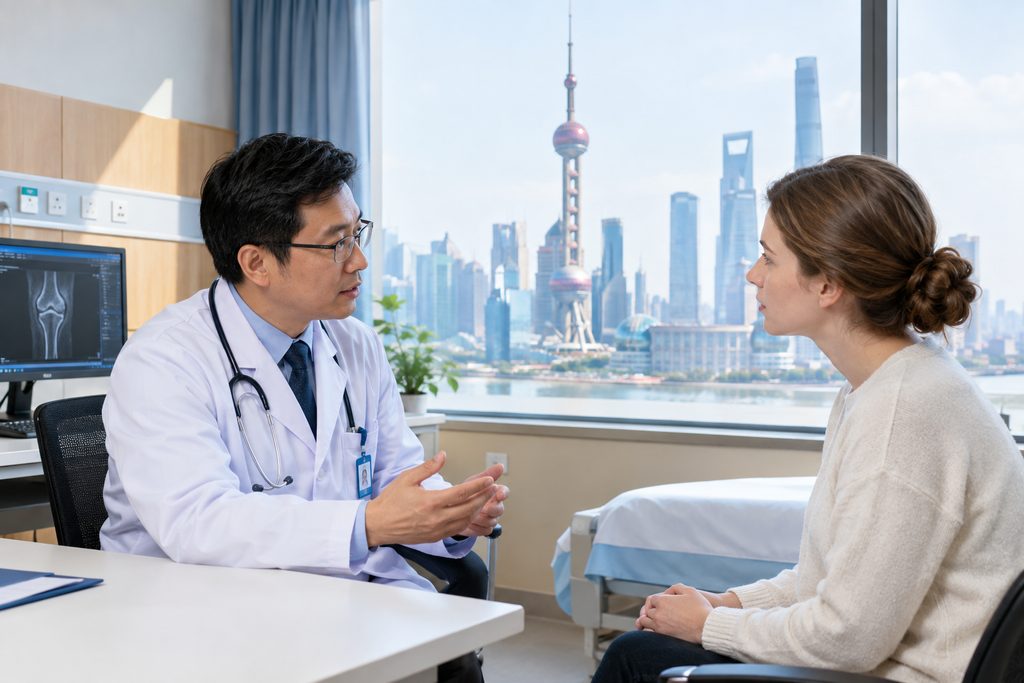
- Public hospital outpatient slots cannot be booked from overseas in advance. Foreign patients generally need a hospital’s international department or a coordination service to secure a specialist appointment before flying.
- Medical travel to China runs on the S2 visa — not the M visa, which is strictly for commercial and trade activity.
When 19-year-old Daniel from Melbourne felt a deep, persistent ache above his knee, his GP initially suspected a sports injury. Six weeks later, an MRI at a Melbourne hospital returned a word his family had never heard: osteosarcoma. The tumor was in his distal femur, the most common site for this rare bone cancer. Australia’s treatment pathway was solid, but the wait for a sarcoma specialist review stretched past five weeks, and his parents began searching overseas. Their question — how do you even begin arranging osteosarcoma care in Shanghai as a foreign patient — is one our team answers regularly.
This guide walks through what Shanghai’s hospitals actually offer for osteosarcoma, what it costs, how the S2 visa works, and the realistic sequence of steps from first email to first appointment.
The Problem: Rare Cancer, Long Waits, and a System That Isn’t Built for Outsiders
Osteosarcoma is uncommon. The American Cancer Society estimates roughly 1,000 new cases are diagnosed in the United States each year, with the peak incidence between ages 10 and 30. Because it is rare, expertise concentrates in a small number of sarcoma centers. In countries with centralized referral systems, that concentration is a strength — but it also creates bottlenecks. A teenager in Canada or the UK may wait weeks for a multidisciplinary sarcoma board to review imaging before chemotherapy even begins.
Timing matters enormously here. Osteosarcoma is treated with neoadjuvant chemotherapy followed by surgery, usually limb-sparing resection, then adjuvant chemotherapy. The chemotherapy response measured in the resected tumor — the percentage of tumor necrosis — is one of the strongest predictors of long-term outcome. Delays at the front end compress the whole schedule.
Cost is the second wall. In the United States, a full osteosarcoma treatment course — chemotherapy, limb-salvage surgery, prosthetics, rehabilitation — can exceed $500,000 before insurance negotiations. Even insured families face deductibles and out-of-network gaps. And for patients in countries with public systems, the wait itself becomes the risk.
Then there is the language and logistics barrier. Shanghai’s top hospitals are enormous. A single tertiary hospital can see more than 10,000 outpatient visits in a day. Signage, registration kiosks, and most clinical staff operate in Chinese. Without a bilingual guide, a foreign family can lose days simply finding the right building.
Why Shanghai Delivers Results for Osteosarcoma Patients
Shanghai is not a compromise destination. It is one of the densest concentrations of high-tier medical expertise in Asia, and for bone tumors specifically, several of its hospitals sit in China’s top tier.
Clinical volume and sarcoma-specific expertise
China’s Fudan Hospital Rankings, the closest equivalent to US News hospital rankings, place 18 Shanghai hospitals in the national Top 100. Within the specialty reputation rankings — which do assign specific positions across 45 specialties — Shanghai institutions appear repeatedly in the top 10 for oncology and orthopedics. High-volume sarcoma units in these hospitals treat bone tumors weekly, not occasionally. That matters: surgical outcomes for limb-salvage procedures improve with cumulative surgeon experience, and prosthetic reconstruction techniques for growing adolescents require a team that does this often.
Technology and multidisciplinary infrastructure
Shanghai’s tertiary hospitals run integrated sarcoma or bone tumor boards combining orthopedic oncology, medical oncology, radiology, and pathology. Imaging equipment — 3T MRI, PET-CT, low-dose CT — is current-generation. What differs from Western hospitals is not the technology but the throughput. A patient referred internally can often complete MRI, biopsy, and pathology review within a single week, because the hospital controls all the steps under one roof. In fragmented systems, those same steps may span three facilities and four weeks.
Cost structure without a quality penalty
Lower prices in China reflect labor economics, hospital scale, and domestic pharmaceutical pricing — not shortcuts. A limb-salvage resection with megaprosthesis in a top Shanghai public hospital typically falls in the range of $15,000 to $35,000 for the surgical episode, with chemotherapy cycles adding several thousand dollars each. The same procedure in the US frequently runs $150,000 or more. These figures vary by hospital and case complexity, and final quotations require the hospital’s own assessment of the patient’s records.
| Cost component (illustrative) | Top Shanghai public hospital | Typical US hospital |
|---|---|---|
| Neoadjuvant chemotherapy (per cycle) | $800 – $2,500 | $10,000 – $30,000 |
| Limb-salvage surgery with prosthesis | $15,000 – $35,000 | $80,000 – $150,000+ |
| Imaging (MRI, PET-CT) | $300 – $1,200 | $3,000 – $8,000 |
| Inpatient stay (per day, ward bed) | $80 – $250 | $2,000 – $5,000 |
Figures are illustrative ranges and vary by hospital and case complexity. International department pricing runs approximately 1.5 to 2 times standard public rates in exchange for English-speaking staff and faster scheduling.
How the Treatment Pathway Actually Works, Step by Step
This is the part most guides skip. Here is the realistic sequence.
Step 1 — Records review. You send existing imaging (MRI, CT, PET), biopsy pathology reports, and clinical notes. A Shanghai sarcoma specialist reviews them and returns a written assessment: whether the diagnosis is confirmed, what treatment sequence is appropriate, and what additional tests are needed. This is a written second opinion, typically $300 to $500.
Step 2 — Video consultation. If the written review supports proceeding, a video call with the Chinese specialty team lets you ask questions directly. Cost ranges from $100 to $300 for a general tertiary hospital international department, up to $500 to $800 for a top-tier sarcoma specialist. For complex cases, a multidisciplinary team conference runs $1,500 to $2,000. Any consultation fee is credited in full toward on-the-ground coordination if you travel within 90 days.
Step 3 — Appointment coordination. Public hospital outpatient registration cannot be booked from overseas through normal channels. Securing a specialist slot requires the hospital’s international department or a coordination service working through official channels. Coordination fees start from $300, with a full refund if the stated appointment cannot be secured.
Step 4 — Arrival and in-person consultation. The patient flies to Shanghai, attends the specialist appointment with a bilingual medical companion, and completes any outstanding tests. Surgery is scheduled only after this in-person assessment — no reputable Chinese hospital commits to an operating date based on overseas records alone.
Step 5 — Admission, treatment, and follow-up. Admission follows hospital rules and bed availability. After discharge, imaging and pathology can be shared with your home oncologist for continuing care.
Choosing Between Public Tertiary, International Department, and Private Hospitals
A realistic planning range for the full treatment course — chemotherapy, limb-salvage surgery, hospitalization, and rehabilitation — is $40,000 to $90,000 at a top public hospital, higher at an international department. This varies by hospital and case complexity, and no accurate figure can be given before the hospital reviews the patient’s records.
Chinese tertiary hospitals handle complex sarcoma cases routinely, but no hospital or service can guarantee an outcome. If the in-person assessment finds the tumor is not resectable or the patient is unfit for surgery, the team will explain alternatives. Our role is coordination and communication — we are not a hospital and do not provide diagnoses or clinical care. Treatment decisions rest with the hospital’s medical team and the patient’s family.
Your Next Step
Osteosarcoma is frightening, but the path through it is clearer than most families expect. Shanghai offers genuine sarcoma expertise, faster scheduling than many Western systems, and costs that are a fraction of US charges — provided you understand the visa category, the appointment reality, and the need for an in-person assessment before surgery. Our team at China Medical Services connects international patients with 340+ top-ranked hospitals across 37 cities and handles records translation, appointment coordination, and bilingual medical companions on the ground. We do not diagnose or treat — we make the system navigable. If you would like a written second opinion or help mapping out a treatment timeline, start with a free consultation, and we will walk through your options with no obligation.
This article is for informational purposes only and does not constitute medical advice. Treatment decisions should always be made in consultation with qualified physicians.
Frequently Asked Questions
Yes. The hospitals used for international patients are JCI-accredited and follow the same international safety standards as top hospitals in the US and Europe. Surgical teams perform high volumes of procedures — often more than their Western counterparts — which studies show leads to better outcomes.
Costs vary by procedure and hospital, but international patients typically save 40-80% compared to US prices — even when factoring in travel and accommodation. A consultation with our team will give you an exact, all-inclusive quote with no hidden fees.
Send us your existing medical reports to get started. We handle everything from hospital selection and appointment scheduling to visa assistance and post-operative recovery planning. Your medical records are reviewed by the specialist before you even book a flight.
For more medical information and treatment options in China, visit chinamedservices.com (China Medical Services).
