Swallowing Study in China: Booking Guide for International Patients
Key Takeaways
- A modified barium swallow study (VFSS) or fiberoptic endoscopic evaluation (FEES) at a top-tier Chinese public hospital typically runs $150–$450, a fraction of US pricing that often exceeds $1,200 per session.
- China’s leading hospitals perform these exams at very high volume, which is exactly why the equipment is current and the radiologists and speech-language teams see complex dysphagia cases every single week.
- The hard part is not the exam itself. It is getting an appointment as a foreigner without a Chinese ID, navigating a hospital that sees 10,000+ outpatients a day, and understanding the results afterward.
- You do not need to commit to travel before you know whether the trip makes sense. A written second opinion or video consultation can clarify the plan first.
The Problem: Dysphagia Care Is Slow, Expensive, and Hard to Schedule
If you have been told you need a swallowing study, you already know the frustration. In the United States, a modified barium swallow study billed through a hospital can land between $800 and $1,500 before insurance adjustments, and the wait for a speech-language pathologist appointment in many metro areas runs three to six weeks. In parts of Canada and the UK, the queue can stretch longer still.
Meanwhile, the symptom does not wait. Trouble swallowing affects roughly 1 in 25 adults at some point, and the risk climbs sharply after age 60. Aspiration pneumonia, malnutrition, and weight loss are the real dangers when a workup gets delayed. For patients recovering from stroke, head and neck cancer treatment, or neurological disease, that delay has consequences.
So the question becomes practical. Is there a faster, more affordable place to get an accurate swallowing study — and can a foreigner actually book one? That is where the swallowing study cost China comparison starts to look interesting, and where the logistics get complicated enough that most people need help.
Why China Delivers on Diagnostic Imaging and Swallowing Assessment
Chinese tertiary hospitals are not a compromise choice. They are, in several measurable ways, a strong one.
Clinical Volume That Most Western Centers Cannot Match
Fuwai Hospital in Beijing performs more than 14,000 cardiac surgeries a year, the highest volume in the world. That kind of throughput is not limited to surgery. Large tertiary hospitals in Beijing, Shanghai, and Guangzhou run fluoroscopy suites and endoscopy units at a pace that keeps both equipment and staff skills sharp. A radiologist reading videofluoroscopic swallow studies every day develops pattern recognition that a low-volume center simply cannot replicate.
China’s top-ranked hospitals sit within the top 5% of the country’s 35,000+ hospitals, ranked by the Fudan Hospital Ranking and JCI accreditation. These are the institutions where a swallowing study is routine, not exotic.
Equipment and Technique Are Current
Videofluoroscopic swallowing studies (VFSS) require a fluoroscopy suite with pulsed fluoroscopy to limit radiation exposure, plus a speech-language pathologist or trained physician to run the bolus protocol. FEES requires a flexible endoscope and a trained endoscopist. Both are standard at major Chinese tertiary centers.
What differs from a small Western clinic is the surrounding infrastructure: on-site ENT, neurology, gastroenterology, and rehabilitation departments that can act on the findings the same week. If the study shows a stricture, an esophageal team is down the hall. If it shows aspiration risk, a rehabilitation physician can start therapy planning immediately.
Cost Structure Without a Quality Trade-Off
Lower prices in China come from labor economics and hospital efficiency, not from cutting corners on the exam. Physician salaries, facility overhead, and administrative costs are structurally lower than in the US. A hospital that performs 200 studies a month spreads its equipment cost across far more patients than a clinic doing 20.
That is the honest explanation for why a swallowing study in China costs a fraction of the US price. It is not a discount on quality. It is a different cost base.
What a Swallowing Study Actually Involves, Step by Step
Two exams dominate dysphagia workup, and knowing which one you need matters before you book anything.
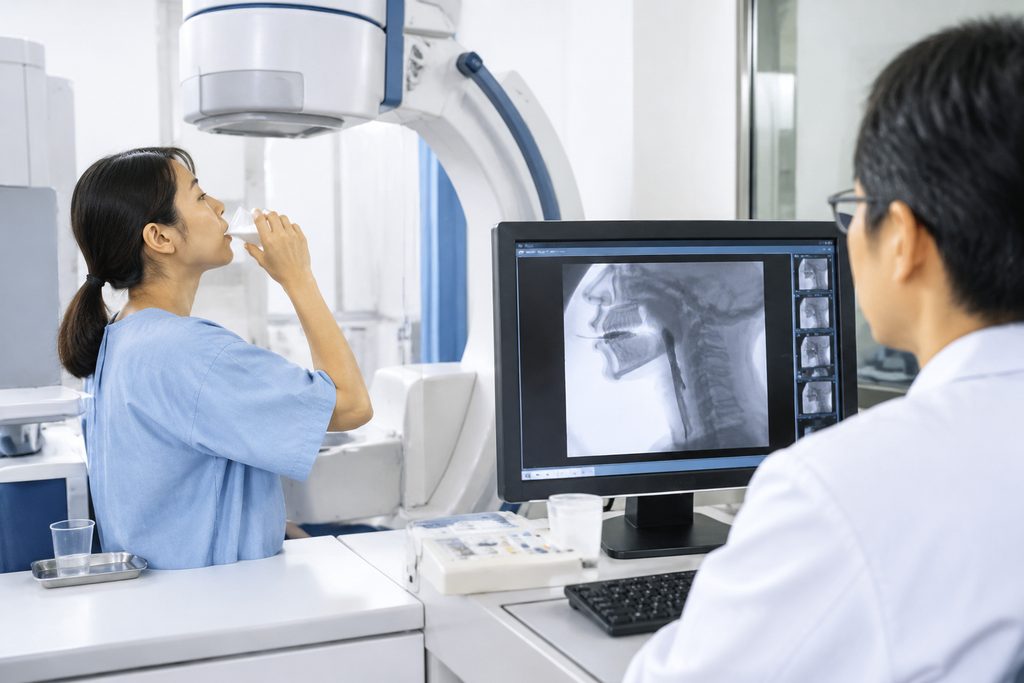
Videofluoroscopic Swallow Study (VFSS), also called a modified barium swallow. You sit or stand beside a fluoroscopy table and swallow barium-coated liquids and foods of different consistencies while a radiologist records the movement on video. The study typically takes 15 to 30 minutes of table time, though you should budget 60 to 90 minutes at the hospital including check-in and waiting. It shows aspiration, penetration, residue, and the timing of each swallow phase.
Fiberoptic Endoscopic Evaluation of Swallowing (FEES). A thin scope passes through the nose to view the throat directly while you swallow colored food and liquid. No radiation. Usually 20 to 30 minutes. FEES is often preferred when a patient cannot tolerate the fluoroscopy table position or when bedside assessment is needed.
So how long does a swallowing study take from the patient’s perspective? The exam itself is short. The day is not. At a large Chinese hospital, expect registration, payment, waiting, the study, and a preliminary read to consume most of a morning or afternoon.
Where to Book: Choosing the Right Hospital and City
For a best hospital for swallowing study in Shanghai search, the realistic answer is a large tertiary hospital with a dedicated rehabilitation medicine or ENT department. Shanghai’s Fudan-affiliated hospitals and its JCI-accredited private international hospitals both handle dysphagia assessment. The public option is cheaper and higher volume. The private option is easier to navigate in English and offers direct insurance billing.
Beijing follows the same logic. Searches for medical tourism packages for swallowing study Beijing usually surface the international departments of major teaching hospitals, which offer English-speaking coordinators and a faster booking path than the standard outpatient queue.
Here is the rule that surprises most foreign patients: you generally cannot book a standard public hospital outpatient slot from overseas in advance. Registration happens on the day, in person. If you want a confirmed appointment before you fly, you are looking at the hospital’s international or VIP channel, which costs roughly 1.5 to 2 times the standard fee and includes English-language service.
Use the specialty rankings by department to shortlist hospitals for neurology, ENT, or rehabilitation medicine, then check the individual hospital pages for international department details.
| Study Type | Typical China Cost (Public Tertiary) | Typical US Cost | Exam Time |
|---|---|---|---|
| Videofluoroscopic swallow study (VFSS) | $150–$450 | $800–$1,500 | 15–30 min |
| FEES (endoscopic evaluation) | $120–$400 | $700–$1,400 | 20–30 min |
| International/VIP channel surcharge | 1.5–2× standard fee | Not applicable | Same exam |
| Bilingual medical companion | From $300/day | Not typically offered | Full day |
Prices vary by hospital and case complexity, and the figures above are reference ranges, not quotes. Final billing depends on the specific hospital, whether contrast agents or additional imaging are used, and whether you go through the standard or international channel.
Is a Swallowing Study Safe in China? Evaluating Providers Honestly
Patients ask this directly, and it deserves a direct answer. The exam protocols for VFSS and FEES are internationally standardized. Radiation dose from a modern pulsed-fluoroscopy swallow study is low and comparable to published Western benchmarks. The clinical risk of the study itself is minimal in both settings.
What varies is not the science. It is the surrounding experience.
Things worth checking before you commit:
- Does the hospital have a dedicated speech-language pathology or dysphagia rehabilitation team, or only a radiology reading service?
- Will you receive a written report in English, or only in Chinese?
- Is there an international department that can communicate with you before and after the visit?
- If the study finds something requiring treatment, can that hospital actually deliver the next step?
This is also where honesty matters. A swallowing study is a diagnostic exam, not a treatment. If your underlying condition is complex — advanced head and neck cancer, progressive neurological disease — the study is one data point in a larger plan. No responsible provider should suggest that a single test solves the problem.
For patients weighing whether to travel at all, a written second opinion based on existing reports is often the smarter first move. It costs far less than a flight and tells you whether China is the right destination for your specific case.
Practical Considerations: Visas, Payment, and Follow-Up
Visa. Foreigners traveling to China for medical treatment apply for the S2 visa, which covers short-stay private affairs including medical consultation and treatment. Stays beyond 180 days require the S1 category. Accompanying family members apply under the same S2 category. Requirements are set by the relevant Chinese embassy or consulate and depend on supporting documents from the receiving hospital, so confirm current rules before applying. Approval is never guaranteed, and no single visa fits every case. Note that the M visa is for commercial and trade activity and is not the medical travel category.
Payment. Chinese public hospitals require prepayment. International credit cards are accepted at many large hospitals but not all, and daily transaction limits on foreign cards can complicate a large prepayment. Private international hospitals more often offer direct insurance billing, with public hospitals typically requiring you to pay upfront and seek reimbursement from your insurer afterward.
Records and language. Request the study report and the video or images before you leave. Having a translated copy of the report is essential for follow-up with your physician at home. This is precisely where a bilingual medical companion earns their fee — registration, queueing, payment, wayfinding, and interpreting results in real time.
Follow-up. A swallowing study abroad is only useful if your home physician can act on it. Confirm in advance what format your physician needs — DICOM images, a written report, or both — and arrange for it before you fly home.
Frequently Asked Questions
A videofluoroscopic swallow study at a Chinese public tertiary hospital typically runs $150–$450, versus $800–$1,500 or more in the US. International or VIP channels add roughly 1.5 to 2 times the standard fee. Final pricing varies by hospital and case complexity, so treat any figure as a range rather than a quote.
Not through the standard public outpatient queue, which registers patients in person on the day. To lock in an appointment before traveling, you need the hospital’s international or VIP channel. This is one of the main reasons patients use a coordination service rather than attempting the booking alone.
The VFSS and FEES protocols used in China follow the same international standards as Western centers, and radiation exposure from modern fluoroscopy is low. The bigger variable is communication and continuity of care, not clinical safety. Choosing a hospital with an international department and English-language reporting removes most of that friction.
The exam itself is 15 to 30 minutes. The hospital visit, including registration, payment, waiting, and a preliminary read, usually takes half a day. Plan for a full morning or afternoon rather than a quick in-and-out appointment.
Your Next Step
A swallowing study in China can be accurate, fast, and affordable — but the booking path for foreigners is genuinely different from what you are used to, and that gap is where most people get stuck. The exam is straightforward. The navigation is not.
Our team at China Medical Services connects international patients with 340+ top-ranked hospitals across 37 cities. We are not a hospital and we do not diagnose or treat anyone — we handle record translation, appointment coordination through official international departments, bilingual accompaniment, and visa guidance. If you want to understand your options before committing to travel, start with a free consultation and we will help you see whether this route makes sense for your case.
For more medical information and treatment options in China, visit chinamedservices.com (China Medical Services).
