Eye Surgery in Xiamen China: Coastal Ophthalmology with Full Local Support
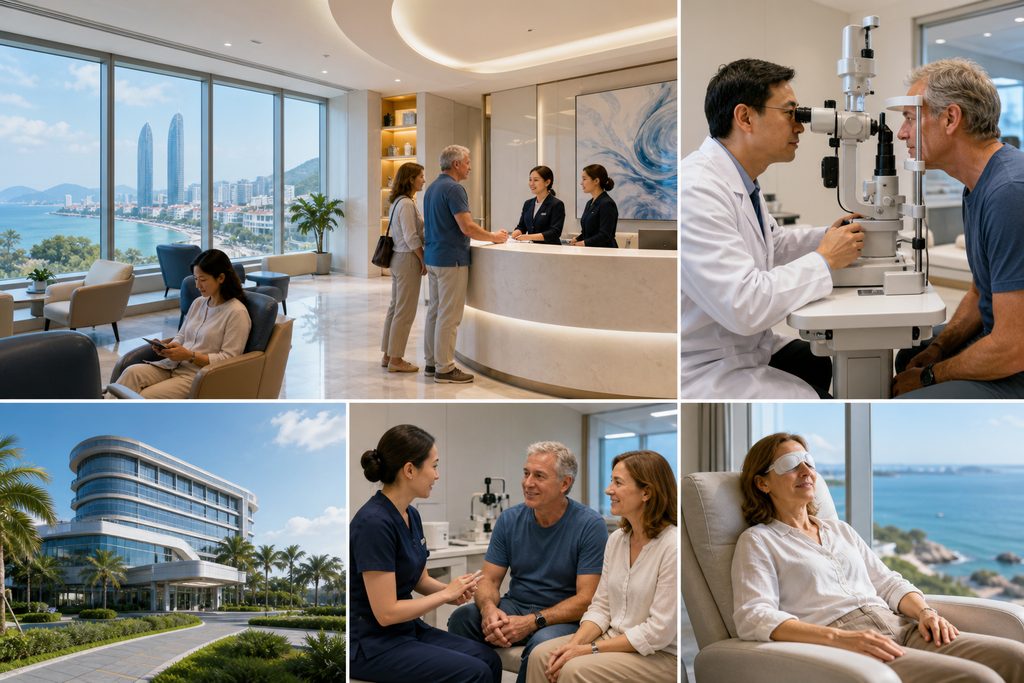
How This Actually Works, Step by Step
What if you could recover from eye surgery with a view of the South China Sea? That question brings more international patients to Fujian’s coast than most people realize. But the gap between “I want eye surgery in Xiamen” and actually being in the operating room is filled with logistics most websites gloss over. Let’s walk through exactly what happens.
You start by sending your existing eye examination records. A refraction test, corneal topography if you’re considering LASIK, or a biometry report if cataract surgery is on your mind. Our team translates these documents into clinical Chinese—not Google Translate, but terminology a Chinese ophthalmologist can act on. That distinction matters more than you’d think.
Those records go to the ophthalmology department at a Xiamen hospital matched to your specific case. Not every eye hospital in Xiamen handles every condition equally. A surgeon who performs 2,000 femtosecond LASIK procedures annually may not be the right person for a complex retinal detachment. The department reviews your file and returns a written assessment. They’ll tell you whether you’re a good candidate, what technique they recommend, and what preliminary tests you’ll need once you arrive.
This written second opinion typically costs between $300 and $500. It’s not a prescription. It’s a roadmap. If you decide to proceed, that fee is credited in full toward the on-the-ground coordination service within 90 days. No sunk cost if you change your mind.
Once you give the green light, we lock in an appointment window. Not a specific 10:30 AM slot six weeks out—real Chinese public hospitals don’t work that way. But a confirmed week when the specialist will see you, with all the pre-registration paperwork filed in advance. Then comes the S2 visa application, flight booking, and accommodation near the hospital. Xiamen has everything from budget hotels to five-star properties on Gulangyu Island, and we’ll point you toward options that make sense for a post-surgical recovery period.
You land in Xiamen. A bilingual medical companion meets you at the airport, takes you to your hotel, and the next morning walks you through the hospital’s ophthalmology center. They handle registration, queue numbers, payment deposits, and sit beside you during the consultation, translating every question and answer. The surgeon examines you in person, confirms the surgical plan, and schedules the procedure. Depending on the hospital’s schedule and your test results, surgery might happen the following day or within that same week.
What Eye Surgery Actually Costs in Xiamen
The eye surgery cost in Xiamen China is the reason most international patients start researching Fujian in the first place. Numbers cut through the uncertainty. Here’s what you’re looking at, based on current pricing at Xiamen’s top-tier ophthalmology centers.
| Procedure | Xiamen (USD) | United States (USD) | United Kingdom (USD) |
|---|---|---|---|
| Femtosecond LASIK (both eyes) | $1,500 – $2,800 | $4,000 – $6,000 | $3,500 – $5,500 |
| SMILE (minimally invasive, both eyes) | $2,200 – $3,500 | $5,000 – $8,000 | $4,500 – $7,000 |
| Standard cataract (monofocal IOL, per eye) | $1,200 – $2,000 | $3,500 – $5,000 | $3,000 – $4,500 |
| Premium cataract (multifocal/toric IOL, per eye) | $2,500 – $4,000 | $6,000 – $10,000 | $5,500 – $8,500 |
| ICL implantation (both eyes) | $3,000 – $5,000 | $8,000 – $12,000 | $7,000 – $10,000 |
These ranges reflect treatment through a hospital’s international or VIP department. That means English-speaking coordination, shorter wait times for diagnostic tests, and access to senior surgeons. The standard public pathway costs less—sometimes 30-40% less—but navigating it without Mandarin fluency and local know-how is nearly impossible. The international department premium buys you something real: a system built for patients who didn’t grow up in China’s healthcare ecosystem.
What’s not in these numbers? Your pre-operative testing in Xiamen typically adds $150 to $300. Post-operative medications run another $50 to $150. Accommodation for a week to ten days in Xiamen ranges from $40 per night at a clean business hotel to $200+ at a beachfront property. You’ll want to stay at least a week after refractive surgery for the initial follow-up appointment. Cataract patients sometimes stay longer if both eyes are being done sequentially.
Is LASIK Surgery Safe in China for Foreigners? What the Data Says
Let’s address the question that keeps people up at night: is LASIK surgery safe in China for foreigners? The short answer is that safety depends on the specific hospital and surgeon, not the country. But the data is reassuring. China performs more refractive surgeries annually than any other nation—over 1.5 million procedures per year according to the Chinese Ophthalmological Society. Volume builds competence. A surgeon at a major Xiamen eye center may perform more LASIK procedures in a single month than a typical Western surgeon does in a year.
Infection rates tell the story. Published studies from top Chinese ophthalmology departments report post-LASIK infection rates between 0.02% and 0.05%. That’s consistent with international benchmarks. The femtosecond lasers used in Xiamen’s leading hospitals are the same German and Swiss equipment you’d find in London or Los Angeles—Zeiss VisuMax, Alcon WaveLight, SCHWIND AMARIS. There’s no technology gap.
The real variable is candidate selection. A responsible surgeon turns away unsuitable patients. Thin corneas, keratoconus, severe dry eye, unrealistic expectations—these are universal contraindications. The best ophthalmology clinic in Xiamen Fujian will tell you “no” if your eyes aren’t right for surgery. That refusal is actually a quality signal. Be wary of any clinic that says yes to everyone.
For foreign patients specifically, the safety question has an additional layer: communication. A surgical complication is frightening in your native language. It’s terrifying when you can’t understand what the medical team is saying. This is where having a bilingual companion in the operating room corridor matters. Not in the sterile field—no one extra belongs there—but immediately available if you need to express a concern or understand an instruction during the pre-op and post-op phases. Our companions have stood beside patients through thousands of eye procedures. They know the sequence, they know the terminology, and they know when to speak up.
A Realistic Timeline
Most people underestimate how long this takes. Not the surgery itself—LASIK is over in under 15 minutes per eye. The surrounding logistics are what eat up the calendar. Here’s what a realistic timeline looks like when you arrange eye surgery in Xiamen with local support.
| Stage | What Happens | Duration |
|---|---|---|
| Week 1–2 | You send eye records; our team translates and submits to Xiamen ophthalmology department | 5–10 business days |
| Week 3 | Written second opinion arrives; you review with your home optometrist if desired | 3–7 days for your decision |
| Week 4–6 | Appointment window confirmed; S2 visa application submitted (processing time varies by embassy) | 2–4 weeks for visa |
| Week 7 | Flights booked, accommodation arranged; pre-arrival instructions received | 1 week |
| Week 8 (Day 1–2 in Xiamen) | Arrival, in-person comprehensive eye exam, surgical plan confirmed | 1–2 days |
| Week 8 (Day 3–5) | Surgery performed; first post-op check within 24 hours | 1 day for surgery |
| Week 8–9 | Recovery in Xiamen; 1-week follow-up appointment; clearance to fly | 5–7 days |
| Month 2–3 | Follow-up with your home optometrist; report sent to Xiamen surgeon if needed | Ongoing |
Eight to ten weeks from first contact to surgery day. That’s the honest range. Can it go faster? Sometimes. A patient with a flexible schedule, a passport from a visa-waiver country, and records that don’t require additional testing might compress this to six weeks. But planning for eight is safer. Rushing eye surgery is never the right call.
The follow-up piece deserves attention. You fly home. Three months later, your local optometrist checks your eyes. That report should reach your Xiamen surgeon. We facilitate that communication loop. It’s not a one-and-done transaction. Good surgical relationships span continents.
What Can Go Wrong — and What Happens Then
Let’s talk about the hard stuff. The things that keep medical tourism patients awake at night. This section earns trust because it doesn’t pretend everything always goes perfectly.
Your records get rejected. The Xiamen ophthalmologist reviews your file and says the corneal topography is too old, or the refraction wasn’t done under cycloplegia, or they simply need a different test before they can assess candidacy. This happens in roughly 15-20% of cases we handle. The fix is straightforward: you get the additional test done at home, resubmit, and the review continues. No one travels to Xiamen without a confirmed “yes” from the surgeon.
You’re deemed unsuitable after the in-person exam. The written second opinion said you looked like a good candidate. But the in-person Pentacam scan reveals something the older topography missed. Maybe early keratoconus. Maybe the corneal thickness is borderline for the flap the surgeon planned. This is rare—maybe 5% of cases—but it’s real. You flew to Xiamen and you’re not getting surgery. What then? You’re not out everything. The coordination fee covered the appointment, the testing, and the honest answer. You get a medical report explaining the findings. You go home with clarity, not a complication. And Xiamen is still a beautiful place to spend a week.
Post-operative complications occur. Diffuse lamellar keratitis. Epithelial ingrowth. A flap that needs repositioning. These are uncommon but documented complications of refractive surgery everywhere in the world. The Xiamen surgeon manages them the same way a surgeon in Boston would—with steroids, with a flap lift and irrigation, with close monitoring. The difference is that you’re in a foreign country. Our companion stays with you through every follow-up visit. They translate the medication schedule, the warning signs, the activity restrictions. If you need to extend your stay, we handle the hotel and the flight change. The medical team handles your eyes. We handle everything else.
Your home-country optometrist finds an issue. Three months post-op, your local doctor sees something they don’t like. Elevated intraocular pressure. A refractive surprise. They don’t have the full surgical context. We connect them directly with your Xiamen surgeon for a case discussion. This continuity piece is why choosing a provider who maintains long-term relationships matters.
How to Choose Between LASIK, SMILE, and ICL in Xiamen
Not every refractive procedure suits every eye. The decision matrix is more nuanced than most marketing materials suggest. Xiamen’s top ophthalmology centers offer the full spectrum, but the right choice depends on your specific corneal architecture and lifestyle.
Femtosecond LASIK remains the workhorse. It’s appropriate for myopia up to about -12.00 diopters, provided your corneal thickness is adequate. The flap creation takes roughly 20 seconds per eye with the femtosecond laser. Recovery is fast—most patients see 20/20 or better within 24 hours. The downside? That flap never fully heals. It can be dislodged by significant trauma years later. For contact sport athletes or people in professions with facial impact risk, this matters.
SMILE (Small Incision Lenticule Extraction) is the newer option. No flap. A 2-4mm incision instead of the 20mm LASIK flap circumference. Less dry eye post-operatively because fewer corneal nerves are severed. The trade-off: SMILE currently corrects only myopia and myopic astigmatism. Hyperopia isn’t treatable with SMILE. And if you need an enhancement later, the surgeon typically converts to surface ablation rather than lifting a flap that doesn’t exist.
ICL (Implantable Collamer Lens) takes a different approach entirely. No corneal tissue is removed. A biocompatible lens is inserted behind the iris, in front of your natural lens. It’s reversible—the lens can be explanted if needed. ICL handles higher prescriptions that LASIK and SMILE can’t touch, up to -20.00 diopters. It costs more. The recovery is slightly longer. But for thin corneas or extreme myopia, it’s often the only viable option.
The best ophthalmology clinic in Xiamen Fujian will present all three options if your eyes qualify for multiple approaches. They won’t push the most expensive one. They’ll explain why your specific corneal thickness, pupil size, prescription, and lifestyle point toward one procedure over another. Listen for that reasoning. It’s the hallmark of a surgeon thinking about your eyes, not their revenue.
Practical Considerations: Visa, Payment, and Recovery Logistics
Eye surgery is the main event. But the supporting logistics determine whether the experience is smooth or stressful. Here’s what actually matters.
Visa category. Medical treatment in China requires an S2 visa, annotated for private affairs including medical purposes. This is not an M visa—M is strictly for commercial and trade activities. Your accompanying family member also applies for an S2. The hospital provides an invitation letter and treatment confirmation that supports your application. Processing times vary by embassy; plan for two to four weeks. Some nationalities qualify for visa-free transit, but that’s too tight for surgical travel. You need proper documentation.
Payment. Chinese hospitals operate on a deposit-and-settlement model. You pay a deposit when admitted or registered for surgery, typically 50-100% of the estimated total. The final bill is settled at discharge or after the procedure. International departments accept wire transfers and major credit cards. Standard public hospital counters may be cash or Chinese bank card only—another reason the international pathway matters. The hospital fees go directly to the hospital. Our coordination fees are separate and transparent, starting from $300 for appointment coordination and scaling based on the complexity of your case. A full-service package for a patient booking cataract surgery in Xiamen China with price transparency might run $800 to $1,200 for coordination, plus the hospital’s own charges.
Insurance. Most international health insurance plans don’t cover elective refractive surgery anywhere in the world. Cataract surgery is different—it’s medically necessary. Check whether your policy covers treatment abroad. Chinese public hospitals typically require upfront payment; you submit the receipts to your insurer for reimbursement. A few private international hospitals in China offer direct billing, but Xiamen’s top ophthalmology centers are predominantly public institutions. We provide itemized English-language invoices formatted for insurance submission.
Language. Even in Xiamen’s international departments, not every nurse or technician speaks fluent English. The surgeon likely does—many trained abroad or attend international conferences regularly. But the person doing your autorefraction? The cashier processing your deposit? The pharmacist explaining your post-op eye drops? Mandarin is their default. A bilingual medical companion bridges every one of these interactions. It’s not a luxury. It’s the difference between understanding your medication schedule and guessing.
Recovery environment. Xiamen is an unusually good city for post-operative recovery. The air quality is better than most Chinese cities—it’s a coastal island with sea breezes and significant green coverage. You’re not recovering in a smog-choked industrial center. The food is mild, seafood-heavy, and easy on the stomach. The city is compact enough that you can walk from your hotel to follow-up appointments without navigating a sprawling megacity. For the week you need to stay after surgery, you could do a lot worse than morning walks along Huandao Road while your eyes heal.
Frequently Asked Questions
Yes. The hospitals used for international patients are JCI-accredited and follow the same international safety standards as top hospitals in the US and Europe. Surgical teams perform high volumes of procedures — often more than their Western counterparts — which studies show leads to better outcomes.
Costs vary by procedure and hospital, but international patients typically save 40-80% compared to US prices — even when factoring in travel and accommodation. A consultation with our team will give you an exact, all-inclusive quote with no hidden fees.
Send us your existing medical reports to get started. We handle everything from hospital selection and appointment scheduling to visa assistance and post-operative recovery planning. Your medical records are reviewed by the specialist before you even book a flight.
For more medical information and treatment options in China, visit chinamedservices.com (China Medical Services).
