Medication Rules for Traveling to China: What to Declare & How We Help
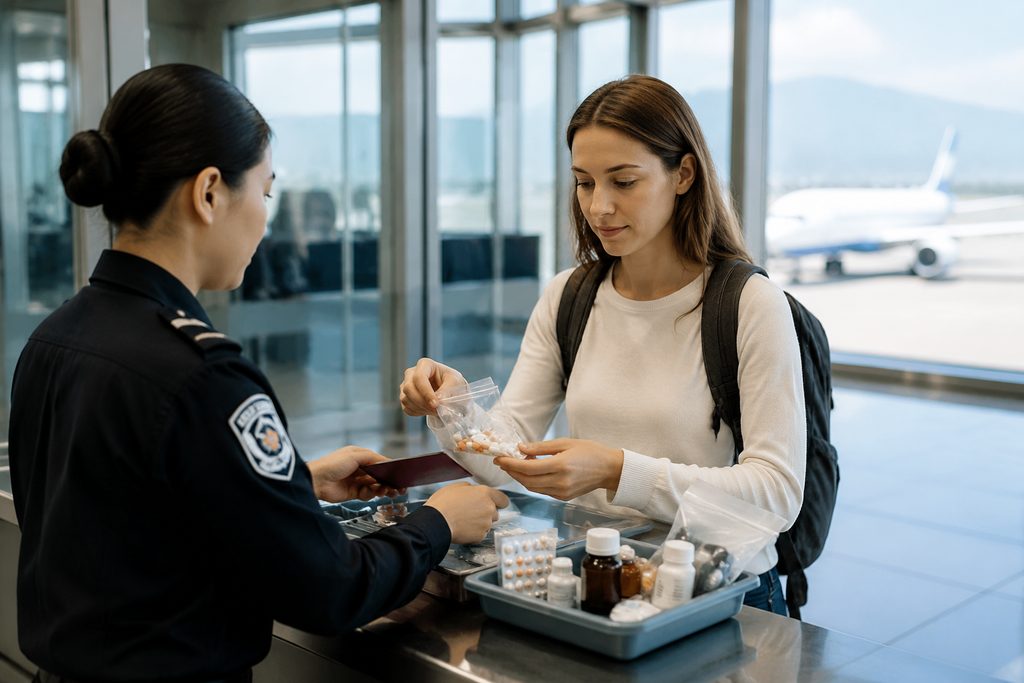
Key Takeaways
- China allows visitors to bring a reasonable quantity of prescription medication for personal use, but strict declaration rules apply — especially for psychotropic and narcotic drugs, which require advance customs approval.
- Carrying a doctor’s letter, original prescription, and keeping medication in its original packaging is non-negotiable; failure to do so can result in confiscation, fines, or entry denial.
- Patients traveling to China for medical treatment face a separate set of medication coordination challenges — our team handles pre-arrival documentation review, hospital pharmacy liaison, and bilingual translation of medical records to prevent treatment gaps.
- Never ship medication to China independently. The process is legally complex, and packages are routinely seized. We coordinate hospital-to-hospital or pharmacy-to-patient logistics through authorized channels only.
The Problem: One Mistake at Customs Can Derail Your Entire Medical Trip
You have booked your consultation at a top-tier Chinese hospital. Flights are confirmed. Accommodation is arranged. Then, standing at the immigration counter, a customs officer flags your carry-on bag. The medication you rely on daily — for blood pressure, for post-surgical pain, for a chronic condition — is now under scrutiny. Without the right paperwork, it could be confiscated. In the worst case, you could be denied entry entirely.
This is not a hypothetical scenario. China’s General Administration of Customs enforces medication import rules with precision. The legal framework is clear, but it is not forgiving of ignorance. A 2023 report from China’s National Medical Products Administration noted a significant increase in medication-related customs detentions involving international travelers, partly driven by post-pandemic travel surges and stricter enforcement of narcotic control regulations.
For a medical tourist, the stakes are even higher. You are not just carrying maintenance prescriptions. You may be bringing post-operative medications, specialized drugs unavailable in China, or controlled substances for pain management. The question “can I bring prescription medication to China” is not a casual inquiry. It is the first logistical hurdle of a successful treatment journey. And the answer depends entirely on what you are carrying, how much, and the documentation you present.
Who We Are
We are not a hospital. We do not provide medical treatment, clinical diagnoses, or dispense any medication. China Medical Services is a medical concierge organization that connects international patients with China’s 340+ top-ranked hospitals across 37 cities. Our team functions as your logistical architects — we translate medical records, coordinate hospital appointments, arrange bilingual medical companions, and navigate the regulatory maze that stands between you and the care you need. Medication compliance at the border is one of the first problems we solve, and we solve it before you ever board your flight.
China Customs Medication Declaration Rules: The Legal Baseline
Understanding what must be declared starts with knowing how Chinese customs classifies medication. The rules are not arbitrary. They are tiered by risk, and the tier determines your obligations.
General Prescription Drugs: The “Reasonable Personal Use” Standard
Most common prescription medications — antibiotics, antihypertensives, diabetes drugs, cholesterol medications, thyroid hormone replacements — fall into the general category. The operative phrase in Chinese customs regulation is “reasonable quantity for personal use.” This is not a specific number. It is an assessment made by the customs officer based on the length of your stay and the prescribed dosage.
Our team advises patients to carry no more than a 30-day supply for short-term medical visits, or up to a 90-day supply with robust documentation for extended treatment stays. Every medication must remain in its original packaging with the pharmacy label intact. A letter from your prescribing physician, written in English and translated into Chinese, must state your diagnosis, the medication name (generic and brand), dosage, and the medical necessity of carrying this quantity. We handle the translation internally — our bilingual team ensures the Chinese version uses the precise terminology that customs officers expect to see.
These drugs must be declared on the Customs Declaration Form for Incoming Passengers. You tick the box. You present the medication and documentation. In most cases, clearance is straightforward. But skipping the declaration — even for a common drug — is a violation. The penalty can range from confiscation to a fine of up to 30% of the item’s declared value, and in cases involving undeclared controlled substances, criminal liability becomes a real possibility.
Prescription Drugs Allowed in China for Tourists: The Controlled Substance Category
Here the rules tighten considerably. China maintains a Catalogue of Narcotic Drugs and Psychotropic Substances, updated regularly by the National Medical Products Administration. Medications containing codeine, morphine, fentanyl, certain benzodiazepines, amphetamine-class drugs (including some ADHD medications like Adderall), and many sleep aids fall under controlled classification.
These are not banned outright. But they require pre-authorization from the National Medical Products Administration before you travel. The application process demands a detailed medical history, a physician’s justification, the exact drug name and dosage, the quantity to be carried, and your travel itinerary. Processing times vary, and incomplete applications are rejected without appeal.
We have seen patients assume that a valid prescription from their home country is sufficient. It is not. A US or EU prescription carries no legal weight at Chinese customs for controlled substances. Without the NMPA authorization letter, the medication is treated as an illegal import. The consequences are severe: detention, deportation, and a potential ban on future entry into China. For a patient already dealing with a serious medical condition, that is an outcome we work relentlessly to prevent.
How to Bring Medicine into China Legally: A Documentation Checklist
Based on hundreds of patient journeys we have coordinated, here is the documentation package that clears customs smoothly:
- Original prescription from your treating physician, dated within 30 days of travel.
- Physician’s letter on official clinic letterhead, detailing your diagnosis, the medication name (brand and generic), dosage, frequency, and total quantity carried. This letter must explicitly state that the medication is for personal medical use only.
- Chinese translation of the physician’s letter — certified and accurate. Machine translations are frequently rejected. Our team provides human-translated documents accepted by customs authorities.
- Customs declaration form with the medication section completed honestly.
- NMPA pre-authorization letter (for controlled substances only) — this is the document that separates a routine declaration from a legal crisis.
- Original pharmacy packaging for every medication. Pill organizers, unlabeled bottles, or loose tablets in a bag will be flagged.
Missing any one of these elements does not guarantee a problem. But it creates risk. And risk, in a foreign customs environment where you have no legal right to appeal an officer’s discretionary decision, is something we eliminate entirely.
Traveling to China with Controlled Substances: The Pre-Approval Process
The NMPA application is not a form you fill out online in ten minutes. It requires compiling medical evidence, translating it into Chinese, submitting it through the proper channel, and waiting for a response. We have seen processing take anywhere from two weeks to over a month, depending on the drug classification and the completeness of the submission.
Our team manages this process end-to-end. We collect your medical records, have them translated by professionals familiar with pharmacological terminology, prepare the application package, and track its progress. If the NMPA requests additional documentation — which happens in roughly 20% of cases based on our internal data — we respond within 48 hours. The goal is not just approval. It is approval with enough lead time that you never feel rushed or uncertain.
A critical detail many patients overlook: the NMPA authorization specifies the exact quantity you may carry. Bring more than the approved amount, and the authorization is void. Bring less, and you may run out during treatment. We work with your prescribing physician and your Chinese hospital to calculate precisely what you need, then apply for that quantity plus a small buffer justified in the application. Precision matters.
Medical Tourism China Medication Support Service: How We Bridge the Gap
Medication management for international patients extends far beyond the customs checkpoint. Once you arrive, new questions emerge. Will the Chinese hospital continue your existing medication regimen? Are your drugs available locally, or must alternatives be prescribed? How do you handle a prescription written in English at a Chinese pharmacy?
Our medication support service addresses each of these points before you travel. We liaise with the hospital’s international department and clinical pharmacy team to confirm which of your current medications are available in China, which have therapeutic equivalents, and which require a new prescription from your Chinese attending physician. We translate your complete medication history — drug names, dosages, frequencies, allergies, adverse reactions — into a format that Chinese clinicians can immediately act upon.
This is not an administrative courtesy. It is a patient safety intervention. Medication errors during care transitions are a leading cause of preventable harm worldwide. A study published in the Journal of Patient Safety found that incomplete medication reconciliation at hospital admission contributes to up to 27% of prescribing errors. When the care transition involves crossing language barriers and different drug formularies, the risk multiplies. Our process is designed to close that gap before it opens.
For patients who require medications that are not commercially available in China, we coordinate with the hospital pharmacy to explore legal import pathways for personal use during treatment. This is a complex, case-by-case process that requires close collaboration with hospital administrators and customs authorities. It is not something a patient can arrange independently. It is exactly the kind of logistical challenge we exist to solve.
What You Need to Know Before Going Alone
If the medication is non-controlled and you simply lacked proper documentation, confiscation is typically the end of the matter — you may also receive a fine. If the medication is a controlled substance and you lack NMPA pre-authorization, the situation is more serious: you may be detained, questioned, and potentially denied entry. In either case, our team can coordinate with your receiving hospital to arrange alternative prescriptions in China, but this takes time and may delay your treatment. Prevention is far better than remediation.
We strongly advise against this. International medication shipments into China are subject to import drug regulations enforced by both customs and the NMPA. Personal medication shipments are frequently seized, and the legal process to retrieve them is complex, slow, and often unsuccessful. If you absolutely cannot carry your medication, we can explore hospital-to-hospital or authorized pharmacy import channels — but this requires weeks of advance coordination and is only viable in specific circumstances.
Common OTC medications like ibuprofen, acetaminophen, antihistamines, and basic cold remedies are generally not subject to strict declaration requirements when carried in reasonable personal quantities. However, some OTC medications available abroad — particularly those containing codeine (common in some countries’ cough syrups and pain relievers) — are classified as controlled substances in China. Always check the active ingredients against China’s controlled substance catalogue before assuming an OTC drug is safe to carry.
For patients carrying only non-controlled prescription medications, we recommend starting at least four weeks before travel — this gives us time to collect, review, and translate your documentation and to coordinate with your receiving hospital. For patients carrying any controlled substance, we recommend a minimum of eight weeks, as NMPA pre-authorization processing can take a month or longer. Last-minute applications are sometimes possible but carry a higher risk of delay or rejection.
Your Next Step
Medication rules for traveling to China are not designed to block legitimate patients. They are designed to control substances that carry genuine public health and safety risks. The system works when you approach it with the right documentation, the right translations, and enough lead time. Most travelers who run into trouble at customs are not trying to break the rules — they simply did not know what the rules required.
Our team ensures you know. We handle the paperwork, the translation, the hospital coordination, and the customs preparation so that your medication is one less thing to worry about. If you are planning a medical trip to China and need clarity on what you can bring, how to declare it, and how to ensure continuity of care once you arrive, request a free consultation with our team. We will review your medication list, identify any regulatory flags, and give you a clear, actionable plan — no pressure, no obligation, just the information you need to travel safely.
Frequently Asked Questions
Yes. We work with JCI-accredited and major Grade 3A tertiary hospitals that follow international safety standards comparable to top hospitals in the US and Europe. Surgical teams perform high volumes of procedures — often more than their Western counterparts — which studies show leads to better outcomes.
Costs vary by procedure and hospital, but international patients typically save 40-80% compared to US prices — even when factoring in travel and accommodation. A consultation with our team will give you an exact, all-inclusive quote with no hidden fees.
Send us your existing medical reports. The relevant specialty reviews them and gives you a written opinion, including treatment direction and options, before you commit to any travel. From there you can add a video consultation with the doctor, or have us attend an appointment on your behalf.
For more medical information and treatment options in China, visit chinamedservices.com (China Medical Services).
