Scarless Surgery in China: Single-Port Laparoscopic Costs & Access
In 2023, the global market for laparoscopic devices crossed $12 billion, driven by one relentless demand: surgery that leaves no trace. For many patients, the cosmetic outcome is not vanity. It is a return to normalcy without a daily visual reminder of the procedure. Our team has seen this shift firsthand. A young professional from London recently told us she would rather pay out of pocket than carry a visible scar into her wedding. A businessman from Dubai equated abdominal scars with questions he did not want to answer in the boardroom. This is the world where single-port and scarless laparoscopic surgery lives. And China has become a quiet powerhouse in it.
But the question that stops most international patients is not about the technique. It is about the single port laparoscopic surgery cost China offers, and whether the quality matches the savings. A standard multi-port laparoscopic cholecystectomy in the U.S. averages $15,000 to $20,000 without complications. In China’s top-tier public hospitals, a scarless gallbladder removal through a single umbilical incision typically runs between $4,000 and $7,000. That is a fraction of the cost. But the number alone means nothing without understanding the access pathway, the safety data, and the practical logistics. That is what we will walk through here.
How This Actually Works, Step by Step
You do not simply book a flight and walk into a hospital. The sequence matters. Here is the path we guide patients through every week.
Step one: you send us your existing medical records. Imaging, lab reports, a physician’s summary. Our team translates these into clinical Chinese and forwards them to the relevant department at a hospital that fits your case. This is not a generic submission. A patient needing scarless gallbladder removal price Shanghai data will get matched with a hepatobiliary unit that performs over 500 single-port cholecystectomies annually. A patient researching the best hospital for scarless surgery Beijing will see profiles of institutions like Peking Union Medical College Hospital, where the minimally invasive surgery department has been refining single-incision techniques for over a decade.
Step two: a written second opinion arrives. This is a clinical document, not a brochure. It states whether the Chinese surgical team considers you a candidate, what approach they recommend, and what the estimated in-hospital timeline looks like. The cost for this written second opinion ranges from $300 to $500. If you later proceed with surgery, that fee is credited in full toward your on-the-ground coordination service.
Step three: you decide. Some patients schedule a video consultation next, speaking directly with the surgeon through a medical interpreter. This costs $500 to $800 for a top-specialist session. Others move straight to planning travel. At this stage, we coordinate the hospital appointment, your S2 visa support letter, and logistics on the ground.
Step four: you arrive. A bilingual medical companion meets you at the airport, accompanies you to preoperative tests, sits beside you during registration, and translates every conversation. You are never alone in a system where the daily outpatient volume at a major hospital can exceed 10,000 visits. The companion handles queuing, payment counters, pharmacy runs. You focus on recovery. This service starts at $300 per day.
What Single-Port Surgery Actually Means
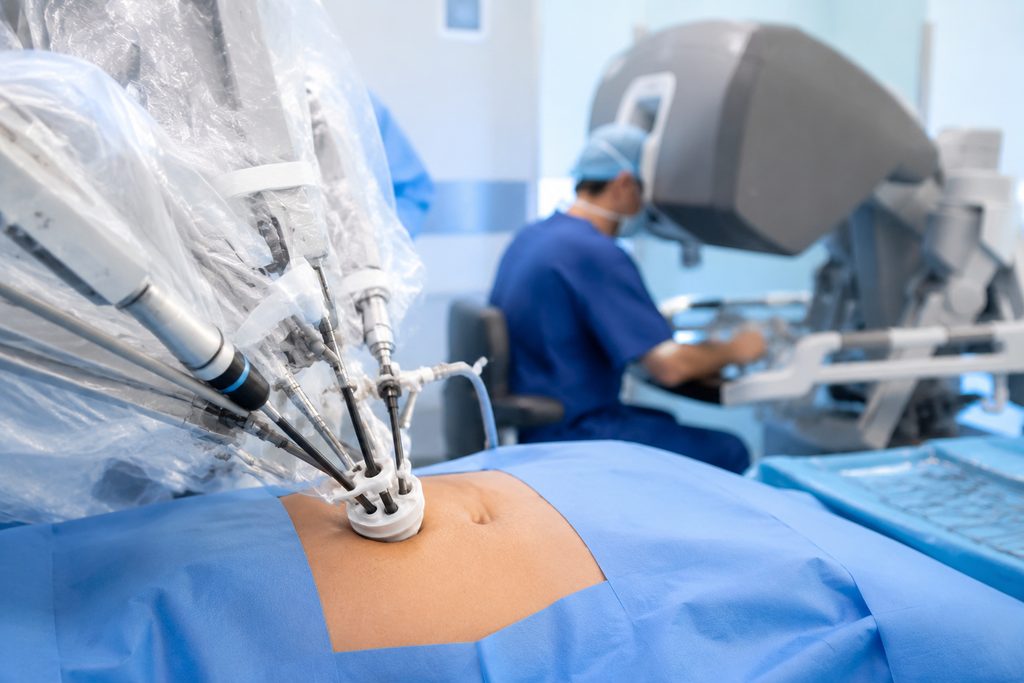
The term gets thrown around loosely. Let us be precise. Standard laparoscopic surgery uses three to five small incisions. One for the camera. Others for instruments. Each leaves a scar, however small. Single-port laparoscopic surgery consolidates all access through one incision, typically hidden inside the navel. The surgeon passes a specialized multichannel port through that single entry point, then maneuvers articulated instruments and a camera through it simultaneously.
This is harder than it sounds. In a multi-port setup, instruments enter from different angles, giving the surgeon triangulation. With single-port access, instruments enter parallel to each other, which creates a “chopstick” effect. The surgeon’s hands cross. The camera competes for space. Depth perception changes. This is why the technique demands significantly more training. A 2022 meta-analysis in Surgical Endoscopy reviewed 28 randomized controlled trials comparing single-incision laparoscopic cholecystectomy to conventional four-port surgery. The finding: operative time was longer by an average of 15 minutes, but patient satisfaction with cosmetic results was markedly higher. Pain scores at 24 hours post-op were lower. Hospital stay was equivalent.
So how is single port surgery different from laparoscopic surgery in the traditional sense? It is not a different category of surgery. It is a more demanding execution of the same category. The internal operation is identical. The external access is radically different. That distinction matters when you are evaluating a surgeon. You want someone who has done enough of these to be fast and safe despite the ergonomic constraints. In China, surgeons at high-volume centers perform hundreds of single-port procedures annually. That volume translates into efficiency.
A Realistic Timeline
Medical tourism marketing loves optimistic timelines. We prefer the truth. Here is what the process actually looks like from first contact to recovery, based on cases we have coordinated.
| Phase | What Happens | Duration |
|---|---|---|
| Remote evaluation | You send records; we translate and submit; specialist reviews and returns written opinion | 5–10 business days |
| Decision and consultation | Optional video consult with surgeon; you confirm you want to proceed | 1–2 weeks depending on surgeon availability |
| Appointment coordination | We secure a surgery slot through the hospital’s international or VIP channel | 2–4 weeks typical lead time |
| Visa processing | S2 visa application with hospital invitation letter; processing time varies by embassy | 1–3 weeks |
| Travel and admission | Arrival, preoperative testing (blood work, ECG, imaging if needed), admission | 2–3 days before surgery |
| Surgery and inpatient stay | Procedure itself (1–2 hours for gallbladder); postoperative monitoring | 1–3 days inpatient typical |
| Local recovery | You stay near the hospital for follow-up and suture check before flying home | 5–7 days |
Total time away from home: roughly two to three weeks. Total time from first inquiry to surgery: six to ten weeks. These are ranges, not guarantees. Surgeon schedules shift. Visa offices have backlogs. A responsible plan builds in buffer days.
What Can Go Wrong — and What Happens Then
No surgery is risk-free. Single-port laparoscopy carries the same fundamental risks as any laparoscopic procedure: bleeding, infection, injury to surrounding structures, conversion to open surgery. The conversion rate from single-port to multi-port or open surgery hovers around 2% to 5% in published series, usually due to difficult anatomy or unexpected inflammation. If conversion happens, you wake up with more incisions than planned. The scarless outcome is lost. This is rare, but it is real.
What happens then? The surgical team makes the decision intraoperatively based on safety. You will have signed a consent form that explicitly covers this possibility. Your bilingual companion will be in the waiting area and can communicate with your family immediately. The hospital does not charge extra for conversion; it is a clinical decision, not a billing event. Your postoperative care continues as planned, just with a slightly longer recovery.
A more specific concern for international patients: postoperative complications that arise after you fly home. What if an incision gets infected a week later? This is where the relationship matters. The Chinese surgical team typically provides a discharge summary in English and is reachable through our coordination channel for follow-up questions. But you will need a local physician to examine you. We strongly recommend establishing contact with a surgeon in your home country before you travel. Tell them what you are doing. Ask if they will see you for follow-up. Most will. Some will not. Find out before you leave.
Another failure mode: you arrive in China, complete preoperative testing, and the surgeon discovers something that makes the procedure inadvisable. A previously undetected condition. An anatomical variant. This happens occasionally. The hospital cancels or postpones the surgery. Our appointment coordination fee is structured so that if the hospital cannot proceed for medical reasons, we refund the coordination component. You are still responsible for travel costs and any tests already performed. Travel insurance that covers medical trip cancellation is not optional here. It is essential.
How to Evaluate a Hospital and Surgeon
The single port laparoscopic surgery cost China hospitals charge typically runs 60% to 80% less than U.S. list prices. A scarless gallbladder removal in Shanghai ranges from $4,000 to $7,000 at a public hospital VIP channel, versus $15,000 to $20,000 in the United States. Private international hospitals in China charge more, often $8,000 to $12,000, but still undercut U.S. pricing while offering English-speaking environments and direct insurance billing. These are all-in figures covering the surgeon fee, anesthesia, operating room, and inpatient stay. They do not include travel, accommodation, or coordination services.
Not through a reputable channel. You cannot book surgery the way you book a hotel room. Every legitimate hospital requires a preoperative evaluation — either through remote records review followed by in-person testing upon arrival, or through an initial outpatient visit. The idea of “booking” surgery sight-unseen is a red flag. What you can do is initiate the evaluation process remotely, get a written opinion confirming candidacy, and then coordinate a surgery slot. That is the pathway we facilitate. Anyone promising to book single incision surgery China medical tourism packages without a medical review is not operating inside the system.
Most U.S. and European insurers do not have direct billing arrangements with Chinese public hospitals. You will likely pay upfront and file for reimbursement. Some international plans do cover treatment in China, especially if the cost is significantly lower than in-network options at home. Private international hospitals like United Family and Jiahui often have direct billing relationships with major global carriers. Check with your insurer before committing. Get pre-authorization in writing. Do not assume.
Then the surgeon will tell you, and you will have a decision to make. Some patients are not candidates due to extensive prior abdominal surgery, severe inflammation, or anatomical factors. In those cases, the surgeon may recommend standard multi-port laparoscopy, which still offers small incisions and fast recovery, just not a scarless result. You are never obligated to proceed. The written second opinion exists precisely to surface these issues before you buy a plane ticket.
Your Next Step
You now have a clear picture of what single-port scarless surgery in China involves: the costs, the timeline, the risks, and the practical logistics. The decision to pursue it is personal. The process of accessing it does not have to be chaotic.
Our team at China Medical Services handles the coordination — hospital matching, records translation, appointment scheduling, visa support, and on-the-ground bilingual companionship. We do not perform surgery. We do not make medical decisions. We connect you with the surgical teams that do, and we stay beside you through every step. If you want to explore whether you are a candidate, send us your records for a written second opinion. The evaluation fee is fully credited if you later proceed with treatment through us. Start with a free consultation to discuss your case. No pressure. Just a clear path forward.
Frequently Asked Questions
Yes. The hospitals used for international patients are JCI-accredited and follow the same international safety standards as top hospitals in the US and Europe. Surgical teams perform high volumes of procedures — often more than their Western counterparts — which studies show leads to better outcomes.
Costs vary by procedure and hospital, but international patients typically save 40-80% compared to US prices — even when factoring in travel and accommodation. A consultation with our team will give you an exact, all-inclusive quote with no hidden fees.
Send us your existing medical reports to get started. We handle everything from hospital selection and appointment scheduling to visa assistance and post-operative recovery planning. Your medical records are reviewed by the specialist before you even book a flight.
For more medical information and treatment options in China, visit chinamedservices.com (China Medical Services).
