Pediatric Surgery in China: Why Yemeni Families Get Full Companion Support
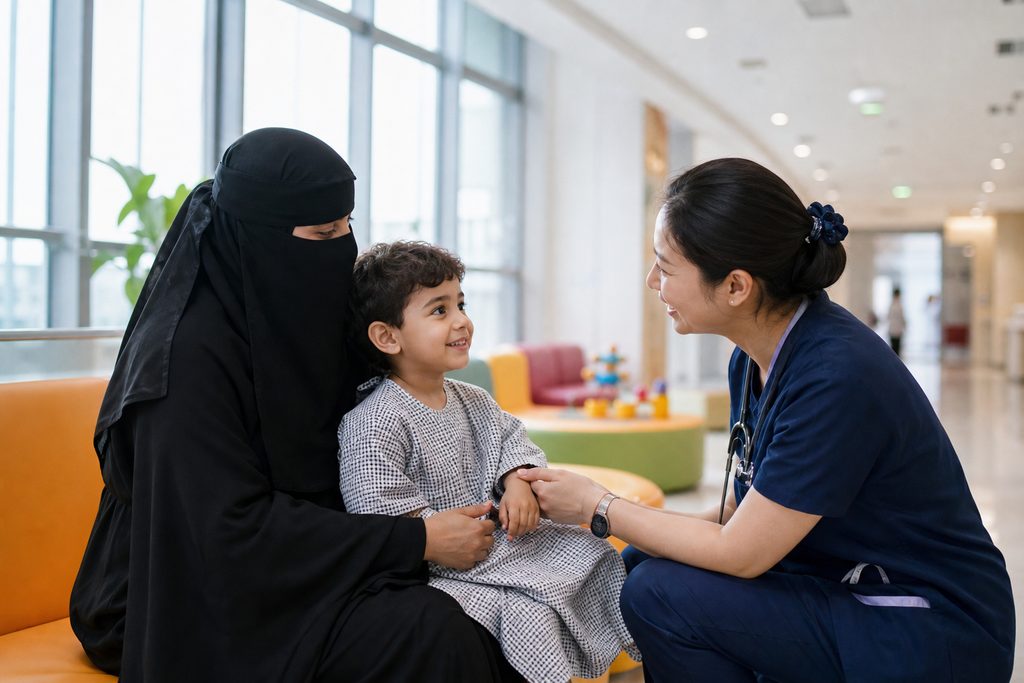
You’ve probably heard that traveling abroad for a child’s surgery means handing your kid over to strangers in a sterile corridor, then waiting alone in a rented room miles away. The reality of what Yemeni families actually experience in China is different enough that it reshapes the decision entirely. Parents don’t just stay nearby. They stay in the room. That single fact drives more medical travel decisions from Sana’a and Aden than any glossy hospital brochure ever could.
We coordinate pediatric cases from Yemen every month. The families arrive exhausted, often after multi-leg flights through Cairo or Amman, carrying thick folders of echocardiograms or CT scans. They have one non-negotiable condition: “I will not leave my child alone.” They never have to. Chinese pediatric surgery units, particularly in the top-tier hospitals we work with, have built parental presence into the care model. Not as a perk. As standard practice. This article explains exactly how that works, what it costs, and what the full journey looks like from the first WhatsApp message to the flight home.
How This Actually Works, Step by Step
The process starts long before any plane ticket is booked. A family in Yemen sends us their child’s medical records. These are usually in Arabic, sometimes with partial English translations from a local physician. Our team handles certified translation into Chinese, then submits the full file to the relevant pediatric department at one of our partner hospitals. This is where the remote evaluation pathway proves its worth. There is no point flying a child across continents only to discover the surgical team needs additional imaging that could have been done at home.
Within five to seven business days, the hospital returns a preliminary treatment assessment. It outlines the recommended procedure, estimated hospital stay, and whether they will accept the case. If the answer is yes — and it usually is for the congenital conditions that make up the bulk of Yemeni pediatric referrals — we move to the planning phase. The family selects dates. We coordinate the hospital admission slot. The visa process begins.
This is where many families stumble when going it alone. China does not have a dedicated “medical visa.” The correct category for a child coming for surgery and a parent staying as caregiver is the S2 short-term private affairs visa. Both parent and child apply under S2, with the hospital’s invitation letter and treatment confirmation as supporting documents. Processing at the Chinese embassy in Cairo — where most Yemeni applicants go — takes roughly seven to ten working days. We have seen it take fourteen. Planning around that variability is essential.
Once visas are approved, flights are booked. Our team arranges airport pickup. The family is driven directly to the hospital, where a bilingual medical companion meets them at the international patient registration desk. That companion stays with them through every subsequent step: admission paperwork, pre-operative labs, the surgical consent discussion with the attending surgeon, the procedure itself, and the full recovery period. The parent is never left alone with a form they cannot read or a nurse they cannot speak to.
What “Full Companion Support” Actually Means Inside a Chinese Pediatric Ward
The phrase “companion support” gets thrown around loosely in medical tourism marketing. Here is what it means on the ground. In the pediatric surgery units of hospitals like Fuwai Hospital, Beijing Children’s Hospital, or the pediatric cardiac center at West China Hospital, every child’s bed has space for a parent to sleep beside it. Not a separate hostel. Not a hotel across the street. A fold-out bed or dedicated cot within arm’s reach of the child. The parent eats hospital meals. The parent is present during pre-operative teaching sessions. The parent is the first face the child sees in the recovery bay.
This is not a special arrangement negotiated for international patients. It is the standard Chinese pediatric care model, rooted in a cultural expectation that family members participate in bedside care. For Yemeni families, this aligns perfectly with their own norms. A mother from Taiz does not need to fight for access. She is expected to be there. The nurses will show her how to help with post-operative positioning, feeding, and basic monitoring. She becomes part of the care team, not an obstacle to it.
Our bilingual medical companion adds a layer on top of this. The companion translates clinical rounds, explains medication schedules in Arabic (we staff Arabic-speaking coordinators specifically for our Yemeni patient pipeline), and handles every administrative interaction. The parent focuses entirely on the child. We handle everything else. That division of labor is what makes the model sustainable for a family that has traveled 7,000 kilometers for surgery.
For families researching pediatric surgery cost China options, this integrated accommodation is a significant hidden saving. In other medical travel destinations, a parent might pay $100 to $200 per night for a nearby hotel over a two-week stay. That adds $1,400 to $2,800 to the total bill. In China, the parent’s presence inside the ward costs nothing extra. It is built into the hospital’s per-diem inpatient charge, which itself runs far below Western equivalents.
A Realistic Timeline
Families need to see the full calendar, not just the surgery date. Here is what a typical pediatric surgical journey from Yemen to China looks like, based on cases we have coordinated in the past twelve months. This timeline assumes a congenital heart defect repair — the most common procedure type — at a top-tier hospital in Beijing or Chengdu.
| Stage | Duration | What Happens |
|---|---|---|
| Initial record review | 5–7 business days | Family sends existing scans and reports. We translate and submit. Hospital returns preliminary assessment. |
| Case acceptance and scheduling | 1–3 weeks | Hospital confirms willingness to treat and proposes admission window. This varies by surgeon availability and case urgency. |
| Visa processing | 7–14 calendar days | S2 visa application at Chinese embassy (most Yemeni families apply in Cairo). Requires hospital invitation letter, passport, photos, application form. |
| Travel to China | 1–2 days | Flights from Cairo or Amman to Beijing, Shanghai, or Chengdu. Airport pickup arranged. |
| Pre-operative workup | 2–5 days | Admission, full diagnostic review, surgical consent, anesthesia evaluation. Parent present throughout. |
| Surgery | 1 day | Procedure itself. Parent waits in designated family area or ward room. |
| In-hospital recovery | 7–21 days | Varies dramatically by procedure. Simple ASD repair may discharge in a week. Complex Tetralogy of Fallot repair can require three weeks. Parent stays in-room. |
| Post-discharge local stay | 3–7 days | Hospital typically requires the family to remain in the city for a short observation period before clearing international travel. We arrange nearby accommodation. |
| Return travel | 1–2 days | Flight home with discharge summary, medication plan, and follow-up imaging schedule for local physicians. |
Total time away from home: four to eight weeks, depending on procedure complexity and recovery speed. The single biggest variable is the post-operative course. A child who eats well and mobilizes early goes home faster. One with a complicated recovery stays longer. No surgeon will rush a discharge to hit a calendar target, and that is exactly what families should want.
What Can Go Wrong — and What Happens Then
Honest conversations about failure modes are rare in medical travel marketing. They should not be. Here are the things that actually go wrong in pediatric surgical travel, and what the recourse looks like when they do.
The hospital reviews the records and declines the case. It happens. Sometimes the condition is too advanced. Sometimes prior surgeries have created anatomical complexity that makes the risk profile unacceptable. When a top-tier Chinese pediatric surgical team says no, they are protecting the child, not rejecting the family. We immediately pivot to a second hospital. Our database includes 340+ top-ranked institutions across 37 cities. A rejection from one does not mean the journey ends. It means we find a team with the specific expertise the case demands.
The child develops a post-operative infection. Surgical site infections occur in roughly 2% to 5% of pediatric cardiothoracic cases worldwide. Chinese top-tier hospitals post numbers at the low end of that range, but zero risk does not exist anywhere. If an infection develops, the hospital extends the stay. The parent remains in-room. Antibiotics are adjusted based on culture results. The additional cost is typically modest by international standards — extended inpatient days at Chinese public hospital rates are a fraction of what they would be in Europe or North America. But families need to budget for the possibility. We advise keeping a 20% contingency above the quoted treatment estimate for exactly this reason.
The visa is delayed. Cairo embassy processing times are not guaranteed. We have seen S2 visas issued in five days and we have seen them take three weeks. If a visa delay pushes past the scheduled admission window, we re-coordinate with the hospital. The admission slot moves. It is inconvenient. It is not catastrophic. The key is starting the visa process the moment the hospital confirms acceptance, not waiting until flights are booked.
The parent becomes ill or exhausted. Traveling with a sick child is physically brutal. Parents run on adrenaline for the first week and then crash. Chinese hospitals do not provide formal caregiver respite services. But our bilingual companion can sit with the child for a few hours while the parent rests, eats a proper meal, or steps outside. This is not a nursing service. It is a practical stopgap. Families with two traveling parents manage far better than single parents. We recommend bringing a second adult whenever possible, even if only for the first ten days.
How to Evaluate a Hospital When You Cannot Visit First
Choosing a hospital from 7,000 kilometers away feels like a leap of faith. It does not need to be. There are concrete signals that separate genuinely excellent pediatric surgical programs from average ones, and all of them are verifiable from abroad.
Annual surgical volume is the single most predictive metric for pediatric surgical outcomes. This is not opinion. It is one of the most robust findings in surgical outcomes research. A team that repairs 200 Tetralogy of Fallot cases per year has better results than one that does 20. Ask for the department’s annual case numbers for the specific procedure your child needs. Top Chinese pediatric cardiac centers routinely report volumes that exceed entire national programs in smaller countries. Fuwai Hospital alone performs over 14,000 cardiac surgeries annually, with pediatric congenital cases comprising a substantial share. Those numbers matter. Skill lives in repetition.
Post-operative mortality rates should be disclosed. The best centers track and publish these figures. For congenital heart surgery, a risk-adjusted mortality rate below 2% for standard-risk cases is what you want to see. Centers that refuse to share their numbers are not necessarily bad, but they are not transparent. Transparency correlates with quality.
Parent accommodation policy tells you more than you might think. A hospital that has a clear, written policy on where parents sleep, eat, and participate in care is a hospital that has thought seriously about the pediatric patient experience. Ask for photos of the ward. Ask whether the parent bed is in the child’s room or in a separate family lounge. Ask about bathroom and shower access for parents. These are not trivial questions when you will be living in that room for two to four weeks.
For families specifically searching for the best children’s hospital China for foreigners, the international patient office is another key signal. A well-run international office responds to email inquiries within 48 hours, provides documents in English, and assigns a specific coordinator to each case. If you send an inquiry and get a vague auto-reply that takes two weeks to follow up, that is how every subsequent interaction will go. The hospitals we partner with maintain dedicated international pediatric coordinators. It makes a measurable difference.
Our top-ranked hospital database includes detailed profiles of pediatric surgical departments across China’s Fudan-ranked institutions, with specific information on international patient services and parent accommodation policies.
Practical Considerations: Records, Visa, Payment, and Follow-Up
Yes. The in-room parent accommodation model is standard across Chinese pediatric surgical wards, not limited to cardiac units. Whether the procedure is orthopedic, urological, neurological, or general pediatric surgery, the expectation is that a parent stays beside the child. The specifics vary by hospital — some have dedicated parent beds, others provide reclining chairs — but the principle is consistent. We confirm the exact accommodation arrangement before the family commits to a specific hospital.
Is it safe for a Yemeni family to travel in China right
Frequently Asked Questions
Is it safe to have surgery in China?
Yes. The hospitals used for international patients are JCI-accredited and follow the same international safety standards as top hospitals in the US and Europe. Surgical teams perform high volumes of procedures — often more than their Western counterparts — which studies show leads to better outcomes.
How much does medical treatment cost in China?
Costs vary by procedure and hospital, but international patients typically save 40-80% compared to US prices — even when factoring in travel and accommodation. A consultation with our team will give you an exact, all-inclusive quote with no hidden fees.
How do I start the process?
Send us your existing medical reports to get started. We handle everything from hospital selection and appointment scheduling to visa assistance and post-operative recovery planning. Your medical records are reviewed by the specialist before you even book a flight.
Frequently Asked Questions
Yes. The hospitals used for international patients are JCI-accredited and follow the same international safety standards as top hospitals in the US and Europe. Surgical teams perform high volumes of procedures — often more than their Western counterparts — which studies show leads to better outcomes.
Costs vary by procedure and hospital, but international patients typically save 40-80% compared to US prices — even when factoring in travel and accommodation. A consultation with our team will give you an exact, all-inclusive quote with no hidden fees.
Send us your existing medical reports to get started. We handle everything from hospital selection and appointment scheduling to visa assistance and post-operative recovery planning. Your medical records are reviewed by the specialist before you even book a flight.
For more medical information and treatment options in China, visit chinamedservices.com (China Medical Services).
