Post-Surgery Wound Care at Your Beijing Hotel: A Complete Guide to Private Nursing
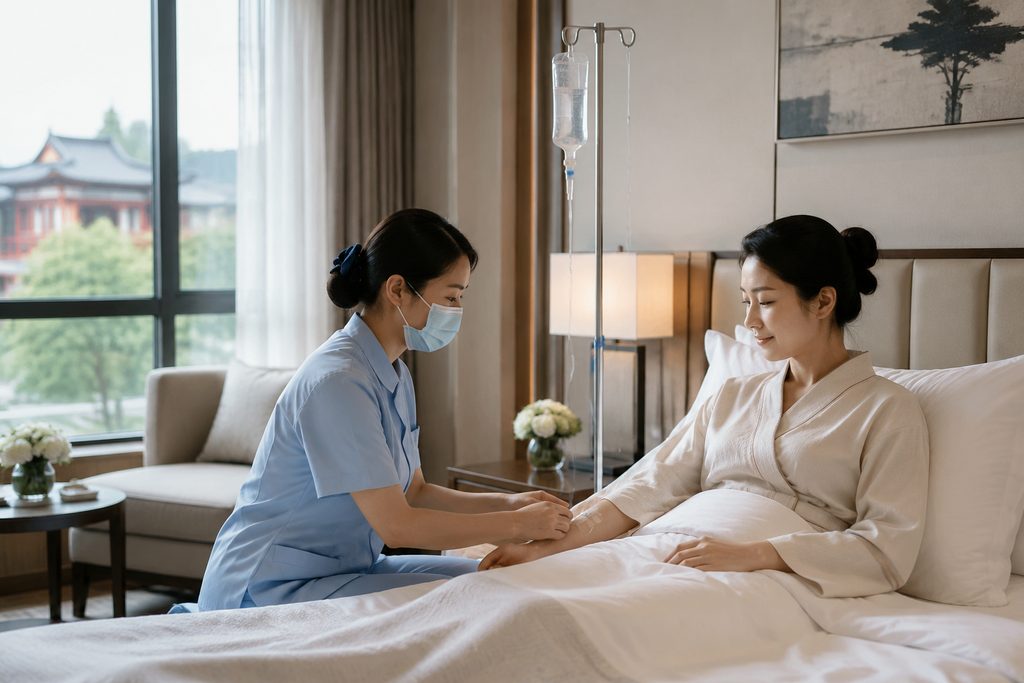
You flew across the world for a procedure at a top-ranked hospital in Beijing. The surgery went well. Now you are back at your hotel, looking at a surgical incision, and the discharge instructions say “daily dressing change.” You have no sterile gauze, no medical tape, and no idea who to call. What do you do?
This situation is more common than most medical travelers anticipate. The question is not whether a nurse can come to your hotel in Beijing. The question is how to arrange it safely, what it will actually cost, and what the alternatives are. We have coordinated post-operative recovery for international patients across 37 cities in China. Here is what you need to know about getting professional wound care without leaving your hotel room.
How This Actually Works, Step by Step
Before your surgery, or immediately after discharge, someone needs to make the arrangements. If you are working with a medical coordination team, they handle this. If you are on your own, you will need to navigate it yourself. Here is the real sequence.
Step 1: Get the clinical requirements in writing. Your surgeon or discharge nurse must specify exactly what the wound care involves. Is it a simple dressing change with saline and gauze? Does the wound need packing? Are there drains to manage? Is antibiotic ointment required? A vague “change the dressing daily” is not enough. The visiting nurse needs to see the discharge summary, the wound care orders, and ideally a photo of the incision before the first hotel visit.
Step 2: Identify who can legally provide this service. In China, only a registered nurse (RN) with an active Chinese nursing license can perform wound care and dressing changes. A hotel concierge cannot do this. A family member should not do this unless specifically trained and cleared by the surgical team. Your options are: a nurse dispatched by the hospital where you had surgery, a nurse from a private nursing agency, or a nurse affiliated with a medical coordination service. Each path has different lead times and costs.
Step 3: Confirm availability and schedule. Private nursing services in Beijing typically require 24 to 48 hours’ notice for the first visit. Same-day requests are sometimes possible but unreliable. For daily dressing changes, you want to lock in a schedule for the full recovery period upfront. A nurse arriving at 2pm one day and 9am the next is not ideal for wound healing consistency.
Step 4: The first visit. The nurse arrives at your hotel room with a portable kit: sterile dressings, saline, gloves, tape, scissors, a clinical waste bag, and a blood pressure cuff. They will assess the wound, check for signs of infection, perform the dressing change, document the wound status, and take vital signs. A professional nurse will also photograph the wound (with your consent) for continuity of care. The visit typically takes 30 to 45 minutes for a straightforward dressing change.
Step 5: Ongoing communication. The nurse should provide a brief written note after each visit. If anything looks concerning — increased redness, unexpected drainage, dehiscence — they should escalate to your surgeon immediately. This feedback loop is the single most important safety mechanism in hotel-based wound care.
What Affects the hotel wound care after surgery Beijing price
The cost of having a nurse come to your hotel for wound care in Beijing is not a fixed number. It depends on several factors that patients often overlook when budgeting for medical travel.
Nurse qualifications and source. A nurse dispatched directly from the hospital’s international department where you had surgery will typically charge more than a nurse from a private agency. Hospital-affiliated nurses bring direct familiarity with your surgeon’s protocols. That continuity has real clinical value. Expect to pay a premium for it.
Visit complexity and duration. A 20-minute simple dressing change costs less than a 60-minute visit that includes wound packing, drain management, and patient education. Be specific about what you need when requesting a quote. Understating the complexity to save money will backfire when the nurse arrives unprepared.
Location within Beijing. Hotels in Haidian or out near the airport involve longer travel times than hotels in Dongcheng or Chaoyang near the major hospital clusters. Travel time is billable time. A nurse stuck in Beijing traffic for 45 minutes each way cannot see other patients. That cost gets passed to you.
Frequency and package deals. Booking a block of 7 or 14 daily visits is almost always cheaper per visit than booking day by day. Some agencies offer wound care packages for medical tourists in Beijing that bundle dressing changes with vital sign monitoring and progress reporting to your home-country physician.
| Service Type | Estimated Cost (USD) | Notes |
|---|---|---|
| Single dressing change visit (private agency nurse) | $80–150 | 30-45 min; includes basic supplies |
| Single visit (hospital international department nurse) | $120–200 | Direct surgeon communication included |
| 7-day wound care package | $500–900 | Per-visit discount of 15-25% |
| 14-day post-surgery nursing package | $900–1,600 | Includes daily vitals and wound photos |
| Complex wound care (packing, drains, multiple sites) | $150–250 per visit | Longer visits; specialized supplies extra |
These are reference ranges based on what we see patients pay in Beijing. Actual post-surgery nursing service Beijing cost varies by hospital affiliation, nurse seniority, and your specific clinical needs. Always get a written quote before committing.
A Realistic Timeline
Most patients underestimate how long they need to stay in Beijing after surgery. They book a flight home too early and then scramble when the surgeon says “not yet.” Here is what a realistic post-operative recovery timeline looks like when you are receiving hotel-based wound care.
| Phase | Timeline | What Happens |
|---|---|---|
| Surgery day to discharge | Day 1–5 (varies by procedure) | Inpatient wound care by hospital nursing staff. Initial dressing applied in sterile conditions. |
| First hotel dressing change | 24–72 hours post-discharge | Private nurse arrives. Assesses wound baseline. Establishes care routine. Reports to surgeon. |
| Daily dressing changes | Day 3–14 post-surgery | Nurse visits daily or every other day depending on wound type and drainage. Monitors for infection. |
| Suture or staple removal | Day 7–14 (surgeon-dependent) | Nurse can remove sutures IF authorized by surgeon in writing. Otherwise, return to hospital outpatient clinic. |
| Reduced frequency care | Week 3–4 | Dressing changes may drop to every 2–3 days. Wound healing progresses. Flight clearance evaluation. |
| Fit-to-fly assessment | Week 2–4 | Surgeon or nurse assesses wound stability for long-haul flight. Provides medical clearance letter if needed. |
The step most patients forget is the fit-to-fly assessment. Airlines can deny boarding if you have an open or draining wound without medical documentation. Some carriers require a letter dated within 48 hours of departure. Factor this into your timeline. Do not book a flight for the morning after your last dressing change and expect smooth boarding.
Visa timing matters too. A standard S2 visa for medical treatment covers stays up to 180 days, which is ample for post-surgical recovery. But if you underestimated your recovery time and your visa is expiring, extensions are processed through the local Exit-Entry Administration Bureau. This takes 7 business days minimum. Plan accordingly.
What Can Go Wrong — and What Happens Then
Hotel-based wound care is safe when done properly. It is not risk-free. Here are the failure modes we have seen and what the actual recourse looks like.
The nurse identifies a wound infection. This is the most common complication. Signs include increased redness spreading beyond the incision margins, purulent drainage, foul odor, warmth, and fever above 38°C. A competent visiting nurse will recognize these signs immediately. They should contact your surgeon within the hour. The recourse is usually a return visit to the hospital outpatient clinic for wound evaluation, possible culture, and oral or IV antibiotics. This is not a hotel-room fix. You need to get back to the hospital.
The dressing change reveals wound dehiscence. If the incision edges have separated, even partially, this is a surgical emergency that cannot wait. The nurse should help you get to the emergency department of the hospital where you had surgery. Do not let anyone attempt to close a dehisced wound in a hotel room. That requires surgical evaluation.
The nurse does not show up. Private nursing agencies in Beijing are generally reliable, but no system is perfect. If your scheduled nurse is a no-show, you need a backup plan. This is why we recommend booking through a service that has multiple nurses on call, not a single independent practitioner. A missed dressing change by a few hours is usually not clinically dangerous. A missed dressing change by 24 hours on a draining wound is a problem. Have the phone number of the agency’s dispatch desk saved in your phone, not just the individual nurse’s WeChat.
Language barrier during an escalation. Your visiting nurse may speak some English. The hospital triage nurse at 2am almost certainly does not. If you need to return to the hospital urgently, having a bilingual coordinator on call who can explain your situation to the emergency department staff is not a luxury. It is the difference between being triaged appropriately and sitting in a hallway for three hours with a surgical complication.
Supplies run out or are inadequate. A visiting nurse carries a standard kit. If your wound requires a specific type of dressing — hydrocolloid, silver-impregnated, foam — and the nurse does not have it, someone needs to source it. Beijing has medical supply stores, but they are not open 24 hours and the staff will not speak English. This is a solvable problem if you have local support. It is a crisis if you do not.
How to Evaluate a Post-Surgery Nursing Service in Beijing
Not all nursing services are equal. When you are comparing options for how to change surgical dressing in hotel Beijing, here are the questions that separate professional providers from the rest.
Ask about licensing. The nurse must hold a current Chinese RN license. This is non-negotiable. Ask to see the license number. A legitimate provider will share it without hesitation. If they deflect or say it is “not necessary,” walk away.
Ask about the escalation protocol. What exactly happens if the nurse finds something concerning? Who do they call? How fast can they reach your surgeon? A good answer names specific people and response times. A bad answer is vague reassurance.
Ask about documentation. You should receive a written note after every visit. This is your medical record. It also protects you if something goes wrong. If the service says they do not provide documentation, that is a red flag.
Ask about continuity. Will the same nurse see you every day, or will it be whoever is available? Wound healing is best assessed by the same set of eyes over time. Rotating nurses who have never seen your wound before are more likely to miss subtle changes.
Ask about the backup plan. If your assigned nurse is sick, who comes instead? How much notice will you get? A service with only one or two nurses in Beijing is fragile. A service with a roster of ten is resilient.
You can certainly search online for “can a nurse come to my hotel for wound care in China” and find options. The challenge is not finding someone who says yes. The challenge is verifying that the yes is backed by clinical competence and logistical reliability.
Practical Considerations: Supplies, Insurance, and Going Home
Your visiting nurse should leave you with a small emergency kit: a couple of sterile gauze pads, tape, and a spare dressing in case the current one gets wet or dislodged. If you need more than that, do not improvise. Call the nursing service. Using non-sterile materials from a pharmacy on a surgical wound is a fast path to infection. Beijing has 24-hour pharmacies, but they stock consumer first-aid products, not surgical-grade supplies. Let the professionals handle resupply.
For uncomplicated post-surgical wounds in stable patients, hotel-based wound care with a licensed nurse is safe and widely practiced. The key word is “uncomplicated.” If your surgeon recommends inpatient observation for wound care, do not push for early discharge to save money. Hotel-based care is appropriate when the wound is clean, the patient is mobile, and the risk of complication is low. It is not appropriate for complex wounds, immunocompromised patients, or situations where the surgeon wants daily in-person assessment. Trust the surgeon’s judgment on this.
English-speaking nurses in Beijing are concentrated in hospital international departments and private agencies that serve the expatriate and medical tourism market. The major private hospitals with international wings — United Family, Raffles, and OASIS — all have nursing staff with English proficiency. Independent agencies vary widely. Always confirm English ability in a phone or video call before booking. Do not rely on a website claim. A nurse who can say “hello” and “no infection” is not the same as one who can explain wound healing stages and answer your questions clearly.
Your Next Step
Recovering from surgery in a foreign country is vulnerable enough without wondering who will change your dressing tomorrow. The logistics are solvable. The key is arranging care before you need it, verifying credentials, and having a clear escalation path if something goes wrong.
Frequently Asked Questions
Yes. The hospitals used for international patients are JCI-accredited and follow the same international safety standards as top hospitals in the US and Europe. Surgical teams perform high volumes of procedures — often more than their Western counterparts — which studies show leads to better outcomes.
Costs vary by procedure and hospital, but international patients typically save 40-80% compared to US prices — even when factoring in travel and accommodation. A consultation with our team will give you an exact, all-inclusive quote with no hidden fees.
Send us your existing medical reports to get started. We handle everything from hospital selection and appointment scheduling to visa assistance and post-operative recovery planning. Your medical records are reviewed by the specialist before you even book a flight.
For more medical information and treatment options in China, visit chinamedservices.com (China Medical Services).
