Rehab in China After Surgery: Orthopedic, Neuro, and Cardiac Recovery Hub
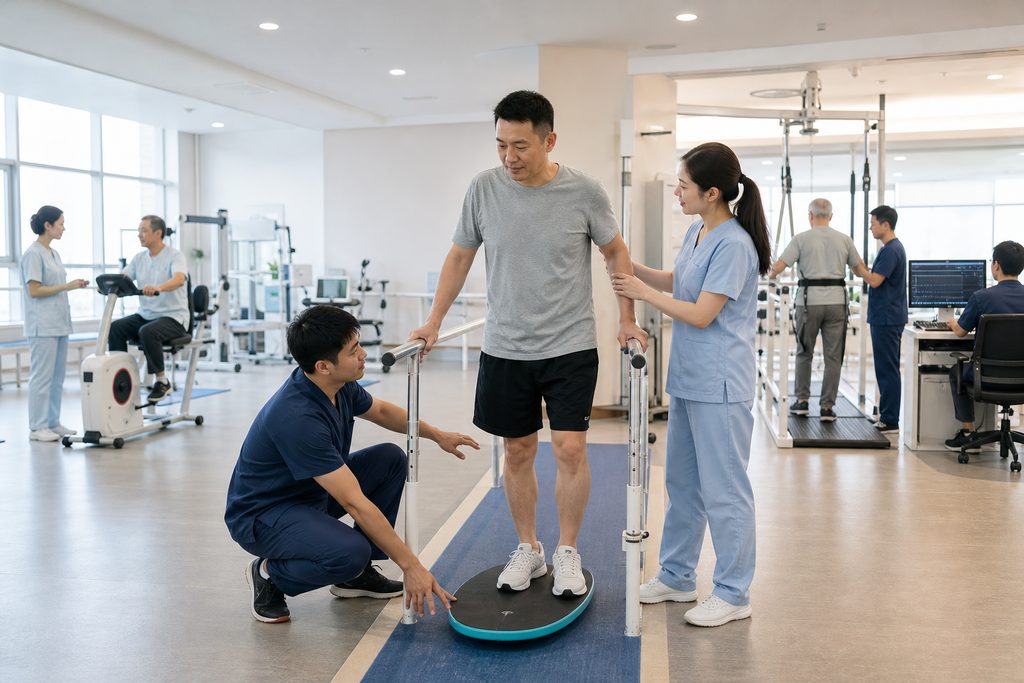
Rehabilitation in China After Surgery: The Short Answer
For a patient facing a long recovery, the orthopedic surgery rehabilitation cost China typically runs 60–80% less than comparable programs in the United States. A comprehensive inpatient stay that might bill $45,000 in the U.S. can land between $8,000 and $15,000 here.
But cost is not the whole picture. China’s top rehabilitation centers have quietly built massive clinical volume. Fuwai Hospital performs over 14,000 cardiac surgeries a year. That volume creates a rehab pipeline that most Western hospitals never see. The question is not just whether you can afford to come. It is whether the program structure fits how you recover.
Who This Is Right For — and Who It Isn’t
Medical travel for rehabilitation makes sense only when the clinical gain justifies the logistical strain. We see the best outcomes when patients match a specific profile.
Typically a strong candidate when:
- You need intensive inpatient physiotherapy after a joint replacement and your home country caps sessions at a handful per week.
- Your cardiac event requires a monitored, phased exercise program that integrates Traditional Chinese Medicine (TCM) modalities you cannot access locally.
- You have a neurological injury — stroke or spinal — and you want aggressive, multi-hour daily therapy that your local insurance will not cover.
- You are stable enough to fly and your surgeon has cleared you for international travel.
This path is probably wrong if:
- You are medically unstable or still in an acute post-surgical window where a complication would require immediate return to the operating theater.
- You need a level of psychosocial support that depends on having your full family network physically present every day.
- You cannot tolerate a language barrier outside the clinical team — your physiotherapist will speak English in an international program, but the world outside the hospital gates operates in Mandarin.
The Options, Compared
Not all rehabilitation in China follows the same model. The differences matter more than the price tag.
| Program Type | Typical Daily Therapy Hours | Clinician English Level | Inpatient Cost Range (per week) |
|---|---|---|---|
| Public Grade-A Tertiary Hospital Rehab Ward | 2–3 hours | Limited — translator often needed | $1,200–$2,500 |
| Hospital International/VIP Wing | 3–4 hours | Fluent English-speaking lead therapists | $2,800–$4,500 |
| Private International Hospital (JCI-accredited) | 3–5 hours | Native or near-native English throughout | $3,500–$6,000 |
| Specialized Standalone Rehab Center | 4–6 hours | Varies — verify per facility | $2,000–$4,000 |
For most international patients, the VIP wing of a public hospital hits the sweet spot. You get the clinical depth of a high-volume institution — the surgeons who did thousands of knees — combined with English-speaking coordination. The private international hospitals feel more like a Western hotel and accept direct insurance billing. But they may not see the complex revision cases that the big public centers handle every Tuesday morning.
Orthopedic, Neuro, and Cardiac: What Recovery Actually Looks Like Here
Rehabilitation in China is not a single product. The experience diverges sharply by specialty.
Orthopedic recovery — particularly after knee or hip replacement — leans heavily on early mobilization. Chinese protocols often start weight-bearing sooner than cautious Western guidelines. A patient might stand with assistance within six hours of a total knee arthroplasty. Physiotherapy sessions run twice daily, six days a week. The goal is discharge to outpatient status within 10–14 days post-op, assuming you arrived for combined surgery-plus-rehab. If you are arriving solely for physiotherapy after knee replacement abroad, a typical inpatient stay runs two to four weeks, depending on your baseline function.
Neuro rehab is where China’s volume advantage becomes hardest to ignore. A major stroke center in Beijing or Shanghai may run a rehab floor with 80 beds and a staff-to-patient ratio that allows three hours of one-on-one therapy daily. This is not luxury. It is repetitive, exhausting, high-dose therapy. The question we hear most: is neuro rehab in China safe for foreigners? The clinical safety record at JCI-accredited or Fudan-ranked hospitals is strong. Infection control protocols match international standards. The real safety variable is communication during a neurological emergency — aphasia or confusion is harder to manage through a translator. That is why we only place neuro patients in programs where the lead rehabilitation physician conducts rounds in English.
Cardiac rehab follows a phased model familiar to anyone who has gone through a program in Europe. Phase I starts in the ICU. Phase II — the monitored outpatient phase — is where China offers something unusual: integration with TCM. Patients at the best cardiac rehab center Shanghai can access, for example, acupuncture for post-sternotomy pain and tai chi as a graduated exercise modality. The evidence base for tai chi in cardiac rehabilitation is real — a 2020 meta-analysis in the Journal of the American Heart Association found significant improvements in VO2 peak among coronary heart disease patients practicing tai chi. That is not mysticism. That is a low-impact, adherence-friendly form of exercise that Western programs rarely prescribe.
What It Costs
Prices vary by city, hospital tier, and case complexity. The figures below reflect international-wing or private-facility pricing with English-speaking staff. Public-ward pricing runs lower but requires Mandarin fluency or a full-time translator.
- Inpatient orthopedic rehab (post-joint replacement): $2,800–$4,500 per week. A four-week stay totals $11,200–$18,000. This typically includes physiotherapy twice daily, nursing care, meals, and a private room.
- Inpatient neuro rehab (post-stroke): $3,000–$5,000 per week. Intensive programs run six to twelve weeks. Total cost: $18,000–$60,000. Factor in that a similar program in the U.S. can exceed $100,000 for a twelve-week stay.
- Cardiac rehab Phase II (outpatient): $150–$300 per session. A standard 36-session course over twelve weeks totals $5,400–$10,800.
What these numbers exclude: international airfare, visa fees, accommodation for a family companion, and any acute medical complications that require transfer back to a surgical service. They also exclude the coordination service fee — which typically starts from $300 for appointment scheduling and runs higher for full concierge support.
One detail that surprises patients: many Chinese hospitals require a deposit upfront, calculated as an estimate of the full stay. A $20,000 rehab program means bringing $20,000 in accessible funds. Insurance reimbursement happens after discharge, not before.
Practical Considerations: Records, Visas, and the Language Wall
You cannot simply book a flight and show up. The preparation makes or breaks the experience.
Medical records. Chinese rehabilitation physicians will want your full surgical record: operative notes, implant stickers (for joint replacements), recent imaging on CD, and a clearance letter from your surgeon stating you are fit for air travel and intensive physiotherapy. If these are not in English or Chinese, certified translation is required. We handle this translation in-house, but it adds three to five business days before a hospital will schedule you.
Visa. Medical treatment falls under the S2 visa category — a short-stay private affairs visa. Your accompanying family member applies for the same category. You will need an invitation letter from the Chinese hospital confirming your admission. That letter alone does not guarantee visa approval. Embassies also want proof of funds and a round-trip flight itinerary. Plan for the visa process to take two to four weeks from the moment the hospital issues the invitation.
Language beyond the clinic. Your physiotherapist may speak excellent English. The nurse on the night shift probably will not. Ordering food, reading a medication label, navigating a billing dispute — these happen in Mandarin. Some patients find this energizing, part of the adventure. Others find it exhausting when they are already physically depleted. Be honest about which type you are.
Follow-up after returning home. The Chinese rehab team will provide a detailed discharge summary and a home exercise program in English. But they will not be managing your care once you leave. Your home physician needs to be willing to receive the handoff. We recommend establishing that willingness before you travel, not after.
Frequently Asked Questions
Most international patients stay two to four weeks for dedicated inpatient physiotherapy following a knee replacement. The first week focuses on pain control, range of motion, and safe gait training. Weeks two through four ramp up strength and functional mobility. Discharge typically happens when you can walk 150 meters independently, climb stairs, and achieve 90 degrees of knee flexion. Some patients extend to six weeks if they had a complex revision or bilateral procedure. The length of stay is not arbitrary — it is gated by functional milestones, not a calendar.
Clinically, yes — at the right facility. The safety risk is not in the therapy itself. It is in the gaps between therapy sessions. A stroke patient with expressive aphasia who cannot make their needs understood to a Mandarin-only nurse faces a real risk of delayed response to pain, bathroom needs, or medication side effects. This is solvable. Choose a program where nursing staff on the neuro floor have at least basic English. Or have a bilingual companion on-site during waking hours. We never place a neuro patient with communication deficits in a facility where the nursing team cannot communicate with them directly.
You can, but the package will be conditional. No reputable Chinese hospital will finalize a rehab admission without seeing your post-surgical records and a clearance letter. What you can do in advance: identify the facility, get a preliminary cost estimate, and begin the visa paperwork. The actual admission date gets locked only after your surgeon at home confirms you are stable. Some patients try to book medical tourism rehab package China months ahead with a fixed start date. We advise against this. Surgical recoveries are unpredictable. Build in a buffer.
A typical post surgery recovery programs Beijing price quote includes the hospital bed, nursing care, physiotherapy sessions, basic meals, and routine medications related to your rehab. It excludes: specialized imaging if a complication is suspected, private-duty nursing, non-rehab medications, and accommodation for family. Beijing pricing runs about 15–20% higher than Shanghai for equivalent programs, driven by higher demand at institutions like Peking Union Medical College Hospital and the neurological centers in the Haidian district.
This is the scenario that keeps patients awake at night. If a complication arises during your rehab stay, the rehab physician will consult the relevant surgical department — orthopedics, neurology, or cardiac surgery — within the same hospital. That is the structural advantage of doing rehab inside a large general hospital rather than a standalone rehab center. You are already inside the building where the surgeon who can fix the problem works. The financial exposure is real, though. Your rehab deposit does not cover a return to the operating room. You would need to pay for acute surgical care separately, then seek reimbursement from your insurer. We strongly recommend a travel insurance policy with a high medical cover limit — at least $100,000 — specifically for this scenario.
Your Next Step
Rehabilitation in China works best when you treat it as a clinical decision with a logistics problem attached, not a tourism package with a medical component. The facilities exist. The volume and outcomes at top-tier centers are real. The gap is in the coordination — getting the right records to the right department, confirming English-speaking staffing on your specific floor, and navigating the visa timeline.
Our team at China Medical Services handles that coordination. We are not a hospital. We do not diagnose or treat. We connect you with the rehabilitation programs that match your clinical needs and communication requirements, then manage the logistics so you can focus on recovery. If you want to understand what a specific program would look like for your case — timelines, costs, and the exact documentation required — you can reach our coordination team for a free initial consultation. No pressure. Just the facts you need to make a clear-headed decision.
For more medical information and treatment options in China, visit chinamedservices.com (China Medical Services).
