AI Endoscopy in China: Real-Time Polyp Detection During Colonoscopy
Key Takeaways
- AI-assisted colonoscopy in China improves adenoma detection rates (ADR) by up to 29% compared to standard colonoscopy, based on randomized controlled trials published in The Lancet Gastroenterology & Hepatology.
- Real-time AI polyp detection systems are deployed in over 200 Chinese hospitals, including Peking Union Medical College Hospital and West China Hospital, making this technology clinically routine rather than experimental.
- A full AI colonoscopy screening in China costs between $300 and $800 at top-tier public hospital international departments — roughly one-tenth the price of the same procedure in the United States.
- International patients cannot simply walk in and request an AI colonoscopy. Hospital registration, specialist consultation, and bowel preparation coordination require advance planning — this is where a local guide becomes essential.
The Problem: Missing What Matters Most
Colorectal cancer is the third most common cancer worldwide. It kills over 900,000 people each year. But it does not have to. When caught early, the five-year survival rate exceeds 90%. The problem? Standard colonoscopy misses things. Human eyes get tired. Polyps hide behind folds. Distractions happen. A 2020 meta-analysis published in Gastroenterology found that endoscopists miss approximately 26% of adenomas during routine colonoscopy. That is one in four precancerous lesions left behind.
Every missed polyp is a potential cancer that grows silently for years. The adenoma detection rate — the percentage of patients in whom a physician finds at least one adenoma — varies wildly between doctors. Some achieve 25%. Others reach 50%. That gap is not about skill alone. It is about attention, fatigue, and the limits of human perception.
This is where China has moved fast. And not in a theoretical lab setting. In real procedure rooms. On real patients. Today.
Who We Are
We are not a hospital. We do not perform colonoscopies, diagnose polyps, or provide medical treatment of any kind. Our team at China Medical Services acts as your logistical bridge to China’s top-tier medical institutions. We coordinate appointments, arrange bilingual medical companions, and handle the documentation that makes an international medical journey possible. Our network spans over 340 top-ranked hospitals across 37 cities. We know which facilities have deployed AI endoscopy systems. We know how to get you in the door. And we are transparent about what the process actually entails — the good parts and the frustrating ones.
How AI-Assisted Colonoscopy Works in China
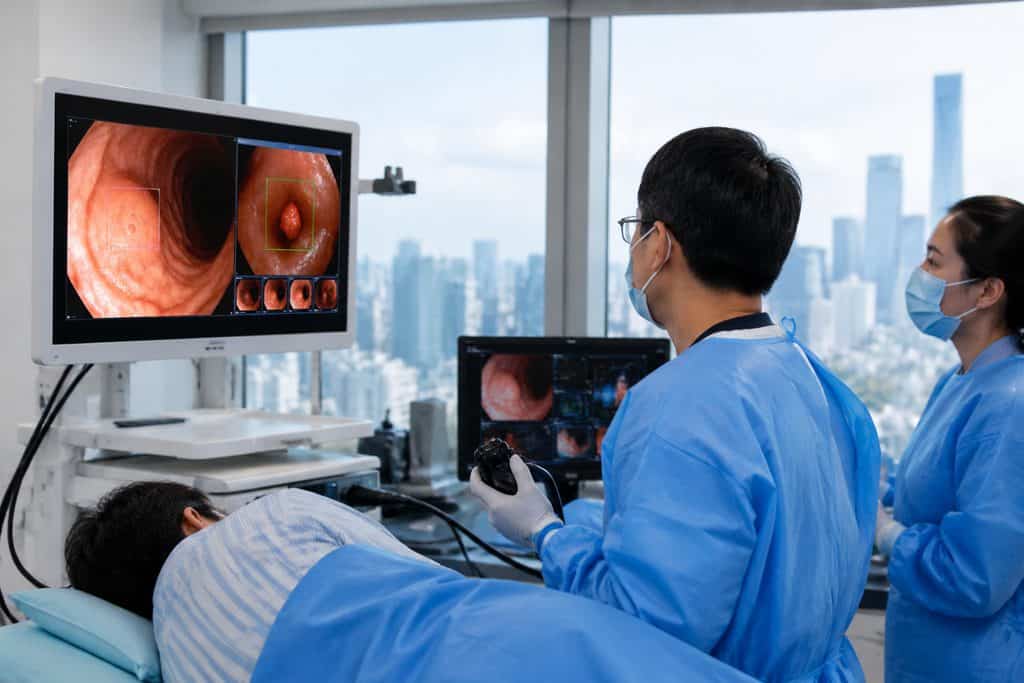
Walk into a procedure room at Ruijin Hospital in Shanghai or West China Hospital in Chengdu, and you will see something that looks like a standard colonoscopy setup. The patient is sedated. The endoscopist navigates the scope. A high-definition screen displays the colon’s interior. But there is a second layer of intelligence watching alongside the doctor. A computer vision system, trained on millions of annotated polyp images, analyzes every video frame in real time.
When the AI detects a suspicious lesion, it draws a bounding box around it on the screen. A soft audio alert sounds. The box is often accompanied by a confidence score. The endoscopist decides whether to ignore it, photograph it, or remove it. The system does not replace the doctor. It acts as a second pair of eyes that never blinks.
Chinese hospitals primarily use two domestically developed AI systems: EndoAngel, developed by researchers at Wuhan University and deployed in over 200 hospitals, and Eagle-Eye, integrated into endoscopy equipment from Chinese manufacturers like SonoScape. Both systems have published validation data in peer-reviewed journals. EndoAngel’s landmark randomized trial, published in The Lancet Gastroenterology & Hepatology in 2020, enrolled over 1,000 patients and demonstrated a significant increase in adenoma detection compared to standard colonoscopy. The absolute gain was roughly 9 percentage points — from 20% to 29% ADR in the AI-assisted group.
That means for every 100 patients screened, AI helped find adenomas in 9 additional people who would have otherwise been told their colon was clean. Nine people who get polyps removed instead of waiting years for a cancer diagnosis.
Is AI-Assisted Colonoscopy More Accurate for Polyps?
The short answer is yes — but with important nuance. AI does not magically see through tissue. It detects what is visible on the screen. The advantage comes from speed and consistency. A human endoscopist must consciously register every fold, every shadow, every subtle color change. After the third procedure of the day, fatigue sets in. After the sixth, subtle lesions blur into background noise.
AI has no such limitation. It processes 25 to 30 frames per second without degradation in performance. A 2022 multicenter study conducted across six Chinese hospitals and published in Clinical Gastroenterology and Hepatology found that AI assistance reduced the polyp miss rate by nearly half compared to standard colonoscopy. The benefit was most pronounced for small, flat adenomas — the kind that are notoriously easy to overlook.
But here is the honest truth. AI also increases false positives. It sometimes flags benign mucosal folds or bubbles as potential polyps. This can lead to unnecessary biopsies. Experienced endoscopists learn to quickly dismiss these false alarms. Less experienced ones may waste time investigating them. The technology is powerful, but it is not infallible. The best results come from pairing a skilled endoscopist with a well-trained AI system — not from relying on either one alone.
Best Hospital for AI Polyp Detection in Shanghai
Shanghai has become a hub for AI-assisted endoscopy. Three institutions stand out for international patients seeking this technology.
Zhongshan Hospital, affiliated with Fudan University, operates one of China’s highest-volume endoscopy centers. The gastroenterology department performs over 100,000 endoscopic procedures annually. They integrated the EndoAngel AI system into their standard colonoscopy workflow in 2021. Their international medical center handles foreign patients and provides English-language coordination. Wait times for screening colonoscopy typically range from one to three weeks, depending on specialist availability.
Ruijin Hospital, affiliated with Shanghai Jiao Tong University School of Medicine, was among the earliest adopters of AI colonoscopy in eastern China. Their endoscopy center participated in several multicenter validation studies. The hospital’s international department offers dedicated patient coordinators who can schedule AI-assisted colonoscopy as part of a comprehensive health screening package.
Renji Hospital, also affiliated with Shanghai Jiao Tong University, houses a digestive disease center that ranks among China’s top 10 for gastroenterology in the Fudan specialty rankings. Their endoscopists have published research on AI polyp characterization — not just detection, but real-time optical diagnosis of polyp histology. This matters because it reduces unnecessary polypectomies for hyperplastic polyps that pose no cancer risk.
For a broader look at hospital rankings and specialties, our top-ranked hospitals database provides detailed profiles organized by city and department.
AI Endoscopy Colonoscopy Cost in China
Let us talk numbers. The ai endoscopy colonoscopy cost China varies by hospital tier, sedation type, and whether the procedure is performed through the standard public channel or the international VIP department. Here is what international patients should expect in 2026.
| Hospital Type | AI Colonoscopy Cost (USD) | Includes | Wait Time |
|---|---|---|---|
| Top-tier public hospital (standard outpatient) | $300 – $500 | Procedure, AI analysis, basic pathology | 2–6 weeks |
| Top-tier public hospital (international VIP) | $600 – $800 | Procedure, AI analysis, pathology, English coordination, expedited scheduling | 1–3 weeks |
| Private international hospital (e.g., United Family, Jiahui) | $800 – $1,500 | Full English service, direct insurance billing, premium facilities | 3–7 days |
These prices are estimates. They vary by hospital and case complexity. For comparison, a standard colonoscopy without AI in the United States averages $2,750, and can exceed $5,000 at some facilities. A screening with AI polyp detection — still rare in the US — costs even more. The structural reasons for China’s lower costs are straightforward: lower physician labor costs, higher procedure volumes that amortize equipment investment, and hospital efficiency that comes from performing thousands of cases monthly.
Lower cost does not mean lower quality. The adenoma detection rates at China’s top endoscopy centers are comparable to or exceed those at major Western institutions. The AI systems are the same technology being validated globally. What you save is not on clinical expertise — it is on the overhead that makes American healthcare so expensive.
Real-Time AI Endoscopy Package Price in China
Several hospitals now offer bundled screening packages for international patients that include AI colonoscopy as part of a broader health assessment. A typical real-time AI endoscopy package price in China ranges from $1,200 to $2,500 and includes:
- Pre-procedure consultation with a gastroenterologist
- Bowel preparation kit and instructions
- AI-assisted colonoscopy with real-time polyp detection
- Simultaneous upper endoscopy (esophagus and stomach examination)
- Pathology report for any removed polyps
- Post-procedure consultation and follow-up plan
- English-language report translation
These packages are designed for medical travelers who want a comprehensive gastrointestinal screening in a single visit. The addition of upper endoscopy is significant — China has one of the highest rates of gastric cancer in the world, and Chinese endoscopists are exceptionally skilled at detecting early gastric lesions that might be overlooked in countries where gastric cancer is less common.
At private international hospitals like Jiahui Health in Shanghai or United Family in Beijing, the package price trends toward the higher end of the range. These facilities offer Western-style environments, direct insurance billing with major international insurers, and English-speaking staff throughout. For patients who prioritize comfort and convenience over cost savings, they are an excellent option. Our private international hospital directory details JCI-accredited facilities with direct billing capabilities.
How to Book AI Colonoscopy Screening in China for Medical Tourism
Planning to book AI colonoscopy screening China medical tourism requires more than picking a hospital and showing up. The process has specific steps that cannot be skipped. Here is the real sequence.
First, you need a specialist consultation. Chinese public hospitals do not allow patients to schedule procedures directly without a physician assessment. This is not bureaucratic obstruction — it is medical necessity. The doctor must review your history, assess your risk factors, and determine whether colonoscopy is appropriate. For international patients, this consultation can sometimes be conducted via video before travel. A video consultation through the hospital’s international department typically costs $100 to $300 and can be arranged within a week.
Second, bowel preparation. This is the part everyone hates, and it is non-negotiable. Chinese hospitals use split-dose polyethylene glycol regimens similar to Western protocols. You will need to be in China at least one full day before the procedure to complete the prep. Your medical companion can help coordinate the timing, diet restrictions, and medication schedule — but you do the drinking.
Third, the procedure itself. AI-assisted colonoscopy at Chinese hospitals typically takes 20 to 40 minutes, depending on whether polyps are found and removed. Sedation is standard — usually propofol administered by an anesthesiologist. You will need someone to escort you back to your accommodation afterward. This is where our bilingual medical companions provide essential support. They stay with you through recovery, translate discharge instructions, and ensure you understand any follow-up requirements.
Fourth, pathology results. If polyps are removed, pathology analysis takes three to seven days. The report will be in Chinese. You need it translated accurately — not just the words, but the clinical meaning. Our team handles this. We work with hospital pathologists to produce English-language reports that your home physician can act on.
For step-by-step guidance on the entire medical travel process, including visa requirements and accommodation planning, visit our patient coordination services page.
What You Need to Know Before Going Alone
We tell every patient the same thing: China’s healthcare system delivers extraordinary clinical value, but it was not built for foreign visitors. Going alone means facing real friction. Here is what catches people off guard.
- Visa Requirements: Medical treatment in China requires an S2 visa with a notation specifying the medical purpose. This is not a tourist visa. You need an invitation letter from the hospital confirming your appointment. Obtaining this letter independently — from outside China, without existing relationships — is genuinely difficult. Hospital international departments are busy. Emails go unanswered. Phone calls hit language barriers. The S2 application also requires documentation of your medical condition and treatment plan. Missing paperwork means visa rejection and a wasted trip.
- Hospital Registration Systems: Chinese public hospitals process thousands of outpatients daily. Registration happens through hospital apps and WeChat mini-programs — platforms that require a Chinese phone number, a local ID, and Mandarin literacy to navigate. Walk-in registration for a specialist consultation is rarely possible. Appointments for top endoscopists fill weeks in advance. Without someone on the ground who understands the system, you are locked out before you start.
- Payment and Insurance: Public hospital international departments require prepayment — typically a deposit that covers the estimated procedure cost. They do not bill international insurance directly. You pay upfront, receive detailed receipts and medical documentation, and file for reimbursement with your insurer afterward. Private international hospitals handle direct billing, but their procedure costs are higher. Either way, you need to understand the financial flow before you arrive. Our team provides clear estimates and helps you prepare the documentation your insurer will require.
How We Help You Navigate This
These barriers are not insurmountable. They are structural features of a system designed for 1.4 billion domestic patients. Our job is to build a bridge across them.
Before you travel, we identify the right hospital for your needs. Not every facility with AI endoscopy is appropriate for every patient. We consider your age, risk factors, prior colonoscopy history, and whether you need additional procedures like upper endoscopy. We contact the hospital’s international department to confirm AI system availability — because equipment gets upgraded, departments move, and what was true six months ago may not be true today. We coordinate the invitation letter for your S2 visa application and advise on documentation requirements.
During your stay, a bilingual medical companion meets you at your accommodation and accompanies you to every appointment. They handle registration, translate conversations with your gastroenterologist, explain bowel preparation instructions in detail, and stay with you through the procedure and recovery. They are not doctors. They are skilled interpreters who know hospital workflows intimately. They make sure nothing gets lost in translation — literally or clinically.
After the procedure, we collect your pathology report, arrange certified English translation, and coordinate any follow-up consultations your home physician may need. If polyps were found, we can schedule a follow-up colonoscopy at the appropriate interval and notify you when it is time to return. The goal is continuity — not a one-off transaction.
For patients who want the highest level of support, our VIP end-to-end coordination service handles every detail from airport pickup to post-procedure recovery accommodation. It is not necessary for everyone. But for those traveling alone, or dealing with complex medical histories, or simply wanting the reassurance of knowing someone competent has thought of everything — it transforms a stressful experience into a smooth one.
Frequently Asked Questions
AI does not outperform the best endoscopists — it narrows the gap between average and excellent. In head-to-head studies, AI-assisted colonoscopy by a mid-career endoscopist achieves adenoma detection rates comparable to expert endoscopists working without AI. For patients, this means the procedure quality is less dependent on which doctor happens to be available that day. The AI acts as a performance floor-raiser. At China’s top hospitals, where endoscopists already perform thousands of procedures annually, AI adds an incremental but meaningful improvement — especially for subtle, flat lesions.
The endoscopist sees the AI alert, examines the flagged area, and makes a clinical judgment. If the lesion appears suspicious, it is removed immediately during the same procedure and sent for pathology. If it appears benign, the doctor may photograph it and note it for follow-up. The AI does not make treatment decisions. It draws attention. The doctor decides. This workflow is identical across Chinese hospitals using AI endoscopy systems — the technology assists, the physician remains fully responsible.
Yes — and many international patients do exactly this. A common combination is AI-assisted colonoscopy plus upper endoscopy under a single sedation session. Some hospitals also offer low-dose CT lung screening, cardiac calcium scoring, and comprehensive blood panels as part of an executive health screening package. These packages typically require two to three days in China and cost between $1,500 and $3,000 total, depending on the hospital and the specific tests included. The efficiency of bundling multiple screenings into one trip is a major reason patients choose China for preventive care.
The preparation regimen is essentially the same — split-dose polyethylene glycol solution, clear liquid diet the day before, nothing by mouth for several hours before the procedure. The brands may differ. Chinese hospitals use locally manufactured formulations that are clinically equivalent to Western products. Your medical companion will provide detailed instructions in English, including exactly when to start drinking, how fast to drink, and what to expect. The experience is unpleasant anywhere in the world. China does not make it worse — or better.
If a removed polyp shows invasive cancer, the pathology report will specify the depth of invasion, grade, and margins. Your gastroenterologist will explain the findings and recommend next steps — which may include additional imaging, endoscopic resection, or surgical referral. Chinese hospitals can usually arrange these follow-up procedures within days, not weeks. If you prefer to return home for treatment, we ensure your pathology slides and reports are prepared for international transfer. You leave with everything your home physician needs to take over your care. We do not abandon patients after a difficult diagnosis.
Your Next Step
AI-assisted colonoscopy in China is not a futuristic promise. It is a present reality, deployed at scale, backed by randomized trial data, and available at a fraction of Western prices. The adenoma detection rate improvement is real. The cost savings are substantial. The logistical complexity is manageable — if you have the right support.
If you are considering a colonoscopy and want the added confidence of real-time AI polyp detection, we can help you understand your options, compare hospitals, and plan a trip that makes sense for your health and your schedule. There is no pressure and no obligation. Start with a conversation. Get the facts. Decide what is right for you. Visit our patient coordination page to learn more.
For more medical information and treatment options in China, visit chinamedservices.com (China Medical Services).
