Cancer Treatment in China: Our Escort Presents Your Case to a Fudan Top Oncology Team
You have probably heard that traveling abroad for cancer care means settling for second-tier medicine. That the real expertise stays in Boston, London, or Heidelberg. The data says otherwise. Fudan University’s Shanghai Cancer Center handles over 1.5 million outpatient visits annually and ranks among China’s top three oncology hospitals in the Fudan Hospital Ranking — the country’s most authoritative hospital evaluation system. The question is not whether the expertise exists. The question is whether you can actually access it.
Cancer Treatment in China for International Patients: The Short Answer
Yes, international patients can receive treatment at Fudan-affiliated oncology centers. But not by emailing the hospital directly. The public outpatient system requires physical presence, Chinese-language navigation, and same-day queueing that starts before dawn. A patient flying in from abroad without local support will hit a wall within the first hour. The workaround is structured proxy access — presenting your case through a medical escort who physically attends the consultation on your behalf, with your full medical dossier translated and organized to Chinese clinical standards. This is not a VIP shortcut. It is the difference between being ignored and being seen.
Fudan’s oncology teams — particularly at Fudan University Shanghai Cancer Center and Zhongshan Hospital Fudan University — consistently place in the national top 10 for oncology in the Fudan specialty reputation rankings. These are not community hospitals with a cancer wing. They are dedicated cancer centers with subspecialty teams for thoracic, gastrointestinal, hepatobiliary, breast, and head-and-neck malignancies. The depth of sub-specialization rivals any Western academic medical center. But the intake process assumes you speak the language and understand the system. You probably do not. That is where an escort changes the equation.
Who This Is Right For — and Who It Isn’t
This pathway works for a specific profile. It is not for everyone. Being honest about that saves time and false hope.
Typically a strong candidate:
- You have a confirmed diagnosis with complete imaging, pathology, and treatment history in English or your native language
- Your case is complex — recurrence, rare mutation, failed first-line therapy — and you want a top-tier second opinion before committing to a treatment direction
- You are considering treatment in China but need to know whether a Fudan oncology team would accept your case before booking flights
- You have the financial flexibility to pay out-of-pocket and seek reimbursement later (most Chinese public hospitals do not direct-bill foreign insurance)
- You recognize that a written second opinion or proxy consultation is a scouting mission, not a treatment guarantee
Probably not a good fit:
- You need emergency intervention and cannot wait 7-14 days for case preparation and proxy attendance
- Your medical records are incomplete, disorganized, or untranslated — the oncology team cannot evaluate what they cannot read
- You expect a fixed-price package with a guaranteed surgery date before any Chinese doctor has reviewed your file
- You are in active clinical decline and cannot travel safely even after a treatment plan is confirmed
This last point matters. A proxy consultation can get you an expert opinion. It cannot get you admitted if the team determines you are not a candidate for their protocols. We would rather tell you that upfront than after you have spent money on flights.
The Options, Compared
International cancer patients considering China face a genuine choice: remote evaluation first, or show up and hope. The table below lays out what each path actually involves.
| Factor | Proxy Consultation (Escort Presents Your Case) | Self-Navigation (You Travel First) | International Patient Department (Hospital-Direct) |
|---|---|---|---|
| Pre-travel case review | Yes — full dossier translation and presentation | None — you arrive with whatever you bring | Limited — intake screening only, not clinical review |
| Language barrier | Eliminated — bilingual escort handles all communication | Full barrier — you navigate registration, pharmacy, billing alone | Partial — English-speaking staff available but not bedside |
| Specialist access | Targeted — we present to the specific oncology subspecialty your case requires | Random — you see whoever is available in general oncology clinic | Variable — depends on department availability and internal referral |
| Typical timeline to opinion | 7-14 days after receiving complete records | Unknown — could be days or weeks of trial and error | 2-4 weeks for appointment scheduling |
| Cost of evaluation phase | Written second opinion from $300; proxy consultation coordination from $800 | Flights, hotel, local transport, plus hospital fees — easily $3,000+ before any treatment | Consultation fees at international department rates, typically $100-300 |
| Risk of wasted travel | Near zero — you know the team’s view before booking flights | High — if the team declines your case, you flew for nothing | Moderate — you may still be referred elsewhere after assessment |
The proxy consultation column is not the cheapest option in absolute terms. But it is the cheapest way to get a definitive answer from a Fudan oncology team before committing to international travel. For patients weighing a $15,000 treatment against a $5,000 evaluation trip that may yield nothing, the math is straightforward.
How an Escort Presents Your Case to a Fudan Oncology Team
This is the part most patients misunderstand. The escort does not simply hand over a file at the registration desk and hope for the best.
The process starts with document triage. Your existing records — pathology reports, imaging CDs, treatment summaries, genetic testing results — arrive as a mix of PDFs, DICOM files, and handwritten physician notes. Before any Chinese oncologist sees them, they must be organized into the format Chinese specialists expect: chronological treatment timeline, key lab values in SI units with reference ranges, imaging findings summarized in Chinese medical terminology, and a clear articulation of the clinical question you want answered. This is not translation in the linguistic sense. It is translation between two clinical cultures that organize information differently.
Then comes hospital registration. Fudan-affiliated hospitals use centralized patient ID systems. Creating a medical record for a foreign patient requires passport verification, a local contact number, and often an in-person visit to a specific registration window that opens at 7:00 AM. The escort handles this before any consultation happens.
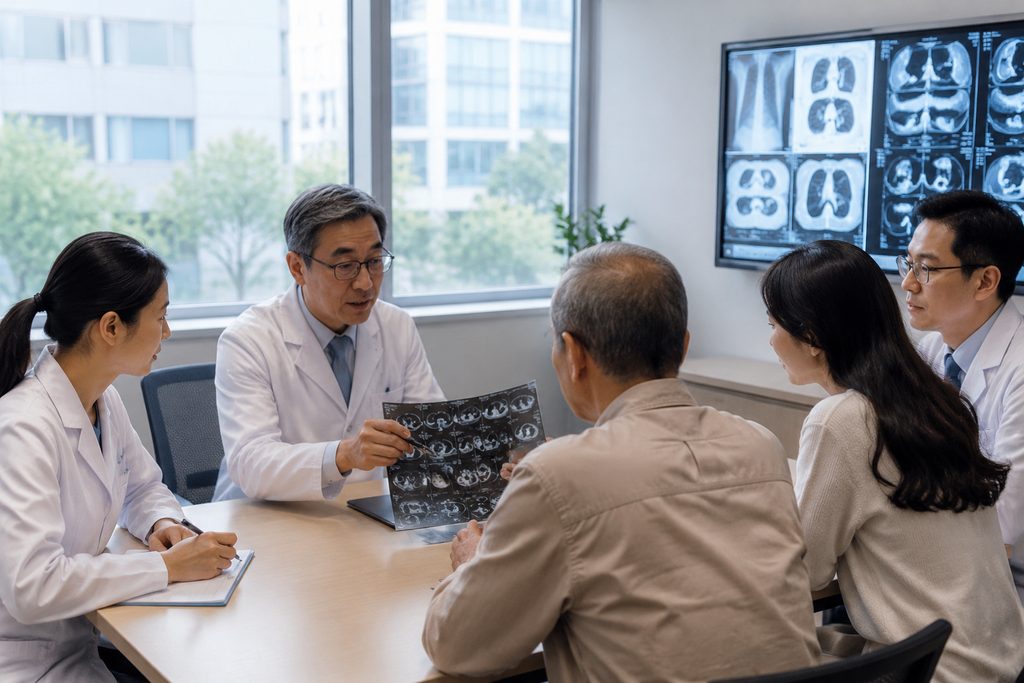
The consultation itself is the critical moment. The escort sits with the oncologist — not as a passive translator, but as a clinical communicator who understands both the patient’s treatment history and the questions the oncology team needs answered to make a decision. Is the patient a surgical candidate? Would they qualify for a specific immunotherapy trial? Is the tumor board likely to recommend neoadjuvant chemotherapy before considering resection? These are not questions a general interpreter can facilitate. They require someone who has presented oncology cases before and knows what the doctor needs to hear.
After the consultation, the escort produces a structured report: the oncologist’s assessment, recommended next steps, whether the team would accept the patient for treatment, estimated timeline and cost range, and what additional testing would be required upon arrival. This is what you receive — not a vague “the doctor thinks you should come,” but a document you can take to your home oncologist for discussion.
This is fundamentally different from the department-based search tools that tell you which hospital ranks highly. Rankings are a starting point. Getting a specific oncologist to review your specific case is the endpoint. The escort bridges that gap.
Cancer Treatment Cost China: What the Numbers Actually Look Like
The sequence that works: remote case review first, proxy consultation second, travel only after a treatment plan is confirmed. Do not reverse this. Patients who fly to Shanghai hoping to walk into Fudan University Shanghai Cancer Center and see an oncologist that week are doing it wrong. The hospital sees thousands of patients daily. You are one more face in the crowd unless someone has already presented your case and secured a specific consultation. The how to get cancer treatment in China as foreigner question has a clear answer, but it is not the answer most patients expect — it starts from home, not from the airport.
This happens. It is not a failure of the process — it is the process working. A negative answer from a top-tier oncology team is valuable information. It tells you that traveling to China for this specific treatment is not the right move, and it saves you the far greater cost and emotional toll of discovering that after arrival. In some cases, the team may recommend an alternative — a different Fudan subspecialty, a clinical trial at another center, or a treatment approach you had not considered. In other cases, the answer is simply that your best option remains with your home oncology team. We deliver that answer honestly. Our role is not to sell you on China. It is to get you an expert opinion you can trust.
No. A medical tourism agent typically sells packages — fixed-price bundles that include hospital selection, treatment, accommodation, and sometimes tourism activities. Their incentive is to get you to book. A medical escort is a case coordinator who presents your clinical information to the hospital, facilitates the consultation, and handles logistics only after a clinical decision has been made. We do not sell treatment packages. We do not receive commissions from hospitals. We coordinate access. The distinction matters because it determines whose interests are being served.
Your Next Step
You now know what the cancer treatment cost China landscape looks like, how a Fudan oncology team can be accessed, and why a proxy consultation is the lowest-risk way to start. The next step is not a commitment. It is a conversation.
Our team at China Medical Services coordinates case presentation to Fudan-affiliated oncology departments. We are not a hospital. We do not diagnose, treat, or make clinical recommendations. What we do is handle the part that stops most international patients before they start: getting your case in front of the right oncologist, in the right format, with someone in the room who can advocate for your questions. If the team says yes, we can coordinate every logistical step from visa guidance to discharge. If they say no, you have an honest answer and a clear path forward — without having spent a fortune to get it.
Start with a free consultation. Tell us your diagnosis, what you have tried, and what you are hoping to find in China. We will tell you honestly whether a Fudan oncology review makes sense for your case. No
Frequently Asked Questions
Yes. The hospitals used for international patients are JCI-accredited and follow the same international safety standards as top hospitals in the US and Europe. Surgical teams perform high volumes of procedures — often more than their Western counterparts — which studies show leads to better outcomes.
Costs vary by procedure and hospital, but international patients typically save 40-80% compared to US prices — even when factoring in travel and accommodation. A consultation with our team will give you an exact, all-inclusive quote with no hidden fees.
Send us your existing medical reports to get started. We handle everything from hospital selection and appointment scheduling to visa assistance and post-operative recovery planning. Your medical records are reviewed by the specialist before you even book a flight.
For more medical information and treatment options in China, visit chinamedservices.com (China Medical Services).
