Bone Graft Recovery in China: Post-Op Companion and Hotel Support
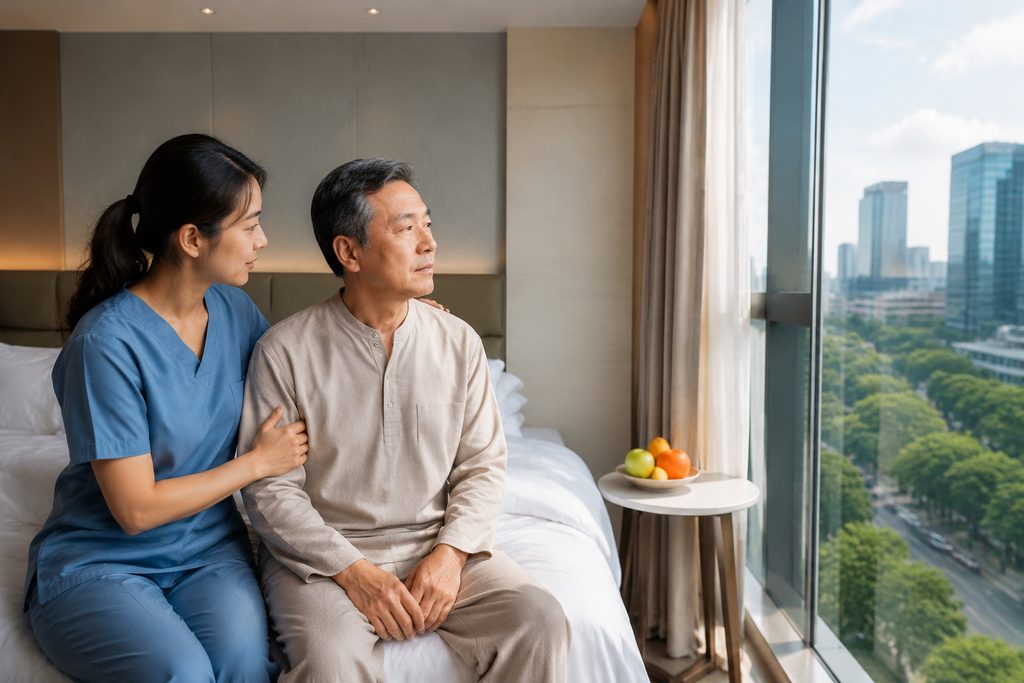
Have you just been told you need a bone graft and now you’re staring at a calendar, wondering how you’ll manage weeks of recovery in a foreign country? The thought of navigating dental or orthopedic surgery in China — then sitting alone in a hotel room with a swollen jaw or a healing leg — is enough to make anyone hesitate. But here’s the reality: thousands of international patients do this every year, and with the right support structure, it’s far more manageable than you might think.
What most people don’t realize is that bone graft surgery cost China runs significantly lower than in the United States or Western Europe — often 60% to 80% less — while the clinical quality at top-tier institutions matches international standards. The real challenge isn’t the surgery itself. It’s the days and weeks after: who translates for you at follow-up appointments, who brings you food when you can’t chew, who calls the hospital if something feels wrong at 2 a.m. That’s where post-op companion and hotel support becomes the difference between a stressful ordeal and a structured recovery.
How This Actually Works, Step by Step
You don’t just book a flight and show up. The sequence matters, and knowing it upfront saves you weeks of confusion.
First, you send your existing imaging — X-rays, CT scans, or a recent dental panoramic — along with your doctor’s notes. Our team translates these documents into Chinese and forwards them to the relevant specialty department at a hospital matched to your case. A written second opinion typically comes back within 5 to 10 business days. That opinion tells you whether a graft is actually necessary, what material would be used, and what the proposed timeline looks like. Written second opinions run from $300 to $500 and are for reference only, not a prescription.
If you want to speak directly with the Chinese medical team before committing to travel, a video consultation costs between $100 and $300 for a standard international department specialist, or $500 to $800 for a top-ranked expert. Any consultation fee is credited in full toward on-the-ground coordination if you proceed within 90 days.
Once you decide to move forward, we coordinate the hospital appointment, help you apply for the S2 visa with supporting documents from the hospital, and arrange your arrival logistics. You land, you attend your pre-op consultation, and surgery is scheduled. After the procedure, this is where the companion service takes over — someone physically present to handle every interaction you’re too tired or too medicated to manage yourself.
What Bone Graft Recovery Actually Looks Like in Shanghai
Let’s be specific, because vague advice is useless when you’re in pain. A dental bone graft — the most common type international patients seek in China — typically involves placing donor or synthetic bone material into the jaw to rebuild volume before an implant. The procedure itself takes 45 minutes to 2 hours under local anesthesia. You walk out the same day.
The first 48 hours are the hardest. Swelling peaks around day 2 or 3. You’ll need soft foods — congee, yogurt, blended soups — and you won’t want to talk much. If you had a larger graft, like a sinus lift or a block graft from your own chin or hip, recovery stretches longer and pain management becomes more involved. Orthopedic bone grafts, used for fractures or spinal fusion, are a different category entirely: those can mean days in the hospital and weeks of limited mobility.
Shanghai and Beijing both have extensive networks of hotels adjacent to major hospital districts. But proximity isn’t the only factor. You need a room with a refrigerator for medications, a bathtub or walk-in shower if mobility is limited, and ideally a front desk that can communicate with your companion. The search term hotel recovery after dental surgery Shanghai reflects a real concern: you don’t want to be in a cramped budget room on the 18th floor of a building with a broken elevator when you can barely stand.
Most patients book serviced apartments or mid-range international hotels — think $80 to $150 per night — within a 15-minute taxi ride of the hospital. Your companion coordinates the booking, confirms the room setup, and makes sure the front desk has your emergency contact on file.
A Realistic Timeline
Here’s the timeline nobody tells you about — the one that includes the waiting you don’t anticipate.
| Stage | What Happens | Duration |
|---|---|---|
| Remote evaluation | Send records, receive written second opinion or video consult | 1–2 weeks |
| Decision and scheduling | Confirm hospital, agree on date, arrange S2 visa | 2–4 weeks (visa processing varies by consulate) |
| Travel and pre-op | Arrive in China, in-person consultation, pre-op tests | 2–4 days |
| Surgery day | Graft procedure (dental: outpatient; orthopedic: inpatient) | 1 day |
| Acute recovery | Swelling, pain management, soft diet, follow-up visit | 5–10 days |
| Observation and clearance | Surgeon confirms graft stability, clears you to fly | Day 7–14 post-op |
| Full integration | Graft fuses with existing bone (dental: before implant; orthopedic: months) | 3–6 months |
Notice the gap between “surgery day” and “clearance to fly.” Many patients assume they can leave after 3 days. For a straightforward dental graft, some surgeons will clear you at day 5. For anything involving the sinus cavity or a larger autograft, plan on 10 to 14 days. The question can I fly after bone graft surgery doesn’t have a single answer — it depends on graft size, location, and whether you developed any complications. Pressurized cabins can cause discomfort in freshly grafted sinus areas. Most surgeons want you grounded for at least a week.
What Can Go Wrong — and What Happens Then
Let’s be honest about failure modes, because pretending they don’t exist helps no one.
Infection is the most common complication, occurring in roughly 2% to 5% of dental bone grafts depending on the study and patient population. Signs include fever, increasing pain after day 4, or pus at the site. If this happens, you need antibiotics — possibly intravenous — and a follow-up with the surgeon within 24 hours. Your companion calls the hospital, arranges the visit, and accompanies you. Without that support, you’re trying to explain “my jaw hurts more than it should” through a translation app while running a fever.
Graft failure happens when the body rejects or resorbs the material. For dental grafts, published failure rates range from 5% to 15% depending on graft type and site. If the graft fails, you’re looking at a repeat procedure — sometimes months later, after the site heals. This is why choosing a hospital with real experience in your specific graft type matters more than choosing the cheapest option.
What if you need to extend your stay? Your S2 visa allows a specific duration. Extensions are handled at the local Exit-Entry Administration bureau, and your companion can assist with the paperwork. It’s bureaucratic but routine.
And what about payment? Public hospitals in China require prepayment for procedures. International departments often accept major credit cards, but many still operate on a deposit system. Budget for the procedure, hospital stay if applicable, medications, hotel, and companion fees. A medical tourism package bone graft China typically bundles several of these elements, but read the fine print: not all packages include post-op companion time, and that’s the part you’ll actually need.
How Long Does a Bone Graft Take to Heal — and What That Means for Planning
The question how long does bone graft take to heal gets asked constantly, and the honest answer frustrates people: it depends. But here are the ranges that actually matter for planning.
For a dental socket preservation graft — done immediately after an extraction — the site is clinically stable in 2 to 3 weeks, but full integration takes 3 to 4 months. That’s when an implant can be placed. For a sinus lift, expect 4 to 9 months before implant placement. For a larger block graft, 4 to 6 months is standard. Orthopedic grafts used in spinal fusion can take 6 to 12 months to fully incorporate.
This creates a strategic decision point. If you’re traveling to China for a dental implant that requires a graft first, you have two options: do the graft and implant in one trip if the surgeon determines immediate or early implant placement is viable, or do the graft, fly home, and return months later for the implant. The second option means two trips, two visa applications, and double the logistics. But it’s sometimes clinically necessary. A video consultation before you travel helps clarify which path applies to your case.
Dental bone graft price Shanghai varies by hospital tier and graft material. Synthetic graft material runs lower; autograft from your own bone costs more because it involves a second surgical site. At top public hospital international departments, a straightforward dental graft might run $800 to $2,500. A sinus lift or block graft can reach $3,000 to $5,000. Private international hospitals like those listed on our private hospital directory charge more — often $4,000 to $8,000 — but offer English-speaking staff throughout and direct insurance billing. Compare this to U.S. prices where a dental bone graft alone averages $2,000 to $5,000 and a sinus lift can hit $8,000 to $12,000.
For orthopedic bone grafts, the cost gap widens further. A spinal fusion with bone graft in the U.S. can exceed $100,000. At top Chinese orthopedic centers, equivalent procedures run $20,000 to $40,000. The specialty department rankings page shows which hospitals lead in orthopedics and oral-maxillofacial surgery based on the Fudan specialty reputation rankings.
Practical Considerations: Records, Visa, Payment, and Follow-Up
Your medical records need to be in order before anything else happens. Digital copies of X-rays or CT scans in DICOM format, a written summary from your current doctor, and a list of medications and allergies. If you’ve had previous grafts or implants, include those records too — scar tissue and prior failures change the surgical plan.
The S2 visa is the correct category for medical treatment and private affairs. Your accompanying family member applies for their own S2. Processing times run 4 to 15 business days depending on your consulate. The hospital provides an invitation letter and treatment confirmation as supporting documents. We guide you through this, but approval is always at the consulate’s discretion.
Payment: public hospital international departments typically require a deposit before admission or surgery. Private international hospitals may bill insurance directly. If you’re using insurance, confirm coverage for overseas procedures before you book — many policies exclude elective dental work abroad or require pre-authorization.
Language: even at top hospitals, the main outpatient floors operate in Chinese. The international department is different — staff there speak English — but once you’re discharged and recovering in a hotel, you’re on your own. Unless you have a companion. That’s the service that fills the gap: someone who checks on you daily, coordinates meals, arranges transportation to follow-ups, and communicates with the hospital if complications arise. Bilingual medical companion service starts from $300 per day, with half-day and full-day options.
Follow-up at home: before you leave China, get a written discharge summary in English, copies of all imaging on a USB drive, and a clear list of warning signs that would require immediate attention. Your home dentist or orthopedic surgeon should review everything within 2 weeks of your return.
Frequently Asked Questions
Plan for 7 to 14 days. The minimum most surgeons require before flying is 5 to 7 days for a simple graft, but sinus lifts and larger grafts need 10 to 14 days of observation. Your surgeon makes the final call at your follow-up visit.
Yes, but not immediately. Cabin pressure changes can cause pain in freshly grafted sinus areas and increase swelling. Most surgeons want you to wait at least 5 to 7 days, and longer for sinus lifts. Always get written clearance from your surgeon before booking your return flight.
A bilingual companion handles logistics you can’t manage while recovering: arranging follow-up appointments, translating during consultations, picking up prescriptions, coordinating hotel requests, ordering appropriate food, and contacting the hospital if something feels wrong. They don’t provide medical care — they bridge the language and navigation gap.
At top-ranked hospitals, yes. China’s leading dental and orthopedic departments perform thousands of graft procedures annually, and many are ranked among the country’s top 10 in their specialty by the Fudan reputation rankings. The key is choosing a hospital with documented experience in your specific graft type, not just any hospital.
A realistic budget for a dental bone graft in Shanghai: $1,000 to $3,000 for the procedure at a public hospital international department, $1,000 to $2,000 for 10 nights of hotel, $1,500 to $3,000 for companion support, plus flights and food. Total: roughly $5,000 to $9,000. Orthopedic grafts cost significantly more due to inpatient stays.
Your Next Step
Bone graft recovery in China doesn’t have to be a solo endurance test. The surgery itself is the easy part for the hospital; the recovery is where structure matters. Our team at China Medical Services coordinates the full arc — hospital matching, record translation, appointment scheduling, visa documentation, and on-the-ground companion support. We don’t perform medical procedures and we don’t guarantee clinical outcomes. What we do is make sure you’re never alone in a foreign hospital system, trying to figure things out through a translation app. If you’re considering a bone graft in China, start with a free consultation to discuss your case and what a realistic plan would look like.
For more medical information and treatment options in China, visit chinamedservices.com (China Medical Services).
