Moxibustion in China: How We Arrange Your TCM Therapy
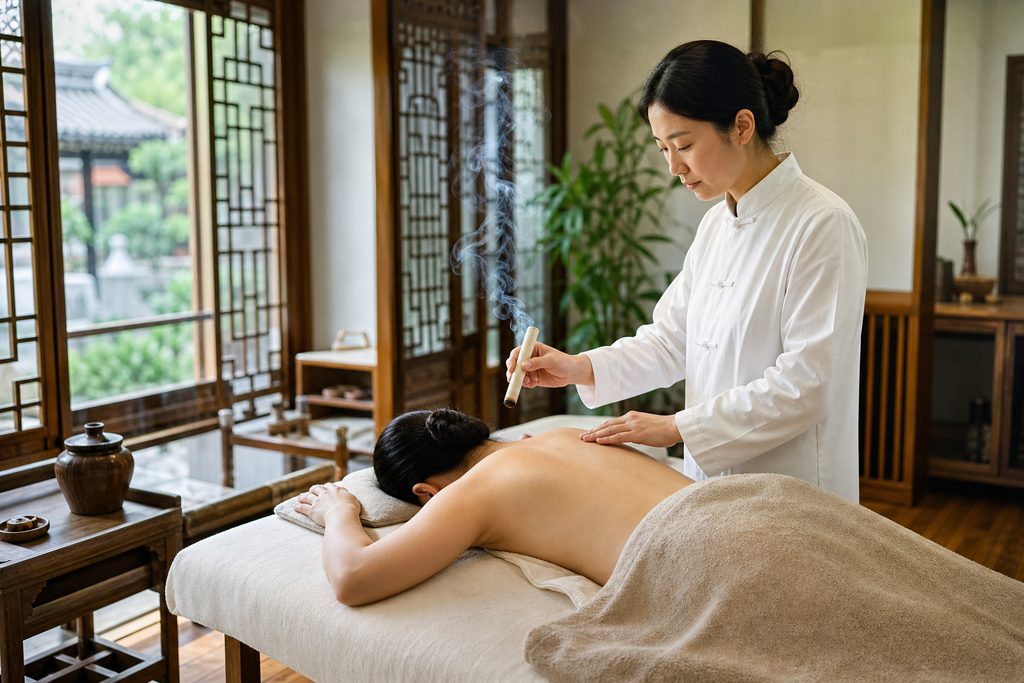
You have probably heard that traditional Chinese medicine in China is either a tourist gimmick or an unregulated gamble. The reality is different. Moxibustion is a structured, hospital-delivered therapy in China, practiced alongside conventional oncology, orthopedics, and gynecology in the same buildings where MRI scans and lab tests happen. The practical question for most international patients is not whether moxibustion exists. It is how to access the legitimate version, what the moxibustion therapy cost China actually looks like, and who coordinates the logistics when you do not speak Mandarin.
Our team at China Medical Services has walked through this process with patients from the United States, the Gulf states, and Europe. What we have learned is that the gap between expectation and reality is almost always about coordination, not medicine. This article explains what moxibustion is, how it works in a Chinese hospital setting, what it costs, what can go wrong, and how a staged approach reduces unnecessary travel.
How This Actually Works, Step by Step
You do not fly to Shanghai, walk into a hospital, and ask for moxibustion. The process is more deliberate. Here is the sequence we use with patients who want moxibustion as part of a broader TCM treatment plan.
First, you send us whatever medical records you have. Discharge summaries, imaging reports, current medication lists, lab results. If your goal is pain management for knee osteoarthritis, we need the orthopedic notes. If it is chemotherapy-related fatigue, we need the oncology summary. Translation into Chinese is handled by our team before anything goes to a hospital department.
Second, we identify which hospital and department fits. Moxibustion is delivered through acupuncture and moxibustion departments, rehabilitation medicine units, or TCM oncology wards depending on the condition. The TCM hospital network we work with includes both dedicated traditional medicine hospitals and integrated departments inside top general hospitals.
Third, a written second opinion or video consultation happens before you travel. The Chinese physician reviews your case and tells us whether moxibustion is appropriate, what frequency they recommend, and what adjunct therapies make sense. This step costs between $100 and $800 depending on the seniority of the specialist and whether it is written or video. That fee is credited in full toward on-the-ground coordination if you proceed within 90 days.
Fourth, you travel. Our bilingual medical companion meets you at the hospital, handles registration, queues, payment, and translation. You receive treatment. Follow-up sessions are scheduled before you leave, or you return home with a written plan your local acupuncturist can follow.
Moxibustion Therapy Cost China: What the Numbers Actually Show
Let us talk about the moxibustion therapy cost China patients actually pay. Prices vary by city, hospital tier, and whether you use the standard public channel or the international VIP department. But the ranges are consistent enough to plan around.
| Service | China (USD) | United States (USD) | United Kingdom (USD) |
|---|---|---|---|
| Single moxibustion session (outpatient) | $15–40 | $60–120 | $50–90 |
| Moxibustion + acupuncture package (10 sessions) | $150–400 | $600–1,200 | $500–900 |
| Initial TCM specialist consultation | $30–100 | $120–250 | $100–200 |
| Written second opinion (top hospital) | $300–500 | $500–1,500 | $400–1,200 |
| Bilingual medical companion (full day) | from $300 | N/A | N/A |
The moxibustion therapy cost China comparison holds up across most conditions. A ten-session course for chronic low back pain in Shanghai’s public TCM hospitals runs roughly $150 to $400. The same course at a private acupuncture clinic in Boston or London typically exceeds $600. That price difference is real, but it is not the whole story. The bigger advantage is integration. In China, your moxibustion therapist can walk your file to the radiology department for a same-day MRI if something looks wrong. That does not happen in a Western strip-mall acupuncture clinic.
Prices are quoted as ranges because hospital grade and case complexity shift the final number. International VIP departments at top-tier hospitals charge 1.5 to 2 times the standard outpatient rate. You pay for English-speaking staff, shorter queues, and appointment scheduling that does not require lining up at dawn.
How Does Moxibustion Work in China? The Hospital Reality
Moxibustion involves burning dried mugwort — Artemisia vulgaris — near specific acupuncture points or along meridians. The heat penetrates tissue. The smoke contains volatile compounds that some studies suggest modulate inflammatory markers. In Chinese hospitals, moxibustion is rarely a standalone therapy. It is bundled with acupuncture, cupping, herbal decoctions, and physiotherapy depending on the diagnosis.
How does moxibustion work in China differently from abroad? Three things stand out. First, diagnosis is formalized. A TCM physician in a Chinese hospital conducts tongue and pulse examination, reviews your Western lab work, and writes a treatment plan that documents which points will be warmed, for how long, and at what frequency. Second, treatment is standardized. Moxa sticks, moxa boxes, and indirect moxibustion with ginger or salt barriers are selected based on the condition, not practitioner whim. Third, outcomes are tracked. Top TCM departments record symptom scores before and after treatment courses. You can ask to see your own progress notes.
Common indications include knee osteoarthritis, dysmenorrhea, breech presentation in late pregnancy, chemotherapy-related leukopenia, and digestive disorders like irritable bowel syndrome. The evidence base is uneven across these conditions. Some, like moxibustion for breech version, have been studied in randomized trials with mixed results. Others rely more on clinical tradition than controlled data. A responsible Chinese physician will tell you which is which. So will we.
A Realistic Timeline
People underestimate the calendar. Here is what a typical moxibustion treatment journey looks like from first contact to first session.
| Stage | What Happens | Typical Duration |
|---|---|---|
| Days 1–3 | You send medical records; we review and translate | 2–3 days |
| Days 4–10 | Hospital and department matching; written second opinion requested | 5–7 days |
| Days 11–20 | Video consultation with TCM specialist if needed | 7–10 days |
| Days 21–40 | S2 visa application with hospital invitation letter | 2–3 weeks |
| Days 41–50 | Travel to China; first in-person consultation | 2–3 days after arrival |
| Days 51–70 | Treatment course (10 sessions over 2–3 weeks) | 14–21 days |
| Day 71+ | Discharge summary, home care plan, follow-up video call | Within 1 month |
The S2 visa is the correct category for short-term medical treatment and private affairs in China. It requires supporting documents from the receiving hospital, which we help arrange. Approval times vary by consulate and your nationality. Plan for at least two to three weeks. Rushing this step is the most common mistake we see.
And remember: standard public outpatient departments do not allow overseas advance booking. You cannot email a top TCM hospital from New York and lock in a Tuesday appointment. The international VIP channel is the workaround, and it costs more. That is not a loophole. It is how the system is structured.
What Can Go Wrong — and What Happens Then
Moxibustion is generally safe, but it is not risk-free. Burns happen. Usually minor, occasionally serious. A 2015 systematic review in the Journal of Acupuncture and Meridian Studies documented adverse events including superficial burns, blistering, and in rare cases, infection at treatment sites. The risk rises with direct moxibustion, where the moxa cone is placed directly on the skin and allowed to burn down. Most Chinese hospitals now use indirect methods precisely to avoid this.
What if you get burned during a session? In a Chinese hospital, the treating department handles it. The wound is dressed, documented, and follow-up is scheduled. If you are at a private clinic without hospital affiliation, you are more exposed. This is why we steer patients toward hospital-based TCM departments, not standalone wellness centers. The institutional accountability matters.
Another failure mode: the treatment does not work. Chronic pain does not always respond. Breech babies sometimes stay breech. A responsible TCM physician will reassess after five or six sessions and tell you if continuing makes sense. If you paid for a package of ten sessions and stop at six, hospital policy determines refunds. Some departments refund unused sessions. Some do not. We clarify this before you commit money.
Language failure is the most preventable problem. A patient who does not speak Mandarin can easily misunderstand treatment instructions, herbal contraindications, or post-treatment care. Our bilingual medical companion exists for exactly this reason. It is a labor cost, not a medical fee, and it is priced accordingly.
Is Moxibustion Safe Traditional Chinese Medicine? What the Evidence Says
Is moxibustion safe traditional Chinese medicine? The honest answer is: mostly, with caveats. The World Health Organization has recognized acupuncture as a therapeutic modality, and moxibustion is often delivered alongside it in Chinese hospitals. But safety depends on technique, practitioner training, and patient selection.
Contraindications include pregnancy in certain points, open wounds, skin infections, and patients with reduced sensation due to diabetic neuropathy. If you cannot feel heat accurately, you cannot tell when the moxa is too close. A trained practitioner screens for this. A rushed one might not.
Smoke exposure is a separate concern. Moxa smoke contains particulate matter and volatile organic compounds. Some studies have raised questions about respiratory effects for practitioners who work with moxa daily for years. For patients receiving short courses, the exposure is minimal. But if you have asthma or COPD, mention it during the video consultation. The physician can use smokeless moxa or a ventilation setup.
The evidence for efficacy is condition-specific. For knee osteoarthritis, a 2021 meta-analysis in Evidence-Based Complementary and Alternative Medicine found moxibustion plus conventional care outperformed conventional care alone for pain reduction. For breech presentation, the evidence is weaker and results are inconsistent. For cancer-related fatigue, preliminary studies show promise but sample sizes are small. We present this range honestly because patients deserve to know what they are buying.
Book Moxibustion Treatment Package China: How to Evaluate Your Options
Yes. The S2 visa is the correct category for short-term medical treatment and private affairs. It requires supporting documents from the receiving hospital. Processing typically takes two to three weeks. Family members accompanying you also apply for S2 visas. The M visa is for commercial and trade activities and is not appropriate for medical travel.
Moxibustion is not painful when performed with indirect techniques. You feel warmth, not burning. The main risks are superficial burns and blistering, which occur more often with direct moxibustion. In hospital-based TCM departments, indirect methods are standard and adverse events are documented and managed on site. Patients with diabetic neuropathy, open wounds, or respiratory conditions should discuss these with the physician before treatment.
Standard public outpatient departments do not allow overseas advance booking. You can arrange advance booking through a hospital’s international VIP department or with a coordination service that works through official hospital channels. A written second opinion or video consultation before travel is the recommended first step. It confirms that moxibustion is appropriate for your condition before you commit to travel.
Most treatment courses in Chinese hospitals run eight to twelve sessions over two to four weeks for chronic conditions. Acute conditions may require fewer. The exact number depends on the physician’s assessment after reviewing your records and, ideally, after an in-person consultation. A responsible physician will reassess progress midway through the course and adjust the plan if needed.
Your Next Step
Moxibustion in China is a legitimate, hospital-delivered therapy with real evidence for specific conditions and honest limitations for others. The difference between a good outcome and a frustrating trip is almost always coordination: the right hospital, the right department, the right diagnosis before you fly, and a translator at your side when you arrive.
We are China Medical Services. We match international patients with top-tier Chinese hospitals, coordinate written second opinions and video consultations, arrange bilingual medical companions, and guide you through the S2 visa process. We do not practice medicine, and we do not promise treatment outcomes. What we do is make the system navigable.
Frequently Asked Questions
Yes. The hospitals used for international patients are JCI-accredited and follow the same international safety standards as top hospitals in the US and Europe. Surgical teams perform high volumes of procedures — often more than their Western counterparts — which studies show leads to better outcomes.
Costs vary by procedure and hospital, but international patients typically save 40-80% compared to US prices — even when factoring in travel and accommodation. A consultation with our team will give you an exact, all-inclusive quote with no hidden fees.
Send us your existing medical reports to get started. We handle everything from hospital selection and appointment scheduling to visa assistance and post-operative recovery planning. Your medical records are reviewed by the specialist before you even book a flight.
For more medical information and treatment options in China, visit chinamedservices.com (China Medical Services).
