Gua Sha Therapy in China: Costs, Safety, and How to Book a TCM Session
Gua Sha Therapy in China: The Short Answer
While a single gua sha session at a licensed clinic in Manhattan can run $120–$180, the same treatment at a top-tier TCM hospital in Beijing or Shanghai typically costs between $15 and $80. That’s the headline number most people search for. The full picture is more layered. The gua sha therapy cost China patients actually pay depends on where you go, who performs the treatment, and whether it’s part of a broader TCM package.
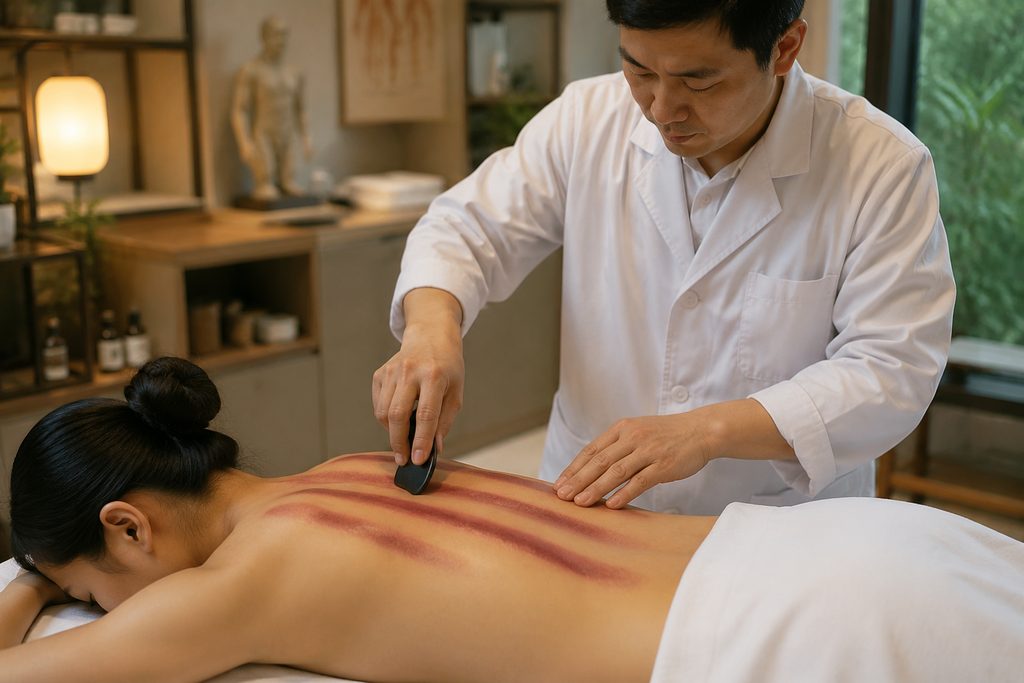
Gua sha — sometimes called scraping or coining — involves pressing a smooth-edged tool across oiled skin to raise petechiae, the red or purple marks that signal increased microcirculation. It’s used for chronic pain, muscle tension, respiratory complaints, and what TCM practitioners describe as “stagnation.” Western medicine has begun to study it too. A 2019 systematic review in Complementary Therapies in Medicine found moderate evidence for gua sha reducing chronic neck and back pain. But “moderate evidence” is not the same as settled science. Anyone considering the treatment should understand both what it can do and what it cannot.
Our team at China Medical Services has helped patients from Europe, the Middle East, and North America arrange TCM care across our network of 340+ top-ranked hospitals in 37 cities. This guide covers what gua sha actually costs in China, where to get it, whether it’s safe, and how to book a session without getting lost in the system.
Who Gua Sha Is Right For — and Who It Isn’t
Gua sha suits a specific profile. Chronic muscle tension, persistent neck or shoulder stiffness, tension headaches, and post-exercise soreness are the most common reasons patients seek it. TCM practitioners also use it for early-stage cold symptoms and what they call “wind-cold invasion.” Many of our clients combine gua sha with acupuncture or tuina massage as part of a broader rehabilitation or wellness plan.
A typical good candidate:
- Has chronic soft-tissue pain that hasn’t responded fully to rest or physical therapy
- Is interested in TCM and comfortable with visible skin marks lasting 3–7 days
- Has no bleeding disorder, is not on high-dose anticoagulants, and has no active skin infection in the treatment area
- Understands gua sha is a complementary therapy, not a replacement for medical diagnosis
Who should skip it:
- Anyone on warfarin, heparin, or other anticoagulants — the scraping can cause excessive bruising
- People with hemophilia, thrombocytopenia, or other bleeding disorders
- Patients with open wounds, burns, sunburn, or active eczema in the treatment zone
- Pregnant women, particularly in the lower back and abdomen — most responsible TCM hospitals will decline this
- Anyone with a deep vein thrombosis or known blood clot risk
If you’re unsure, a licensed TCM physician should evaluate you before any scraping begins. Reputable hospitals in China do this as standard practice. Walk-in massage parlors often do not.
The Options, Compared
Not all gua sha is equal. The setting matters enormously — for price, for safety, and for what you actually get. Here’s how the main options stack up for international patients.
| Setting | Typical Cost per Session | Practitioner | Language Support | Best For |
|---|---|---|---|---|
| Top-tier public TCM hospital (e.g., Beijing, Shanghai) | $15–$40 | Licensed TCM physician | Limited; companion recommended | Medical-grade treatment, complex cases |
| Private international clinic (e.g., United Family, Jiahui) | $60–$150 | Licensed TCM physician or trained therapist | English-speaking staff | Convenience, insurance billing |
| Local TCM clinic or community health center | $8–$20 | Varies — may be physician or technician | Minimal | Budget option, Mandarin speakers |
| Hotel spa or wellness center | $40–$100 | Spa therapist, often not medically licensed | Usually English available | Relaxation, not medical treatment |
The public TCM hospital route offers the best clinical value but demands the most navigation. The private international clinic route costs more but removes friction. The spa route is fine for relaxation but should not be confused with medical treatment. If you have a specific pain complaint, choose the first two columns. If you just want the experience, the fourth is acceptable.
Best TCM Hospital for Gua Sha in Beijing and Shanghai
The question we hear most often is where to go. The answer depends on whether you prioritize clinical authority or convenience.
For clinical depth, Beijing’s public TCM hospitals anchor the field. The capital hosts 21 of the Fudan-ranked top 100 hospitals — the highest concentration in China. Among TCM institutions, the leading names are long-established, research-heavy centers where gua sha is typically delivered as part of a comprehensive treatment plan rather than a standalone service. You can browse our TCM hospital directory for profiles, specialties, and practical details. Shanghai follows closely with 18 top-100 hospitals and a strong TCM tradition of its own. Patients often ask specifically about how much does gua sha cost in Shanghai — the answer is roughly $20–$50 at public TCM hospitals, with private international clinics charging $70–$140.
What these hospitals share: gua sha is performed by physicians trained in the full TCM diagnostic framework. They will ask about your tongue, your pulse, your sleep, your digestion. The scraping is one piece of a larger assessment. That’s a feature, not a bug — but it means you should budget 40–60 minutes for a first visit, not 15.
Is Gua Sha Treatment Safe in China?
The honest answer: yes, when performed by licensed practitioners in regulated settings. And no, when performed in unregulated environments. The gap between those two settings is wider in China than in most Western countries — which is precisely why the question “is gua sha treatment safe in China” deserves a straight answer rather than blanket reassurance.
The technique itself is low-risk. The tool — traditionally a buffalo horn, jade, or porcelain edge — glides over lubricated skin. No skin is broken. The marks are not bruises in the medical sense; they’re petechiae from capillary dilation. They fade within a week. Complications are rare when the practitioner follows basic protocols: avoiding the spine, avoiding broken skin, adjusting pressure to the patient’s tolerance, and screening for contraindications.
The risk lies in the setting. A licensed TCM physician at a public hospital or accredited private clinic has formal training, regulatory oversight, and a professional license at stake. A therapist at a walk-in massage parlor or hotel spa may have none of that. The tool might be shared between clients. The pressure might be excessive. The screening questions might never be asked.
One more safety point: the marks. They look dramatic. If you’re returning to a Western country within a week, expect questions at the beach, the gym, or the doctor’s office. Some patients have been mistakenly reported for suspected abuse. It’s a real, documented phenomenon. If this concerns you, ask the practitioner to use lighter pressure — the therapeutic effect may be reduced, but the marks will be too.
Gua Sha Therapy Cost China: What the Numbers Actually Include
Typically 3 to 7 days, sometimes up to 10 for patients with sensitive skin or strong treatment pressure. The marks fade from red to purple to brownish-yellow as they heal. They are not permanent and do not scar. If marks last longer than two weeks, see a doctor.
No. Gua sha is contraindicated for anyone on anticoagulant or antiplatelet medications, including aspirin at therapeutic doses, warfarin, clopidogrel, and newer agents like apixaban. The treatment increases capillary bleeding, and blood thinners amplify that effect into genuine bruising. Discuss any medication with the TCM physician before treatment.
Sometimes. Plans that include complementary and alternative medicine (CAM) benefits may reimburse gua sha from licensed practitioners. Public hospitals provide itemized receipts for claims. Private international clinics often bill insurers directly. Check your policy’s CAM coverage before booking, and confirm the practitioner’s license type matches your insurer’s requirements.
Worsening is uncommon but possible, particularly if the practitioner used excessive pressure or if you had an undiagnosed condition. If pain increases significantly within 24 hours, if you develop fever, or if the marks become raised and painful rather than flat and fading, seek medical evaluation. A licensed hospital will have a pathway for this. An unlicensed parlor will not.
Your Next Step
Gua sha in China offers something genuinely rare: a centuries-old treatment delivered by practitioners who perform it daily, at a cost that undercuts Western prices by 60–80%. The trade-off is navigation. Public TCM hospitals are not built for walk-in international patients, and the language barrier is real.
Our team at China Medical Services helps international patients arrange TCM care at top-tier hospitals across China — from hospital matching to bilingual companion support on the day of treatment. We are not a hospital and we do not provide medical diagnoses or treatment ourselves. We handle the coordination so you can focus on the therapy
Frequently Asked Questions
Yes. The hospitals used for international patients are JCI-accredited and follow the same international safety standards as top hospitals in the US and Europe. Surgical teams perform high volumes of procedures — often more than their Western counterparts — which studies show leads to better outcomes.
Costs vary by procedure and hospital, but international patients typically save 40-80% compared to US prices — even when factoring in travel and accommodation. A consultation with our team will give you an exact, all-inclusive quote with no hidden fees.
Send us your existing medical reports to get started. We handle everything from hospital selection and appointment scheduling to visa assistance and post-operative recovery planning. Your medical records are reviewed by the specialist before you even book a flight.
For more medical information and treatment options in China, visit chinamedservices.com (China Medical Services).
