Pediatric Eye Care in China: How We Arrange Your Child’s Vision Check
Pediatric Eye Exam Cost China: The Short Answer
For a standard pediatric eye exam cost China ranges from $30 to $150 at public hospital international departments, and $80 to $250 at private international clinics like United Family or Jiahui. That covers visual acuity, refraction, slit-lamp examination, and a consultation with a pediatric ophthalmologist. If your child needs cycloplegic dilation, orthoptic assessment, or optical coherence tomography, expect the total to climb toward $200–400.
But the sticker price is only half the story. The real question is whether you can walk in and get seen the same week — and in most top-tier Chinese hospitals, the answer depends on which channel you use. Public walk-in registration for a pediatric ophthalmology clinic at a hospital like Beijing Tongren can mean arriving at 6:00 AM and still facing a three-hour wait. The international department route costs more but runs on appointments. That trade-off shapes everything below.
Who This Is Right For — and Who It Isn’t
Families traveling to China for a child’s vision check tend to fall into a few clear groups. Expats already living in Shanghai, Beijing, or Shenzhen who want a thorough exam without flying home. Parents from Southeast Asia or the Middle East combining a family trip with a medical appointment. And families who have been quoted $400–700 for a comprehensive pediatric eye exam in the US or UK and want a second data point at a fraction of the cost.
Good candidates typically have:
- A child aged 3 to 16 with stable or slowly progressing refractive error
- Existing records — previous prescriptions, school vision screening results, or referral letters
- Flexibility on timing, since international department slots are booked days or weeks ahead
- A parent comfortable communicating through a bilingual coordinator or interpreter
This is not the right path for a child with an acute eye emergency — sudden vision loss, severe trauma, or suspected retinal detachment. Those cases need immediate local care, not a flight. It’s also not ideal for infants under 12 months needing specialized electrophysiology testing, which is available in China but requires careful advance coordination with a specific hospital department. And if your child has a rare genetic eye condition already managed by a specialist at home, a one-off exam in China won’t replace that longitudinal relationship.
The Options, Compared
China’s pediatric eye care landscape splits into three tiers. Each serves a different family profile, and the price gap between them is wider than most parents expect.
| Option | Typical Cost (USD) | Wait for Appointment | English Support | Best For |
|---|---|---|---|---|
| Public hospital, standard clinic | $15–60 | Same-day queue, 2–5 hour wait | Minimal — bring interpreter | Budget-first families with Mandarin support |
| Public hospital, international department | $30–150 | 2–7 days | Partial — nurse or coordinator | Families wanting top specialists with English help |
| Private international hospital | $80–250 | Same day to 3 days | Full — English-speaking staff | Expats and visitors prioritizing convenience |
The standard public clinic column is where the best children’s eye hospital Shanghai or Beijing truly shines on price — but it demands patience. Registration is first-come, first-served. The international department column gives you the same hospital’s senior pediatric ophthalmologists with an appointment system and someone who speaks English at the front desk. The private column trades some of the academic prestige for speed and comfort. If you ask us which matters more for a routine vision check, we’d say the specialist’s experience with children matters more than the hospital’s name on the building.
What a Child Vision Check in China Actually Includes
Here’s what the exam itself looks like at a reputable pediatric ophthalmology department — and what separates a thorough screening from a quick refraction.
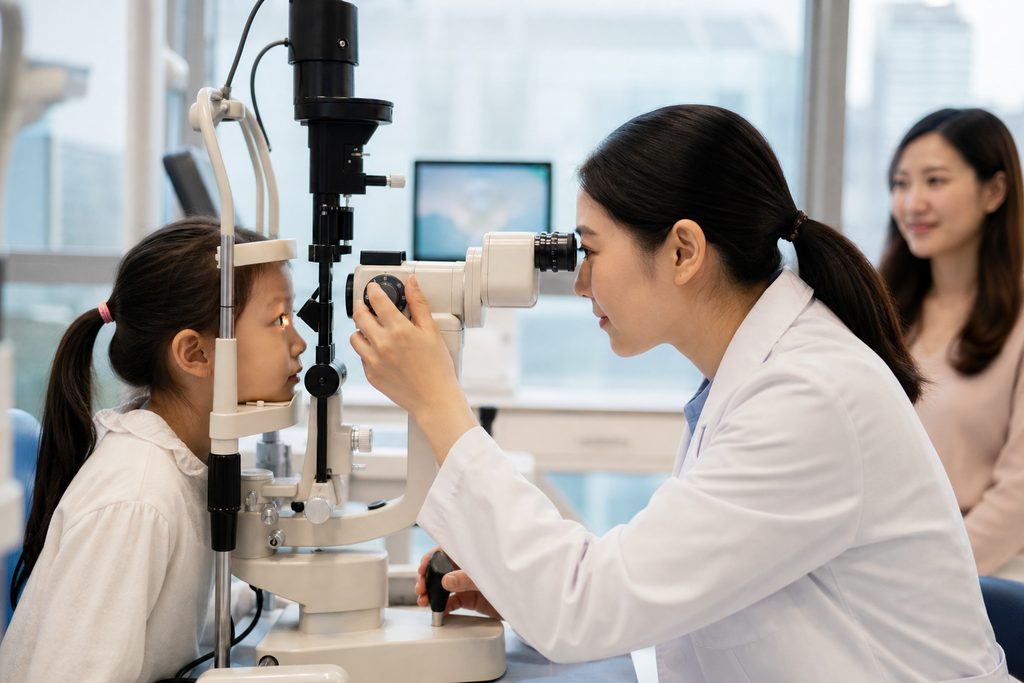
A proper pediatric eye exam in China starts with history-taking. The doctor will ask about birth history, any squinting or head-tilting you’ve noticed, screen time habits, and family history of myopia or amblyopia. Then comes visual acuity testing — for younger children this uses picture charts or tumbling E charts instead of letters. Refraction follows, and for children under 12 the doctor will almost always recommend cycloplegic eye drops to relax accommodation. That means your child’s pupils will stay dilated for several hours afterward, so bring sunglasses and expect some light sensitivity.
Beyond that, a complete exam covers ocular alignment, stereopsis, and a slit-lamp look at the anterior segment. Some hospitals add fundus photography or axial length measurement using optical biometry — the latter is increasingly common because China’s myopia epidemic has pushed axial length tracking into routine care. If your child has suspected amblyopia or strabismus, the doctor may recommend a follow-up orthoptic workup, which is usually billed separately.
One thing worth knowing: Chinese pediatric ophthalmologists see enormous volumes of myopia. A specialist at a top children’s eye hospital in Shanghai may examine 60 to 100 children in a single morning. That volume translates into pattern recognition — but it also means the consultation can feel brisk. Write down your questions before you go in.
How Much for Child Vision Test Beijing vs Shanghai
You can fill the prescription in China or at home. Optical shops inside major hospitals typically turn around single-vision lenses in 1–3 days. Prices for children’s frames and lenses in China run $50–200 depending on brand and lens type. But there is no obligation to buy on-site — the written prescription is yours to take anywhere.
Usually not for a routine exam. Most travel policies exclude preventive or elective outpatient care. If your child has a diagnosed condition and the exam is part of ongoing treatment, some international health plans will reimburse — but you will likely pay upfront and claim later. Private international hospitals in China offer direct billing with major insurers like Cigna, Aetna, and Allianz; public international departments typically do not.
You will be told during the consultation. If surgery or ongoing treatment is recommended, the doctor will explain the options and you decide whether to pursue care in China or return home. No one will pressure you into immediate treatment. For surgical recommendations, we always suggest a second opinion from your home specialist — written second opinions from Chinese top specialists run $300–500 and can be arranged remotely, for reference only and not as a prescription.
Your Next Step
A pediatric eye exam in China is a practical, safe, and cost-effective option for families who plan around the system rather than fighting it. The key decisions are which hospital tier fits your budget and whether you need an appointment before you travel. We help families match their child’s needs to the right pediatric ophthalmology department across our network of 340+ top-ranked hospitals in 37 cities, including Shanghai and Beijing. We are not a hospital and we do not diagnose or treat — we coordinate appointments, arrange bilingual companions from $300 per day, and guide you through the visa and payment logistics. If you are considering a children’s vision screening package abroad and want to know what your child’s exam would actually cost at a specific hospital, start with a free consultation at our patient services page and we will map out the realistic options.
Frequently Asked Questions
Yes. The hospitals used for international patients are JCI-accredited and follow the same international safety standards as top hospitals in the US and Europe. Surgical teams perform high volumes of procedures — often more than their Western counterparts — which studies show leads to better outcomes.
Costs vary by procedure and hospital, but international patients typically save 40-80% compared to US prices — even when factoring in travel and accommodation. A consultation with our team will give you an exact, all-inclusive quote with no hidden fees.
Send us your existing medical reports to get started. We handle everything from hospital selection and appointment scheduling to visa assistance and post-operative recovery planning. Your medical records are reviewed by the specialist before you even book a flight.
For more medical information and treatment options in China, visit chinamedservices.com (China Medical Services).
