Anti-Aging Treatment in China: Costs, Legality, and How to Book Care
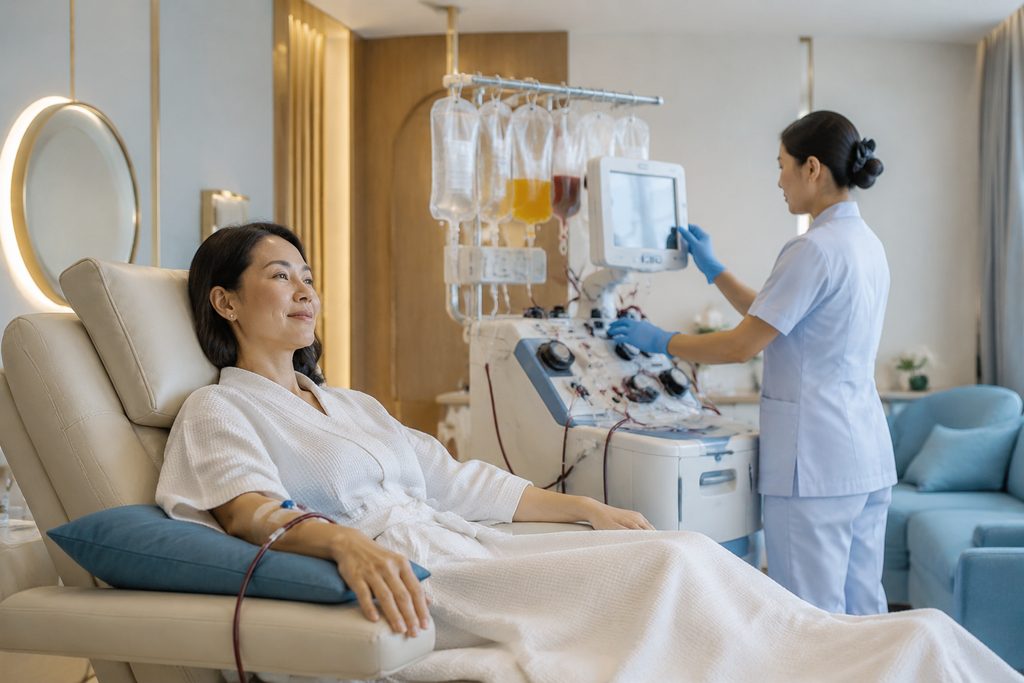
Can You Get Anti-Aging Treatment in China? A Practical Guide to Costs, Legality, and Clinics
Key Takeaways
- Anti-aging treatment cost China typically ranges from $200 for basic aesthetic procedures to $20,000+ for comprehensive stem cell or longevity programs at top-tier hospitals.
- China’s anti-aging sector spans three distinct categories: cosmetic dermatology, functional medicine, and regulated stem cell research through hospital clinical programs.
- Stem cell anti-aging therapy is heavily restricted in China — only hospital-based clinical trials are legal, and any clinic offering “guaranteed” stem cell rejuvenation outside that framework is operating illegally.
- You cannot book a specific anti-aging specialist from overseas through standard public hospital channels; international medical coordination is required for advance scheduling.
What Does “Anti-Aging Treatment” Actually Mean in China?
Anti-aging treatment cost China is a search term that bundles together several very different medical services. Before you compare prices, you need to know what you’re actually looking at. In simple terms, anti-aging medicine in China falls into three buckets. Cosmetic dermatology covers injectables, laser resurfacing, and skin tightening. Functional medicine includes hormone panels, nutritional IV therapy, and longevity-focused health screenings. And then there’s the category everyone asks about: stem cell therapy, which is legal only inside tightly controlled hospital research programs.
The confusion is understandable. Search “best anti-aging clinic Shanghai” and you’ll find glossy websites promising everything from telomere extension to “cellular rejuvenation.” But many of those clinics operate in a gray zone. China’s National Health Commission has repeatedly cracked down on unapproved stem cell treatments since 2015. The legitimate anti-aging work happening in China is far more grounded — and in many cases, more clinically credible — than the marketing suggests.
The Problem: Sky-High Anti-Aging Costs at Home Push Patients to Look Abroad
A single session of fractional CO2 laser resurfacing in the United States costs between $1,500 and $3,500. A full-face treatment series can easily reach $8,000. In the UK, private anti-aging clinics charge £1,000–2,500 for a single injectable session. Now factor in longevity medicine: comprehensive biomarker panels, hormone optimization, and peptide protocols at private clinics in the US or Switzerland routinely run $10,000–30,000 per year. For most people, that’s not healthcare. That’s a luxury purchase with diminishing returns.
And here’s the harder problem. Many Western anti-aging clinics operate with minimal regulatory oversight. A 2023 investigation by the UK’s Advertising Standards Authority found that 70% of anti-aging claims made by private clinics could not be substantiated. Patients pay premium prices for unproven protocols. So the real question isn’t just “how much does anti-aging therapy cost in Beijing” — it’s whether you’re getting legitimate medical care for your money at all.
Why China’s Anti-Aging Sector Delivers a Different Kind of Value
Hospital-Based Aesthetic Dermatology at Scale
China’s top public hospitals run dermatology and plastic surgery departments that handle enormous patient volumes. Shanghai Ninth People’s Hospital, one of the most respected institutions for cosmetic and reconstructive procedures, performs over 100,000 outpatient procedures annually. That volume drives efficiency. A full-face fractional laser session at a top Chinese public hospital typically costs $200–500, compared to $1,500+ in the US. The technology is the same — Lumenis, Cynosure, and Fotona devices are standard. What differs is labor cost and hospital efficiency, not clinical quality.
But here’s the catch. These departments serve primarily domestic patients. English-speaking staff are rare. Registration happens in person, same-day, with long queues. If you don’t speak Mandarin, navigating a public hospital dermatology department alone is genuinely difficult. That’s the structural reality, not a sales pitch.
Functional Medicine and Executive Health Screening
China’s top-tier hospitals have invested heavily in preventive and longevity-focused health screening programs. Peking Union Medical College Hospital and West China Hospital offer comprehensive executive health packages that include advanced cardiovascular imaging, full hormone panels, genetic risk screening, and nutritional assessment. These programs cost $1,500–5,000 depending on scope — a fraction of what equivalent executive physicals cost at Mayo Clinic or Cleveland Clinic, where comprehensive packages start around $5,000 and climb past $10,000 with advanced imaging.
The difference is structural. Chinese hospitals amortize expensive imaging equipment across massive patient volumes. A coronary CT angiogram that costs $1,200 in the US might cost $150 in China. Same Siemens or GE machine. Same radiologist training. Different economics.
Stem Cell Anti-Aging: What’s Actually Legal
Let’s address the elephant. “Stem cell anti-aging therapy China price” is one of the most searched phrases in this space. Here’s the truth: China permits stem cell research and clinical application only through hospital-based programs registered with the National Health Commission. As of 2024, there are over 100 registered stem cell clinical trials in China, covering conditions like osteoarthritis, diabetes, and certain degenerative diseases. Some of these trials include aging-related parameters as secondary outcomes.
What does that mean for you? If a private clinic in Shenzhen or Shanghai offers “stem cell rejuvenation” for $10,000 with no hospital affiliation and no trial registration number, walk away. That is not legal anti-aging medicine. That is an unregulated procedure with unknown risks. Legitimate stem cell treatment in China happens inside hospitals, under ethics committee oversight, with documented informed consent — and it is not marketed as a luxury anti-aging product.
How Much Does Anti-Aging Therapy Cost in Beijing, Shanghai, and Beyond?
Anti-aging treatment cost China varies dramatically by city, hospital tier, and procedure type. Beijing and Shanghai command premium pricing at private international clinics, while public hospital departments offer lower base rates. Chengdu and Hangzhou often price 20–30% below Beijing for comparable aesthetic procedures. Here’s a realistic snapshot:
| Treatment Category | Typical Cost in China (USD) | Typical Cost in US/UK (USD) | Notes |
|---|---|---|---|
| Fractional CO2 laser (full face) | $200–500 | $1,500–3,500 | Price varies by device and hospital tier |
| Botulinum toxin (per area) | $150–400 | $400–800 | Brand-dependent; imported toxins cost more |
| Dermal filler (per syringe) | $300–700 | $700–1,500 | Hyaluronic acid fillers; premium brands higher |
| Comprehensive executive health screening | $1,500–5,000 | $5,000–15,000 | Includes advanced imaging and biomarker panels |
| Hormone panel + functional medicine consult | $300–800 | $1,000–3,000 | Private international clinics charge more |
| Hospital-based stem cell clinical trial participation | Often subsidized or free | Not widely available | Eligibility criteria apply; not a retail service |
These figures are ranges, not quotes. Your final anti-aging treatment cost China depends on the specific hospital, the specialist’s seniority, and whether you access care through the standard public channel or the international/VIP channel. The international channel typically costs 1.5–2 times the standard rate but includes English coordination and advance scheduling.
Is Anti-Aging Treatment Legal in China? What You Need to Know
Yes — with important boundaries. Cosmetic dermatology, aesthetic injectables, laser therapy, and functional medicine are all legal and widely available in China. Licensed physicians perform these procedures in both public and private hospitals. The regulatory framework is actually stricter than in many Western countries for certain categories: botulinum toxin and dermal fillers require prescription and physician administration, and unlicensed aesthetic clinics face aggressive enforcement.
The legal gray area is stem cell therapy. China’s 2015 Stem Cell Clinical Research Management Measures and subsequent 2023 regulations make clear that stem cell treatments can only be administered within registered clinical trials or approved hospital protocols. Any clinic advertising “stem cell anti-aging” as a retail service is violating those rules. So when you search “stem cell anti-aging therapy China price” and see $20,000 packages from private clinics, understand that those offers sit outside the legal framework. Legitimate stem cell research in China does not operate on a retail pricing model.
What to Look for in a Chinese Anti-Aging Provider — and What to Avoid
If you’re considering booking an anti-aging medical package in China, your first filter should be hospital affiliation. A legitimate anti-aging or longevity program is housed inside a hospital with a verifiable license from the National Health Commission. The hospital should appear in the Fudan University hospital rankings or hold JCI accreditation. Our database of top-ranked Chinese hospitals is a good starting point for identifying institutions with credible dermatology, endocrinology, and preventive medicine departments.
Second, ask for the physician’s credentials. In China, a licensed cosmetic dermatologist or plastic surgeon holds a medical practitioner certificate and a specialty registration. You can verify this through the National Health Commission’s public database. If a clinic cannot name the physician who will perform your procedure, or if the “doctor” is actually a technician, that’s a red flag.
Third, be wary of any clinic that promises specific outcomes. No legitimate physician guarantees that a laser treatment will “reverse aging” or that a supplement protocol will “extend telomeres.” Anti-aging medicine is preventive and incremental. Anyone selling certainty is selling something else.
Red flags to avoid: clinics that offer stem cell injections without a hospital trial registration number, packages that bundle “detox” therapies with unproven IV infusions, any provider that refuses to share physician credentials, and pricing that seems dramatically below market — unlicensed operators often undercut legitimate providers by 50% or more.
Practical Considerations: Visas, Records, and Follow-Up
If you decide to pursue anti-aging care in China, the logistics matter as much as the medicine. For medical travel, you will apply for an S2 visa, which covers short-term private affairs including medical treatment. Your accompanying family members also apply for S2 visas. The Chinese embassy or consulate will require supporting documents from the hospital — typically an invitation letter or treatment confirmation. Processing time varies by country, but plan for 2–4 weeks minimum.
Medical records are your responsibility. Bring all relevant laboratory results, imaging, and medication lists. Chinese hospitals will want to see baseline data before recommending any treatment plan. If you have a complex medical history, consider having records translated into Chinese in advance — our team handles this as part of coordination, but it’s worth knowing it’s a real step.
Payment is straightforward: Chinese public hospitals require prepayment, and international credit cards are not always accepted at public hospital cashiers. Private international hospitals such as United Family and Jiahui accept major international insurance and credit cards directly. If you have health insurance, check whether anti-aging or preventive services are covered — most international policies exclude cosmetic procedures and unproven longevity therapies.
Follow-up after returning home is the part most people forget. Anti-aging treatments often require multiple sessions spaced weeks apart. A single laser treatment delivers modest results; a series of three to five delivers the real benefit. Before you book, ask the hospital what the recommended treatment cadence is and whether remote follow-up is available. Some Chinese hospitals offer video consultations for post-treatment review, which can save you a second trip.
Frequently Asked Questions
Yes. Foreign patients can legally receive cosmetic dermatology, aesthetic injectables, laser therapy, and functional medicine in China. Stem cell therapy is legal only within hospital-based clinical trials or approved protocols — not as a retail service. Always verify hospital licensing and physician credentials before booking.
Beijing and Shanghai are broadly comparable, with Shanghai’s private international clinics sometimes pricing 10–20% higher for the same procedures. Public hospital departments in both cities offer lower base rates but require in-person registration and Mandarin proficiency. Expect to pay $200–500 for a full-face laser session at a top public hospital in either city, and $400–800 at a private international clinic.
For English-speaking foreign patients, JCI-accredited private international hospitals such as Jiahui and United Family Shanghai offer the smoothest experience with direct insurance billing and Western-style care. For hospital-based dermatology at scale, Shanghai Ninth People’s Hospital is widely regarded as a leader in cosmetic and reconstructive procedures, though English support is limited. The right choice depends on your procedure and language needs.
Standard public hospital channels do not allow advance booking from overseas — you register in person on the day of your visit. To schedule ahead with a specific specialist or department, you need to go through the hospital’s international or VIP coordination channel. This typically costs 1.5–2 times the standard rate and includes English-language coordination, appointment scheduling, and sometimes a bilingual companion for the visit.
Most Chinese hospitals offer video consultation for post-treatment review, typically priced from $100–300 depending on the specialist. Your home physician can also manage routine follow-up if you share treatment records. Before you leave China, request a complete treatment summary in English — this should include all procedures performed, products used, and recommended next steps.
Your Next Step
Anti-aging treatment in China offers genuine value — comparable technology, strong clinical volume, and prices that are often 50–70% below Western private clinics. But the system rewards preparation. Understanding what’s legal, what’s credible, and what’s marketing is the difference between a good experience and a costly mistake. Our team at China Medical Services helps international patients navigate these decisions — we match you with appropriate hospitals, coordinate appointments through official channels, and provide bilingual support on the ground. We are not a hospital and we do not provide diagnoses or treatment recommendations. If you’re ready to explore your options, start with a free consultation to discuss your goals and get honest guidance on what’s feasible. No pressure. Just clarity.
For more medical information and treatment options in China, visit chinamedservices.com (China Medical Services).
